Chinese Garden Art: Where Nature Becomes Poetry
There’s a moment that every visitor to Suzhou remembers—the instant when you step through a modest door set in an unassuming wall and the world transforms. Suddenly you’re standing in a landscape that seems impossible: a miniature mountain range rising from a still pond, ancient trees twisting toward the sky, pathways that promise discoveries just around the next corner. The noise of the modern city falls away, replaced by the sound of wind through bamboo and water trickling over stones. You’re standing in a Chinese garden, and you’ve just crossed a threshold not just in space but in time and imagination.
Chinese garden art is one of humanity’s great artistic achievements—yet it’s far less known in the West than its counterparts from European traditions. Where a French formal garden announces its order and control from the moment you enter, a Chinese garden conceals and reveals. It doesn’t dominate nature; it collaborates with it. It doesn’t explain itself; it invites you to discover its meanings. To understand Chinese garden art is to understand something fundamental about how the Chinese have viewed the relationship between humans and the natural world for over a thousand years.
The Garden as Microcosm: Daoist Foundations
The story of Chinese garden art begins with philosophy—not the abstract philosophy of academic texts, but the practical spirituality that shaped how ordinary Chinese people understood their world. The key philosophy here is Daoism, with its emphasis on living in harmony with nature and its suspicion of artificial human constructs.
Daoist thinkers, from Laozi in the 6th century BCE onward, taught that nature holds truths that human logic cannot grasp. The flowing water, the patient stone, the endless cycle of seasons—these all point toward something deeper than everyday life. When Chinese aristocrats and scholars began creating private gardens during the Tang Dynasty (618-907 CE), they weren’t just making pleasant outdoor spaces. They were building physical manifestations of their spiritual beliefs.
The Chinese garden, at its core, is meant to be a microcosm—a small version of the vast natural world. A garden designer doesn’t try to recreate an entire landscape; instead, they create a compressed version that captures essential qualities. A few carefully placed rocks can suggest a mountain range. A small pond can evoke the ocean. A winding path implies journeys far beyond its actual length. The Chinese call this principle wan bian qian hua—creating endless changes through limited means.
This microcosm principle explains why Chinese gardens feel so different from Western ones. In European traditions, gardens often aim for geometric order—symmetrical layouts, precisely trimmed hedges, plants arranged in mathematical patterns. Chinese gardens deliberately reject this. They celebrate nature’s irregularity. A gnarled old tree with a twisted trunk is more valuable than a perfectly straight sapling. A jagged rock from a mountain quarry is prized over a smoothly carved replica. The goal is to capture nature’s spirit, not to improve upon it.
The Art of Stones: China’s Obsession with Rocks
If there’s one element that exemplifies Chinese garden art more than any other, it’s the rock. The Chinese fascination with rocks is almost obsessive—they’ve been collecting, displaying, and contemplating rocks for thousands of years. Rocks appear in gardens, in indoor displays, in painting, and in poetry. Understanding this obsession is key to understanding Chinese garden art.
The Chinese word for rock, shi (石), sounds similar to the word for “truth” or “reality” (shi, 真). This isn’t a coincidence. Rocks, to the Chinese mind, represent the fundamental truth of nature—they’ve been shaped by wind and water over eons, and their forms carry the memory of geological time. A well-chosen rock in a garden is meant to evoke an entire mountain, the primordial forces that carved it, and the philosophical principles it embodies.
Chinese garden rocks come in several recognized types, each with its own aesthetic value. The most prized are taihu shi (Lake Tai stones), named for Lake Tai near Suzhou. These strange, perforated rocks look like they’ve been sculpted by centuries of wind and water—which, in fact, they have. Natural erosion has carved holes and strange shapes into these limestone boulders, making each one unique. The most famous of these, the “Cloud-Capped Peak” in Suzhou’s Lingering Garden, has been admired for over 400 years and stands as a testament to the Chinese rock-appreciation tradition.
Another important type is yingshi (英石), from Guangdong Province in southern China. These rocks are prized for their jagged, angular forms—unlike the rounded Lake Tai stones, yingshi look like miniature mountain peaks with dramatic vertical shapes. Garden designers arrange these rocks in groups that mimic natural mountain formations, creating the illusion of vast peaks in a small garden space.
The placement of rocks in a Chinese garden is an art unto itself. Rocks are rarely placed alone; they’re arranged in groups of three or more, following principles borrowed from landscape painting. The tallest rock represents the “emperor” rock, with secondary and tertiary rocks supporting it like ministers attending a ruler. Even the shadows cast by rocks are considered—the Chinese believe that rocks should cast “good” shadows, which means shadows that are graceful and well-proportioned.
Water and Reflection: The Garden as Living Mirror
If rocks provide the bones of a Chinese garden, water provides its soul. The Chinese believe that water is the mirror of nature—it reflects the sky, the clouds, the surrounding pavilions, effectively doubling the visual space of a small garden. But water does more than reflect. It moves, it sounds, it changes with the seasons and the light.
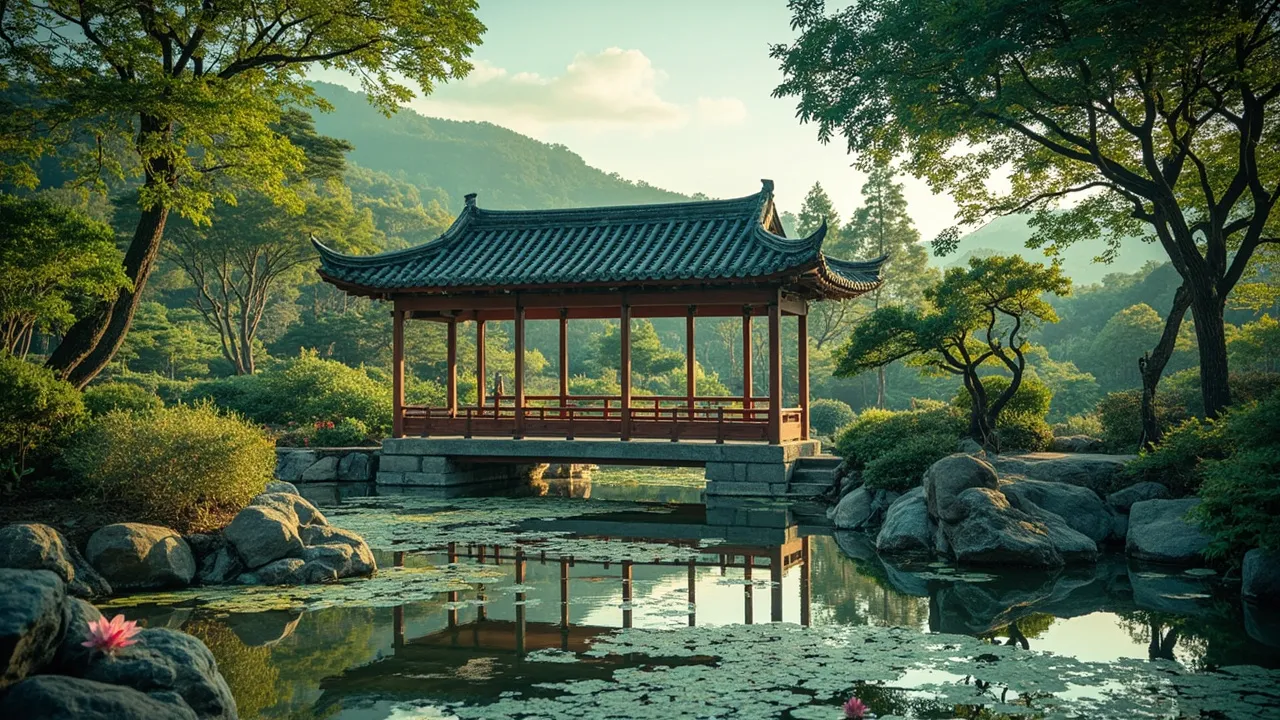
The classical Chinese garden uses water in several ways. A large pond might serve as the garden’s central feature, with bridges arching over it, pavilions standing at its edges, and lotus lilies floating on its surface. Or water might appear as a tiny stream, burbling through a rock garden or disappearing mysteriously into a hidden corner. Some gardens feature elaborate waterworks—small waterfalls, splashing fountains, rills that connect different parts of the garden with the sound of moving water.
The symbolism of water runs deep in Chinese culture. Water represents the flow of time, the course of life, and the wisdom of yielding to greater forces. The famous Daoist image of water yielding to obstacles by flowing around them became a model for human behavior in difficult times. A garden stream, winding past rocks and through channels, embodies this philosophy in physical form.
The interaction between water and other elements is crucial. The classic pairing of rock and water creates a composition that evokes mountain lakes and remote waterfalls—the shan shui (山水, “mountain water”) that forms the subject of China’s greatest landscape paintings. In a famous Suzhou garden called the Garden of the Master of the Nets, a tiny pond is positioned so that it reflects not only the surrounding pavilions but also the sky and clouds above, creating an effect of almost infinite space in a garden barely larger than a backyard.
Plants with Meaning: The Symbolic Garden
Walk through a Chinese garden and you’re surrounded by meaning—not just visual beauty, but layers of symbolism that have accumulated over centuries. Every plant has been chosen for what it represents as much as for how it looks.
Bamboo is perhaps the most important garden plant in Chinese tradition. It represents resilience and flexibility—because bamboo bends in the wind but never breaks. A garden with bamboo implies these virtues, and Chinese scholars often planted bamboo outside their studios as a reminder of the qualities they hoped to cultivate in themselves. Bamboo also symbolizes friendship and the bonds between gentlemen—a gift of bamboo signifies respect and affection.
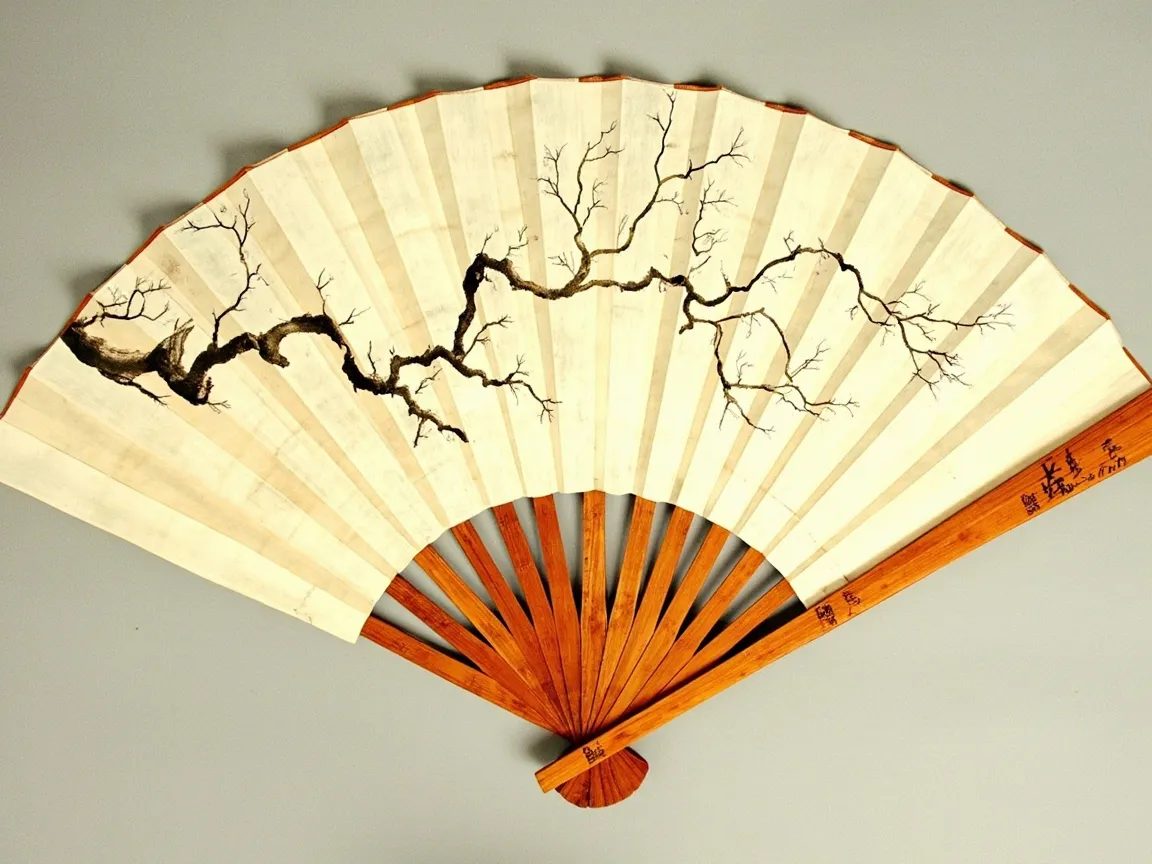
Plum trees bloom in the depths of winter, when almost nothing else is flowering. This makes them powerful symbols of perseverance and hope—the ability to flourish in adversity. Plum blossoms also represent beauty in old age, since the trees become more gnarled and interesting with age. A garden with old plum trees implies wisdom gained through experience.
Pine trees can live for centuries, making them symbols of longevity and steadfastness. The pine also represents the gentleman scholar—someone with firm principles who remains upright regardless of circumstances. A pine in a garden adds dignity and age, connecting the present to the past.
Peonies are China’s national flower and represent wealth, honor, and romance. Often called “the king of flowers,” peonies were historically grown in imperial gardens and remain the most prized garden flowers in China. A peony in bloom is a celebration of prosperity and good fortune.
Lotus flowers grow from muddy water but emerge pristine and clean, making them powerful symbols of purity and spiritual transcendence. The lotus is especially important in Buddhist traditions, which see it as representing the possibility of enlightenment for all beings.
These aren’t just random plants. A skilled garden designer chooses plants that work together to tell a story, creating a composition that speaks to educated Chinese viewers on multiple levels. A garden with plum, pine, and lotus together represents the “Three Friends of Winter”—the plants that bloom in cold weather, symbolizing perseverance and integrity.
The Architecture of Contemplation
No Chinese garden is complete without buildings—pavilions, corridors, bridges, and moon gates that create the framework for viewing the garden. These structures aren’t just decorative; they’re designed to provide specific experiences, framed views, and opportunities for contemplation.
Pavilions (亭, ting) are open-sided structures that invite visitors to stop and observe. A pavilion might be placed at the edge of a pond, offering views of the water and surrounding scenery. Or it might occupy a high point in the garden, serving as a viewing platform. The name “pavilion” doesn’t quite capture these structures—they’re more like outdoor rooms, places to sit, read, drink tea, or simply watch the garden change with the seasons.
Corridors and walkways (廊, lang) connect different parts of the garden and provide covered paths for rainy-day strolls. But they’re more than mere passageways. Chinese garden corridors are designed to unfold gradually—a straight corridor would reveal everything at once, but curved corridors hide what’s coming next, creating anticipation and discovery. Windows cut into corridor walls (called “missing wall” windows) frame views like paintings, turning every garden vista into a composition.
Moon gates—circular openings in walls—are perhaps the most photographed element of Chinese gardens. These circular frames turn every view into a portrait, literally framing nature as art. Walking through a moon gate feels like crossing a threshold into another world—which is precisely the point.
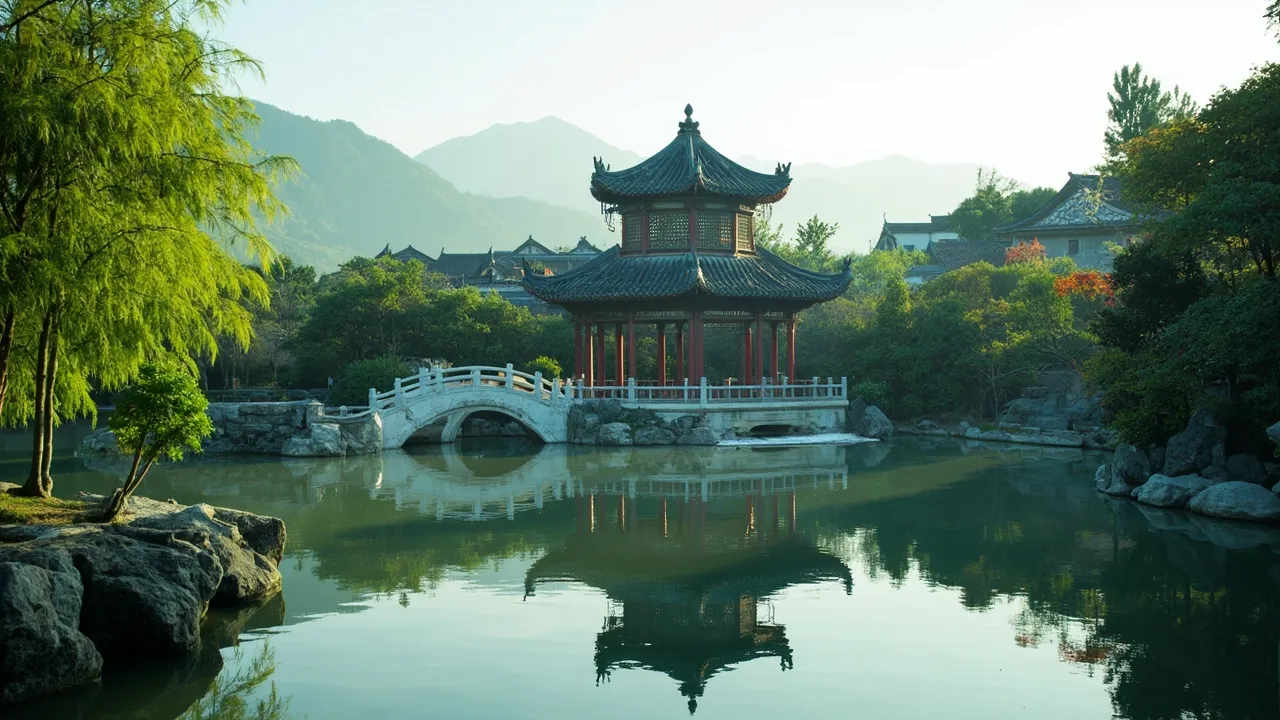
Bridges over garden ponds serve both functional and aesthetic purposes. Chinese garden bridges are rarely straight—they curve like the backs of snails, inviting leisurely crossing rather than efficient transit. A bridge offers different views of the garden from its center than from either shore, and the reflection of the bridge in water doubles its visual presence.
The names given to these structures carry poetic meaning. A pavilion might be called “Listening to the Rain” or “Viewing the Moon,” turning a simple shelter into an invitation to experience specific moments and sensations. Even functional structures like gates become poetic when named “Gate of mists and clouds” or “Gate of welcoming spring.”