Chinese Garden Design: Nature Captured in Stone and Water
There’s something magical about walking through a classical Chinese garden. You step through a modest gateway, and suddenly the outside world fades away. What looks from the outside like a simple wall hides an entire universe—winding paths that reveal new vistas at every turn, ancient trees that have witnessed centuries pass by, and water that glitters like scattered diamonds under the sun. Chinese garden design isn’t just about planting flowers or arranging stones. It’s about capturing the spirit of nature and distilling it into a space you can walk through, think in, and feel connected to.
For American readers curious about landscape design, Chinese gardens offer a fascinating counterpoint to the formal parterres of Versailles or the manicured lawns of English country estates. Instead of dominating nature or forcing it into rigid shapes, Chinese gardens work with natural forces. They borrow from the landscape around them, create the illusion of vastness in limited space, and weave philosophical meaning into every rock and water feature. Understanding these gardens means understanding a philosophy that has shaped Chinese culture for over a thousand years.
Philosophy of Chinese Gardens
The story of Chinese gardens begins with Daoism, the ancient philosophy that emphasizes living in harmony with the natural world. Daoist thinkers believed that nature holds truths that human logic cannot grasp. The flowing water, the patient stone, the endless cycle of seasons—these all point toward something deeper than everyday life. When Chinese scholars and aristocrats began building private gardens during the Tang Dynasty (618-907 CE), they weren’t just creating pretty outdoor spaces. They were building physical manifestations of their spiritual beliefs.
This philosophical foundation explains why Chinese gardens feel so different from Western ones. In European tradition, gardens often aim for order and control—geometric patterns, symmetric arrangements, plants shaped into exact forms. Chinese gardens take the opposite approach. They celebrate nature’s irregularity. A gnarled old tree with a twisted trunk is more valuable than a perfectly straight sapling. A jagged rock from a mountain quarry is prized over a smoothly carved replica. The Chinese word for landscape painting, shan shui (山水), literally means “mountain water,” and Chinese gardens strive to bring these mountain landscapes down to human scale.
Another key concept is borrowed scenery (or what the Chinese call jie jing). Instead of building walls to block out the outside world, Chinese garden designers learned to incorporate whatever lay beyond the garden walls. A distant mountain peak becomes part of the garden’s composition. A nearby pagoda’s roof adds visual interest. This technique turns limitations into advantages and makes small gardens feel expansive. Even if you only have a tiny courtyard in your backyard, you can borrow elements from the surrounding landscape to create depth and meaning.
The principle of wan bian qing hua—creating endless changes through limited means—also shapes Chinese garden design. A skilled designer uses a small set of elements (rocks, water, plants, buildings) but arranges them so that visitors discover new perspectives at every step. Walk ten feet to the left, and an entirely different scene opens up. This isn’t accidental. It’s the deliberate use of screens, walls, and cleverly placed plantings to create a series of “garden rooms” that unfold like a visual story.
Elements of a Classical Garden
Walk through any classical Chinese garden, and you’ll notice four primary elements working together: rocks, water, plants, and architecture. Each carries its own symbolic weight and aesthetic function.
Rocks hold a special place in Chinese garden tradition. The Chinese word for rock, shi (石), sounds similar to the word for “truth” or “reality.” Garden rocks are meant to embody the rugged spirit of mountains. The most prized specimens come from Lake Tai (Taihu) near Suzhou—these strange, perforated stones look like they’ve been sculpted by centuries of wind and water. Garden designers arrange these rocks in groups that mimic natural mountain formations. A single impressive rock might stand as a focal point, its texture and shape commanding attention like a sculpture in a museum.
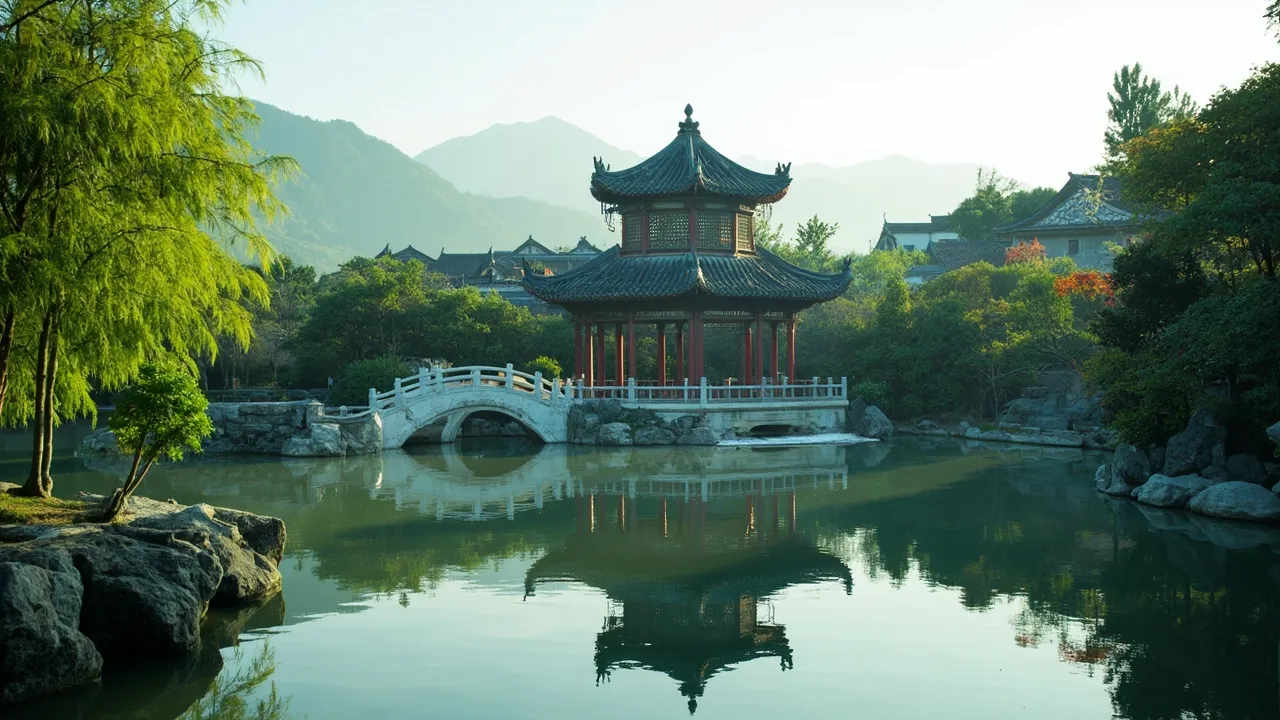
Water brings life to the garden, both visually and audibly. A pond reflects the sky and surrounding pavilions, effectively doubling the visual space. The sound of water—trickling from a small waterfall, splashing into a fountain, rippling against the shore—adds a sensory dimension that purely visual gardens lack. Water also represents the flow of time and the course of life in Chinese philosophy, making it a deeply meaningful element beyond its decorative function.
Plants in Chinese gardens are chosen for their symbolic meanings as much as their looks. Bamboo represents resilience and flexibility (it bends but never breaks in the wind). Plum trees bloom in winter, symbolizing perseverance and hope. Pines live for centuries, representing longevity and steadfastness. Peonies, the national flower of China, symbolize wealth and honor. A well-designed Chinese garden tells a story through its plantings, with each species adding another layer of meaning.
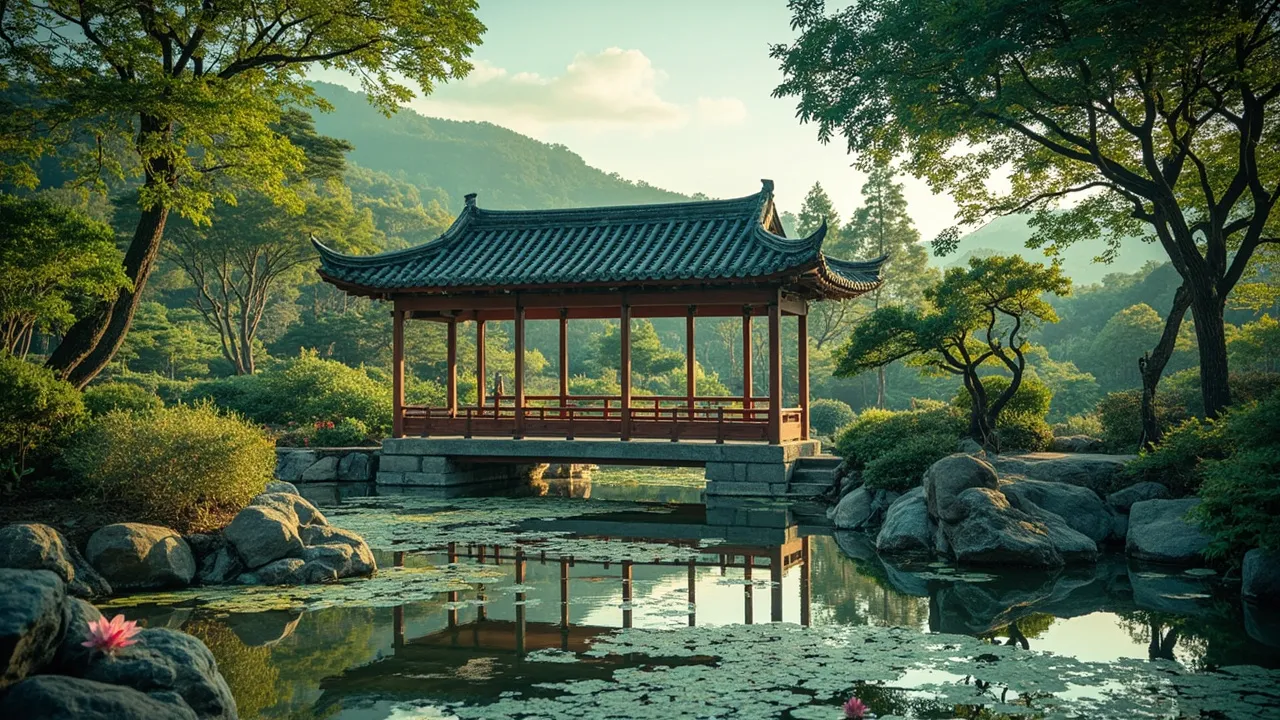
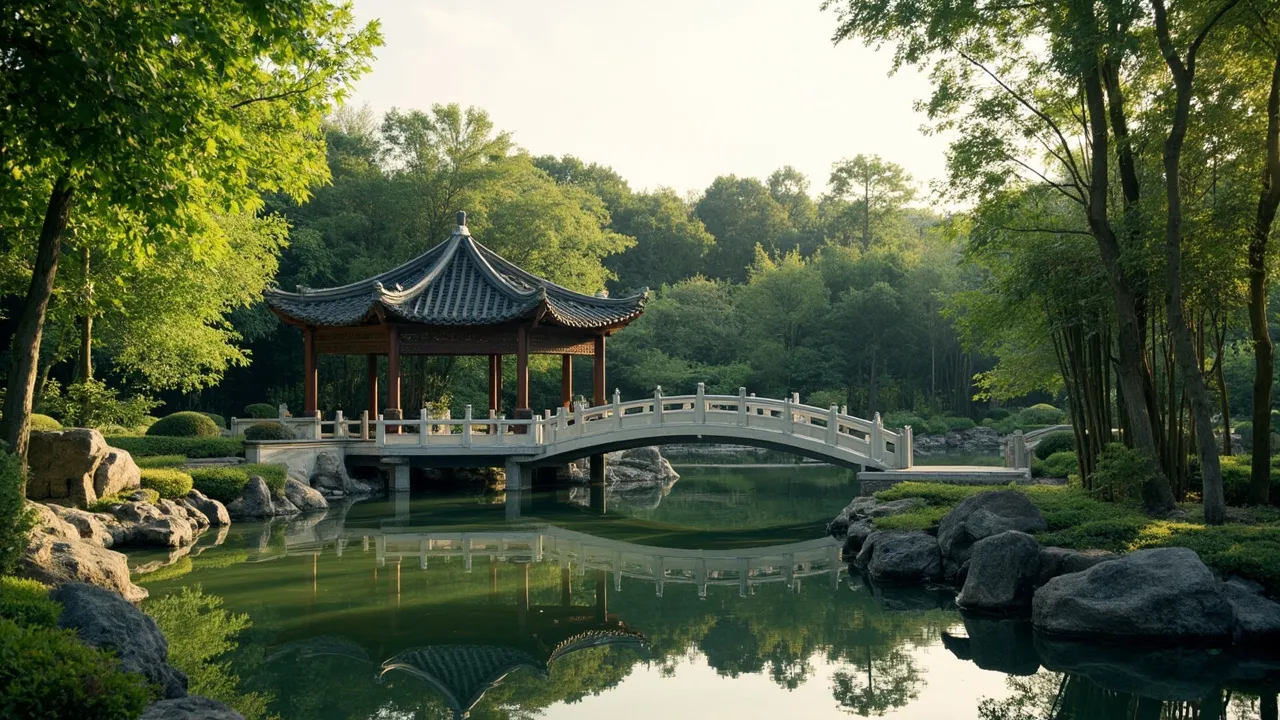
Architecture—pavilions, bridges, corridors, moon gates—provides structure and creates frames for viewing the garden. These buildings aren’t placed arbitrarily. They’re positioned to offer the best views, to create interesting sightlines, and to provide places for contemplation and shelter. A pavilion at the water’s edge invites you to sit and watch the fish. A covered walkway protects you from rain as you observe the seasonal changes. Even the names given to these structures carry poetic meaning, turning a simple bench or bridge into a metaphor for life’s journey.
Famous Chinese Gardens
When people talk about classical Chinese gardens, Suzhou deserves special attention. This city in Jiangsu Province, often called the “Venice of the East” for its network of canals, contains some of the finest garden examples in the world. Nine of its gardens are UNESCO World Heritage sites, and wandering through them feels like stepping back into the Ming and Qing Dynasty golden age of garden design.
The Lingering Garden (Liu Yuan) is perhaps the most famous. Created in the 16th century and refined over centuries, it showcases every element that makes Chinese gardens remarkable. The rock garden here features the “Cloud-Capped Peak,” a stunning specimen from Lake Tai that’s been admired for generations. The overall layout uses clever techniques to create the feeling of expanded space—corridors twist and turn, windows frameviews like paintings, and every turn reveals a new scene.
The Master of the Nets Garden (Wangshi Yuan) proves that smaller can be better. This compact garden, one of the smallest in Suzhou, demonstrates how skilled designers create the illusion of vastness in a limited space. Every element serves multiple purposes, and the balance of water, rocks, and plants achieves a harmony that feels almost magical.
The Humble Administrator’s Garden (Zhuo Zheng Yuan) is the largest of the Suzhou gardens and the most famous in all of China. Originally the private garden of a retired official, it covers about 5 acres and divides into three sections: the residential area, the central administrative area (which is actually the garden proper), and the inner garden. The interplay of simple buildings and elaborate landscaping creates spaces that feel both grand and intimate.
Beyond Suzhou, the Imperial Gardens in Beijing offer another dimension of Chinese garden tradition. The Summer Palace (Yiheyuan), built around a large lake in the northwestern suburbs of Beijing, demonstrates how Chinese designers created vast recreational landscapes for emperors. The Long Corridor, stretching over 700 meters, features thousands of paintings depicting Chinese history and mythology. The Kunming Lake itself mimics the vastness of Chinese lakes and rivers, bringing a sense of grandeur to the imperial retreat.
The Old Summer Palace (Yuanming Yuan), now largely in ruins, was once an extraordinary complex of European-style palaces and Chinese gardens. European missionaries and architects contributed Baroque-style buildings and fountains, creating a unique fusion of Western and Eastern garden aesthetics. Its destruction by Anglo-French forces in 1860 remains a painful memory in Chinese history, and the ruins today serve as a reminder of both the garden’s former glory and the country’s turbulent modern history.
Gardens in Modern China
Chinese garden design didn’t end with the Qing Dynasty. Contemporary China has seen a revival of interest in classical garden aesthetics, along with creative adaptations for modern life.
In cities like Shanghai and Beijing, designers are finding ways to incorporate traditional Chinese garden principles into contemporary public spaces. The Shanghai World Expo Park, built for the 2010 World Expo, includes gardens that blend classical elements with modern landscape architecture. Shopping malls and luxury hotels often feature small “court gardens” that borrow from traditional design—water features, carefully placed rocks, bamboo screens—that offer brief moments of calm in the middle of bustling urban life.
Chinese landscape architects are also gaining recognition internationally. The late architect and theorist I.M. Pei, though best known for his modernist buildings like the Louvre Pyramid, drew on Chinese spatial concepts throughout his career. His designs often featured layers of progressively private spaces, a principle fundamental to Chinese garden design. More recently, Chinese firms have been commissioned to design public gardens and parks around the world, bringing these traditional principles to new audiences.
For American homeowners interested in incorporating Chinese garden elements, several approaches work well. You don’t need a vast estate to borrow from these traditions. A small water feature, a carefully chosen specimen rock, or a bamboo screen can evoke Chinese garden aesthetics even in a modest backyard. The key is thinking about the relationship between elements—the way a stone anchors a planting bed, how water can be positioned to reflect interesting views, or how a curved path creates anticipation of what’s around the corner.
The Chinese Garden at the Huntington Library in San Marino, California, offers one model. Opened in 2008, this three-acre garden features authentic Suzhou-style architecture, a traditional rock garden, koi-filled ponds, and plants chosen for both beauty and symbolic meaning. It’s become a popular destination, proving that American audiences can appreciate and learn from Chinese garden traditions.
Conclusion
Chinese garden design offers something increasingly rare in our hyperconnected world: a space designed for slow, thoughtful engagement with nature. These gardens remind us that beauty doesn’t require vast space or unlimited resources. It requires patience, sensitivity to context, and an understanding that we’re part of something larger than ourselves.
Whether you visit the classical gardens of Suzhou, explore the imperial grounds of Beijing, or simply incorporate a few Chinese garden principles into your own backyard, you’re participating in a tradition that stretches back over a millennium. The next time you step into a garden—whether it’s a famous UNESCO site or a small courtyard behind someone’s house—pause for a moment. Watch how the light plays on the water. Notice the way a single rock draws your eye. Feel how the plants and buildings work together to create a sense of harmony. In that moment, you’re experiencing the same aesthetic pleasures that Chinese scholars and emperors sought centuries ago. That’s the enduring power of Chinese garden design: it creates spaces where time slows down, and nature’s quiet wisdom becomes audible.