The quiet instrument with a surprisingly large history
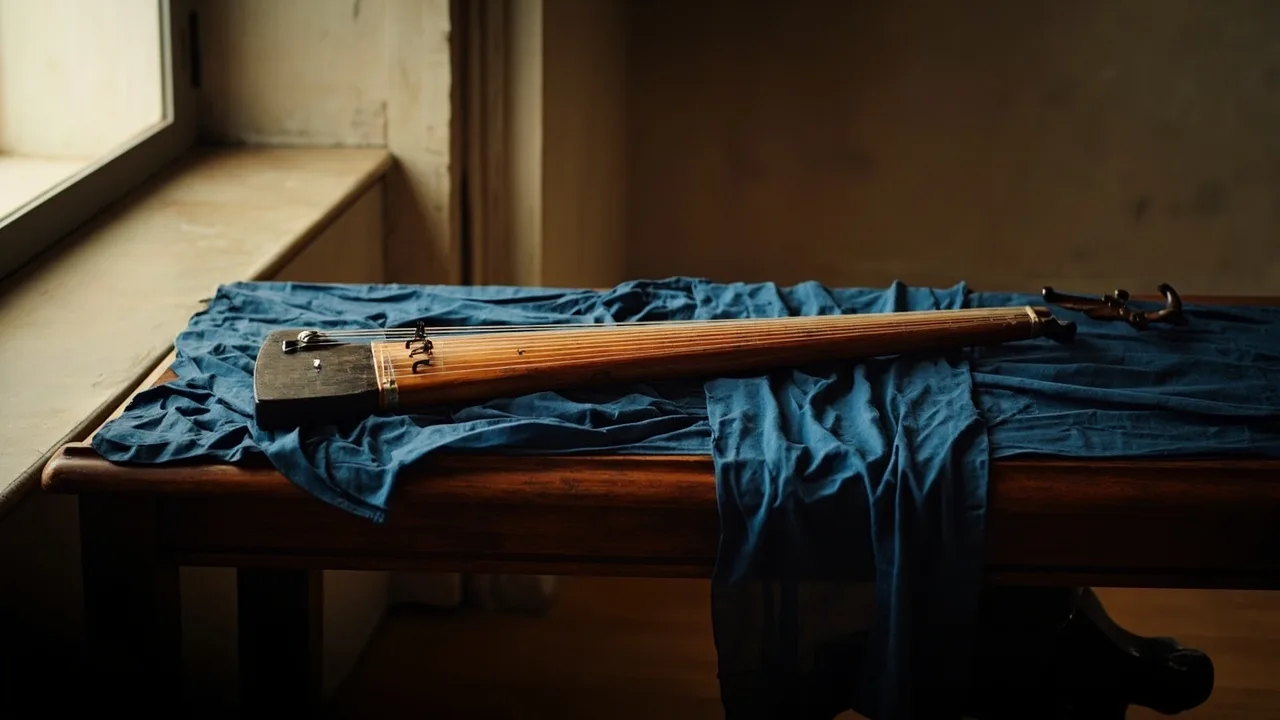
The guqin is easy to overlook if you expect Chinese music to announce itself. It has no drum’s punch, no trumpet-like call, and none of the quick sparkle many listeners associate with the pipa. A player sits with the long, dark zither laid across a table and draws sound from seven strings. The result can be so quiet that a nearby conversation would ruin it. That quiet is not a weakness. It is part of the instrument’s identity.
The guqin, traditionally called qin, has been associated with scholars, officials, monks, and artists for more than two thousand years. In 2003, UNESCO proclaimed the guqin and its music a masterpiece of the oral and intangible heritage of humanity. The recognition reflected more than an old instrument. It acknowledged a whole practice: repertoire, notation, performance technique, craftsmanship, philosophy, and the idea that music could cultivate a person’s character.
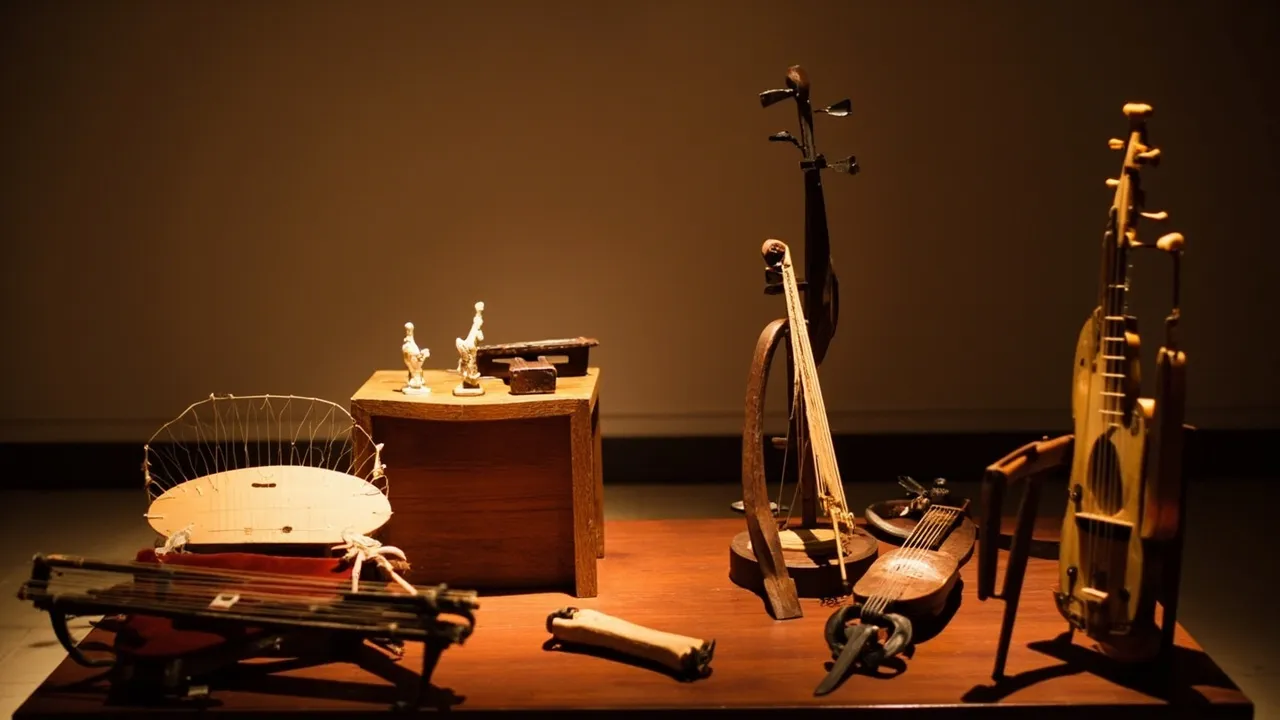
Western readers sometimes see the guqin described as a “Chinese zither,” which is accurate but incomplete. A zither has strings stretched across a soundboard without a neck, and the guqin fits that broad family. Yet the way it is played makes it distinctive. The left hand presses, slides, bends, and lightly touches the strings, while the right hand plucks with carefully shaped fingers. Players use harmonics, stopped notes, open strings, and sliding tones. A single note can carry an audible beginning, a changing middle, and a fading end.
This is music that rewards attention rather than background listening. It asks you to hear the space around a note. Once you do, the guqin’s slow pace starts to feel less like emptiness and more like room to think. A good recording may leave enough silence for a listener to notice the room, the slight rasp of a finger, or the way an open string continues after the hand has moved away.
That intimacy shaped where the instrument was played. A qin might be heard in a study, a garden pavilion, a temple, or a small gathering rather than in a huge public hall. Its repertoire includes pieces connected with mountains, water, historical figures, and personal reflection, but titles are invitations rather than instructions. You do not have to imagine literal waves whenever a piece mentions a river. The music uses an image as a starting point for mood and thought.
The instrument’s history is also a history of listening habits. Players learn to value restraint, but restraint is not the same as passivity. A quiet note can be placed with great precision. A slide can make a phrase feel almost vocal. A pause can create expectation. The guqin’s small gestures are deliberate, and that deliberateness is part of its appeal.
Seven strings, thirteen hui, and a body made for nuance
A guqin is usually a little over three feet long, though historical instruments vary. Its wooden body has a broad top, a flatter underside, and a soundboard whose shape is often explained through symbolic language. The seven strings have traditionally represented aspects of culture and history, while the thirteen small position markers, called hui, help players locate harmonics and stopped notes.
The choice of materials matters in ways that go beyond durability. Old qin makers prized old paulownia wood, often from trees that had stood through a generation or more, because long-aged timber is lighter and more resonant. The underside is sometimes built with Chinese catalpa or similar local hardwoods. Lacquer, applied in many thin coats over cloth or directly on the wood, seals the surface and gives the instrument its final color. Antique qin develop a fine craquelure in this lacquer, the kind of surface pattern collectors prize. A well-preserved Tang or Song dynasty qin is not just an instrument but a piece of furniture shaped by centuries of drying and handling, and a few are still playable today.
Those markers are practical and poetic at once. A player can touch a string lightly at a hui and produce a clear harmonic, or press between positions to bend pitch and create a voice-like inflection. The guqin is not limited to the twelve notes of a keyboard. Its expressive world includes shades of pitch, controlled noise, resonance, and the sound of the finger moving across the string.
Traditional instruments may use paulownia for the top board and catalpa or another dense wood for the underside, though construction varies by period and maker. The lacquer surface is not simply a glossy finish. Layers, repairs, cracks, and age can tell a story about how the instrument was made and played. Famous old qin have names and biographies, while ordinary instruments can carry a family’s musical memory just as meaningfully.
The guqin’s written notation is also unusual. Jianzipu, or reduced-character notation, records finger techniques and string positions rather than presenting a staff that shows a melody at a glance. A notation entry may tell the player which finger to use, where to place it, how to pluck, and how to release or slide. It is closer to a compact set of instructions than a fully audible blueprint.
That design assumes a teacher, a tradition, and repeated listening. Two players can follow the same notation and produce performances with different timing and phrasing. The score preserves a path, not a machine-readable audio file.
Confucius, the scholar’s instrument, and the danger of a simple stereotype
Stories connect the guqin with Confucius, who is said to have valued music as part of education and moral cultivation. Historical details around such stories are difficult to verify, but the association captures an important ideal: music was not only entertainment. It could train attention, restraint, judgment, and the ability to respond appropriately to the world.
In the traditional image of the Chinese literatus, the qin appeared alongside calligraphy, painting, and knowledge of the classics. A scholar might play for personal reflection, for a small circle of friends, or in a ritual or educational setting. This was not the same as performing for a noisy public hall. The instrument’s social world favored intimacy and concentration.
Still, it would be misleading to say that every guqin player was a secluded philosopher in flowing robes. The literati image is an idealized cultural portrait, shaped by paintings, essays, and later nostalgia. Real players had different levels of skill and different reasons for making music. Some practiced seriously; some owned an instrument as a sign of education; some performed in religious or court contexts.
The ideal remains useful if we treat it as a set of values rather than a costume. Guqin culture places unusual emphasis on how one approaches sound. Playing too loudly can be a musical mistake, but it can also signal that the performer is trying to dominate the listener. A good performance may feel conversational. It leaves space for the listener’s mind to participate.
For someone learning today, this aspect can be liberating. You do not need to pretend to be an ancient scholar. You do need patience. The guqin’s early sounds may be thin or uneven. Progress often arrives as a better sense of touch, a cleaner harmonic, or a more controlled silence rather than a dramatic virtuoso flourish.
Bo Ya and Ziqi: the listener who understood
One of the best-known guqin stories concerns Bo Ya, a master player, and Zhong Ziqi, a friend who understood the images inside his music. When Bo Ya played of high mountains, Ziqi heard mountains. When he played of flowing water, Ziqi heard water. After Ziqi died, Bo Ya reportedly broke his instrument and never played again, believing that no one else could truly understand him.
The tale is often called “High Mountains and Flowing Water,” after the music associated with it. Its emotional center is not technical perfection. It is recognition. Bo Ya does not merely want an audience; he wants someone who can receive the intention behind his notes. Ziqi’s gift is not that he can identify a tune, but that he can meet the player’s imagination with his own.
That idea has made the story durable far beyond guqin circles. Chinese literature uses the phrase zhiyin, “one who knows the sound,” for a person who understands another deeply. It can describe friendship, artistic sympathy, or the relief of being seen without having to explain everything.
There is a practical listening lesson here. Guqin music can seem sparse if we measure it by the number of notes. Try another measure: what changes in the tone, and what does the performer allow to disappear? Listen for the pluck, the resonance, the pressure of the left hand, and the moment a note becomes breath-like noise. Recordings with notes about the technique can help, but unannotated listening matters too.
The story also guards against a common mistake: assuming the instrument’s value is proven only by its loudness or speed. Guqin music is built for a listener willing to stay close. Bo Ya’s ideal audience is not a crowd cheering at a climax. It is one attentive person hearing the thought inside the sound.
Guqin is not pipa, and it is not dizi
For readers new to Chinese instruments, comparison is useful. The guqin and pipa are both plucked string instruments, but their bodies, techniques, and musical settings are very different. The pipa has a fretted neck, a pear-shaped body, and four strings. It can produce sharp attacks, fast passages, dramatic tremolo, and energetic effects. The guqin is a flat, long zither played horizontally, with seven strings and no frets in the pipa’s sense.
The dizi is different again. It is a bamboo transverse flute, commonly recognized by the distinctive dimo membrane that adds a buzzing color to the sound. A dizi player shapes phrases with breath, fingerwork, tonguing, and ornaments. The guqin player shapes them through touch, plucking, pressure, slides, and resonance.
These distinctions are not trivia. Each instrument creates a different relationship between body and sound. A pipa performance may project clearly across a stage. A dizi can cut through an ensemble or imitate birdsong and wind. A guqin is often most effective in a small room where subtle changes remain audible.
Modern concerts sometimes place the instruments together, and composers continue to write new music for them. That does not erase their histories. It simply shows that traditions can meet without becoming interchangeable. If you like the pipa’s brilliance or the dizi’s breathy edge, you may still find the guqin compelling for opposite reasons: it keeps asking what a small sound can do.
When searching for recordings, check the instrument name carefully. “Chinese zither” may refer to the guzheng, a larger plucked zither with movable bridges, rather than the guqin. The guzheng is beautiful and important, but it is not the seven-string qin described here.
Learning the guqin in the present day
Guqin education has expanded beyond the old teacher-student circles. Conservatories, community music schools, cultural associations, and online teachers now introduce the instrument to people in China and abroad. That wider access is welcome, but a beginner still benefits from guidance. Hand position, nail length, string care, and left-hand pressure are difficult to learn from pictures alone.
Start with listening. Find performances by respected players and notice how different interpretations handle tempo, silence, and ornament. Then learn the instrument’s parts and basic right-hand gestures before chasing famous pieces. A good teacher will explain not only what a movement is called, but why it produces a particular kind of sound.
Instrument choice deserves care. A cheap decorative qin may look convincing and be almost impossible to play. A beginner instrument does not need to be an antique, but it should have a stable body, usable strings, appropriate action, and a maker or seller willing to answer practical questions. Silk strings are historically important, while modern metal-wound or composite options may be easier to maintain. Ask what kind of stringing and setup the instrument has.
Practice quietly and regularly. Ten focused minutes can teach more than an hour of distracted plucking. Keep the instrument out of direct heat and damp, and learn how to cover it properly. The guqin is not a prop for an aesthetic corner; it is a sensitive wooden instrument.
UNESCO recognition has helped preserve the tradition, but its future depends on ordinary habits: teachers teaching, players practicing, makers building carefully, listeners showing up, and communities deciding how their knowledge should be represented. The guqin’s quietness has never meant that it is fragile. It has survived because people keep choosing to listen.