- name: “The Ming Dynasty: A History of China (Part One)” url: “https://www.amazon.com/dp/9190115341" asin: “9190115341” description: “An engaging narrative of Ming Dynasty history — the era that refined the imperial examination into its most elaborate and consequential form.”
- name: “The Tang Dynasty: The Golden Age (Dynasties of Ancient China)” url: “https://www.amazon.com/dp/1959043951" asin: “1959043951” description: “An accessible introduction to the Tang Dynasty — the period when the imperial examination system first produced a genuine civil service meritocracy.”
- name: “Li Shi Min, Founding the Tang Dynasty: The Strategies That Made China Great” url: “https://www.amazon.com/dp/0875869785" asin: “0875869785” description: “A detailed narrative of the Tang Dynasty’s founding and the governance strategies that made it one of history’s most successful empires.”
- name: “China’s Cosmopolitan Empire: The Tang Dynasty” url: “https://www.amazon.com/dp/0674064011" asin: “0674064011” description: “A comprehensive scholarly account of the Tang Dynasty — the golden age that saw the imperial examination system reach maturity.”
- name: “The Poetry of the Chinese: A Versified Translation of Tang and Sung Poems” url: “https://www.amazon.com/dp/1618040984" asin: “1618040984” description: “A comprehensive bilingual anthology of Tang and Song poetry — the Confucian classics and literary tradition that defined the examination’s content.”
Here is a number that is worth sitting with for a moment: the Imperial Examination System operated continuously for 1,300 years. The United States is 249 years old. The average Chinese dynasty lasted about 300 years. The examination system outlasted four dynasties, survived multiple dynastic collapses, and was only abolished in 1905 — when China’s defeat in the Sino-Japanese War made it clear that the system was testing knowledge of ancient texts rather than knowledge useful for modern governance.
1,300 years. More than twice the age of the United States. The idea that you could select government officials through a competitive written exam — rather than through hereditary privilege or military power — was not obvious. It was, in fact, a Chinese invention.
I find this underappreciated. The modern civil service exam, the idea that government jobs should go to the qualified rather than the well-connected — we tend to think of these as Western innovations, born in 19th-century Britain and exported to the world. China got there first, by about 1,200 years.
The Problem with Hereditary Privilege
The Western Zhou Dynasty, which began around 1046 BCE, organized Chinese society around a system of aristocratic birth. Your position in the government was determined by your position in your family. The king appointed dukes; dukes appointed counts; counts appointed viscounts and barons. The system was hierarchical, stable, and deeply unfair. The worst rulers were often the best-connected.
Confucius (551–479 BCE) noticed this. His response — that virtue and ability, not birth, should determine who governs — sounds obvious to modern ears, but it was a radical argument in a world where political power was literally inherited. Confucius was not a political theorist in the formal sense. He was an educator who believed that the cultivation of personal virtue was the foundation of good governance, and that anyone could cultivate virtue through study and practice, regardless of their family background.
Mencius, his most famous disciple, elaborated this into a more systematic argument. He described an early form of meritocratic ideal — the “well-field” system — in which land was divided and public officials were selected based on their demonstrated abilities, not their bloodlines. Whether this system ever actually existed in the form Mencius described is disputed. What matters is that it was imagined, debated, and held up as an ideal for centuries before anyone figured out how to implement it.
The Han Dynasty (206 BCE – 220 CE) took a partial step toward meritocracy with the xiaolian system — a process by which local officials nominated promising candidates for government service. This was not a written exam. It was more like a recommendation letter, which meant it depended heavily on who you knew. But it introduced the concept that government service should involve some form of objective evaluation, not just birth.
The real breakthrough required a systematic, standardized test.
The Birth of the Examination
Emperor Wen of Sui (r. 581–604 CE) is not a well-known ruler in the West, but he may be one of the most consequential figures in the history of governance. During his reign, he established the first formal imperial examinations — a system in which candidates from any social background could compete for government positions by demonstrating their knowledge of Confucian classics, poetry, and statecraft.
The official purpose of the system was to select talent (rencai) regardless of origin. A farmer’s son could take the same exam as a minister’s son. They would be graded on the same criteria. The best scores would determine who entered the bureaucracy. This was revolutionary. In the entire world at that time, no other society was doing anything like this.
The Tang Dynasty (618–907 CE) expanded and institutionalized the system. The exam had three levels: the xiangshi (Prefectural Exam), the huishi (Metropolitan Exam), and the dianshi (Palace Exam). Passing the highest level — the Palace Exam — made you a jinshi (“presented scholar”), which was the ticket to the highest offices in the land. The jinshi degree was not just a credential. It was a transformation. You went from being a private individual to being part of the ruling class, regardless of what your father did.
The test content was Confucian classics, poetry, and essays on statecraft. The essays were practical exercises — you might be given a historical scenario and asked to write a policy recommendation. This sounds dry, but the implications were significant. The exam was testing not just memory but judgment. You had to know the classics, but you also had to be able to apply them.
What I find remarkable is that this system produced some of the most genuinely talented administrators in Chinese history. Wang Anshi, the Song Dynasty reformer, passed the imperial exams and went on to attempt the most ambitious modernization of the Chinese state in his era. Su Shi (also known as Su Dongpo) — the poet, calligrapher, and all-around genius — was a jinshi. So was Zhu Xi, the philosopher who shaped Neo-Confucianism and through it the intellectual culture of East Asia for the next 700 years. These were not cookie-cutter bureaucrats. The system, at its best, identified genuinely remarkable people.
The Scholar-Official Class
By the Song Dynasty (960–1279 CE), the examination system had produced something genuinely new in the world: a class of scholar-officials who held both political power and cultural authority simultaneously.
A jinshi who passed the Palace Exam entered the bureaucracy and could expect to serve as a magistrate (governing a county), a minister (heading a ministry), or a governor (running a province). But he was also expected to be a cultured gentleman — someone who wrote poetry, practiced calligraphy, understood philosophy, and could recite the classics from memory. Governance and cultural cultivation were not separate activities. They were the same activity, seen from different angles.
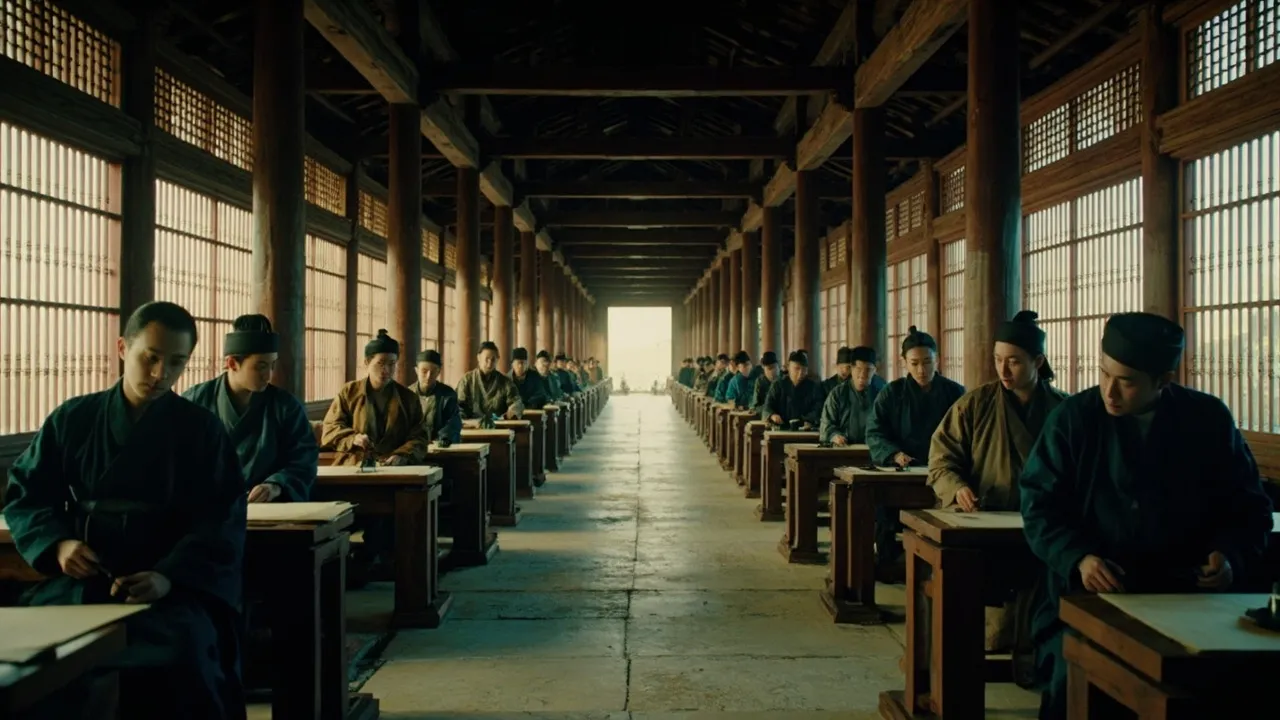
The life cycle of a scholar-official went something like this: you showed promise as a young boy, you studied the classics for years, you traveled to the provincial capital to take the Prefectural Exam, you traveled to the capital to take the Metropolitan Exam, and if you were among the best, you sat the Palace Exam in front of the emperor himself. The emperor might not grade your paper personally — this was usually delegated — but the fact that the highest exam was called the Palace Exam told you something about who you were serving.
The jinshi who emerged from this process were not administrative drones. They were, in many cases, extraordinary generalists. Su Dongpo was a poet, a calligrapher, a painter, a gastronome (he is credited with inventing several famous dishes, including dongpo rou — braised pork), a hydraulic engineer, and a government official who actually cared about the welfare of the people in his jurisdiction. The system rewarded this kind of well-rounded excellence because the exam itself was designed to identify it.
But the system also had a shadow side. The same Confucian classics that trained officials in ethical governance also trained them in conformity to established forms. The exam rewarded mastery of tradition, not innovation. The more successful you were at the exam, the more you had internalized the correct way of thinking about problems. This was a feature, not a bug, from the perspective of the emperors who administered it — they wanted officials who would uphold the established order, not question it.
The Exam That Consumed a Civilization
By the Ming Dynasty (1368–1644 CE), passing the imperial exam had become the singular goal of ambitious families across China. This was not hyperbole. Entire family fortunes were spent on a single male child’s examination preparation. Coaching schools proliferated. Parents mortgaged farms. Younger siblings went without education so that one brother could have the time and resources to study.
The scale of the competition was extraordinary. In the peak Ming era, more than 100,000 candidates sat for the provincial exams in each cycle, competing for a few thousand slots that would advance them to the next level. The number of jinshi degrees awarded over the entire 1,300-year history of the system was approximately 130,000. That is roughly 100 per year, across all of China. The competition was brutal, and the stakes were everything.
The format of the exam essays became increasingly rigid over time. By the Ming Dynasty, the standard form was the bagguwen — the “eight-legged essay.” This was an eight-part structure with very specific rules about parallelism, tone, and content. You could not improvise. You could not express original opinions. You had to write within the form, demonstrating mastery of both the content and the structure. The form was designed to make grading fair — the examiners could compare essays side by side because they followed the same structure. It was also designed to prevent bribery or favoritism, since a badly formatted essay would be disqualified regardless of who wrote it.
The bagguwen worked, up to a point. It did produce a standardized, merit-based elite. It did identify people who had mastered the Confucian canon. But it also rewarded formula over thought. The best and brightest of Chinese society were spending their most productive years learning to write eight-part essays about ancient texts. When China needed to respond to the modern world — to Western military technology, to industrial economics, to new forms of political organization — the scholar-officials who had been trained exclusively in the bagguwen format were not well-equipped to think outside the classical tradition.
The obsession with the exam had other costs. Women were officially prohibited from taking it, which meant that roughly half the population was excluded from the path to advancement by design. Some women disguised themselves as men and took the exam anyway — a few even passed — which tells you something about the desire the system created. Regional disparities also became pronounced: the south consistently outperformed the north, partly because the south had more established educational infrastructure, partly because wealth correlated with educational access. The system that was designed to be meritocratic became, over time, a system that reproduced existing advantages.
The word “mandarin” — for the language spoken by educated Chinese officials — comes from this world. Its etymology is debated, but it likely derives from the Portuguese word mandar (to command), via the Malay word menteri (minister), or directly from the Chinese guan (官), meaning official. Whatever its origin, the word points to the real-world power of the class that the examination system produced: men who could read and write classical Chinese, who understood the ritual forms of governance, who were the administrators of an empire that, at its height, governed one-third of the world’s population.
The Collapse and the Legacy
In 1905, Empress Dowager Cixi — who had ruled China for decades as the power behind several weak emperors — abolished the examination system. The proximate cause was the Sino-Japanese War (1894–1895), in which China was humiliatingly defeated by Japan. The defeat revealed that China had fallen behind the modern world in ways that the bagguwen could not address. Cixi’s decision was an admission that the system had failed.
It had failed, but not in the way that is sometimes claimed. The examination system did not fail because meritocracy was a bad idea. It failed because the content of the exam — classical Confucian texts — had become disconnected from the knowledge required to run a modern state. The form was still working. The selection mechanism was still broadly fair. But what it was selecting for was no longer what China needed.
The modern Chinese university entrance exam — the gaokao — is a direct descendant of the imperial examination. It is taken annually by roughly 10 million students, it determines access to higher education, and it is fiercely competitive. The gaokao preserves the core logic of its predecessor: a standardized, merit-based test that selects the most prepared students for the best opportunities. The content has changed completely — it now tests mathematics, science, and modern languages — but the philosophy is the same. Selection by examination, not by birth.
The British, interestingly, came to the same conclusion through a different path. In the mid-19th century, British officials observed the Chinese examination system and decided to adopt something similar for their own civil service. The British India Civil Service began using competitive exams for recruitment in 1855, and the practice spread to the Home Civil Service over the following decades. The British credited the Chinese system as an inspiration. The Chinese invented meritocracy; the British adapted it for their own context; and the idea spread from there to most modern governments.
China’s 1,300-year experiment in meritocratic governance produced both the world’s first civil service and its most rigid examination culture. These are not separate achievements — they are the same system, seen from different angles. The system identified talented people and gave them a path to power. It also created a cultural obsession with examination performance that shaped Chinese society at every level, from the imperial court to the village school.
The paradox at the center of this history is that the same system that produced extraordinary scholar-officials like Su Dongpo and Zhu Xi also produced a class of officials who could not think their way out of the classical tradition when the modern world arrived. The form was right. The content was wrong. And for 1,300 years, nobody noticed, because the content felt right — it was traditional, authoritative, and connected to everything the culture valued.
The imperial examination is gone. The gaokao is not.