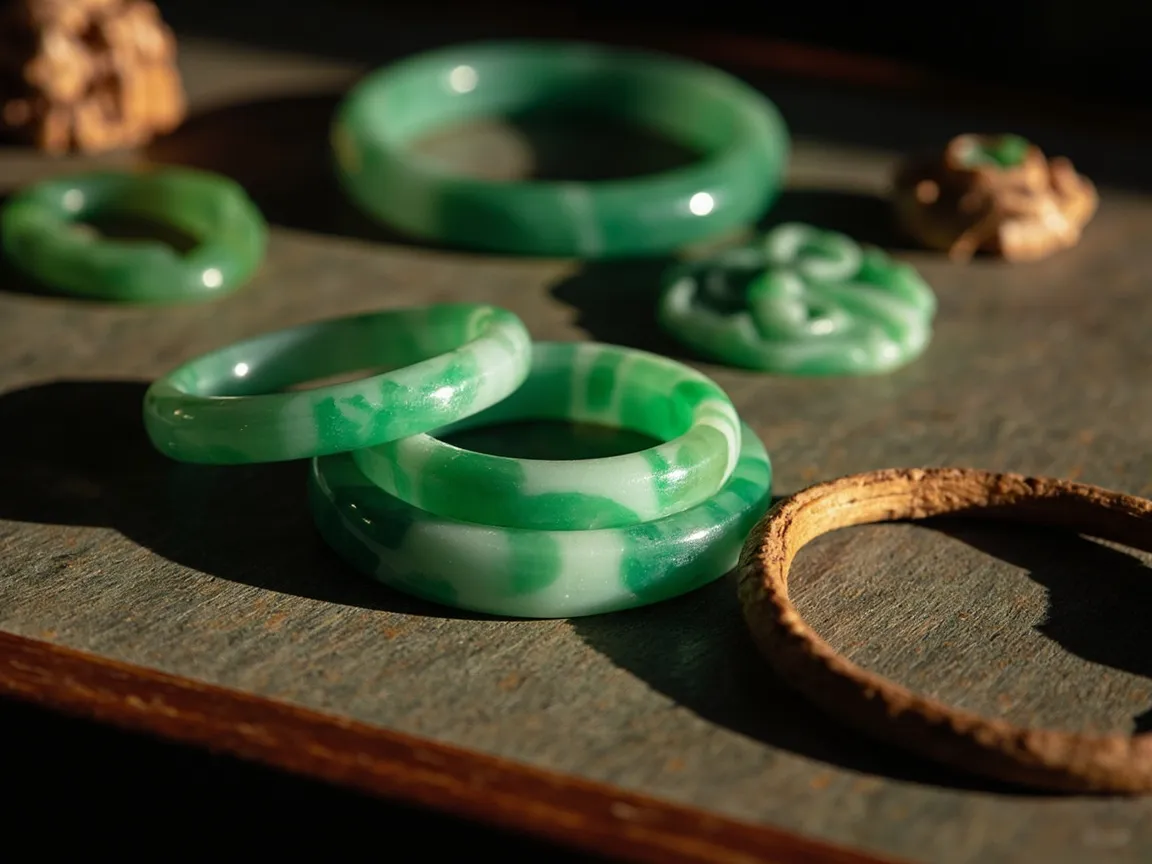
Chinese Jade Culture: The Stone of Heaven
There’s a stone that the Chinese have treasured for over five thousand years—a stone they’ve called more valuable than gold, more precious than diamonds. It’s jade, and in China, it carries a meaning that goes far beyond its beauty. For Americans curious about Chinese art and culture, understanding jade is understanding something fundamental about how the Chinese see the world.
Walk into any Chinese museum, and you’ll find jade objects dating back to the Neolithic period—simple pendants, ceremonial blades, and ritual discs that were buried with the dead to ensure their journey to the afterlife. These aren’t just pretty stones. They’re keys to understanding a civilization that has valued this one material more than any other for millennia.
What Makes Jade Special
First, let’s clear up something that surprises many people: the jade most prized in China isn’t actually jadeite, the bright green gemstone you might find in a jewelry store. That’s a relatively recent import from Burma (Myanmar), prized for its vivid colors but historically secondary to the real Chinese favorite: nephrite.
Nephrite is a calcium magnesium iron silicate, and it’s found in many parts of the world—including China itself, particularly in the remote northwestern region of Xinjiang. But what makes Chinese nephrite special isn’t just where it comes from. It’s the stone’s physical properties. Nephrite is remarkably tough—not hard, but tough. It has a granular structure that allows it to be carved into extraordinarily detailed shapes without breaking. A skilled carver can work nephrite for months, slowly revealing a dragon coiled in the stone’s depths or a delicate peony blooming across its surface.
This toughness gave jade a practical advantage in ancient times—tools made from jade could actually cut harder materials. But the Chinese didn’t just see jade as useful—they saw it as something almost magical. The word for jade in Chinese is yu (玉), and it’s one of the oldest characters in the Chinese writing system, appearing in oracle bone inscriptions from over three thousand years ago.
Here’s what’s really interesting: in ancient China, the same character was used for both jade and for a musical instrument made from jade tubes. That connection wasn’t accidental. The Chinese believed that jade produced a sound like no other—something closer to the music of the heavens than to any earthly instrument.
The qualities the Chinese associated with jade go on and on. They said it was gentle like kindness, strong like wisdom, flexible like justice, pure like propriety, and shining like sincerity. Five virtues, five thousand years of reverence. No wonder emperors called themselves “the Son of Heaven” and wore jade to communicate with the divine.
The History of Jade in China
The story of jade in China begins in the Stone Age. Archaeologists have found jade ornaments in graves dating back to around 7000 BCE—making jade one of the oldest continuously used materials in human civilization. These early pieces were simple, often polished pebbles with holes drilled through them for wearing as pendants. But even in these humble beginnings, the symbolism was clear: jade marked the boundary between the ordinary and the sacred.
During the Liangzhu culture (around 3400-2250 BCE) in what is now Zhejiang Province, jade reached a new level of sophistication. The Liangzhu people carved intricate bi discs—circular rings with holes in the center—and cong tubes—square outside, round inside—that would become central to Chinese ritual life for the next three thousand years. These objects weren’t jewelry in the modern sense. They were spiritual technology, ways of communicating with ancestors and spirits.
The Han Dynasty (206 BCE – 220 CE) marked a turning point. It was during this period that jade really became intertwined with Chinese religious and philosophical thought. The famous “jade burial suit”—a garment made of thousands of small jade pieces sewn together with gold or silver thread—was developed for the highest-ranking aristocrats. The idea was astonishing: by enclosing the body in jade, the person’s spiritual essence would be preserved, leading to resurrection in the afterlife.
Think about that for a moment. The Chinese believed so strongly in jade’s power that they would sew a dead emperor into a suit made of thousands of individually crafted jade tiles, connected with precious metal thread. A complete suit could take over a decade to complete and required the work of hundreds of skilled artisans.
Through the Tang, Song, Yuan, Ming, and Qing dynasties, jade remained at the center of Chinese culture—but its role evolved. It still held sacred meaning, but it also became art in the fullest sense. Emperors competed to have the finest jade carvings. The Qianlong Emperor (r. 1735-1796) was famously obsessed with jade, collecting and commissioning thousands of pieces. He even wrote poetry about jade, celebrating its ability to capture the essence of mountains and rivers in miniature form.
Jade in Chinese Art and Ritual
If you visit China today, you’ll quickly notice that jade hasn’t faded into mere history. It remains deeply woven into daily life, from the carved jade pendants that newborns receive to the jade bracelets worn by elderly women who believe the stone brings health and longevity.
But let’s talk about what really makes Chinese jade art distinctive: the carving. Chinese jade carving isn’t like Western gem cutting, which focuses on maximizing sparkle and clarity. Instead, Chinese carvers work with the stone’s natural colors and variations, often leaving areas of rough surface alongside highly polished sections. The goal isn’t perfection—it’s to reveal the spirit hidden within the material.
The most celebrated Chinese jade carvings often depict traditional subjects: dragons for power and good fortune, bats for happiness, peonies for wealth and honor, lotus flowers for purity, and fish for abundance. A skilled jade carver might spend months or even years on a single piece, using specialized rotary tools and constant water cooling to slowly bring out the image trapped in the stone.
One of the most famous jade carvings in existence is the “Green Legend” (Cui Lian), a flawless jadeite cabbage that now sits in Taiwan’s National Palace Museum. Carved from a single piece of Burmese jadeite, it depicts a cabbage leaf with a cricket hiding beneath it—achieved through masterful use of color gradients in the stone itself. The piece is considered one of the Three Treasures of the museum, along with a meat-shaped stone and a ancient painted pottery vase.
In terms of ritual, jade continues to play a role in Chinese life that might seem almost superstitious to Western eyes—but make no mistake, the Chinese don’t see it as superstition. Feng shui practitioners recommend placing jade objects in homes to bring positive energy. Many Chinese people wear jade bracelets or pendants not as fashion statements but as protective talismans. The belief is simple: jade absorbs and channels positive qi, the vital energy that flows through all things.
Modern Jade Industry
Today, China remains the world’s largest market for jade, but the industry has changed dramatically. The finest jadeite now comes primarily from Burma, and the biggest auctions take place in Hong Kong and Shanghai rather than in the ancient workshops of Yangzhou or Suzhou.
The city of Shenzhen, just across the border from Hong Kong, has become the epicenter of the modern jade trade. Its markets feature endless rows of vendors selling everything from mass-produced bracelets to museum-quality masterpieces. Prices can range from a few dollars for a simple pendant to millions for an exceptional antique or contemporary masterwork.
What’s fascinating is how the market has evolved. Traditional nephrite from Xinjiang still commands respect, but it’s jadeite—with its vivid greens, lavender hues, and translucent “ice” varieties—that has captured the imagination of a new generation of Chinese consumers. The term “mutton fat jade” (羊脂玉) is still used for the finest milky white nephrite, but it’s the “imperial jade” green jadeite that fetch record prices at auction.
For American collectors interested in Chinese jade, the landscape is both exciting and challenging. Exciting because beautiful pieces are more available than ever before, with online markets and international shipping making it easy to acquire jade from dealers around the world. Challenging because the market is also full of fakes, treated stones, and misleading claims. A piece sold as “natural imperial jade” might have been chemically enhanced to improve its color.
The key, as with any valuable collectible, is education and trusted sources. Understanding the differences between nephrite and jadeite, recognizing the hallmarks of quality carving, and buying from reputable dealers who can provide certification—all of this matters. Many collectors start with more affordable pieces—pendants, rings, or simple bracelets—and learn to appreciate the subtle beauty of good jade before moving to more significant investments.
The Enduring Allure
What is it about jade that has held the Chinese imagination for over five thousand years? Perhaps it’s the paradox at its heart: jade is stone, yet it seems alive. It’s hard, yet it can be carved into the most delicate forms.
Or perhaps the answer lies in what the Chinese have always believed about this remarkable material—that it embodies the harmony between heaven and earth, between the refined and the natural, between the permanent and the changeable. When you hold a piece of fine Chinese jade, you’re holding something that a Chinese artisan might describe as “the condensed essence of the mountains and rivers,” a piece of nature refined by human skill and patience.
For American readers exploring Chinese culture, jade offers a window into values that remain central to Chinese civilization: patience, craftsmanship, harmony with nature, and the belief that beauty and meaning can be found in the same object. Whether you’re drawn to the ancient ritual pieces in museums, the intricate carvings of master artisans, or simply the quiet beauty of a jade pendant, you’re connecting with a tradition that spans millennia.
That’s the real story of Chinese jade: not just a gemstone, but a continuous conversation between humans and the natural world, carried on across five thousand years and still going strong today.