What it looks like, and why it’s not what most Westerners think
If you’ve ever walked through a Chinatown in late August or early April and seen smoke rising from a metal barrel at the corner of a side street, you’ve probably seen joss paper being burned. The fire is fed by sheets of yellow paper stamped with silver squares, or by elaborate folded structures: a paper house, a paper car, a paper iPhone. A short distance away, someone has usually set up a small altar with incense, fruit, a glass of rice wine, and a photograph of a deceased relative.
This is joss paper, and the practice is one of the oldest continuous religious habits in Chinese culture. The technical name in Chinese is 纸钱 (zhi qian), literally “paper money,” or 冥纸 (ming zhi), “the paper of the underworld.” The English word “joss” comes from Portuguese deus (god), picked up by Portuguese sailors in Macau in the 1500s, and applied to the Chinese religious figures they saw being worshipped — hence “joss paper,” “joss stick,” and “joss house” for a small temple.
If you haven’t grown up with it, the practice can look baffling. Why burn money for a person who’s dead? Doesn’t the smoke just disappear? Is this a religious thing or a family thing? The short answer is yes — it is religious, it is family, it is community, and it is, for a lot of Chinese families, the most important non-Calendar ritual of the year.
This article is what I wish someone had given me before I went to my first Qingming service in Guangzhou in 2017. It is not an apology for the practice, and it is not a defense of it. It is an explanation, mostly, with a few notes on how to participate respectfully if you find yourself at one.
Where it started, and why paper
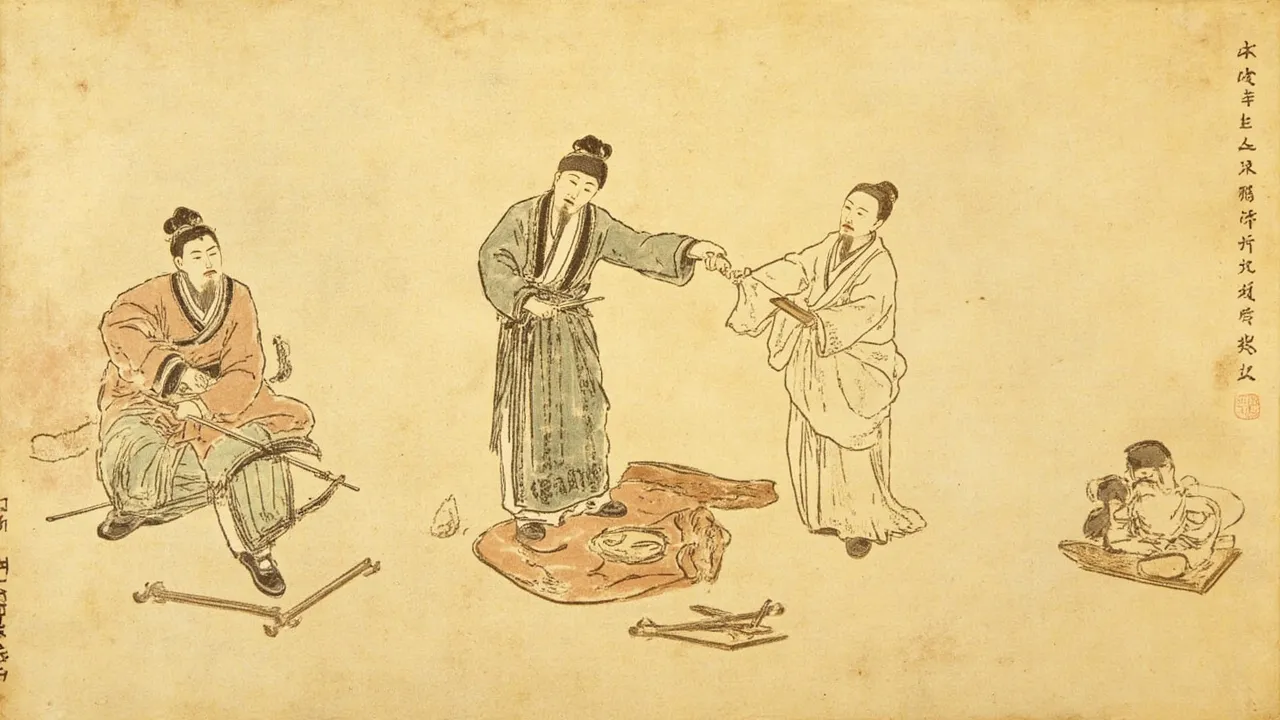
The Chinese practice of burning things for the dead is older than paper itself. During the Shang dynasty (around 1500–1000 BCE), bronze vessels, jade pieces, and silk cloth were buried with the dead or burned at graves. Tomb excavations at Anyang have turned up the remains of thousands of such sacrifices. The dead were thought to need possessions in the afterlife — weapons, food, clothing, servants. The wealthier the family, the more was sent along.
This was expensive. By the Western Han dynasty (around 200 BCE), the practice had shifted: families would burn clay replicas instead of the real thing. (This is one of the early examples of mass-produced religious kitsch — clay soldiers and clay pigs, often mass-stamped.) But the cost was still considerable.
Then, around 105 CE, the eunuch Cai Lun (蔡伦) — under imperial patronage — refined a papermaking process. By the Eastern Han dynasty (around 100–200 CE), paper was being produced in quantity, and somebody realized paper could be a cheap substitute for silk and cloth. At first it was used for tombs because it was affordable; eventually it replaced the real silk money that families had been sending to the afterlife for centuries.
The earliest written evidence of paper specifically being burned as money for the dead appears in the 6th-century Qimin Yaoshu (齐民要术), an agricultural manual that includes a section on proper burial rituals. By the Tang dynasty (618–907 CE), paper money for the dead was common practice. By the Song dynasty (960–1279), the shapes were elaborate — paper representations of clothing, furniture, servants, houses, and even tiny paper coins stamped with the seals of the underworld’s spirit bureaucrats.
This is worth pausing on: paper money for the living existed in Song-dynasty China around the same time as paper money for the dead. Some scholars have argued the two evolved together — that the same merchant economy that produced printed paper money for living merchants also produced printed paper money for dead ancestors.
The forms paper takes
Walk into a Chinese stationery and ritual-goods shop, or a Chinatown shop in late March, and you’ll see an array that takes a while to understand. Here are the categories I find most useful:
Gold and silver paper (金银纸). The most basic form. Stacks of yellow paper (for “gold,” which goes to ancestors) and white or silver paper (for “silver,” often considered suitable for ghosts or lower-status spirits). You fold them into small rectangles, sometimes stamp them with a square seal in red or black, and stack them in a tin or bamboo container. At the burn site, you fold once more, often write the recipient’s name on the back, and feed them into the fire a few at a time.
Coin paper (钱纸). Sheets printed with rows of circular or square shapes meant to represent ancient Chinese cash coins (round with a square hole in the middle). Some of these are painstakingly detailed; some are simple silhouettes. The traditional use is for ancestors and wandering ghosts.
Spirit money for the underworld banks. These are the elaborate versions. Tall stacks of yellow paper bound with red string, printed with fake denominations — billions, trillions — for the great underworld banks. There is humor in this; the same irony that Americans bring to lottery tickets is in Chinese joss paper. Burning a “trillion-yuan” sheet is not unlike mailing a “you’re our 1,000,000th customer” letter. The universe is in on the joke.
Paper houses and paper goods (纸扎, zhi za). This is the most theatrical category. Whole paper mansions, with paper servants and paper furniture inside. Paper cars, increasingly including Teslas and Mercedes. Paper smartphones. Paper gold bars. Paper jewelry. Paper clothes (sometimes real designer brands, knockoff, recognizable to anyone who’s been to a wholesale market). In some Hong Kong and Guangdong funerals, you can rent a full paper apartment for the deceased — paper kitchen, paper bedroom, paper bathroom.
Heaven and Earth notes (天地钱). Stacks of small white squares printed with red seals, used to “buy a way” through the various underworld checkpoints. Some families write the deceased’s name on the front and burn these along with the gold paper.
In Taiwan, the elaborate versions are sold at major ritual-goods stores; you can also hire a “spirit goods” service that comes to the funeral and burns everything in a dedicated burner, sometimes accompanied by an effigy of the deceased.
When the burning happens
There are two main ritual seasons, plus a bunch of smaller ones.
Qingming (清明). Also called Tomb-Sweeping Day, Qingming falls around April 4 or 5 each year (15 days after the Spring Equinox). It’s a public holiday in mainland China, Taiwan, Hong Kong, and Vietnam. Families travel to the graves of their ancestors, sweep the gravesite, place fresh flowers (traditionally willow branches, now often chrysanthemums), offer food, and burn joss paper. The official history links Qingming to the Cold Food Festival (寒食节) of the Spring and Autumn period, which forbade fire for a day; the merging of the two festivals happened during the Tang dynasty.
The Hungry Ghost Festival (中元节). Falls on the 15th day of the 7th lunar month — usually late August or early September. This is the month when the gates of the underworld are open, and the spirits of the dead are believed to roam among the living. Families burn paper for their own ancestors; communities sometimes hold open-air “ghost banquets” with empty seats set out for the hungry dead, and burn paper by the road for wandering spirits who have no descendants to remember them.
Other occasions: the Lunar New Year (especially New Year’s Eve), the winter solstice, the death anniversaries of parents and grandparents (called 做七, the seventh-day rituals that extend through the first 49 days of mourning), and any major family event — a wedding, a birth, an exam — sometimes includes a small joss paper offering to inform the ancestors.
In overseas Chinese communities, the schedule often follows the lunar calendar, which is why the dates of major burns in Chinatowns around the world look unfamiliar to people who track the Western calendar. If you’re trying to time a visit, ask a local Chinese bakery or temple; they’ll tell you when.
Regional differences you should know
Chinese folk religion varies a lot by region, and joss paper is no exception. The patterns I have seen most clearly:
Cantonese (Guangdong, Hong Kong). The most elaborate paper-house tradition. Whole paper mansions, paper cars (sometimes with a paper driver at the wheel), paper airplanes. Heavy use of incense, and a long-form ritual chant in Cantonese led by a Daoist priest.
Fujianese / Taiwanese. Heavy on the gold-paper stacks; the ancestor tablets (神主牌) are kept at home on a permanent altar and burned offerings are made at the table, not just at the grave.
Northern Chinese. Less elaborate paper goods; the focus is on gold and silver paper and incense. The ritual is more spare, sometimes more Confucian in tone. In Beijing and Tianjin, you can still find roadside burners set up by temples specifically for Qingming and Ghost Month.
Overseas Chinese communities. Often a mix. In Singapore and Malaysia, the practice is institutionalized — every HDB (public housing) estate has a designated burner tower, and the dates are published in the local Chinese newspaper. In San Francisco, Oakland, and Manhattan, the practice happens mostly at temples or in community parking lots. In London and Sydney, it tends to happen at temple grounds.
The environmental debate
This is the part of the article I want to write carefully, because the debate is real and the practice is also deeply held.
Modern joss paper, especially the printed gold and silver paper, contains metallic inks, synthetic dyes, and small amounts of plastic. When burned in metal barrels or open fires, it produces particulate matter that contributes to local air pollution. In Hong Kong, the air quality readings spike during Qingming. In Taiwan, the Environmental Protection Administration has run public-awareness campaigns since the 1990s encouraging people to burn less. In mainland China, large cities have designated burn sites (often with better ventilation), and in some districts, especially Beijing’s central districts, the practice has been restricted or moved to specific temples.
Reform efforts exist. There are now “paperless” joss paper services — temples that handle the burning on your behalf with a single consolidated fire, or apps that let you “send” virtual joss paper to your ancestors. There’s a small but growing market for paper made of recycled materials and non-toxic inks. Some families have started burning a smaller amount of paper and donating the equivalent amount of money to a charity in the ancestor’s name. (This is sometimes called 化纸为善, “turning paper into good.”)
At the same time, the cultural and emotional importance of the practice is hard to overstate. For many Chinese families, especially those who have moved away from their ancestral villages, the annual Qingming or Ghost Festival burn is the primary way they stay in touch with their dead. The conversation at the burner — who your grandmother was, why your grandfather left the village in 1948, what your great-aunt’s name was — is something that does not happen on the phone. The smoke is part of that conversation.
I do not think there is a clean answer here. I think anyone who visits a Chinese cemetery during Qingming should expect to see and smell the burning, and should understand that it is one of the most important days in the Chinese ritual calendar.
How to participate respectfully as a non-Chinese visitor
If you find yourself invited to a Qingming grave-sweeping, a Ghost Festival temple event, or a funeral that includes a joss paper burn, here is what to keep in mind.
Don’t take photos of the burn without asking. Some families are fine with it; some are not. The burn is a private family moment, and a flash can feel intrusive. When in doubt, ask.
Don’t joke about the practice. Especially the elaborate paper goods — paper houses, paper cars. To a Chinese family, these are not jokes. They are literal gifts to a deceased loved one. (They are also, on some level, in on the joke themselves. The humor is in the family, not for outsiders.)
Don’t try to burn things in a place that’s not set up for it. Many Western countries have strict rules against open burning in public. The right place to do it is at a temple, a designated burner, or at the gravesite itself if the cemetery allows it.
Do bring a small offering if you’re visiting someone’s grave. Fruit, tea, flowers (especially chrysanthemums, which are the funeral flower in Chinese tradition — note: do not bring chrysanthemums to a wedding, they’re considered inauspicious). Even a glass of the deceased’s favorite drink works. Don’t burn anything yourself unless the family invites you to.
Do bow or nod at the grave. The Chinese practice is to bow three times, but most overseas Chinese families will be flexible if you just nod respectfully.
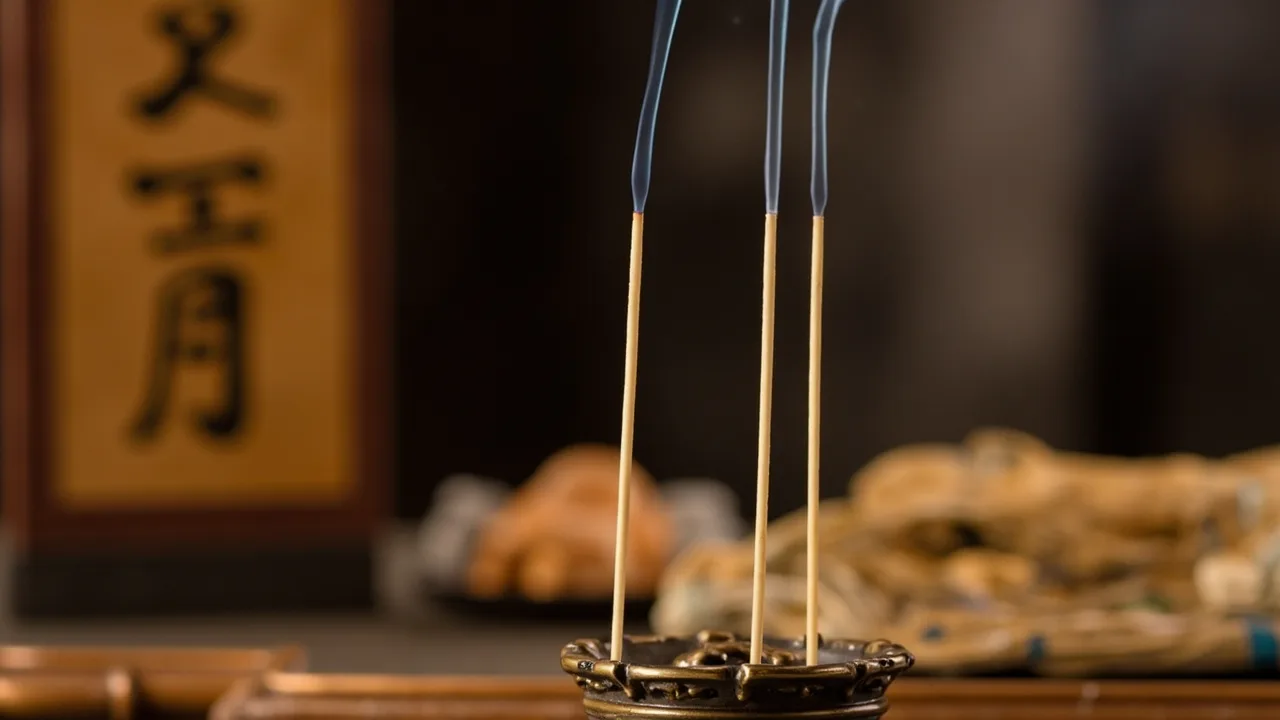
Be prepared for incense smoke. Strong. If you have asthma or a sensitivity to smoke, bring a mask. The incense is not optional — most of the people at the event will be holding three sticks.
If you are visiting during Qingming or Ghost Month in a Chinese-majority neighborhood, expect to see a lot of smoke. Most of it is joss paper. Try to find a spot where you can watch without being in the way, ask someone what they’re doing if you can do so politely, and if you have a chance to join a Chinese friend’s family event, do. It is one of those Chinese cultural traditions that is hard to understand from a textbook and obvious once you’ve stood next to the burner for a few minutes.
Why this tradition has lasted
Chinese joss paper has been burned for roughly two thousand years. The forms have changed — from clay to silk to paper to glitter-glued paper mansions with paper iPhones — but the gesture is the same. The dead are not gone. They are elsewhere, and they still need what the living need.
A Chinese friend explained it to me once in a way that has stuck. The burning of paper money is not, strictly, about whether the dead person can use the money. It’s about whether the living person still remembers them. As long as someone stands at a burner and folds paper in the name of the dead, the dead are not forgotten. The smoke is a witness.
That is a strange, beautiful, ancient idea, and it has been practiced continuously in some form for two thousand years. You can argue with the metaphysics. You cannot easily argue with the people at the burner.