Chinese Kites: Ancient Art of Sky Dancing
There is something almost impossibly light about the moment a kite leaves your hands and catches the wind — that instant when an object made of paper and bamboo suddenly becomes alive, pulling upward, dancing at the end of its string as if it has been waiting all its life for exactly this gust, this temperature, this slant of sunlight. For thousands of years, Chinese people have known this feeling. Kite flying in China is not a hobby or a sport; it is an art, a science, a meditation practice, and a link to ancient history all wrapped into one simple pleasure that requires nothing more than wind, a well-made kite, and someone willing to stand in an open field and look up.
The Chinese word for kite is fengzheng, which literally means “wind harp” — a name that captures something essential about what these objects feel like when they are airborne. A properly flown kite makes sounds. The string hums and whistles as air moves across it, producing a range of tones that experienced kite flyers learn to read the way sailors once read the wind. In some traditions, the kite string is fitted with glass beads or small bamboo attachments that increase the sound, making the kite into a kind of musical instrument playing the sky. This connection between kite flying and music is ancient, and it reflects a Chinese understanding of the natural world in which even the wind has a voice if we are willing to listen.
Origins: The Legend of the Woodcutter and the Silk Banner
The invention of the Chinese kite is traditionally credited to the philosopher Mozi, who lived during the Warring States period (475-221 BCE) — a time of great intellectual ferment and equally great political violence, when hundreds of competing states fought for survival and supremacy. Mozi, founder of the Mohist school of philosophy, was known for his arguments in favor of universal love, mutual benefit, and practical governance. He was also, apparently, a man of considerable practical ingenuity.
According to the historical record, Mozi spent three years building what he called a “wooden bird” — a bamboo-framed object that was the precursor to the kite. The device reportedly flew, though details of how it worked and how long it stayed aloft are frustratingly absent from the surviving accounts. What is clear is that Mozi’s creation inspired others, and within a few centuries, kite flying had spread from the philosophical workshops of the Warring States period to become a common activity across China, used for military signaling, recreational flying, and religious or ceremonial purposes.
The most poetic origin story, though, belongs not to Mozi but to a legend involving an early Chinese emperor and his general. The story goes that during the Han Dynasty (206 BCE - 220 CE), a rebel leader named Liu Bang was besieging the city of Julu, but his forces were struggling to coordinate with each other across the enemy lines. His general, Han Xin, devised a solution: he built a large kite from silk and bamboo, flew it above the enemy camp at night, and used it to determine the distance to the city walls. Once he knew the distance, he tunneled beneath the walls and launched a surprise attack that won the battle and ultimately helped Liu Bang establish the Han Dynasty.
Whether or not this story is literally true, it points to an important historical fact: kites were used for serious purposes in ancient China, not just for play. Military signaling kites were employed to communicate across difficult terrain, to measure distances, and even — according to some accounts — to lift observers above battlefield lines for reconnaissance. The same principle that makes a kite dance in a summer breeze was harnessed to win wars, which is a rather striking example of how deeply human creativity and practical necessity intertwine.
The Craft of Traditional Kite Making
A Chinese kite is not a simple thing, even when it looks simple. The best traditional kites are made entirely by hand, using techniques that have been passed down through families of kite makers for generations, and the process of making a single kite can take days or even weeks. The materials are deceptively humble — bamboo, paper or silk, glue made from rice or other natural starches, and cotton string — but the skill required to transform these materials into something that will fly beautifully, responsively, and safely is considerable.
The frame is the foundation of everything. Traditional kite makers select specific varieties of bamboo for specific parts of the frame — a harder, more flexible species for the main spar, a lighter variety for the cross-struts. The bamboo is harvested at particular times of year, dried and aged, and then cut and shaped with small hand tools. The maker bends the bamboo over heat to achieve the precise curves required for different kite designs, and the joints are typically tied with fine cotton thread rather than glued, because the slight flexibility of the tied joint allows the frame to flex in the wind without breaking.
The covering material is stretched over the frame with careful attention to tension and uniformity. Paper kites use a special thin, strong paper — historically, kite paper was often a byproduct of the calligraphy and printing trades, made from materials similar to traditional xuan paper. The paper is glued to the frame along its edges, and the tension must be even across the entire surface; too loose and the kite will be sluggish and unstable, too tight and it will be prone to tearing in sudden gusts. Silk kites, which were historically reserved for wealthier owners, use a more expensive but more durable covering that allows for more elaborate painting and decoration.
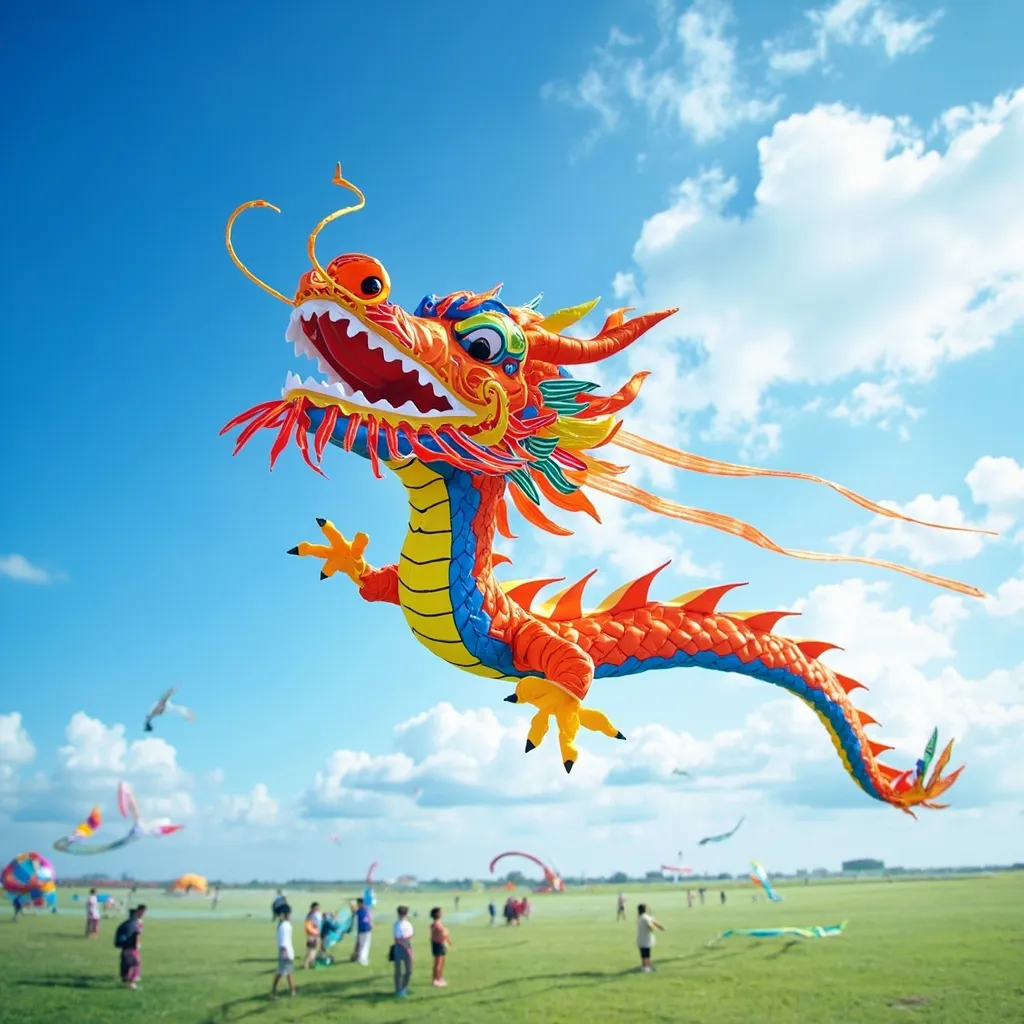
Once the basic structure is complete, the real artistry begins: painting and decoration. Traditional Chinese kites are often decorated with vibrant colors and intricate designs that draw on the full vocabulary of Chinese visual art — dragons, phoenixes, fish, lotus flowers, calligraphic characters, and scenes from mythology and folklore. The painting is done with fine brushes, using techniques that were also used in the Chinese painting and calligraphy traditions, and the designs often carry symbolic meaning. A kite decorated with carp fish, for instance, might symbolize perseverance and ambition (because carp are famous in Chinese culture for their determination in swimming upstream); a kite showing a dragon might be a wish for rain and good harvests.
The bridle — the string system that connects the kite to the flying line — is another area where traditional craftsmanship shows itself. The bridle must be precisely calculated to balance the kite’s center of gravity with the aerodynamic center of pressure, and small adjustments to the bridle attachment point can dramatically affect how a kite flies. Experienced kite flyers adjust their bridles to suit wind conditions, moving the attachment point forward in light wind and backward in strong wind to maintain stable, responsive flight.
Weifang: The World Capital of Kite Flying
Every spring, in the coastal city of Weifang in Shandong Province, something extraordinary happens. The sky fills with kites — hundreds, then thousands, then tens of thousands of them, in every color and shape imaginable, from traditional Chinese dragon kites that stretch sixty meters or more in length to intricate multi-panel creations depicting scenes from Chinese history and folklore, from delicate butterfly kites that seem to hover in place to massive rotating spherical kites that look like they belong in a science fiction film.
The Weifang International Kite Festival, held each April, is the largest and most prestigious kite flying event in the world. It attracts competitors, enthusiasts, and spectators from dozens of countries, and the contests — particularly the team kite ballet competitions, in which dozens of kites are choreographed to music in coordinated routines — are breathtaking displays of skill and artistry. Weifang’s prominence as a kite city is not accidental: the city and its surrounding region have been known for kite making for more than a thousand years, and the local kite-making tradition has been recognized by the Chinese government as an intangible cultural heritage.
The reason Weifang became the center of Chinese kite culture is partly geographic — the city sits on the coast with consistent onshore winds, has large open beaches and fields suitable for flying, and is far enough from major mountain ranges to avoid the unpredictable turbulence that can make mountain flying hazardous. But it is also partly cultural: kite making in Weifang developed as a community craft, with families and workshops specializing in different aspects of the tradition, and this accumulated expertise created a critical mass of knowledge and skill that has proven remarkably durable.
The kite flying competitions at Weifang are organized into several categories. The most dramatic is often the ballet team event, where groups of flyers coordinate dozens of kites in elaborate routines set to music. The kites move in synchronized patterns, forming shapes, spiraling, cascading — it is part dance, part engineering demonstration, and entirely mesmerizing. There are also individual stunt kite competitions, where flyers perform precision maneuvers with dual-line control kites, and traditional kite competitions that judge the craftsmanship of the kites themselves as well as their flying performance.
Kite Flying Traditions and Cultural Significance
Beyond the festivals and competitions, kite flying in China has always been embedded in daily life and cultural practice. In many parts of China, it was traditional to fly kites at specific times of year — particularly in early spring, when the winter winds were giving way to the warmer currents of the new season. Parents would fly kites with their children, teaching them the feel of the wind and the subtle art of controlling the string. Young couples would fly kites together as a form of romantic outing. And kite flying was understood as something more than recreation: the activity was believed to bring good luck, to ward off evil spirits, and to symbolically release problems and worries into the sky.
There is a tradition in some Chinese communities of flying kites in the shape of insects or birds and then, at the end of the flying session, cutting the string to let the kite drift away — a symbolic act of releasing something precious and accepting that it is gone. This practice, which has parallels in other cultures, captures something of the kite’s dual nature in Chinese cultural thought: it is simultaneously an object that you hold close and control, and an object that wants to fly, to rise, to get as far away as possible. Cutting the string is a way of acknowledging that some things cannot be held onto forever, and that letting go can be beautiful.
The connection between kites and children is particularly strong. Making kites was historically a common craft project for Chinese children, who would fashion simple diamond kites from newspaper and bamboo slivers, decorate them with whatever paints or dyes were available, and then spend whole afternoons trying to get them to fly. These home-made kites rarely performed as well as professionally crafted ones, but the process of making and flying them was itself valuable — teaching patience, hand-eye coordination, and a feel for the wind that would stay with the child throughout life.
In the modern era, kite flying has faced competition from electronic entertainment, and concern about the decline of traditional crafts is real. But kite culture in China has proven remarkably resilient. There are active kite clubs in most major Chinese cities, and the number of young people taking up the hobby has actually increased in recent years, driven partly by a broader cultural interest in traditional crafts and outdoor activities. Social media has created new spaces for kite enthusiasts to share designs, techniques, and videos of their flights, and the global kite flying community — centered on events like the Weifang festival — has created connections between Chinese kite makers and enthusiasts around the world.
Visiting Weifang and Experiencing Kite Culture
For anyone interested in experiencing Chinese kite culture directly, Weifang is the obvious destination. The city maintains several dedicated kite flying venues — large, open spaces with good wind, clean facilities, and kite rental shops where visitors can try flying traditional designs before committing to a purchase. The kite museum in Weifang houses an extraordinary collection of historical and contemporary kites, including some of the largest traditional dragon kites in existence, and provides detailed explanations of the making and flying traditions. Guided workshops are available where visitors can learn basic kite making from experienced craftspeople, using traditional tools and materials.
Beyond Weifang, kite flying is practiced in some form across China, and many cities have active communities that welcome visitors. Beijing’s parks are popular kite flying spots in spring, and several historic neighborhoods have kite shops that have been in business for decades, run by families who have been making kites for several generations. Shanghai, Guangzhou, and Chengdu all have kite clubs that hold regular flying sessions and occasionally organize larger events.
For those who want to bring Chinese kite culture home, quality traditional kites are available from a growing number of international retailers, though the selection can be limited. Ordering directly from Weifang-based kite makers is possible through several online platforms that connect craftspeople with international buyers. When purchasing traditional kites, look for products made from natural materials (bamboo frame, paper or silk covering) rather than modern plastic alternatives; the flying experience is genuinely different, and the connection to the living tradition is more direct.
Kite flying remains one of those activities that is far simpler to do than to explain — the wind does not care about instructions, and the feel of a well-flown kite on a good day is something that resists verbal description. But anyone who has felt that pull on the string, that sudden lightness as the kite catches and rises, will understand immediately why this ancient Chinese invention has persisted for twenty-five hundred years. It is not just an object that flies. It is a conversation between a person and the sky, conducted in the oldest language there is.
Recommended Products for Chinese Kite Culture Exploration
1. Traditional Chinese Diamond Kite (Handmade Bamboo and Silk) A high-quality handmade kite in the classic diamond shape, constructed using traditional methods with bamboo frame and silk covering. Each kite is decorated with traditional Chinese patterns (dragon, phoenix, carp, or lotus designs) and includes cotton bridle and flying line. Available in several sizes; larger kites fly better in moderate wind, smaller kites are more responsive in light conditions. Look for kites from established Weifang workshops to ensure authentic craftsmanship.
2. Weifang International Kite Festival Annual Pass and Tour Package For serious enthusiasts, several travel operators offer packages that include admission to the Weifang International Kite Festival, accommodations at nearby hotels, guided visits to the Weifang Kite Museum, and workshop sessions with master kite makers. These packages fill quickly and are typically available only during the February-March booking window. Check reputable China cultural travel operators for current availability.
3. “The Art of Chinese Kite Making” (Illustrated Craft Book) A detailed, step-by-step guide to traditional Chinese kite construction, written by a third-generation Weifang kite maker and available in English translation. Covers bamboo selection and preparation, frame construction, paper and silk covering techniques, bridle calculation, and painting and decoration methods. Includes patterns for several traditional kite designs and a history of the craft tradition. Suitable for intermediate crafters; some experience with fine handwork helpful.
4. Kite Flying String with Glass Bead Attachments (Traditional Style) Traditional Chinese kite flying line fitted with small glass beads that create the characteristic whistling sound as air moves across them. This is the same type of line used in classical Chinese kite flying, and the sound adds a new dimension to the flying experience. Available in different lengths and bead colors; choose a length appropriate to your typical flying场地. Quality varies significantly between producers, so look for brands with positive reviews from experienced kite flyers.
5. Bamboo Kite Making Kit (Complete Starter Set) Everything needed to make your own traditional Chinese kite: pre-cut bamboo strips in appropriate dimensions, traditional thin kite paper in multiple colors, cotton thread for lashing frame joints, rice glue powder with mixing instructions, brushes for decoration, and an illustrated instruction booklet covering basic construction and first flight techniques. This is the same type of kit used by generations of Chinese children learning the craft and makes an excellent gift for anyone interested in traditional crafts or Chinese culture.