What it is, and why it takes 30 layers of patience
Lacquerware is the art of painting wood (or sometimes bamboo, leather, ceramics, or paper) with thin coats of tree sap, sanding each layer, and building up dozens of coats until the surface is glassy, deep, and impossibly hard. The Chinese word is 漆器 (qi qi). The English word “lacquer” comes from the Portuguese laca, which in turn comes from a Hindi word for the same tree sap.
The thing about lacquerware is that almost everything you think of as “fine craftsmanship” in Western furniture and decorative arts is, when you sit down and measure it, faster and more forgiving than Chinese lacquer. A museum-quality carved lacquer box from the Ming dynasty might have a hundred coats on it, each one dried, sanded, polished, and checked by hand. A skilled lacquer master in 2026 — there are still a few — works on a single piece for months at a time. The deepest reds of a well-made carved lacquer bowl are not paint; they are stacked layers, and you can see the depth if you tilt the bowl under a light.
This is one of the oldest Chinese craft traditions. Lacquerware objects have been found at Neolithic sites along the Yangzi river basin dating to about 5000 BCE. A red lacquer wooden bowl excavated at the Hemudu site in Zhejiang province is one of the oldest lacquerware pieces on earth, and it still has visible brush strokes from 7,000 years ago. China has been making lacquer for longer than almost any other civilization has been making pots.
If you’ve ever touched a piece of good Chinese lacquer — say, a small red bowl from a craft market, or an old tea tray from a friend’s grandmother — you will remember the surface. It feels like glass that has been softened slightly by hand. It is warm to the touch, unlike plastic. It catches the light in a way that paint doesn’t, because the depth is real, not painted on.
The sap, the seasons, and why this craft refuses to be hurried
The raw material is the sap of the lacquer tree (Toxicodendron vernicifluum, originally Rhus vernicifera), which grows in mountainous regions of China, Japan, Korea, and parts of Southeast Asia. The Chinese variety is generally considered the highest quality. Trees are tapped, like rubber trees, and the sap — a greyish liquid that oxidizes black-brown when exposed to air — is collected in buckets.
Raw lacquer sap (生漆, sheng qi) is mildly toxic and can cause severe allergic reactions on skin contact. Most lacquer masters develop a tolerance over years of working with it, but it’s not unusual for apprentices to spend their first months unable to touch the raw sap directly. The Japanese word for lacquer, urushi, comes from the same root.
To make the lacquer usable, the sap is heated, filtered, and tinted. Black lacquer is made by adding iron oxide. Red lacquer (the famous Chinese red, 朱漆 or 雕漆 red) is made by adding cinnabar (mercury sulfide). The most prized cinnabar reds are deep, slightly translucent, and look almost like stained glass when held up to the light.
Then comes the layering. A lacquer piece is built up one coat at a time. Each coat is brushed on as a thin film, then left to dry in a humidity-controlled room for at least 24 hours — sometimes for several days, depending on the season, the temperature, and the type of lacquer. After drying, the surface is sanded smooth with a fine abrasive (traditionally a special clay, or charcoal from specific trees), then polished. Then the next coat goes on.
A small box might take 30 coats and a month of work. A large carved lacquer screen might take 200 coats and several years.
The patience this requires is hard to overstate. There are no shortcuts. Skip the drying time, and the next coat won’t bond. Skip the sanding, and the surface ripples. Get the humidity wrong, and the lacquer never sets properly. Modern lacquer workshops in Beijing, Fuzhou, and Yangzhou still work this way, because they have to.
The major techniques, and how to tell them apart
Chinese lacquerware is not one craft but several, each with its own regional tradition and visual vocabulary. Here are the four you’ll see most often.
Plain lacquer (素漆, su qi). Solid color, often red or black, with no carving or inlay. The technique is in the polishing — every layer is built up so the final surface is glassy and deep. A plain black lacquer bowl from the Song dynasty, with no carving, can be a masterpiece because the color is even and the surface is flawless. Imperial plain lacquer was often decorated inside with gold-painted motifs (描金) or with mother-of-pearl inlay.
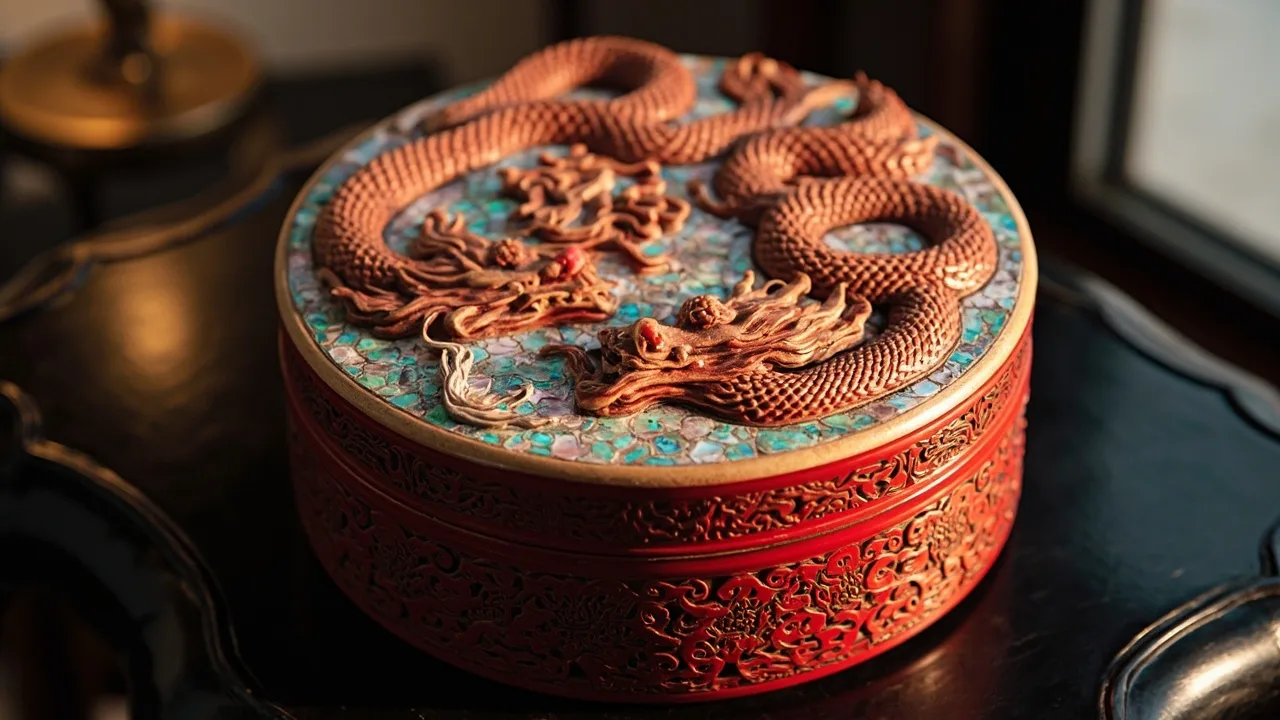
Carved lacquer (雕漆, diao qi). The most dramatic technique. The artisan paints dozens of layers of red lacquer onto a base, then carves through the layers with a small knife, cutting away the surface to reveal the layers beneath. Because every layer is the same color, the carving looks like bas-relief sculpture in solid color — flowers, dragons, landscapes, figures. The effect depends entirely on how thick the layers are: a fine carving has thin layers, a deep carving has thick ones. The most prized carved lacquer from the Ming dynasty can have 100 to 200 layers, and the carving depth is sometimes a full centimeter.
Mother-of-pearl inlay (螺钿, luo dian). Small pieces of abalone shell, cut into shapes, set into the lacquer surface and polished flush. The shells refract light in greens, blues, and pinks against the dark lacquer underneath. The technique reached its peak in the Yuan and early Ming dynasties, especially in lacquer pieces commissioned by the imperial court. Luodian is also a major character in Chinese literature — the famously beautiful concubine Yang Guifei of the Tang dynasty is described in poetry as having a “luodian face” with iridescent beauty.
Gold and silver inlay (金银平脱, jin yin ping tuo). Thin sheets of gold or silver are applied to the lacquer surface, often in floral or animal patterns, then sealed under more layers of lacquer and polished. Used heavily in Tang dynasty imperial lacquer; rare in later periods because of cost.
A fifth technique, less common, is engraved lacquer (戗金, qiang jin), where the artisan scratches a design through the lacquer surface and inlays gold powder into the scratches. Some Tang-dynasty pieces survive with this technique.
There is also bodiless lacquer (脱胎漆器, tuo tai qi qi), a Fujian specialty where the artisan builds up layers of lacquer over a clay or plaster form, then removes the form. The result is a hollow lacquer object — a tray, a vase, a teapot — that is essentially pure lacquer with no wood inside. A bodiless lacquer teapot can be lighter than a porcelain one.
The high points: when Chinese lacquer reached its peak
A quick tour, since you might be looking at these in a museum someday.
Neolithic and Shang. The earliest surviving pieces. Wooden bowls and combs from Hemudu and Liangzhu sites (5000–3000 BCE). The craftsmanship is surprisingly sophisticated — the bowls are often painted with red and black patterns in two-color lacquer, a technique already standard by 4000 BCE.
Warring States and Han dynasty. Lacquerware becomes a major industry. Lacquer workshops in Chu state (modern Hunan/Hubei) produce thousands of pieces, including ear cups, boxes, weapons sheaths, and musical instrument cases. Han dynasty tombs have produced an astonishing array of lacquer pieces — including painted lacquer coffins. A piece of Han lacquer excavated from a Chu tomb in Hunan had a sticker label still readable in ancient Chinese characters; that’s how good the lacquer preservation is after 2,000 years.
Tang dynasty. The imperial court commissions elaborately carved and inlaid lacquer. The most famous surviving pieces include carved lacquer boxes with figural decoration (Buddhist scenes, court ladies, horses) and mother-of-pearl inlaid pieces with birds and flowers. The Tang court also sent lacquer as diplomatic gifts to Japan and Korea, where the technique continued in different directions (Japanese lacquerware, japanning, eventually becomes its own tradition in Europe).
Song dynasty. Plain lacquer, especially black lacquer, reaches a quiet peak. Song pieces are spare, simple, and rely on the polish itself for their beauty. The aesthetic is so restrained that Song plain lacquer is sometimes mistaken for cheap modern work by people who don’t know what they’re looking at.
Yuan and Ming dynasty. Carved lacquer reaches its highest level. The Ming imperial workshop in Beijing produces carved lacquer pieces that are still in museums today — red, deep, with dragon motifs so finely cut you can see scales. The Yongle and Xuande emperors were major patrons. A 15th-century carved lacquer plate from the Xuande reign is one of the most expensive Chinese decorative arts pieces ever sold at auction.
Qing dynasty. Mixed fortunes. The Qianlong emperor was a lacquer collector but his taste ran to densely patterned, heavily carved pieces that some modern viewers find over-decorated. The craft continued, especially in Fujian and Beijing, but the heights were less consistently hit.
Modern lacquerware: where the craft lives now
If you want to see good modern Chinese lacquerware, three places matter most.
Fuzhou (福州), Fujian province. The heart of modern Chinese lacquer. Fuzhou’s lacquer industry goes back to the Ming dynasty and is still active today. The Fujian Arts and Crafts Museum in Fuzhou has a permanent collection that covers the major techniques. The Fuzhou lacquer industry still produces both high-end museum pieces (carved lacquer screens that take years to complete) and more affordable consumer goods (lacquer tea sets, lacquer trays, lacquer jewelry boxes). Most of the lacquerware you can buy in a Chinese airport gift shop or a Chinatown craft store came from Fuzhou or one of its satellite workshops.
Beijing. Carved lacquer is still produced in the imperial style. Beijing’s lacquer masters work for the Palace Museum’s restoration workshop and for a handful of high-end ateliers. Carved lacquer from Beijing is the most expensive Chinese lacquerware on the market today — a large carved lacquer screen can run from $20,000 to several hundred thousand dollars.
Yangzhou (扬州), Jiangsu province. A smaller lacquer tradition, focused especially on painted lacquer and gold-inlaid lacquer. Yangzhou lacquer is less famous internationally than Fuzhou’s but produces some of the most refined modern work.
In the West, good Chinese lacquer is sold at specialist Asian art dealers (Sydney L. Moss Ltd in London, J. J. Lally & Co. in New York, Michael Goedhuis in London) and at the larger auction houses (Christie’s, Sotheby’s, Bonhams, Heritage Auctions all run dedicated Chinese decorative arts sales).
If you’re starting a collection, my honest advice is this:
- Buy from the maker or a known dealer, not an unmarked gift shop. Modern Chinese lacquer ranges from exquisite to genuinely bad, and you cannot tell from a photo.
- Look at the back and the inside, not just the front. A well-made piece will be finished on the back and inside; a poorly made one will have raw wood or a thin spray finish on the reverse.
- Test the surface with a fingernail, gently. Real lacquer is hard; if your nail leaves a mark, walk away.
- Be patient. The market for serious Chinese lacquer is small but real. Wait for the right piece.
How to live with lacquer if you have it
Lacquer is durable but not indestructible. A few rules.
Don’t leave it in direct sun. UV light will fade the red cinnabar pigment over years. Most antique Chinese lacquer has been kept in display cases for that reason.
Don’t soak it. Lacquer is water-resistant, not waterproof. A wipe with a damp cloth is fine; a sink full of water is not.
Don’t use alcohol-based cleaners. They will cloud the surface. A soft dry cloth is usually enough. If something is stuck, a tiny bit of olive oil on a cloth will lift it.
Don’t stack lacquer pieces without padding. Soft cloth between pieces. Lacquer-on-lacquer contact will mark both surfaces.
If you have a piece of antique Chinese lacquer, the value is in its condition. Cracks, chips, and repairs all affect price. Don’t restore it yourself — find a specialist conservator. Most major American and European museums have Chinese decorative arts departments that can recommend one.
Why this craft has lasted 7,000 years
There’s a recurring argument in craft writing that the crafts that survive are the ones the industrial revolution couldn’t replicate. Lacquerware is a good test case. The chemistry of tree sap doesn’t lend itself to mass production — every layer is hand-applied, every surface is hand-sanded. A lacquerware factory is essentially a collection of skilled artisans, not a production line.
There are fewer lacquer masters today than there were 50 years ago. The apprenticeship system in China has weakened, and the patience required is not a good match for a fast-fashion economy. Some techniques — carved lacquer with 200 layers, especially — are now practiced by a vanishingly small number of artisans. A young carver in Fuzhou might be in their 40s, with five or ten masters left who can teach them.
At the same time, there is a small but real revival among younger Chinese consumers. Lacquer tea trays, lacquer coffee tables, lacquer earrings — there’s a generation of Chinese buyers who are buying back the craft their grandparents’ generation associated with the Cultural Revolution’s destruction. Modern lacquer designers in Shanghai and Beijing are experimenting with new forms: lacquer iPhone cases, lacquer earrings, lacquer watches. Most of it is mediocre. Some of it is genuinely good.
If you have the chance to handle a piece of Chinese lacquer, take it. There is something about the surface that doesn’t translate to photographs. It’s the same warmth the Neolithic potters at Hemudu felt when they brushed the first red lacquer onto a wooden bowl, 7,000 years ago. The brush stroke looked like that. The surface felt like that. The patience required was the same.