- “Dried lotus seeds (grocery-grade, vacuum-packed) — for congee, soups, traditional Chinese desserts”
- “Lotus leaf tea bags (green tea wrapped in lotus leaf) — for brewing traditional herbal drinks”
- “Print: ‘Lotus and Crane’ Chinese brush painting reproduction — for home decor and gifts”
- “Lotus root tuber (organic, sliced and vacuum-sealed) — for stir-fry, soups, braised dishes”
- “Lotus seed paste (for mooncakes and pastries) — pantry staple for Chinese bakery”
Chinese Lotus Culture: The Sacred Flower That Grew Out of the Mud and Became Everything
There’s a Chinese saying I’ve been turning over in my head for years: 荷花出淤泥而不染 — the lotus flower grows out of the mud but is not stained. Walk past any pond in summer and you’ll see it in action. The roots are buried in black, anaerobic muck. The stems push up through turbid water. And then — somehow — the bloom opens in pale pink or white, completely clean.
That single observation, made by someone in the Chinese heartland maybe three thousand years ago, turned a water plant into a theology, a meal, a wedding decoration, a chair-throne design, and one of the most painted subjects in the history of East Asian art. This is the lotus culture of China, and it is — as far as I’m concerned — the most interesting thing a flower has ever gotten itself into.
The Lotus That Wouldn’t Stay in the Pond: Symbolism Before Buddhism
Here’s something that surprises most Western readers: the lotus was sacred in China before Buddhism arrived. When Buddhism filtered in from India during the Han dynasty (roughly the 1st century CE), it didn’t introduce the lotus to Chinese culture — it grafted itself onto an existing obsession.
The earliest Chinese poetry that survived intact treats the lotus (荷花, héhuā, or 莲花, liánhuā) as a seasonal marker. The Classic of Poetry (诗经), compiled around 600 BCE, mentions lotus harvests. The Chu Ci — the collection of poems associated with Qu Yuan, the disgraced minister who drowned himself in the Miluo River in 278 BCE — is where the lotus first starts sounding like a moral symbol. In Li Sao (离骚, “Encountering Sorrow”), Qu Yuan dresses himself in a costume made of fragrant plants, and the lotus appears as one of the leaves in his imaginary garland. It’s not decoration; it’s identity. By wearing the lotus, the poet says he belongs to the pure world even though his political world has gone corrupt.
That move — I am the flower, the world around me is the mud — is the seed of everything that comes later. Confucian scholars picked it up: the junzi, the superior person, was supposed to remain uncorrupted by a corrupt court, just like the lotus remains unstained by its muddy bed. It’s a very Chinese kind of heroism. Not fighting the system, not leaving it, just staying clean in it.
When Buddhism arrived, it found this metaphor already half-built and moved in. The Buddhist lotus has a more elaborate theology — it carries the Buddha and the bodhisattvas, it has the thousand-petal form, it blooms in the pure land of the west. But the underlying logic was Chinese all along: a thing can live in filth and remain holy. The Dalai Lama’s throne is still a lotus. Guanyin’s feet rest on a lotus. But Chinese poets had been writing about exactly that paradox for a thousand years before Guanyin set foot on one.
The Lotus Throne and the Lotus Heart: Buddhist Symbolism in China
Once Buddhism settled into China, the lotus became its single most important visual object. Walk into any Buddhist temple in China — the bigger ones in Beijing, the tiny cliff-side shrines in Sichuan, even the neighborhood nunnery down the street — and the lotus is everywhere. Carved into stone. Painted on the ceiling. Drawn on the prayer flags. Stamped into the metal work of incense burners.
What I love about the Buddhist lotus is how systematically they built meaning onto a flower. Every visible part of the plant became a teaching:
- The bloom above the water is enlightenment — the mind rising above suffering.
- The stem running through the mud is the practitioner — moving through the dirty world without touching it.
- The roots in the dark are desire, ignorance, the human predicament.
- The seedpod, full of seeds, standing upright in the center of the flower, is sometimes read as the Buddha-heart. Each seed is a potential Buddha. (Which is why lotus seeds show up at weddings, but more on that later.)
There are also specific colors and forms that mean specific things in the Chinese Buddhist system. A red lotus (红莲) is associated with the historical Buddha and with Amitabha’s western paradise. A white lotus (白莲) is for spiritual perfection, often connected to Tara. A blue lotus is rare in Chinese art but appears in Tibetan-influenced Vajrayana contexts. And the thousand-petaled lotus — sahasrara in Sanskrit, 千瓣莲 in Chinese — sits at the crown of the head in tantric body diagrams, where it represents the highest state a person can reach.
You can see this theology in the famous Dunhuang cave murals from the Tang dynasty. The Paradise paintings show Buddha Amitabha seated on a giant lotus in the middle of a lake, with smaller lotuses rising from the water for every soul who has been reborn. It is, when you stand in front of one of those murals, a remarkably visual religion. Everything important is happening in a lotus.
This brings me to a side observation. I have always found it slightly funny that the Chinese Buddhist lotus and the Chinese Confucian lotus are both trying to say the same thing — stay clean in a dirty world — but Buddhism wants you to escape the world while Confucianism wants you to serve in it. The flower is doing a lot of philosophical heavy lifting in two completely different directions. A botanist would say it just grows that way. A Chinese poet would say the flower knows.
The Lotus Garden: West Lake, Yuanmingyuan, and the Summer Palace
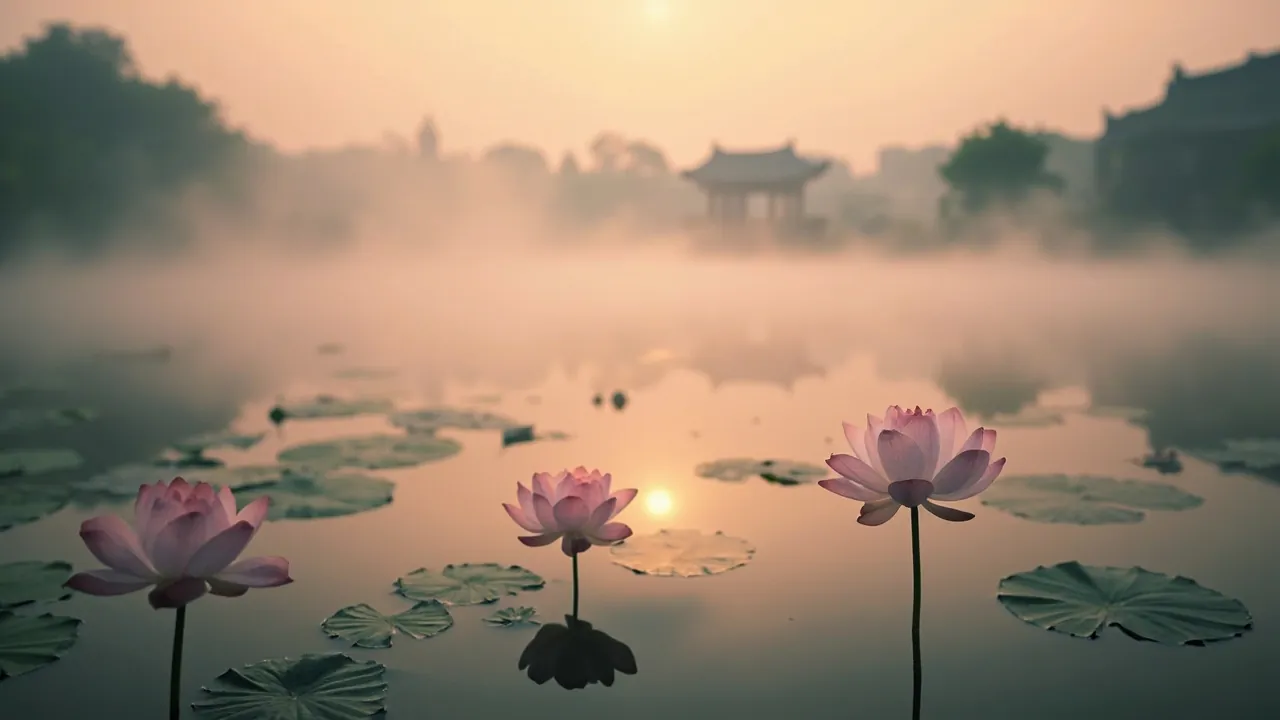
If you want to understand how the lotus sits inside Chinese garden culture — not as a decoration but as the whole point — go to Hangzhou’s West Lake (西湖) between mid-June and late July. The famous “Ten Scenes of West Lake” include one called Lotus Breezes at Winding Courtyard (曲院风荷, Qūyuàn Fēng Hé), and the Chinese have been visiting it since the Southern Song dynasty in the 12th century. You stand on a walkway that goes out over a pond thick with lotus plants, the breeze brings you the green-vegetable smell of the leaves, and the flowers open pale pink against dark water. Eight hundred years of people have done exactly the same thing.
This is not an accident. The Chinese garden tradition treats the lotus pond as one of the four great “natural” garden scenes — alongside mountains, bamboo groves, and pine forests — that you try to compress into a courtyard. The Ming dynasty garden manuals (especially Zhangwuzhi and Ji Cheng’s Yuan Ye, both from the 17th century) devote whole chapters to where to put a lotus pond and what kind of lotus to plant. The general principle: lotus ponds should be irregularly shaped, never square, and they should always have somewhere to sit and look at them from. A pavilion, a covered walkway, a stone bench — the rule is that the lotus should be viewed, not just grown.
The single most famous historical lotus garden is gone, and that loss still bothers people. The Yuanmingyuan — the Old Summer Palace outside Beijing, looted and burned by Anglo-French troops in 1860 — had an entire section called the “Lotus in the Field at Ease” (万方安和, Wànfāng Ānhé), where the emperor Qianlong liked to sit in a lotus-shaped hall surrounded by actual lotus ponds. We have the engravings. We have the poems he wrote there. We do not have the building. There’s a famous line from a Qing-dynasty poet lamenting its loss: the burned ruins of Yuanmingyuan, he wrote, are a wound that will not heal for ten thousand autumns. (其实没这么客气 — 痛彻心扉.)
What remains, and what I would actually tell an American friend to visit, is the Summer Lotus Pond (荷花池, Héhuā Chí) at Beijing’s Summer Palace (颐和园, Yíhé Yuán). The views across Kunming Lake with lotus in the foreground and Longevity Hill in the background are very close to what Qing emperors were looking at. In early morning, before the tour buses arrive, you can still hear the lotus leaves rustling in the breeze — a thick, papery, almost fabric rustle that is the sound a Chinese garden is built to deliver.
One detail I find myself thinking about: in the classical Chinese garden, the lotus is almost never grown in a “pretty” arrangement. The slightly overgrown lotus pond is more valued than a tidy one. The flowers should look like they happened. The hand of the gardener has to disappear. Compare that to the Versailles parterre, where the gardener is the whole point, and the two garden philosophies face off across the centuries.
Eating the Lotus: Seeds, Roots, Leaves, and the Pantry of the South
Now we come to the part of the lotus story Americans are least likely to know, and probably the most important in everyday Chinese life: you can eat almost every part of the plant, and Chinese cooks have been eating it for a very long time.
The lotus seed (莲子, liánzǐ) is the most common form in the US. If you’ve ever had red bean and lotus seed soup at a dim sum place, or a lotus-paste mooncake at Mid-Autumn Festival, you’ve eaten it. Dried lotus seeds have a slightly sweet, slightly starchy flavor — closer to a chestnut than to an almond — and they need to be soaked overnight and then simmered for 30–45 minutes before they soften. The bitter green sprout in the middle of the seed (莲心, liánxīn) is removed in commercial dried seeds but kept in some traditional preparations, because Chinese medicine treats it as a “clearing heart-fire” herb.
The lotus root (莲藕, lián’ǒu) is the one most American grocery stores actually carry now, usually sliced and vacuum-packed. It’s the long, tubular rhizome with the characteristic pattern of holes — nine holes if you cut it crosswise through most of a mature root. That hole pattern is famous in Chinese art; a single lotus root slice, fried until the edges curl and dusted with salt, is one of the prettiest side dishes in the Sichuan canon. The texture is the surprise: it’s crisp and juicy in a way that no other root vegetable quite matches. A friend of mine in Chengdu once told me the nine holes represent “openness and clarity of mind,” which I think is mostly a folk etymology, but it’s the kind of folk etymology Chinese culture runs on.
The lotus leaf (荷叶, héyè) is the wrapper. The classic dish is lo mai gai (糯米鸡, sticky rice chicken) — glutinous rice, chicken, mushrooms, sometimes a salted egg yolk, all steamed inside a folded lotus leaf. The leaf isn’t really food; it’s an aromatic that gives the rice its distinctive warm-green flavor. Lotus leaves are also dried and used to wrap whole fish before steaming, or brewed into a tea (荷叶茶) that Chinese herbal medicine has claimed, with mixed evidence, helps with summer dampness and water weight. The taste of lotus leaf tea is unusual — grassy, slightly bitter, faintly mineral. I like it cold in summer.
The lotus flower’s pollen is even used in some Chinese wines and desserts, though you’d be hard-pressed to find it outside of specialty shops. And the lotus stem, the part between the root and the leaf, is a specialty pickle in Hunan that I have only ever eaten once and have thought about weekly since.
Putting all of this together: the lotus is one of the very few plants in the world that gives Chinese kitchens four or five distinct ingredients, each with its own season and technique. For southern Chinese families — especially in Hunan, Hubei, Jiangsu, Zhejiang — it has been a kind of seasonal calendar in the pantry for centuries. Spring is new lotus shoots. Summer is fresh flowers and leaves. Autumn is the seed harvest. Winter is stored dried seeds and root slices. A grandmother’s pantry in Wuhan would have had lotus in some form twelve months of the year.
This is, by the way, why the lotus is more interesting than the peony. The peony (牡丹) gets the title of “king of flowers” in Chinese culture, and it is gorgeous, but you cannot eat it. The lotus gets to be sacred, beautiful, AND useful. That combination is rare in any culture’s plant symbolism, and I think it explains a lot of why the lotus is in more Chinese poems than any other flower.
The Lotus at Weddings, Funerals, and Other Important Moments
The last thread I want to pull is the one that ties it all together: the lotus as a sign of good wishes in Chinese family life. You see it everywhere, from wedding banquets to funeral wreaths, and the meanings are surprisingly specific.
At weddings, the lotus motif shows up in two main ways. The first is on the bride’s headpiece or in her bouquet — usually a hehua (lotus flower) hairpin or a longfeng (dragon and phoenix) crown with lotus-petal details. The second, and more interesting to me, is the lotus bed (莲房, liánfáng) motif — the seedpod with the seeds still in it, used as a decoration on the bridal bed or on the wedding sweets. Each seed is a wished-for child. In a culture that historically put enormous pressure on a new bride to produce a male heir, the lotus bed was a hopeful, slightly anxious, very tender image. A wedding banquet in Canton today will often have a dessert shaped like a lotus pod, with each “seed” being a small red bean paste ball. The symbolism is older than anyone at the table.
Lotus shoes (弓鞋, gōngxié) were the tiny, pointed embroidered shoes worn by women with bound feet for about a thousand years (roughly 10th to early 20th century). The name comes from the shape — the shoes were meant to make a bound foot look like a lotus bud. The “lotus” association became so strong that bound feet themselves were called jinlian (金莲, “golden lotus”), a phrase still used in modern Chinese to refer to the practice. This is the part of lotus culture I find hardest to write about with affection. The aestheticization of women’s suffering under the name of a sacred flower is one of those things where you have to hold two thoughts at once — yes, the lotus is genuinely beautiful in Chinese art, and yes, the same flower was borrowed to make cruelty sound pretty. It is a useful example of how flowers can be bent to mean whatever a culture needs them to mean.
At funerals, the lotus reappears. White lotus motifs are common on memorial wreaths and on paper offerings burned for the deceased. The meaning is similar to the Buddhist use: the soul rises, unstained, from the muddy world it is leaving. Tomb sculptures in some southern dynasties — the Southern Tang, the Southern Song — sometimes featured lotus designs carved into the stone that would have been visible to mourners approaching the tomb.
In Buddhist lay practice, the lotus is in the strings of 108 beads of a mala (prayer beads), where each bead is sometimes carved from a single lotus seed. In Taoist practice, the lotus is less central but still present — the Immortals often sit on lotus thrones when they appear in temple art, even though Taoism has its own preferred plant symbolism (the peach, the plum, the fungus of immortality).
And then there is the small, quiet presence of the lotus in everyday Chinese objects. Lotus-petal-shaped teacup rims. Lotus-patterned embroidery on children’s hats. Lotus-shaped windows in garden walls, with the cutouts designed to frame a view of a real lotus pond on the other side. (This is one of my favorite details in classical Chinese garden design — the window is a lotus, framing a lotus.) The flower has been so thoroughly absorbed into the design vocabulary that you stop seeing it. That, to me, is the test of a real cultural symbol. It isn’t the things that are loudly famous. It’s the things that have quietly become part of the wallpaper.
Where the Lotus Goes Next
A short coda, because this article is already running long and I want to land the plane.
The lotus is having a quiet revival in contemporary China. Not as a religious symbol — Buddhism in China has been through too much in the last century to function as a simple devotional force — but as a cultural anchor. The “Guochao” (国潮, national tide) movement, which pushes young Chinese consumers toward traditional Chinese aesthetics, has put lotus motifs on sneakers, lipsticks, milk tea packaging, and subway station murals. The traditional “lotus viewing” seasons at West Lake and Beijing’s Summer Palace draw real crowds again, mostly domestic tourists. And dried lotus seed exports to the US have grown steadily as more Americans discover liánzǐ congee and lotus-paste mooncakes.
I do not know whether the lotus will keep its specific religious freight in another hundred years. The peony might outrank it for sheer decorative appeal, the orchid for scholarly elegance. But for now — for the last two or three thousand years, anyway — the lotus has been the flower that holds the most things at once. Muddy roots. Clean blooms. Wedding beds. Temple ceilings. Sweet soups. Stone carvings. A nine-holed root you can pickle and a thousand-petaled throne for the Buddha. I cannot think of another plant in any culture that wears that many hats at the same time.
So next time you see a lotus pond, whether it is in a Chinese garden in Hangzhou, a Japanese garden in San Francisco, or a temple pond in Queens, take a second. The plant is not doing anything especially impressive by the standards of a water lily or a pond iris. What is impressive is what humans did with it.
Recommended Products
- Dried lotus seeds (vacuum-packed) — Amazon US. Long shelf life, perfect for slow-simmered liánzǐ congee or sweet red bean soup; buy a 1kg bag and you’ll use it for months.
- Lotus leaf tea bags — Amazon US. Real lotus-leaf-wrapped green tea (荷叶茶) for a traditional Chinese summer drink; light, grassy, very different from regular green tea.
- ‘Lotus and Crane’ brush painting reproduction — Amazon US / Etsy. The classic lotus-and-crane motif is the most iconic image in Chinese flower-and-bird painting; a print gives you the look without the price of an original.
- Lotus root (sliced, vacuum-sealed) — Amazon US / H Mart. Already washed and cut; ready to stir-fry with garlic and chili, or pickle with vinegar for a Wuhan-style suàn là ǒu salad.
- Lotus seed paste (for pastries) — Amazon US / Woon. The pantry staple behind Cantonese mooncakes and tóng yùn pastries; spread it on toast or use it as a filling for homemade Chinese bakery.
Disclosure: This article contains affiliate links. We earn a commission on qualifying purchases.