Chinese Meditation: Ancient Practices for Modern Minds
My first encounter with Chinese meditation happened somewhat unexpectedly. I was visiting a public park in Chengdu early one morning when I stumbled upon a group of elderly people moving in perfect synchrony through a series of slow, deliberate motions. Their movements seemed to flow into each other like water finding its path downhill — continuous, unhurried, and strangely hypnotic. One of them noticed my interest and invited me to join. That morning of awkward, stiff attempts to imitate their grace sparked a curiosity that eventually led me deep into China’s contemplative traditions.
What I discovered was a rich tapestry of practices spanning more than two thousand years, developed by Daoist hermits, Buddhist monks, martial artists, and ordinary families seeking health and balance. These weren’t just relaxation techniques but comprehensive systems for understanding and transforming the relationship between mind, body, and the mysterious energy the Chinese call qi. Even today, when neuroscience can peer inside the meditating brain, these ancient practices continue to offer insights that modern science is only beginning to validate.
Daoist Inner Alchemy: Transforming the Body from Within
While many people associate meditation with Buddhism, the Chinese actually developed sophisticated contemplative practices centuries before Buddhism arrived from India. The Daoist tradition, which emerged from shamanic traditions and nature worship in ancient China, developed its own meditation system known as inner alchemy or neidan.
The core premise of Daoist meditation is surprisingly modern in its framing: the human body contains vast untapped potential for self-healing, longevity, and even spiritual transformation. The Daoist meditator seeks to cultivate and refine the body’s qi, or vital energy, through specific practices involving breath, visualization, and movement. Rather than escaping the body for some transcendent realm, the Daoist works directly with the physical form, treating it as a laboratory for spiritual development.
The basic framework involves what Daoists call the “three treasures”: jing (essence), qi (energy), and shen (spirit). These aren’t abstract concepts but describe three aspects of a person’s being that can be consciously influenced through practice. Jing, roughly translatable as physical vitality or reproductive essence, forms the foundation. Qi is the animated energy that animates living things. Shen is the clarity of consciousness, the quality of awareness itself.
Daoist meditation practices aim to cycle and refine these three treasures through the body. One fundamental technique involves breathing in a specific pattern while visualizing energy moving along pathways called meridians. The meditator might imagine drawing breath down to the “elixir field” located below the navel, then exhaling while guiding that breath up the spine and over the crown of the head. This circulation of breath and energy, practiced daily over months and years, was believed to strengthen health, clarify the mind, and extend life.
The goal of highest Daoist practice was something called “immortality” — but this didn’t necessarily mean never dying in the literal sense. Rather, it described a state of transformed consciousness where the practitioner achieved unity with the Dao, the ineffable source of all things. Some Daoist texts describe this as the soul becoming free from the body, able to travel to distant realms while the physical form remains healthy and vital. Whether we interpret this literally or symbolically, it points to a vision of human potential far beyond what ordinary life achieves.
Buddhist Chan Meditation: The Direct Path to Awareness
When Buddhism arrived in China from India around the first century CE, it encountered this existing Daoist meditation culture and gradually merged with it, eventually producing the distinctive Chan Buddhism that would later become Zen in Japan. The synthesis was remarkable — Buddhist mindfulness techniques combined with Daoist energy practices to create something new.
Chan meditation, at its heart, focuses on the nature of mind itself. Unlike some religious traditions that emphasize devotion to external deities or complex philosophical speculation, Chan teaching points directly to the meditator’s own awareness. “Look directly into your own nature,” as one famous Chan instruction puts it. This emphasis on direct experience over conceptual understanding became the hallmark of Chinese Buddhism.
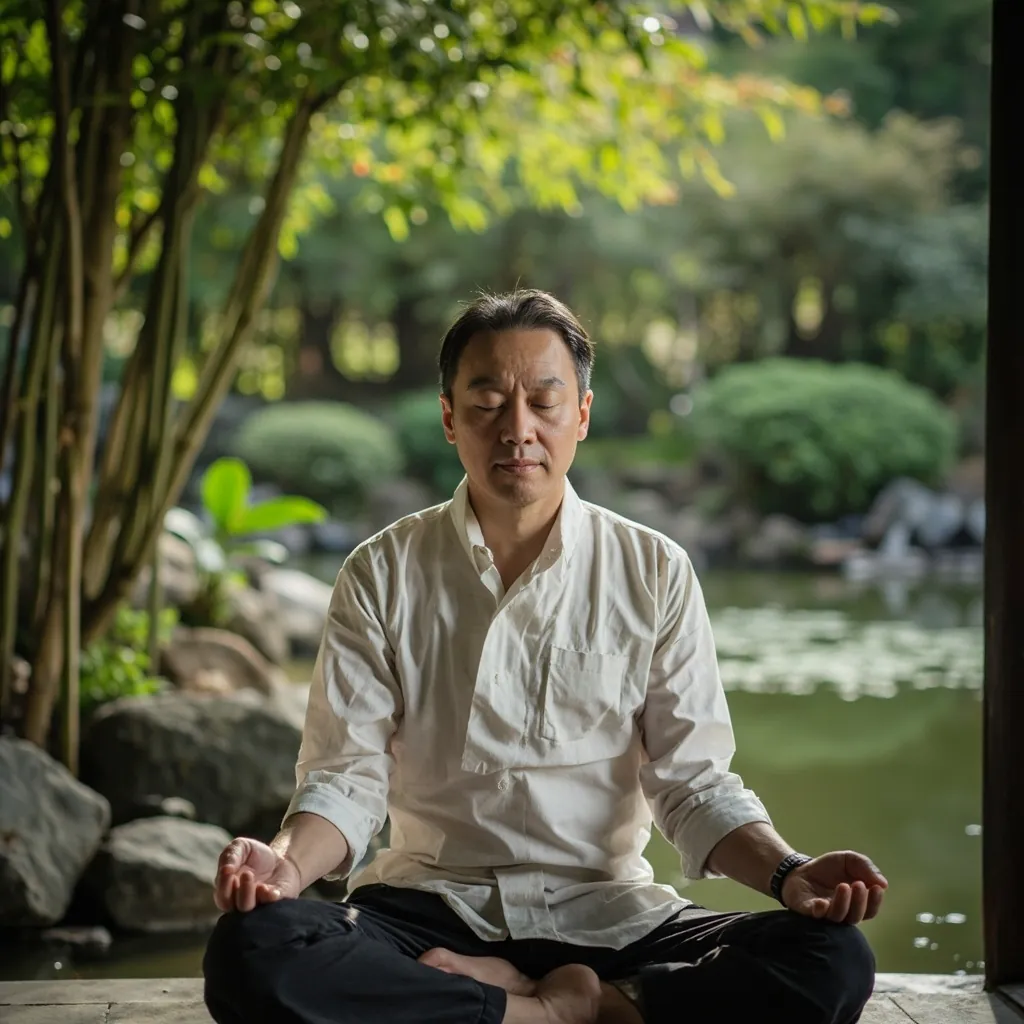
The basic practice of Chan meditation is deceptively simple. The meditator sits in a stable posture — traditionally the lotus or half-lotus position, though any dignified seated position works — and focuses attention on the breath or on a specific point, such as the lower abdomen or the huatou (a phrase or question used for contemplation). When thoughts arise, as they inevitably do, the practitioner doesn’t struggle against them or become absorbed in them but simply returns attention to the meditation object.
This sounds straightforward but proves profoundly challenging in practice. Most people discover within minutes that the mind has its own agenda, churning out plans, worries, memories, and random associations with relentless energy. The practice isn’t about stopping thoughts — that’s essentially impossible — but about changing one’s relationship to them. The meditator learns to observe thoughts arising and passing without being carried away by them, maintaining a background of open, stable awareness.
The concept of “wu wei” — often translated as “non-action” or “effortless effort” — plays a crucial role in Chan practice. This doesn’t mean being passive or doing nothing but rather describes a quality of action that emerges naturally when one stops forcing and struggling. The Chan meditator seeks to settle into meditation like water finding its level — not through struggle but through the natural release of tension and effort.
Over time, regular Chan meditation practice often produces a quality of mind that extends beyond the meditation session itself. Practitioners frequently report increased clarity, reduced reactivity to stress, and a greater sense of presence in daily activities. These aren’t mystical achievements but natural consequences of training attention and developing equanimity.
Qigong and Breathing Exercises: Movement as Meditation
Chinese meditation tradition extends far beyond seated practice. Qigong, which literally means “energy work,” encompasses a vast array of exercises combining movement, breathing, and visualization. While some qigong forms are quite simple and accessible, others are elaborate practices that take years to master.
The fundamental principle underlying all qigong is the cultivation and circulation of qi through the body’s meridian system. Unlike Western approaches that tend to treat the body mechanistically — as if it were essentially a biological machine — Chinese medicine and qigong understand the body as a living system animated by energy. When this energy flows smoothly, health results. When it becomes blocked or depleted, illness follows. Qigong practice aims to maintain the free flow of qi and prevent the patterns of blockage that lead to disease.
The most accessible qigong practices involve simple standing meditation, gentle movements, and conscious breathing. Standing meditation, known as “zhan zhuang” or “standing pole,” might look deceptively simple — the practitioner stands with bent knees and arms held in various positions while breathing naturally and directing attention inward. Yet this practice can be surprisingly challenging, and even a few minutes of proper standing can leave muscles trembling and sweat breaking out. The point isn’t to strain but to find the balance between relaxation and engagement, releasing unnecessary tension while maintaining structural integrity.
Breathing exercises, called “tuna” in Chinese, form another foundation of Chinese meditation. Most people breathe shallowly, using only the upper chest, which limits oxygen intake and fails to massage the internal organs. Chinese breathing exercises teach practitioners to breathe deeply into the lower abdomen, allowing the diaphragm to descend fully and the lungs to expand completely. This “abdominal breathing” or “belly breathing” forms the basis of virtually all Chinese meditation and martial arts practices.
The integration of movement and meditation in qigong offers something that seated practice alone cannot. Moving meditation helps release physical tension that sitting still can lock in place. The rhythm of movement gives the mind something concrete to focus on, making it easier to maintain awareness. And the cultivation of “song” — a quality of relaxed looseness in the muscles and joints — carries over into seated practice, making it easier to sit comfortably for extended periods.
The Science of Chinese Meditation: What Modern Research Reveals
One of the most fascinating developments in the study of Chinese meditation has been the application of modern scientific methods to understand what actually happens in the brain and body during practice. This research has validated many traditional claims while also revealing aspects of these practices that even their ancient practitioners might not have suspected.
Studies using functional magnetic resonance imaging (fMRI) have shown that different types of Chinese meditation activate distinct brain regions. Chan-style meditation, which emphasizes open awareness, produces increased activity in areas associated with attention control and emotional regulation. Daoist inner cultivation practices seem to engage different neural pathways, possibly related to the visualization and energy circulation components of those techniques. This suggests that the traditional distinction between different meditation types isn’t merely philosophical but reflects real differences in how the practices affect the nervous system.
Research on qigong practitioners has revealed measurable effects on various physiological parameters. Regular qigong practice has been associated with reduced blood pressure, improved immune function, better balance and coordination, and decreased levels of stress hormones. While some of these findings need replication in larger studies, the pattern of evidence suggests that qigong practices produce genuine health benefits rather than merely placebo effects.
Perhaps most intriguing are studies examining the long-term effects of meditation on brain structure. Research has shown that people who meditate regularly tend to have thicker cortical tissue in brain regions associated with attention and sensory processing. This suggests that meditation doesn’t just change brain activity temporarily but actually reshapes neural architecture over time — the brain, like muscle, grows stronger with use.
The scientific study of meditation also raises interesting questions about the traditional concept of qi. While modern science has no framework for understanding energy in the way Chinese tradition describes it, some researchers have begun investigating whether practices like qigong might work by influencing the autonomic nervous system or other physiological mechanisms that Western medicine is only beginning to understand. The traditional concept of qi might be an intuitive map of real phenomena that science hasn’t yet fully characterized.
Bringing Chinese Meditation into Your Daily Life
You don’t need to become a monk or spend hours each day practicing to benefit from Chinese meditation techniques. Even a modest daily practice can produce noticeable improvements in stress levels, mental clarity, and physical well-being. The key is consistency — fifteen minutes of practice each day will serve you better than occasional marathon sessions.
For beginners, the most accessible entry point is probably abdominal breathing combined with seated meditation. Find a comfortable chair or cushion, sit with your spine reasonably straight but not rigid, and place one hand on your lower abdomen. Breathe naturally and observe how your belly rises and falls with each breath. Try to deepen and slow your breathing slightly, keeping the exhalation smooth and unhurried. After a few minutes of this, let the hand rest and continue breathing abdominally while simply sitting and observing your experience without trying to control anything.
If you prefer movement, try practicing a simple standing meditation for five to ten minutes daily. Stand with feet roughly shoulder-width apart, knees slightly bent, and arms held in front of your body in a comfortable position — many people find holding the arms like they are embracing a large tree works well. Relax into the position while breathing abdominally, feeling your feet connected to the ground and allowing any unnecessary tension to drain away.
The journey into Chinese meditation is ultimately a journey of self-discovery. The practices will show you aspects of your own mind and body that you never knew existed. They will challenge your assumptions about what you are capable of and open doors to experiences that no words can adequately describe. Whether your interest is health, spiritual development, or simply finding a way to navigate modern life with less stress and more presence, Chinese meditation offers a time-tested path worth exploring.
Recommended Reading and Study Resources
Ready to deepen your practice or learn more about Chinese meditation? These resources offer valuable guidance:
“The Tao of Physics” by Fritjof Capra — Though not exclusively about Chinese meditation, this classic book explores fascinating parallels between Daoist philosophy and modern physics, offering a broader context for understanding Chinese contemplative traditions.
“The Dao of Medicine” translated by Liu Tianham — An accessible introduction to the foundations of Daoist health practices and their philosophical underpinnings.
“Qigong for Health and Martial Arts” DVD series — Step-by-step instruction in fundamental qigong exercises suitable for beginners, with demonstrations by experienced practitioners.
Affiliate Product Recommendations
Looking to establish or enhance your personal meditation practice? These products can support your journey:
Premium Meditation Cushion - Traditional Buckwheat Hull Fill — A well-designed zafu-style cushion that provides proper support for seated meditation practice. The buckwheat hull fill conforms to your body while maintaining the firm support needed for comfortable extended sitting. Essential for anyone serious about establishing a daily meditation routine.
Professional Qigong Training Video Course — A comprehensive video series taught by master instructor Lee Hui, covering foundational standing meditation, basic qigong movements, and breathing exercises. Over 8 hours of content suitable for all levels from complete beginner to advanced practitioner.
TaoTao Essentials Essential Oil Blend for Meditation — A carefully formulated blend of sandalwood, frankincense, and amber designed to create a contemplative atmosphere. The subtle, grounding scent supports meditation practice and can be diffused during practice or applied topically in diluted form.
Five Elements Acupuncture Model Set — A beautiful decorative and educational model depicting the five elements (wood, fire, earth, metal, water) and their relationships in Chinese medicine and Daoist cosmology. Makes an inspiring addition to any meditation space while serving as a learning tool for understanding traditional Chinese concepts.
Digital Qi Gong Course - Twelve Healing Exercises — An online course teaching the “Twelve Piece Brocade” (Shi Er Duan Jin), a classic set of qigong exercises developed centuries ago for health maintenance and spiritual development. Includes detailed video instruction, printable reference guides, and community access for questions and feedback.
This article is part of our ongoing exploration of Chinese cultural traditions and their applications in modern life.