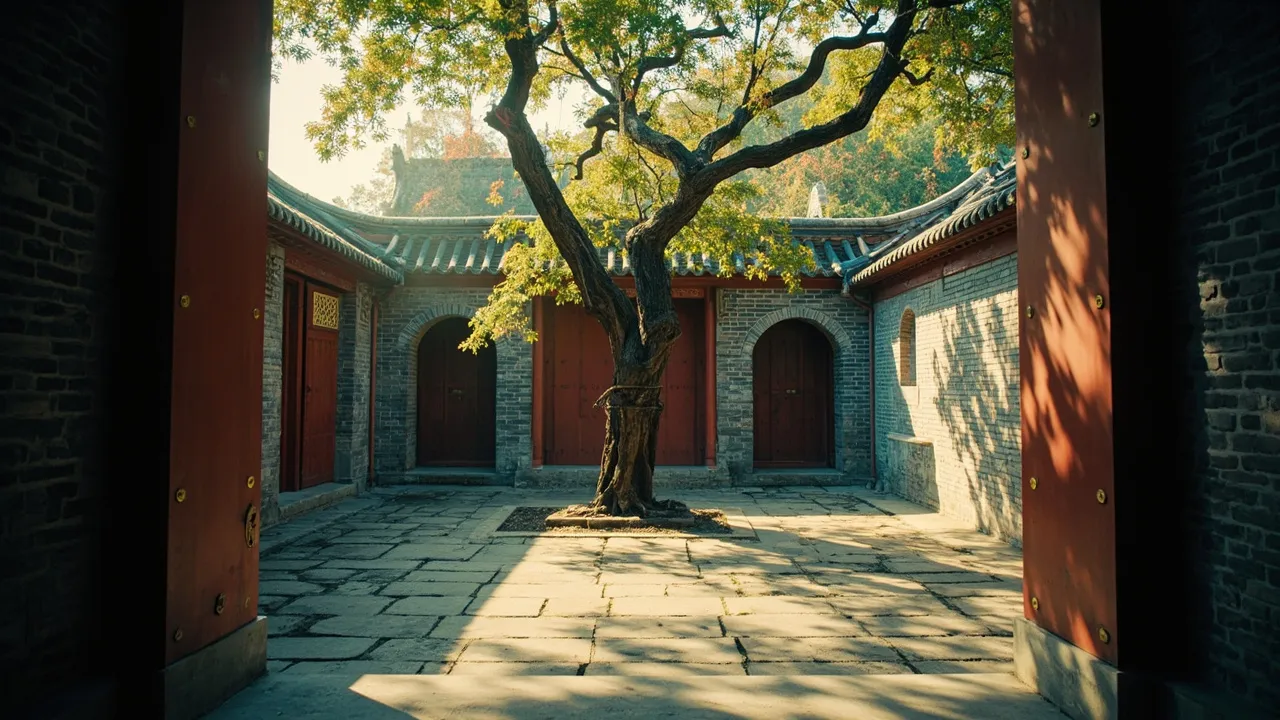
The first time I saw a Miao woman in full festival dress, I did not realize I was looking at her biography. She was standing in a courtyard in Guizhou Province, in southern China, and the silver headdress she wore must have weighed somewhere between five and eight kilograms. I know this because, while we were talking, she shifted her weight to rest her neck, which is what women in heavy Miao headdresses do after standing for a while. The silver did not move. It was bolted to her hair, essentially. The dress she wore below the headdress was embroidered in blue and purple wax-resist patterns. The chest plate over her heart was a flat silver panel the size of a small cutting board, hung on a chain around her neck. She had silver bracelets up both forearms, silver earrings that hung to her collarbones, and a belt buckle the size of my palm.
None of this was decoration in the sense that Western readers usually mean the word. It was information. She was from a particular village, in a particular sub-clan, married to a particular family, of a particular generation, with a particular status in her community. Every piece of silver on her body was a sentence in a language that her people had been writing, in metal, for a thousand years.
The Miao and Where They Live
The Miao (苗族) are one of the largest ethnic minority groups in China, with a population today of roughly nine million. They are not a single culture but a federation of related sub-groups, each with distinct dialects, dress, and silver patterns. What unifies them is a shared origin story, a shared identification as “Miao,” and the practice of wearing elaborate silver costumes for festivals and ceremonies.
The geographic center of Miao culture is Guizhou Province (贵州), in the mountainous southwest of China. About half of all Miao people in China live in Guizhou, and the largest single Miao settlement is Xijiang Qianhu Miao Village (西江千户苗寨), in Leishan County. “Qianhu” means “a thousand households” and it is roughly accurate — Xijiang has about thirteen hundred Miao families, living in traditional stilted wooden houses that climb the hillsides above a small river. The visual effect, especially at dusk when the lights come on in every house, is one of the more striking urban landscapes in China, and it is the closest you can get to seeing what a complete traditional Miao community looks like in the twenty-first century.
Smaller Miao populations also live in Hunan, Yunnan, Guangxi, and Hainan, as well as in Vietnam, Laos, Thailand, and the United States (a small diaspora). The silver tradition I am describing here is strongest in Guizhou and the immediately adjacent parts of Hunan, and the heaviest, most elaborate headdresses are typically those of the Guizhou highland subgroups.
Why Silver, and Why on the Body
The reason silver is so central to Miao identity is the most important fact about Miao culture that almost no English-language source emphasizes, and it is this: the Miao traditionally had no written language.
There is no Miao script in the same sense that there is Chinese, Tibetan, or Mongolian script. Miao languages exist — several of them — and they have been written using Chinese characters or, more recently, Latin alphabets developed by Christian missionaries in the early twentieth century. But the Miao people themselves did not, for most of their history, have a writing system of their own. Their history, their clan lineages, their family genealogies, their village affiliations, and their accumulated cultural knowledge were not written down. They were worn.
Silver was the writing material. The Miao woman I described above was, in a real sense, displaying her family’s archive on her body. The headdress style — phoenix crown, butterfly, ox horn, cicada — identifies her sub-clan and her village. The chest plate design carries motifs that her family has used for generations. The earrings, the belt buckle, the back ornaments, the bracelets: each one tells a piece of the story that, in another culture, would be written on paper and stored in a wooden chest. The Miao chest was the human body. The paper was silver.
There is a second reason silver matters, and it has to do with the Miao cosmology. The Miao, like several other southwest Chinese minorities, traditionally worshipped the sun. Silver is the color of the sun. Wearing silver was, in religious terms, wearing the light of the sky on your body. There is also a protective function. Miao silver is believed to ward off evil spirits, prevent disease, and bring luck to a marriage. A bride wearing eight kilograms of silver on her wedding day is not making a fashion statement. She is sealing a spiritual contract.
The Headdress and What the Patterns Mean
The Miao headdress is the single most recognizable piece of Miao silverwork. There are several major styles, distinguished by their dominant motif.
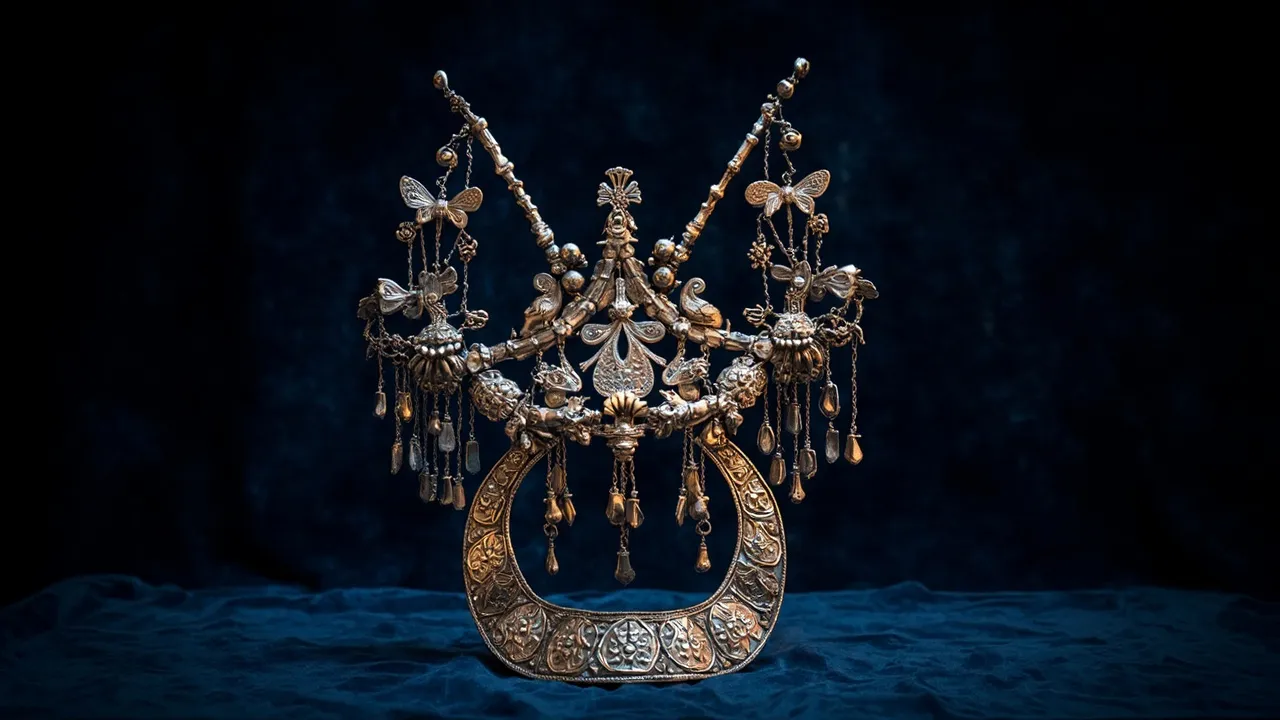
The phoenix crown (凤冠) is the most formal. Worn by brides and by women of high status in certain Miao subgroups, the phoenix crown is a tall, branching structure of silver, often with a phoenix figure at its center, wings spread, perched on a stylized mountain. Smaller silver flowers, birds, and dragons hang from the crown on thin chains, and these catch the light and produce a soft chime when the wearer moves. A particularly elaborate phoenix crown might rise a foot above the head.
The butterfly pattern (蝴蝶纹) refers to the founding myth of one of the major Miao subgroups. According to this tradition, the Miao ancestor was born from a butterfly — the egg of a butterfly, hatched by a bird, mothered by a water spirit. Butterfly motifs in Miao silver, embroidery, and weaving all reference this origin story. A butterfly-pattern headdress is, in effect, a tribal emblem.
The cicada pattern (蝉纹) is one of the most ancient. Cicadas in Chinese culture generally symbolize rebirth, because they emerge from the ground after years underground. Miao cicada-pattern silver tends to use the insect’s body as a central decorative element, often paired with cloud motifs.
The ox horn comb (牛角梳) is named for its shape, which resembles the curved horns of a water buffalo. It is associated with Miao sub-groups whose history involved cattle-raising in the high pastures of the Guizhou mountains. The ox horn comb is more compact than the phoenix crown and is often worn by women who work in the fields.
The weight of these headdresses is not a small thing. A full phoenix crown can weigh five to eight kilograms, and women who wear them regularly develop noticeable neck muscles. During major festivals — Miao New Year in particular — women wear their heaviest silver for hours at a time. There is a particular posture that experienced Miao silver-wearers adopt, with the chin slightly tucked to balance the weight, that you can recognize at a distance.
The Full Silver Costume
The headdress is just one element. A complete Miao festival outfit includes silver across most of the body. The chest plate (胸饰) is a flat silver panel that hangs on the chest, often carved with dragons, flowers, or family emblems. The earrings are typically long and pendant-shaped, sometimes extending to the collarbones. The necklaces are multiple strands of silver beads. The bracelets are heavy and frequently paired — sometimes four or five on each arm. The belt buckle is a substantial piece, often with a central animal motif. The back ornaments (背饰) hang from the back of the neck and drape down the back, producing the soft chime sound when the wearer moves.
Putting on a full Miao festival outfit takes time, and it takes help. The pieces are heavy, and many of them attach to the hair or the clothing in ways that require another pair of hands. Festival days are also social events, and the dressing is part of the social ritual. Mothers help daughters dress. Older women help younger women. The clothes connect the wearer not just to her own family but to a chain of women who wore the same kinds of silver before her.
Inside the Workshop
The silversmithing itself is done by hand, in small workshops, often in the Miao villages themselves. The silver is melted from ingots (modern workshops use refined silver bars; older workshops used silver coins, broken silver, and recovered family silver), poured into molds or hammered while hot into sheets and wire, and then cut, shaped, and joined by hand. The joining technique is a careful one: silversmiths use a silver solder with a slightly lower melting point than the base silver, so that pieces can be joined without melting the original work. This is distinct from the cheaper lead-soldered silver tourist pieces, which can be identified by their duller color and softer metal.
The decorative patterns — phoenix, butterfly, dragon, flower, cloud — are chased into the silver with small hammers and chisels. The most skilled silversmiths in Guizhou can spend weeks on a single phoenix crown. A workshop in Xijiang might employ five or six silversmiths, with the senior craftsperson doing the most delicate work and the apprentices handling the heavier hammering and polishing.
The Miao silversmithing tradition is recognized as Intangible Cultural Heritage by the Chinese government, which has helped protect it from being displaced by mass-produced factory silver. It has also created a two-tier market: authentic handmade Miao silver for the cultural market, and cheaper factory-made imitations for tourists. The real thing is heavier, more detailed, and significantly more expensive.
Xijiang Today
Xijiang Qianhu Miao Village is now a major tourist destination, with daily bus arrivals from Guiyang, the provincial capital of Guizhou. The village has adjusted to the visitors by adding restaurants, hotels, and performance venues. There are daily Miao song and dance performances. There are silver shops selling both authentic handmade pieces and factory imitations. There are also genuine Miao families still living in the village, raising children, working in the fields, and observing the same festival cycles their ancestors observed.
What Xijiang is not, is a museum. It is a working community, and it is one of the best places in China to see how an ethnic minority tradition survives contact with the modern Chinese economy. The silver tradition is still alive. It is also being adapted — younger Miao women sometimes wear smaller silver pieces for daily use and reserve the full heavy costume for festivals. The headdresses are still handmade. The patterns still mean what they have always meant. The butterflies, the phoenixes, the cicadas still carry the founding myths of a people who, for a thousand years, wrote their history on the human body.
A Short Note on Buying Miao Silver
If you travel to Guizhou and consider buying a piece of Miao silver to take home, a few practical points are worth knowing. First, real handmade Miao silver is heavy for its size — a phoenix crown that looks manageable in the shop will weigh your arm down within minutes. The weight is a clue. Mass-produced imitations use thinner gauge silver and tend to feel light.
Second, the metal should ring. Real silver at 99% purity produces a clear, sustained bell-like tone when tapped. Lead-soldered tourist pieces produce a dull thud. Ask the seller to let you tap two pieces together and listen.
Third, the price tells you something. A genuine handmade Miao silver necklace or bracelet in 2026 typically runs from $80 for a simple piece to several hundred dollars for substantial work. Anything significantly cheaper is almost certainly factory-made, regardless of what the label says. Many reputable workshops in Xijiang will put a small maker’s mark on the inside of the piece and provide a certificate of authenticity.
Fourth, if you cannot tell, buy smaller items — earrings, pendants, hairpins — where the difference between authentic and imitation is harder to spot and the financial risk is lower. The phoenix crowns and full headdresses belong on Miao heads, not in tourist suitcases.
Recommended Products
- [miao-silver-replica]: Miao Silver Replica Headdress — Hand-crafted miniature replica of traditional Miao phoenix crown headdress
- [guizhou-travel-guide]: Guizhou Travel Guide — Comprehensive guide to Miao villages including Xijiang Qianhu
- [chinese-ethnic-art-book]: Chinese Ethnic Minority Arts Book — Visual survey of Miao, Dong, Yi, Zhuang traditional crafts
- [silver-jewelry-cleaning-kit]: Silver Jewelry Cleaning Kit — Polishing cloth and gentle cleaner for silver jewelry care
Disclosure
Some links above are affiliate links. We earn a small commission if you purchase through these links, at no extra cost to you. We only recommend products we genuinely believe enhance your understanding of Chinese culture.