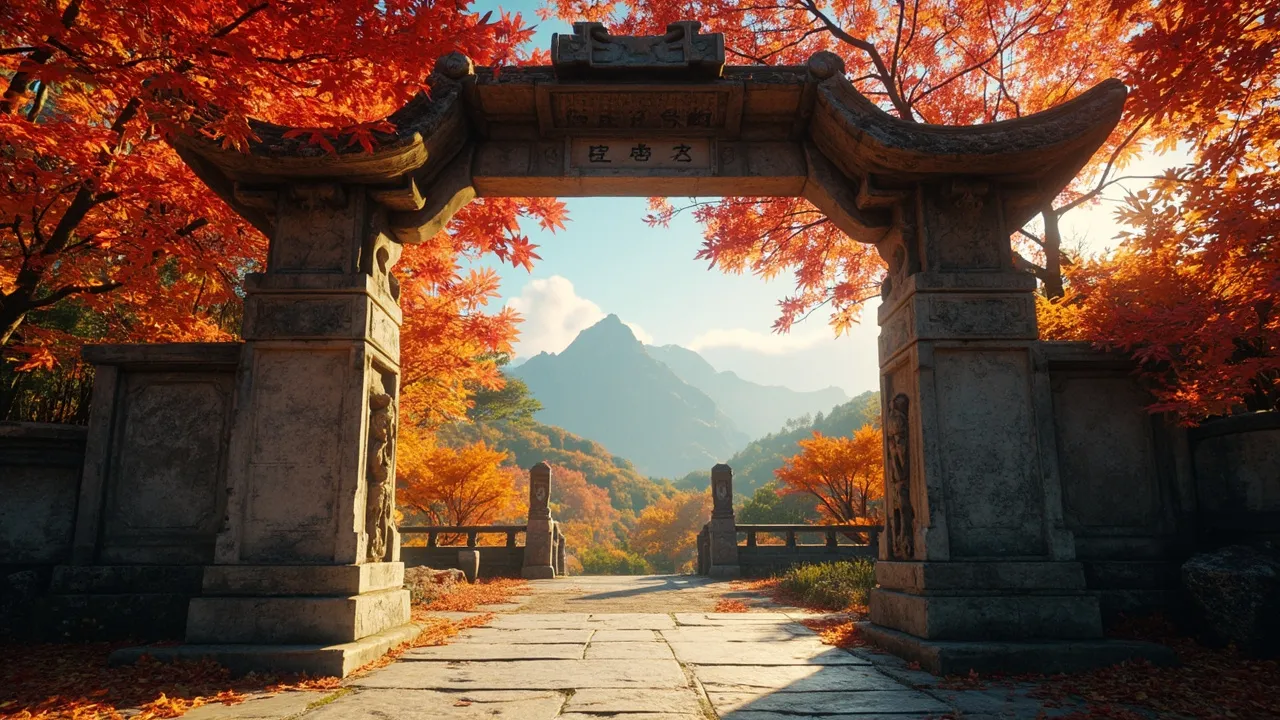
If you have read the recent pieces on Mount Tai and Mount Hua — the Eastern and Western Sacred Mountains of China — you know that those two mountains are almost comically different from each other. Mount Tai is a stately, processional climb where emperors went to confirm their right to rule. Mount Hua is a granite fist that wants to throw you off a cliff. What you may not know is that there is a third mountain in this series, the Southern Sacred Peak, which is neither of those things. Mount Heng — Hengshan — is gentler, greener, more religiously diverse, and historically a place where warriors trained rather than died heroically.
It is also the one most likely to be confused with another mountain. And not by Western tourists — by everyone, including Chinese readers on auto-translate. There are two Mount Hengs in China, and they are completely different. The one this article is about is written as Hengshan in pinyin, with the character 衡 (meaning “balance scale”), and it sits in Hunan Province in south-central China. The other one — Hengshan in Shanxi Province, written with the character 恒 (meaning “constant”) — is the Northern Sacred Mountain. Pronunciation is identical. The characters are not. I will note this distinction again, because it is the single most common way people get confused about the Five Sacred Mountains.
Where the Geese Stop
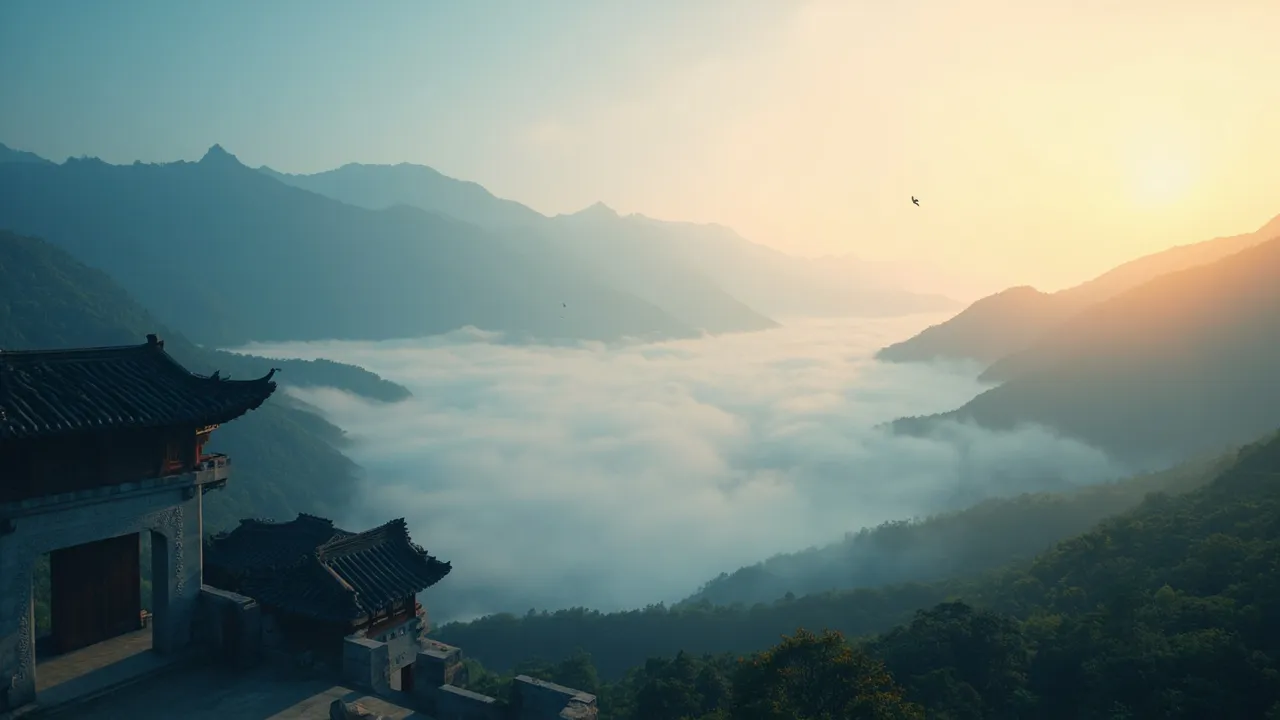
Mount Heng sits about 110 kilometers south of Changsha, the capital of Hunan. Its main ridge runs roughly east to west for about 32 kilometers, and within that ridge there are said to be 72 peaks. The highest, Zhu Rong Peak, reaches 1,300 meters — modest compared to Mount Tai’s 1,545 or Mount Hua’s 2,154. What distinguishes Hengshan is not altitude. It is that the mountain is covered in subtropical forest, shrouded in mist for around 250 days a year, and raked by the kind of rain that turns the entire range into a watercolor.
The character 衡, “balance,” gives the mountain its name. The southern foot of the range is the city of Hengyang, named for the same balance scale — and the city’s original name Yuyang refers to the wild geese (yu) that once stopped here on their way south. The mountain’s southernmost peak, Huiyan Peak — “Returning Goose Peak” — supposedly marks the spot where migrating geese hit the southern edge of the mountain range and turn back. This is what gives the mountain its position as the Southern Sacred Peak of the Five Mountains. The geese had to stop somewhere, and the Chinese canonical system decided it would be here.
What this means in practice is that Hengshan feels wetter, greener, and quieter than the northern sacred mountains. When you stand at Huiyan Peak in autumn and watch the geese turn back north, you understand why the southern traditions of Chinese religion — the more contemplative, less throne-oriented ones — settled here. The Northern mountains are harder. The Southern one is contemplative.
Two Religions Under One Roof
The most unusual thing about Mount Heng, from a religious history perspective, is that you do not have to choose between Buddhism and Taoism here. Most Chinese sacred mountains are dominated by one tradition. Mount Tai is Confucian and imperial. Mount Hua is aggressively Taoist. Mount Heng, by contrast, has spent the last fifteen centuries letting both traditions coexist, and the architectural proof of this is the Great Temple of Mount Heng — Nanyue Damiao — at the foot of the mountain in the town of Hengshan.
The Great Temple is one of the largest temple complexes in China, covering about 75,000 square meters, and it is roughly nine separate courtyards arranged along a north-south axis. What makes it remarkable is that the eastern half of the complex is a Buddhist monastery and the western half is a Taoist monastery, and the two share a single wall, a single gate, and a single entrance fee. You walk through one door and you can visit both. There are very few places in China where this is possible. Most temples are either one or the other. The Great Temple of Mount Heng is both, and the arrangement is not a recent compromise — it dates to at least the Tang Dynasty, with the current structure rebuilt during the Qing Dynasty in 1875.
In the eastern (Buddhist) half, the main hall is dedicated to the Buddha Vairocana, with eight stone-carved arhats flanking the altar. In the western (Taoist) half, the main hall is dedicated to the Jade Emperor. Both halves face the same central courtyard, and both have been tended by monks and priests continuously for centuries. The temple survived the Cultural Revolution — barely — and most of the statues you see today are recent restorations, but the architecture, the layout, and the dual tradition are original.
This is why Mount Heng is sometimes described as a meeting point of the two great Chinese religions. Most of the time, in most of China, Buddhism and Taoism coexisted politely but kept separate temples. Hengshan decided to put them in the same building.
The Peak With the Fire God’s Name
If you climb Hengshan — and the cable car from the town of Hengshan to the upper slopes only takes about eight minutes, so it is not the cardio event that Mount Tai is — the highest point you can reach is Zhu Rong Peak. At 1,300 meters, it is the highest summit in the Hengshan range, and it is named after Zhu Rong, the fire god of Chinese mythology.
Zhu Rong is one of the more interesting deities in the Chinese pantheon. In the oldest Chinese texts — the Shan Hai Jing, the Zuo Zhuan — he is depicted as a giant in red clothing, sometimes with a human face and a tiger’s body, who governs the south and the element of fire. He is, in some readings, the same figure as the Yan Emperor (Yan Di), one of the legendary founders of Chinese civilization. Putting a fire god on the highest peak of the southern sacred mountain is not accidental. The Chinese cosmogram associates south with fire, fire with the color red, and the south with summer. Hengshan is the southern peak. The fire god goes on top.
What makes Zhu Rong Peak historically significant is that emperors actually climbed it. The feng and shan ceremonies — the imperial rites of offering to heaven and earth on Mount Tai — were not exclusive to Mount Tai. By the time of the Han Dynasty, emperors were also performing variants of these rites at the other four sacred mountains, and Hengshan was the one for the south. The great Tang dynasty emperor Wu Zetian — the only woman to rule China under her own name — performed a sacred mountain ceremony at Hengshan in 690 CE, shortly after declaring herself emperor. The mountain has imperial inscriptions carved into its cliffs dating to that period, and the tradition of imperial pilgrimages continued, with long gaps, until the Ming Dynasty.
The climb from the upper cable car station to Zhu Rong Peak takes about 40 minutes on foot. At the summit, there is a small temple, a few modern pavilions, and on a clear day a view across the entire range to the Xiang River valley. More often, you will see clouds. Hengshan is famous for its clouds. The Chinese phrase “Hengshan clouds” has been used to describe dramatic, slow-moving mists since at least the Tang Dynasty.
The Southern Martial Arts School
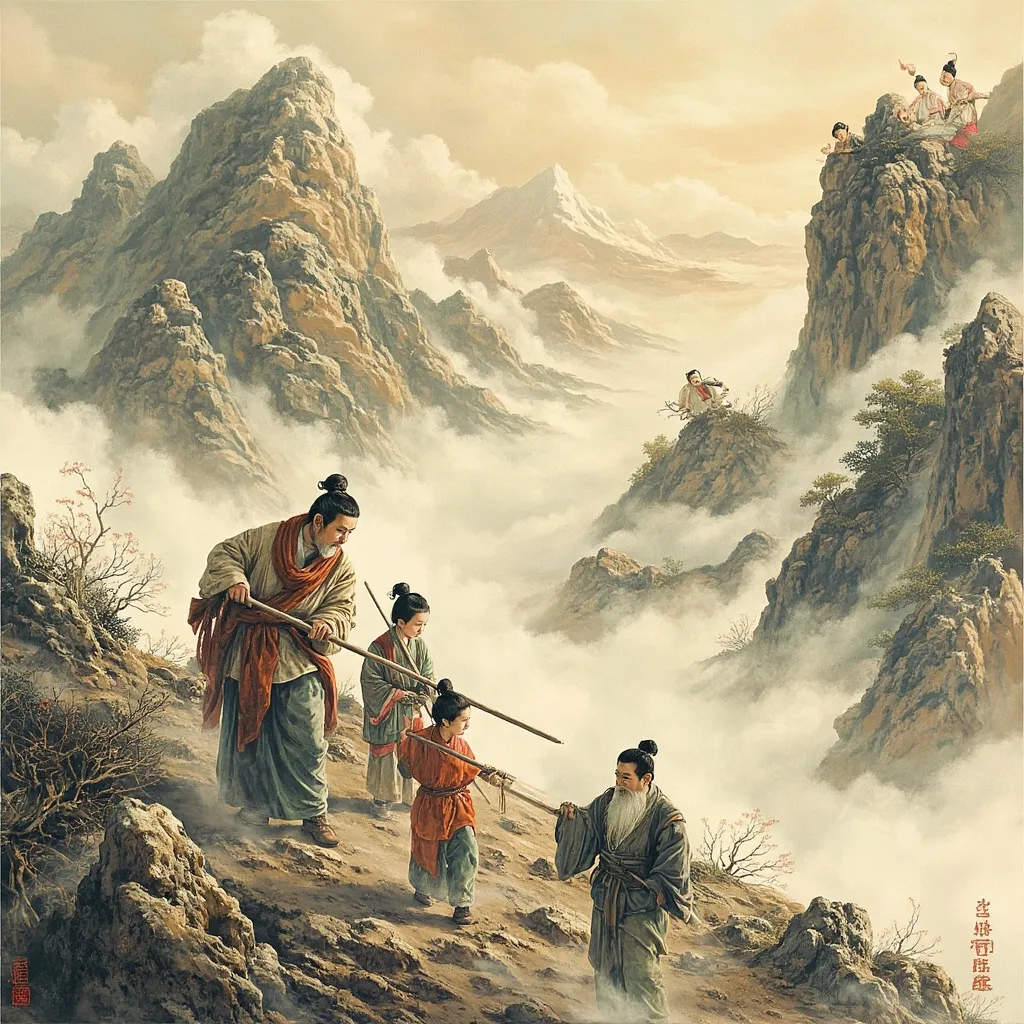
Here is the thing that surprised me when I first read about it: Mount Heng has a martial arts tradition, and it is not the same as Shaolin or Wudang. The Hengshan martial arts school — Hengshan pai — is one of the so-called “Seven Southern Families” of Chinese martial arts, and although it is far less famous than the two great northern schools, it is historically real.
The Hengshan school is sometimes grouped with the Wudang tradition because both emphasize internal cultivation, slow deliberate movements, and the use of qi (internal energy) alongside physical technique. The connection is real but not identical. Where Wudang martial arts tend to emphasize circular, flowing patterns rooted in Taoist philosophy, the Hengshan school is more pragmatic. It is not focused on mysticism. It is focused on fighting.
The signature technique of the Hengshan school is called wuhuduanmen — “Five Tigers Breaking the Door.” The name refers to a fighting pattern where the practitioner uses five strikes in rapid succession from five different angles, each named after a tiger (the lunging tiger, the crouching tiger, the leaping tiger, the turning tiger, the descending tiger). It sounds hokey when written out. It is, by accounts from practitioners, brutally effective at close range. The school also emphasizes short-range weapons — the single saber, the short staff, the iron fan — because much of its historical practice was in forest and mountain terrain where long weapons were impractical.
The Hengshan school is best known today through the novels of Jin Yong and Gu Long, the same writers who put Mount Hua and Wudang on the cultural map. In Jin Yong’s The Smiling, Proud Wanderer (Xiao Ao Jiang Hu), the Hengshan school appears as one of the “Five Mountains Sword Alliance” — a fictional coalition of five sword schools, one per sacred mountain, that includes Hengshan alongside Mount Tai, Mount Hua, Mount Heng (Shanxi), and Mount Song. The real historical Hengshan school never actually formed such an alliance, but the novels made the mountain a recognizable part of the martial arts imagination for several generations of Chinese readers.
If you visit Hengshan today, you will find active martial arts schools offering training in the Hengshan style. The martial arts tourism industry is smaller than Mount Hua’s, but it is there. You can train seriously, in a specific regional style, on a sacred mountain, in pretty much one place in the world.
The Poets Who Climbed Here
Hengshan has a strong literary tradition. The mountain is associated with two of the most important political poets of the Tang and Song dynasties.
Du Fu (712–770 CE), often considered the greatest Chinese poet of the Tang Dynasty, visited Hengshan during the An Lushan Rebellion, the catastrophic civil war that broke out in 755 CE. He was traveling south with his family, fleeing the rebel advance, and he passed through Hengshan on his way to what is now Hunan. His poem about the climb — climbing Hengshan in autumn — captures the experience of being a refugee on a sacred mountain:
“Autumn in the south, the Hengshan peaks, Three thousand li north, where is my home?”
The poem is brief, but the image is the point. Du Fu, mid-flight from a collapsing empire, on a mountain that emperors had climbed to perform rites, looking back toward a home he may never see again. The poem is famous in China. It is not as famous as his poem about Mount Tai, but it has the same quality of compression — a few lines that say a thousand things.
The other poet most associated with Hengshan is Wen Tianxiang (1236–1283), the Song Dynasty patriot and military commander who was captured by the Mongol Yuan armies and refused to defect. Wen Tianxiang is from Jiangxi, which is adjacent to Hunan, and Hengshan was a place he visited during his military campaigns against the Mongol invasion. His most famous poem is Passing Through Lingding, written while being transported under Mongol escort, but the Hengshan connection is preserved in another piece, the Song of Hengshan, which uses the mountain as a symbol of southern loyalty and resistance.
Wen Tianxiang’s appeal for later Chinese readers was not just his poetry. It was his refusal to collaborate. He was offered Yuan Dynasty positions, riches, even his life, and he refused. He was executed in 1283. The Ming Dynasty, which overthrew the Yuan in 1368, honored him as a national hero, and Mount Hengshan was one of the places where his loyalty was remembered in stone. There is a memorial pavilion near the summit of the Zhurong ridge walk, with Wen Tianxiang’s portrait and some of his verses inscribed.
This is the literary landscape of Hengshan. A mountain associated with imperial rites, with the fire god, with a regional martial arts tradition, and with two poets who represent the Confucian refusal to give up. The mountain is not just a place. It is a set of meanings.
Going There
Mount Heng is much easier to visit than Mount Tai or Mount Hua. The town of Hengshan is about 30 minutes by high-speed train from Changsha, and the high-speed train from Changsha to Guangzhou takes only two hours. The mountain is well-developed for tourism, with cable cars, paved paths, and a functional bus system. The rain and the mist are non-negotiable, but the elevation is manageable for most visitors.
The Great Temple is at the base and is free to enter. The cable car to the upper slopes is about 80 yuan. The full circuit on foot, including the climb to Zhu Rong Peak, takes about six to eight hours. Most visitors spend two days — one for the temple and lower slopes, one for the summit.
If you go, the best time is October or November. The summer is wet and the winter is cold with ice on the upper paths. Spring is beautiful but tourist-heavy. Autumn is the dry season, with the kind of clear, sharp weather that makes the sea of clouds visible from the summit.
Recommended Products
- [hengshan-travel-guide]: Hunan Mountain Travel Guide — https://www.amazon.com/dp/hengshan-travel-guide — Comprehensive guide to Hengshan region including access routes
- [chinese-mountain-painting]: Traditional Chinese Landscape Painting Scroll — https://www.amazon.com/dp/chinese-mountain-painting — Shan shui painting capturing misty southern peaks
- [buddhist-meditation-cushion]: Meditation Cushion Set — https://www.amazon.com/dp/buddhist-meditation-cushion — Round zafu cushion for Buddhist practice
- [chinese-tea-set-gongfu]: Gongfu Tea Set — https://www.amazon.com/dp/chinese-tea-set-gongfu — Yixing clay teapot + cups for traditional brewing
Disclosure
Some links above are affiliate links. We earn a small commission if you purchase through these links, at no extra cost to you. We only recommend products we genuinely believe enhance your understanding of Chinese culture.