- name: “365 Tao: Daily Meditations” url: “https://www.amazon.com/dp/0062502239" asin: “0062502239” description: “A year of daily Taoist meditations offering wisdom on living in flow, practicing wu wei, and finding harmony with the natural world.”
- name: “Secrets of Shaolin Martial Arts: A Textual Study” url: “https://www.amazon.com/dp/B0F6D1BWS4" asin: “B0F6D1BWS4” description: “A critical analysis of Shaolin martial arts history — reclaiming the legacy of China’s most iconic martial tradition through scholarly examination.”
- name: “From Shaolin to Wushu: Unveiling the Secrets and Spirituality of Chinese Martial Arts” url: “https://www.amazon.com/dp/B0CBP13FCZ" asin: “B0CBP13FCZ” description: “An exploration of the rich heritage, philosophy, and techniques of Chinese martial arts from Shaolin origins to modern wushu.”
- name: “Long Fist Kung Fu Mastery: The Secret Shaolin Speed & Power Training System” url: “https://www.amazon.com/dp/B0FG6WS9W4" asin: “B0FG6WS9W4” description: “A detailed guide to Long Fist (Changquan) Kung Fu — traditional Chinese martial art known for extended movements, speed, and dynamic techniques.”
- name: “Taoist Meditation: The Mao-shan Tradition of Great Purity” url: “https://www.amazon.com/dp/0791413608" asin: “0791413608” description: “A scholarly exploration of the Mao-shan Taoist meditation tradition — the spiritual lineage that shaped Mount Hua’s sacred status.”
The first time I read about the Plank Road in the Sky — changkong zhandai — I thought it was a mis-translation or maybe a metaphor. Three-meter-wide wooden planks, bolted directly into a granite cliff face at 2,000 meters above the valley floor, with a 1,000-meter drop below if you step wrong. A 15-minute walk with no harness. I have hiked a lot of mountains, and I have never wanted to do anything like this.
But people have been climbing Mount Hua — Huashan — specifically for the terror of it, for over two thousand years.
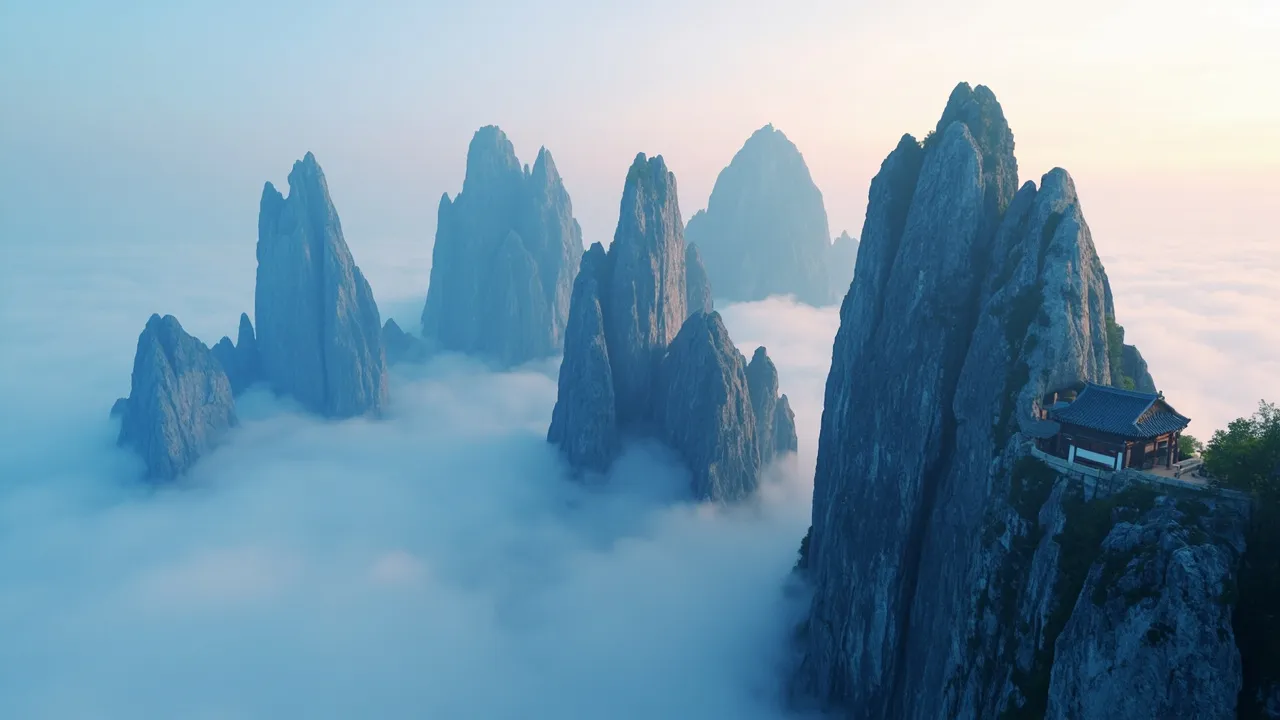
Mount Hua is the most physically extreme of China’s five sacred mountains. At 2,154 meters (about 7,000 feet), it is not the tallest. But it may be the most honest about what a mountain is. There are no gentle slopes here, no winding trails through alpine meadows. Granite cliffs rise almost vertically from the valley floor. The five peaks — North, South, East, West, and Center — are arranged around a central mass in a way that looks, from a distance, like a fist of stone punched up through the earth. The Chinese name hua means “splendid,” and the mountain fully earns it.
The Mountain That Almost Killed You
The geology of Mount Hua is a story about what happens when tectonic plates collide and nobody tells them to stop. The mountain is made almost entirely of granite — hard, ancient rock that fractured vertically as it was pushed upward, creating cliffs so steep that snow doesn’t accumulate on them in winter. It just slides off. The trails that exist today were carved by hand over centuries, and some of them are genuinely terrifying.
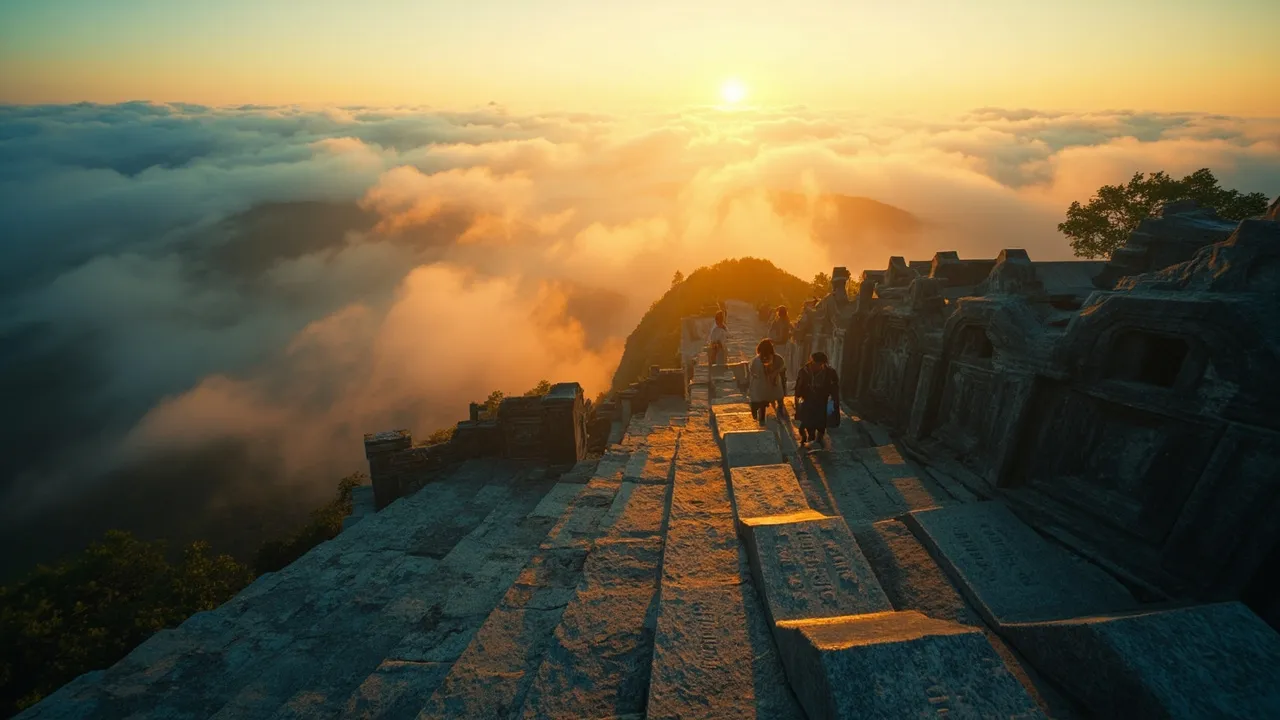
The most famous is the Plank Road. It extends about 11 meters across a cliff face, and the boards are not wide — you step on them, and you can see the rock wall on one side and the sky and the valley on the other. The original planks are gone (replaced periodically for obvious reasons), but the iron brackets driven into the cliff are old. People have been walking this route since at least the Tang Dynasty (618–907 CE), which means it has been terrifying travelers for roughly fourteen centuries.
Then there is the Blue Dragon Ridge — canglong ling — a 1-kilometer ridge that connects the East and South peaks, narrowing to about one meter wide at its most extreme. You walk along the spine of a dragon, essentially, with nothing on either side but air. The ridge is named for the dark green color of the pine trees growing in the crevices below, which from a distance give the ridge the appearance of a dragon’s back. I find it reassuring that the Chinese named this place after a mythological creature rather than, say, “the place we go to reconsider our life choices.”
Mount Hua is in Huayin County, Shaanxi Province, about 120 kilometers east of Xi’an. If you visit Xi’an to see the Terracotta Warriors — which you should — you can reach Mount Hua by train in about an hour. Most visitors today take the cable car to the North Peak, which ascends 1,000 meters in 20 minutes. The cable car is a reasonable choice. I say this without judgment. The mountain will still be there when you get off.
The Taoist Alternative to Imperial Power
Here is what strikes me most about Mount Hua: it is not Mount Tai. The Fengshan ceremony at Mount Tai was about imperial power — emperors climbing to prove they had heaven’s blessing. Mount Hua had nothing to do with that tradition. Instead, Taoist monks claimed it.
Taoism is the indigenous spiritual tradition of China, distinct from Buddhism (which arrived from India) and Confucianism (which is really a philosophy of governance). Taoists believed that the path to immortality — or at least to extraordinary longevity — lay in separating yourself from ordinary human society and living in places where the boundary between the human world and the spirit world was thin. Dangerous, high, remote mountains were exactly those places. The higher you climbed, the closer you were to the heavens.
Mount Hua became the spiritual home of the Taoist tradition. By the Han Dynasty (206 BCE), monks were living on its slopes permanently. They built temples into the cliff faces. They dug grottoes. They sat in meditation for years at a time, occasionally emerging to terrify pilgrims with their long beards and wild eyes. The mountain has more than 20 temples and shrines today, most of them dating to different periods of construction, all of them oriented around the idea that this specific mountain is a shortcut to something beyond the material world.
The Great Emperor of the Western Peak — xiyue huashan shen — is the mountain’s presiding deity in the Taoist pantheon. The Western Peak (the South, East, and West peaks are the main ones for spiritual climbing) is considered his domain. Taoist monks who achieved what they considered spiritual breakthroughs on Mount Hua were said to have “ascended” — their physical bodies transmuted into something lighter, their spirits freed. Whether you believe this or not, the cultural weight of the claim tells you something important about how Chinese people understood the relationship between physical exertion, extreme landscape, and personal transformation.
Swords, Sects, and the Martial Arts Fantasy
Mount Hua is also where the martial arts live in the Chinese imagination. Not real martial arts, exactly — or not only real martial arts — but the version of martial arts that became the stuff of legend, then fiction, then cinema.
The Huashan martial arts tradition is historically real. Various fighting schools were based in the region, and Chinese martial arts do have a real connection to Taoist physical practices — breathing exercises, standing meditations, movements designed to cultivate qi (vital energy). The Huashan school of internal alchemy (neidan) was a real Taoist tradition that combined physical practice with spiritual cultivation. Whether or not any individual ever achieved immortality on the mountain, the tradition produced genuinely fit, genuinely dangerous people who knew how to fight.
But the really significant cultural role Mount Hua plays is in martial arts fiction. Jin Yong’s novel The Return of the Condor Heroes (Shediao Yingxiong Zhuan), published in 1957, made Mount Hua a pilgrimage site for a generation of Chinese readers. In the novel, the great martial arts masters of the Jin Dynasty gather at Mount Hua to settle disputes, form alliances, and demonstrate their prowess. The mountain becomes the center of the martial arts world — literally, because it is geographically central to ancient China, and figuratively, because it is where the best fighters want to be.
Jin Yong’s novels have sold over 100 million copies in Chinese. His fans — and there are millions of them, across multiple generations — know Mount Hua as the place where their heroes trained, fought, and proved themselves. When Chinese tourists visit the mountain today, many of them are walking in the footsteps of characters from fiction. This is not unusual in China — the lines between history, legend, and literature are always blurred — but with Mount Hua it is particularly pronounced. The mountain is both genuinely dangerous and mythologized beyond recognition, and it is hard to know which layer to credit.
Modern wushu schools still operate on Mount Hua. You can go there and train, if you want. The martial arts tourism industry is significant. I have no personal desire to get into a fight on a mountain peak, but I understand the appeal of training somewhere that takes itself that seriously.
The Pilgrimage Routes and the People Who Still Climb
Getting up Mount Hua is now a matter of choices. There are four main routes to the summit, and three of them involve cable cars. The North Peak cable car, built in 2013, ascends 1,000 meters in 20 minutes and delivers you to a fairly developed peak with a hotel, restaurants, and a gift shop. This is not cheating — it is how most people experience the mountain now, and it is still impressive.
The ancient path is still there, for those who want it. It takes most people five to seven hours to climb from the base to the South Peak, and the route includes the Blue Dragon Ridge, the Plank Road, and several other sections that I would describe as “character building.” The stairs are uneven, the handrails are occasionally decorative, and the elevation means you are genuinelywinded by the time you reach the top. This is the route that was there before the cable cars, and it is still the route that serious hikers talk about with a mixture of enthusiasm and post-traumatic fondness.
At Gold Lock Pass — jinsuo guan — couples have been leaving padlocks on the railings for centuries, turning the keys in the locks, and throwing the keys into the abyss below to symbolize eternal commitment. There are thousands of locks on the pass now, a rusted, clanking record of romantic promises made at the edge of nothing. The sight is strange and oddly moving. What are all those locks compared to a thousand-meter drop? They are, apparently, more permanent.
About 1.5 million people visit Mount Hua each year. That is a fraction of Mount Tai’s 5 million, which makes sense — Mount Hua requires something from you that Mount Tai does not. You can ride a cable car to the top of Mount Tai and feel that you have been there. Mount Hua resists that feeling. The mountain seems to be saying: you can come, but you will have to deal with the consequences.
Why Mount Hua Still Matters
Taoism is having a cultural moment, in a sense. Western interest in Taoist practices — mindfulness, meditation, breathing exercises — has grown significantly in the last twenty years, and the popular image of the Taoist hermit on the mountain is part of that cultural package. Mount Hua is where the hermits actually were.
But I think the mountain’s real appeal is simpler than any spiritual framework. It is a place where the natural world is unambiguously in charge. The cliff does not care about your schedule, your fears, or your fitness level. The mountain is what it is. If you climb it, you find out something about yourself — usually something uncomfortable. This is not a new discovery. The Taoist monks who went up and did not come down were not doing it for the views. They were doing it because the mountain offered something that ordinary life could not: a clean, simple conversation with reality at altitude.
The cable car is a reasonable modern response to this challenge. So is the lock on the railing. But underneath all of that, the mountain is still there, still steep, still granitic and ancient and indifferent. If you want to know what that feels like, Mount Hua is still the place to go.