If you know anything about Mount Song, it is almost certainly that the Shaolin Temple sits somewhere on it. That is fair. The Shaolin Temple is one of the most famous monasteries in the world, and its connection to Mount Song — specifically to the Lesser Chamber Peak (Shaoshi Shan) — is the only reason most Western readers have ever heard of the mountain at all. But if you stop there, you will have missed the more interesting fact, which is that Mount Song is the only one of the Five Sacred Mountains where three entire religions built their main institutions within walking distance of each other and stayed there for more than a thousand years.
Buddhism built Shaolin on the Lesser Chamber Peak. Taoism built the Zhongyue Temple in the foothills below. Confucianism built the Songyang Academy on the same mountain, a little higher up. They did this not as a compromise, not as a museum display, but as a working arrangement that survived dynastic collapses, foreign invasions, civil wars, and the slow grinding of centuries. There are temples in China where Buddhists and Taoists share a complex. There are sites where Confucians and Buddhists have competed. I do not think there is another mountain where all three traditions built something permanent and stayed.
So this article is about that. It is about Mount Song as a mountain — a real one, with peaks and rivers and weather — and as a piece of Chinese religious and intellectual history where the geography was unusually kind to cooperation. I will come to Shaolin, but I want you to meet the academy and the Taoist temple first. They are older than Shaolin’s kung fu reputation, and they do not usually get their turn.
Two Peaks, One Mountain
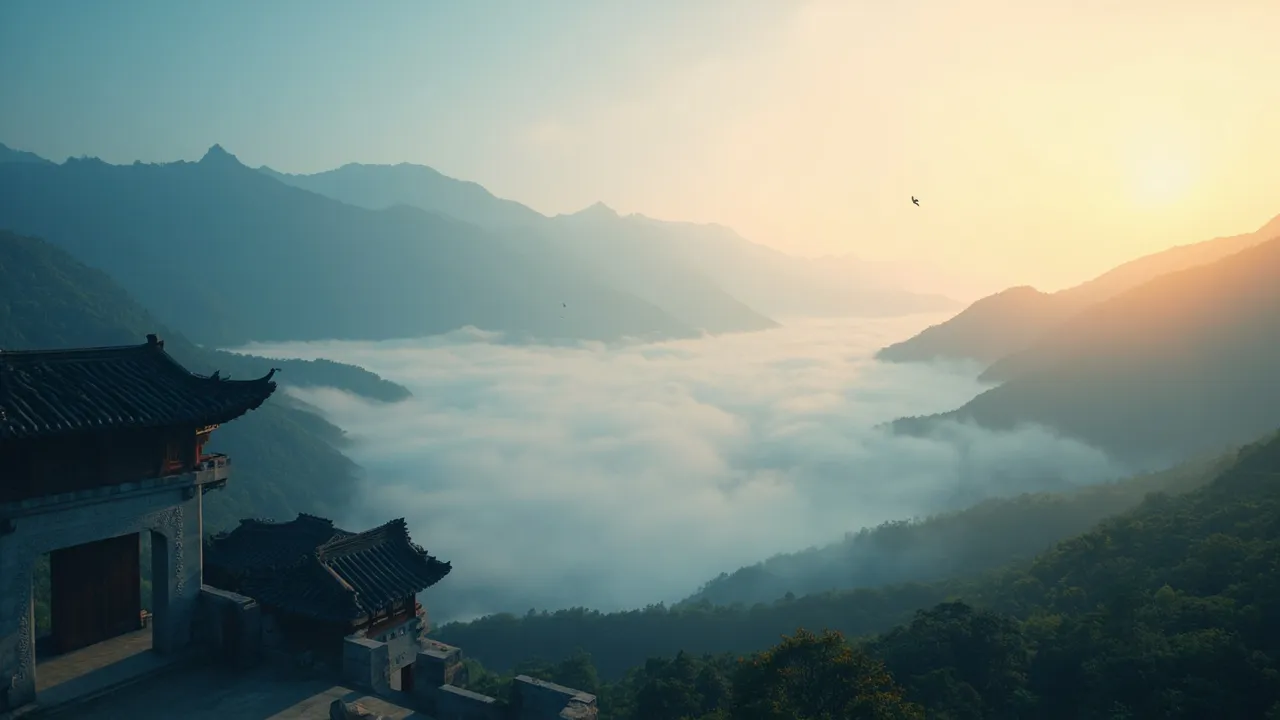
Mount Song (Songshan) sits about seventy kilometers west of Zhengzhou, in the middle of Henan Province. It is not the highest of the Five Sacred Mountains — that distinction belongs to Mount Hua in Shaanxi — but it is the most politically central. Its title, the Central Sacred Mountain (Zhongyue), comes from the fact that it sits at the geographic heart of old China. When emperors performed the imperial sacrifices to the Five Sacred Mountains, Mount Song was the one they were technically closest to.
The mountain is not really one peak. It is a range of seventy-two named peaks running roughly east to west, and the two most important are the Greater Chamber Peak (Taishi Shan) on the east and the Lesser Chamber Peak (Shaoshi Shan) on the west. The names — Greater Chamber and Lesser Chamber — refer to a mythological figure, the mother of the Xia dynasty’s founder Yu the Great, who is said to have given birth in a cave on the mountain after failing to deliver at a more fashionable address. The two peaks became the gender-divided axis of the range, and most of the famous sites are anchored to one or the other.
Taishi Shan is where the Taoist Zhongyue Temple sits, where the Songyang Academy still teaches, and where the Wu Zetian’s gold tablet was eventually found. Shaoshi Shan is where the Shaolin Temple has stood since the late fifth century. Between them runs a string of valleys, springs, and old stone roads that have carried pilgrims, soldiers, students, and emperors for about 1,500 years.
The Academy Before the Temple
The Songyang Academy (Songyang Shuyuan) is the oldest of the three institutions on Mount Song, and the easiest to underestimate. It is not a small school. It is one of the Four Great Academies of the Northern Song dynasty — a group that also includes the Yuelu Academy in Changsha, the White Deer Grotto Academy in Jiangxi, and the Chengyi Academy in what is now Hubei. In an era before modern universities, these four institutions were the closest thing China had to elite graduate schools, and the young men who studied at them went on to staff the imperial examination system.
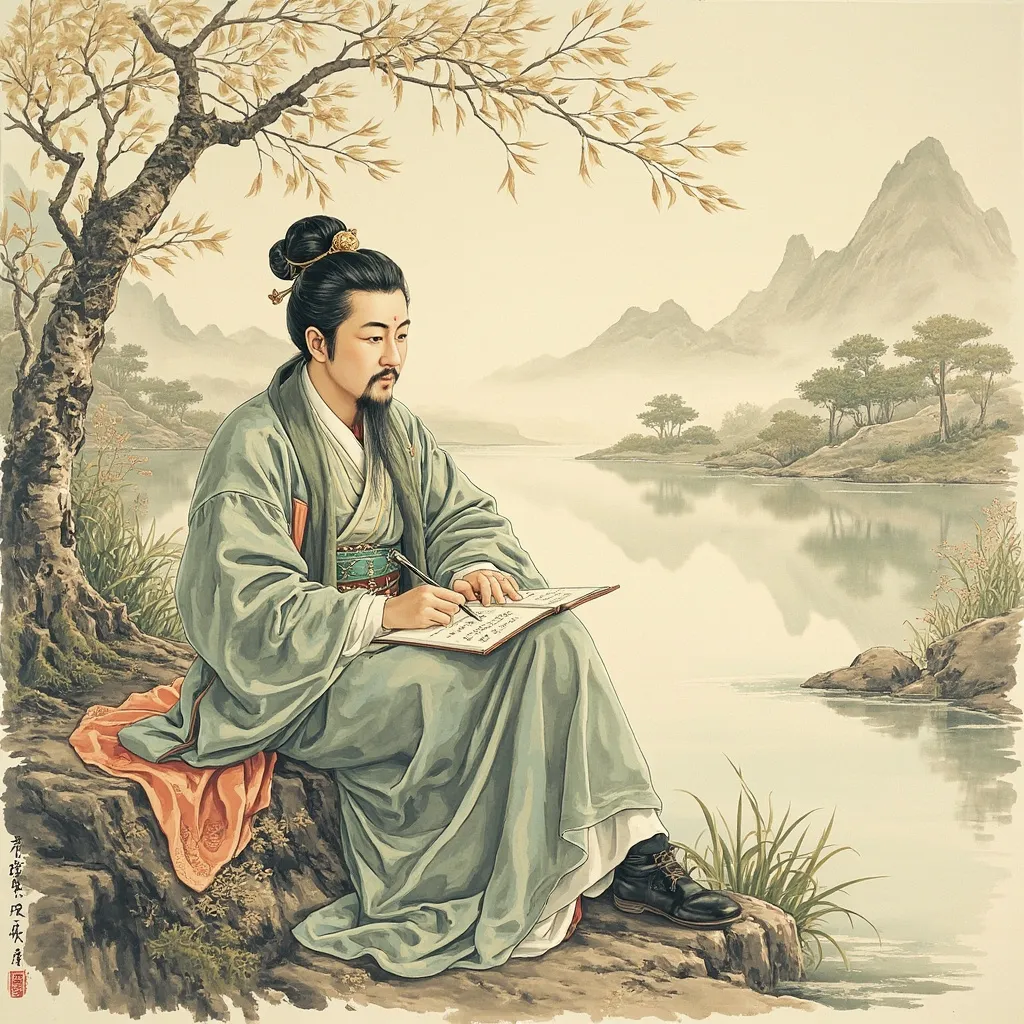
Songyang’s claim to fame is intellectual. In the eleventh century, the brothers Cheng Hao (Cheng Hao, 1032-1085) and Cheng Yi (Cheng Yi, 1033-1107) came to the academy to teach. Together, they developed what later became known as the Cheng-Zhu school of Neo-Confucianism — the philosophical synthesis that, after some refinements by Zhu Xi in the twelfth century, became the official ideology of the Chinese state for the next six hundred years. The Cheng brothers did not do all their work at Songyang. They taught there for a period in the 1060s and 1070s, and what they wrote during that period became foundational. Zhu Xi himself, a century later, came to the academy specifically to study the works of the Cheng brothers and to formalize them into the synthesis that would become the basis of the civil service examination. If you have ever wondered how a single philosophical school came to dominate Chinese government for so long, the answer begins in a quiet courtyard on a mountain in Henan.
The academy itself is older than the Cheng brothers. It was founded during the Northern Wei dynasty, in the early fifth century, as a kind of imperial library and study retreat. By the Tang dynasty, it was already a recognized site of Confucian learning. The buildings you can visit today are mostly Ming and Qing dynasty restorations — the original Northern Wei structures did not survive — but the layout and the central courtyard still follow the old plan. There are two enormous cypress trees in the courtyard, called the General Cypresses (Jiangjun Bo), which are believed to be about 4,500 years old. The Chinese government has officially counted them, and they are still alive.
I want to be honest about why this matters. The Songyang Academy was not just a school. In a country where the civil service examination was the only reliable path to social mobility, the academies were where the curriculum was being written. When Zhu Xi revised the Cheng brothers’ work into the version of Neo-Confucianism that the Ming and Qing dynasties used for their exams, he was not just writing a philosophy textbook. He was deciding what every educated Chinese person would have to memorize for the next six centuries. The academy on this quiet mountain, with its 4,500-year-old cypresses, was, for a brief period in the eleventh century, the place where that curriculum was being decided.
The Shaolin Temple
The Shaolin Temple (Shaolin Si) is the monastery that almost everyone has heard of, and the kung fu tradition is the part almost everyone knows. But the temple predates the martial arts by about four centuries, and it is worth remembering what it was originally for.
It was founded in 495 CE, in the reign of Emperor Xiaowen of the Northern Wei dynasty. The Northern Wei was, at that moment, a dynasty of Xianbei (proto-Mongolic) rulers who were deeply invested in promoting Buddhism as a state ideology. They sponsored massive cave-carving projects at Yungang and Longmen. They built monasteries. They sent monks to India. The Shaolin Temple was one of several imperial monasteries founded in the late fifth century, and it was built specifically to house an Indian monk named Bodhidharma (Damo in Chinese) — or at least to honor the tradition that he had stayed there.
Bodhidharma is the figure at the heart of the Shaolin legend. Whether he actually arrived at the temple in 527 CE, as some sources claim, is contested; what is not contested is that a meditation tradition associated with him — Chan Buddhism in China, Zen in Japan — was being taught at Shaolin within a century or two of the temple’s founding. Chan Buddhism’s distinctive emphasis on direct insight, meditation, and the irrelevance of scripture was, in its Chinese form, shaped in the foothills of Mount Song.
The kung fu tradition is a later development. Most historians date the formal association of Shaolin with martial arts to the Sui and Tang dynasties, in the seventh and eighth centuries, when monastery militias defended the temple against bandits. By the Song dynasty, the monks had a reputation for physical discipline. By the Ming and Qing dynasties, they had the legends of the Bodhidharma cave meditation, the muscle-tendon changing classics, and the 72 martial arts techniques that became the basis of the modern global image. If you are interested in the martial side, my article on Shaolin Kung Fu covers it in depth. For Mount Song, what matters is that the temple is the institutional anchor of Buddhism on the Lesser Chamber Peak, and that it has been there continuously for more than 1,500 years — through the Northern Wei, the Sui, the Tang, the Song, the Yuan, the Ming, the Qing, the Republic, and into the present day.
The Taoist Temple and the Iron Men
The third institution is the one Western readers are least likely to have heard of, and that is a shame, because the Zhongyue Temple (Zhongyue Miao) is, by some measures, the most important Taoist temple in China after the Palace of Supreme Purity in Beijing. It is the seat of the Taoist tradition of Mount Song, and it has been functioning continuously since the Qin dynasty — earlier than Shaolin, earlier than the academy in its current form.
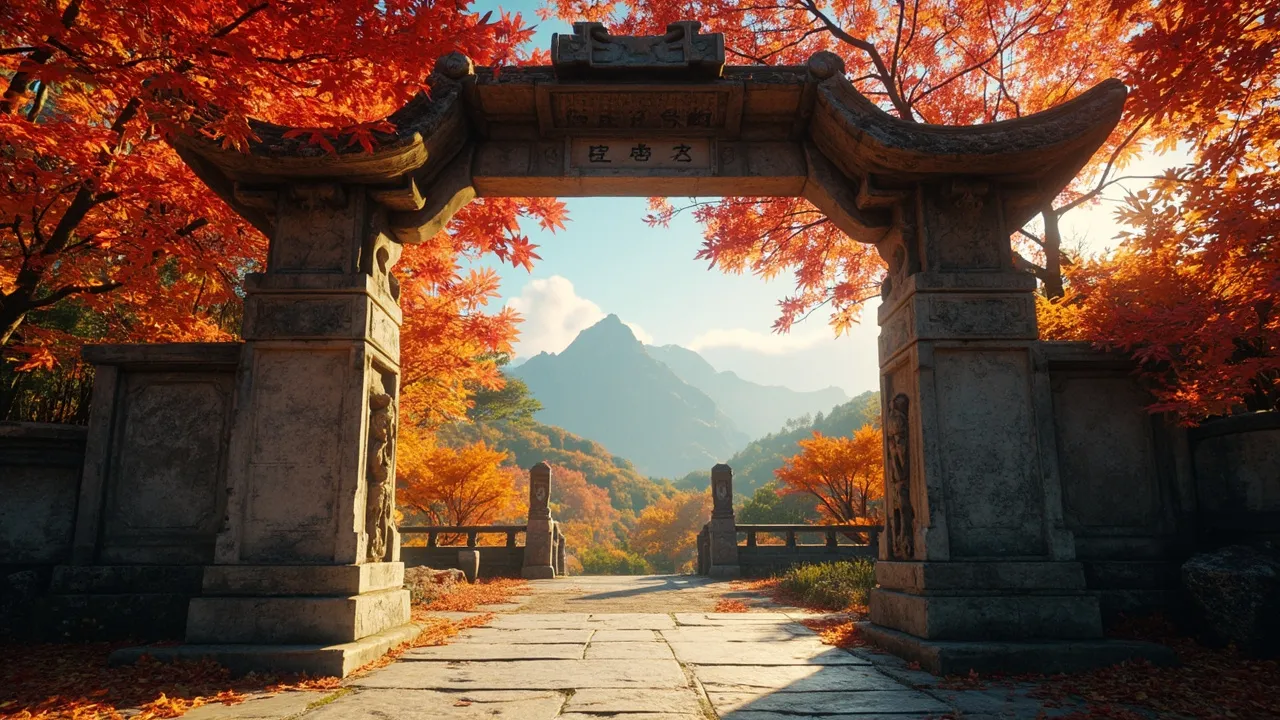
The temple’s position in the foothills below the Taishi Peak, where the Greater Chamber Peak begins to rise, made it a natural administrative and ceremonial center for the whole range. It is built on an axial plan, running roughly north to south for about 600 meters, with a sequence of gates, halls, and courtyards culminating in a final hall dedicated to the mountain itself. The scale is unusual. It is not one building. It is essentially a small walled town.
The most famous objects in the temple are the four Iron Men (Tie Ren). Cast in 1064, during the Northern Song dynasty, they are iron statues about three meters tall, representing four guardian generals. They were originally installed outside one of the temple’s main gates, and they have stood in the courtyard for almost a thousand years. They are striking for two reasons. First, the metallurgy — the casting is detailed enough that you can see the individual muscles, the expressions, the armor plates. Iron casting at this level of finish was rare even in the Northern Song. Second, the fact that they have survived at all. China has lost an enormous amount of its pre-modern metalwork to war, to revolution, and to the simple economics of recycling. Four almost-meter-tall iron statues, in their original location, from 1064, are not a common survival.
The temple’s other claim to fame is imperial worship. Throughout the long arc of Chinese history, when the imperial court wanted to perform sacrifices to the Central Sacred Mountain, the ceremonies were often held at the Zhongyue Temple, not at the mountain’s summit. The temple functioned as a kind of diplomatic outpost — a place where the imperial cult of the mountain could be carried out without requiring emperors, with all their massive entourages, to actually climb. The Taoist clergy of the temple were the priests of the imperial cult.
The Star Observatory and an Astronomical Achievement
There is a fourth institution on Mount Song that is not religious, and it is one of the most underrated scientific structures in Chinese history. The Star Observatory (Guangxing Tai) sits in the village of Gaocheng, at the eastern foot of the mountain. It was built in 1276, during the early Yuan dynasty, by the astronomer Guo Shoujing (Guo Shoujing, 1231-1316), and it is the oldest surviving astronomical observatory in Asia.
Guo Shoujing was one of the great astronomers of his era, anywhere in the world. He designed a series of precision instruments — the gnomon, the clepsydra, the armillary sphere — and conducted observations accurate enough to fix the length of the tropical year at 365.2425 days, which is closer to the modern value than the Julian calendar’s figure was at the time and roughly matches the value the Gregorian calendar would adopt three centuries later. He also produced a calendar, the Shoushi Calendar (Shoushi Li), that was used from 1281 to the end of the Yuan dynasty and represented a substantial improvement over the older systems.
The observatory is a 9.46-meter-tall stone pyramid with a long horizontal stone slab running along its center. The slab is the gnomon — the part that casts the shadow. By measuring the shadow length at solar noon, the astronomers could determine the precise date of the solstices and the length of the year. The structure is so well built that it is still standing, and you can still see the gnomon slot. It is not decorative. It worked, and it was used, and the science that came out of it was real.
Wu Zetian’s Gold Tablet
The last thing I want to mention is small and strange and worth knowing. In 1982, a local woman named Liu Fumin was picking herbs on the summit of Mount Song, on the Taishi Peak, when she noticed a small piece of gold sticking out of the soil. It was about 36 centimeters long and weighed about 223 grams, and it was inscribed with engraved characters in a careful hand. She handed it over to the local museum, and the museum identified it as a jin jian, a gold tablet, of the type that Chinese emperors and empresses would bury at sacred sites as a substitute for the imperial body during sacred mountain rites.
This one was from Wu Zetian (Wu Zetian, 624-705), the only woman ever to rule China as emperor in her own right. She performed the feng-shan ceremonies on Mount Song in 696 CE, during her reign as Zhou dynasty sovereign, and the gold tablet she buried at the summit was her prayer to the mountain — the only physical object that survives from that imperial visit. It is in the Henan Museum today, and it is one of the few direct relics of imperial sacred mountain worship in all of Chinese history. The story of finding it, half-buried in the soil of the summit, more than a thousand years after she left it there, is the kind of detail that makes the mountain feel less like a museum exhibit and more like a place where the past occasionally surfaces.
What the Mountain Adds Up To
Mount Song is, on paper, a fairly ordinary mountain range — about 1,500 meters at its highest peak, not particularly striking compared to the granite spires of Mount Hua or the imperial scale of Mount Tai. What is not ordinary is the density of human use. A Confucian academy, a Chan Buddhist monastery, a Taoist temple, and a Yuan-dynasty astronomical observatory, all within a few kilometers of each other, all still functioning. Add to that the imperial worship cult, the Wu Zetian tablet, the 4,500-year-old cypresses, and the multiple dynastic histories that all single out this mountain as the Central Sacred Peak, and you start to see what the title actually means.
The mountain does not need to be the highest. It is the place where the central institutions of Chinese civilization happened to cluster, and where they stayed. If you ever go, do not only go to Shaolin. Go up the Taishi Peak to the academy, and down to the Zhongyue Temple, and stop at the Star Observatory on your way out. The kung fu is what brings tourists in. The rest of the mountain is what kept the pilgrims there.
Recommended Products
- [songyang-academy-book]: Songyang Academy History — A scholarly work on one of China’s four great academies and its role in Neo-Confucianism
- [shaolin-kung-fu-dvd]: Shaolin Kung Fu Documentary — A documentary on the warrior monks and the Shaolin martial arts tradition
- [chinese-stone-carving-art]: Chinese Stone Carving Art Book — A survey of ancient Chinese stone carving including Songyang Academy inscriptions
- [zen-meditation-book]: Zen Mind, Beginner’s Mind — A classic introduction to Chan Buddhist meditation and the tradition that took shape on Mount Song
Disclosure
Some links above are affiliate links. We earn a small commission if you purchase through these links, at no extra cost to you. We only recommend products we genuinely believe enhance your understanding of Chinese culture.