- name: “China’s Cosmopolitan Empire: The Tang Dynasty (History of Ancient China)” url: “https://www.amazon.com/dp/0674064011" asin: “0674064011” description: “A comprehensive scholarly account of the Tang Dynasty — China’s golden age of cosmopolitan empire, poetry, and imperial governance.”
- name: “365 Tao: Daily Meditations” url: “https://www.amazon.com/dp/0062502239" asin: “0062502239” description: “A year of daily Taoist meditations offering wisdom on living in flow, practicing wu wei, and finding inner peace through ancient Chinese philosophy.”
- name: “The Tang Dynasty: The Golden Age (Dynasties of Ancient China)” url: “https://www.amazon.com/dp/1959043951" asin: “1959043951” description: “An accessible introduction to the Tang Dynasty’s remarkable world — trade, culture, poetry, and the emperors who shaped an era.”
- name: “Taoist Meditation: The Mao-shan Tradition of Great Purity” url: “https://www.amazon.com/dp/0791413608" asin: “0791413608” description: “A scholarly exploration of the Mao-shan Taoist meditation tradition — one of the most important lineages in Chinese spiritual practice.”
- name: “Li Shi Min, Founding the Tang Dynasty: The Strategies That Made China Great” url: “https://www.amazon.com/dp/0875869785" asin: “0875869785” description: “A detailed narrative of how Li Shi Min transformed war-torn China into one of history’s greatest empires through strategic genius.”
There is a Chinese idiom that still shows up in newspapers and political speeches: an ru tai shan — “as stable as Mount Tai.” Nobody uses this phrase thinking about geology. They use it because for three thousand years, Mount Tai was the closest thing China had to a physical guarantee of divine approval.
I find that remarkable. A mountain doesn’t have to do anything. It just sits there. But Mount Tai spent millennia being climbed, sacrificed to, poemized, and mythologized until it became an argument — made of granite and cloud — about where political power comes from.
The Mountain That Rose First
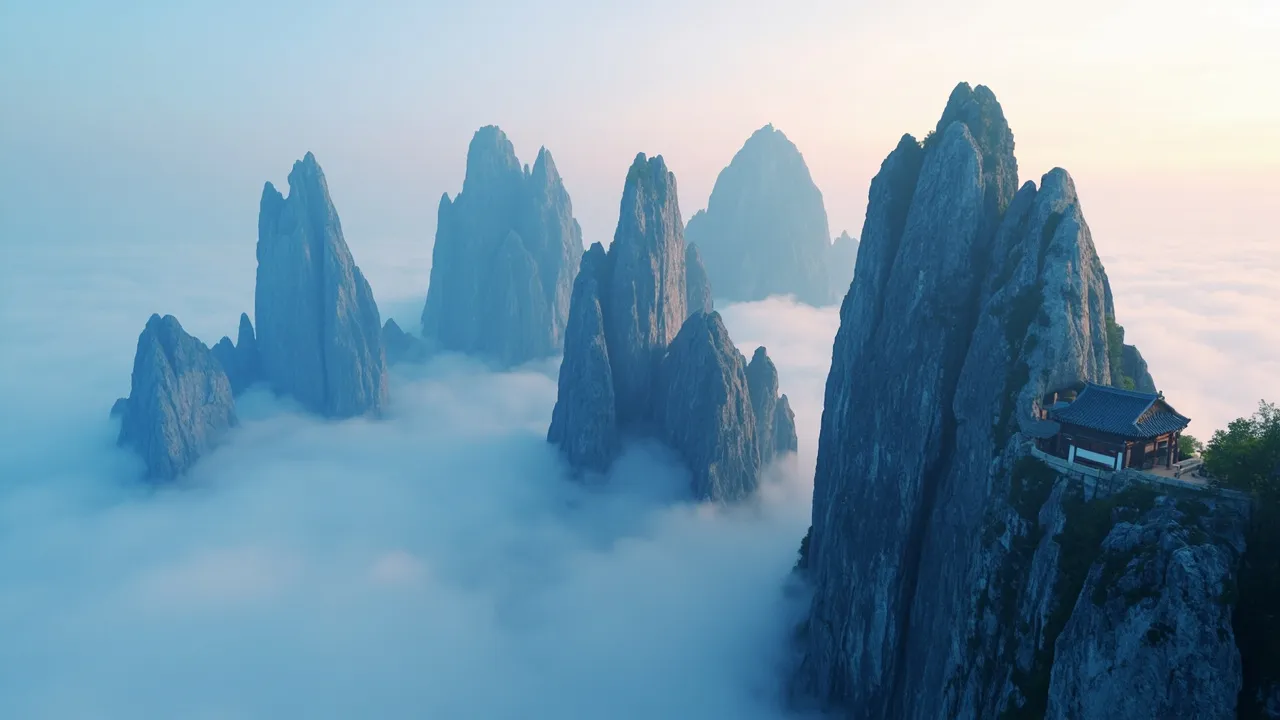
The Chinese didn’t worship all five sacred mountains equally. They ranked them, and Mount Tai came first. The character tai (泰) means something like “great” or “peaceful,” but it also appears as the last character in dongyue — the Eastern Peak. In the Chinese cosmological scheme, East is where the sun rises, where spring begins, where the Blue Dragon lives. East is birth and renewal. So when ancient Chinese looked east and saw a mountain poking through the plain, they didn’t just see geography. They saw the axis of the world tilted slightly toward heaven.
Geologically, Mount Tai is about 300 million years old — older than the dinosaurs, older than almost anything that still resembles a landscape on Earth. Tectonic forces pushed it up to 1,545 meters (roughly 5,000 feet) above sea level, and its position on the eastern edge of the Shandong plain means it is visible from more than 100 kilometers away on a clear day. Before modern cartography, that visibility mattered. You could see it from a hundred li and know you were approaching the center of the world.
The mountain earned its sacred status not through beauty but through position. It sits at the literal eastern edge of the Chinese world, the place where the land meets the sky on behalf of everyone in between. That geographic fact is what made it the tai — the great one, the first among equals.
The Emperor’s Highway to Heaven
If you were a Chinese emperor and you wanted your subjects to believe that heaven had personally selected you to rule, there were a few options. You could issue edicts. You could stage elaborate court ceremonies. Or you could do what Qin Shi Huang did in 219 BCE: climb a mountain while the whole world watched and light a fire on its summit.
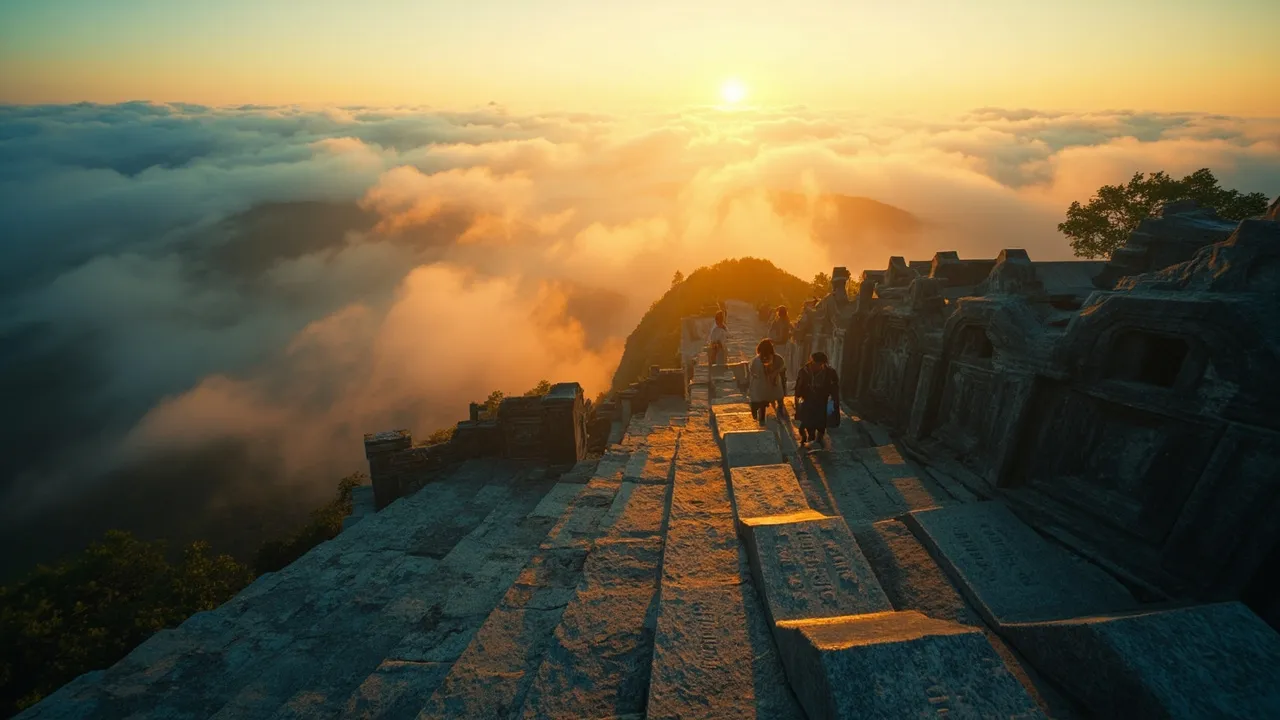
The climb itself was the message. Mount Tai rises abruptly from the plain — there are no gentle switchback trails to the top, just a steep stairway of roughly 7,000 stone steps called the Sacred Way (tiandao, the Heavenly Path). The emperor would begin at the base, in Tai’an city, where the Dai Temple (daimiao) served as the ritual staging ground. This temple complex, covering about 60 acres, was built around 200 BCE and houses the earthly headquarters of the mountain’s spirit. Think of it as heaven’s waiting room on the ground floor.
What happened at the summit was the Feng (封) sacrifice to Heaven and the Shan (禅) sacrifice to Earth. The emperor would offer jade discs, silk, and ritual牲畜 — the finest things he could produce — and announce to the gods that he had successfully ruled the realm and now presented himself and his accomplishments for divine review. It was part performance, part political insurance. An emperor who skipped the climb was an emperor whose reign carried a subtle but permanent asterisk.
The historical record is messy here, as it always is with ancient Chinese sources. Emperor Shun supposedly climbed Mount Tai around 2256 BCE to perform a similar ceremony, which would make this the oldest continuous ritual tradition on Earth that we can still name. Qin Shi Huang did it after unifying China for the first time in 221 BCE. Emperor Wu of Han climbed in 110 BCE and again in 106 BCE, each time using the occasion to announce some major political or military achievement to the cosmos. By the time of the Song and Qing dynasties, the climb had become so politically essential that emperors were performing it even when they were in poor health — the physical exertion was part of the point.
What strikes me is the physicality of it. This was not a symbolic gesture. Climbing 7,000 steps at altitude, in the clothing of a Han emperor, in all weather — it was genuinely dangerous. The emperors who did it were making a bodily argument: I am fit to rule because I can do what ordinary men cannot. The mountain was the ultimate stress test of dynastic legitimacy.
A Mountain Full of Ghosts, Poets, and Pilgrims
If emperors owned the religious meaning of Mount Tai, poets and pilgrims owned something else entirely: its emotional reality.
Confucius is said to have climbed Mount Tai around 500 BCE and wept at the view from the summit — not because the vista was beautiful, though it probably was, but because he could see the world laid out below him and understand, for a moment, how small individual lives look against the backdrop of history. He allegedly said something like: the world has no use for me, so I will go and float with the dragons. Whether or not this story is true, it tells us something real about how Chinese culture understood the relationship between mountains and moral solitude.
Li Bai — the Tang Dynasty poet who may be China’s most beloved writer — wrote one of the shortest great poems in Chinese literature about Mount Tai. It goes, in translation: One day I’ll ride the wind and return, straight to the edge of the sky — then look back on the mortal world below and laugh. Three lines. Li Bai was always writing about escape, about the impossibility of fitting his enormous personality into ordinary life, and Mount Tai gave him exactly the landscape his imagination needed.
Du Fu, his contemporary, wrote about the mountain differently. Where Li Bai wanted to fly away from the world, Du Fu wanted to understand it. His Mount Tai poem is steadier, more observational — a man at a particular moment in his life, standing on a particular peak, taking inventory of what he sees.
The mountain has 66 Taoist temples distributed across its slopes, which always makes me smile. Taoists believed that dangerous, remote places brought you closer to the immortal realm, and Mount Tai — steep, cloud-covered, spiritually charged for three millennia — was as dangerous and remote as it got in the Chinese heartland. Rather than competing with the imperial ritual tradition, Taoist monks simply moved in and set up their own spiritual infrastructure. The mountain became, in effect, a supernatural apartment block with a very long waiting list.
Today, about five million people visit Mount Tai each year. Most of them ride the cable car partway up and walk the last section to the summit. The Sacred Way still exists — you can climb it — but it takes most people three to four hours, and the bottom section has been commercialized into something resembling a very long outdoor mall. I find this strangely appropriate. The mountain has always been a place where the sacred and the mundane rubbed up against each other.
One of the things I find most revealing about the mountain is how many different spiritual traditions it absorbed without becoming exclusively any of them. The imperial Fengshan ceremony was a state ritual, not a religious one in the Western sense — it was about political legitimacy, not salvation. The Taoist temples that dot the slopes are Taoist, which is a different thing entirely — focused on individual immortality and the cultivation of qi. Buddhist temples also appear on the mountain, introduced centuries after the Taoist presence was established. None of these traditions “won” Mount Tai. The mountain remained what it had been from the beginning: a place where the question of heaven’s relationship to earth was worked out in ritual and stone.
This religious ambiguity may be why the mountain survived the arrival of Buddhism (which in China sometimes absorbed local gods rather than replacing them) and later survived the anti-religious campaigns of the 20th century. The mountain’s sacred status was never exclusively tied to any one institution. It was tied to geography, which is hard to argue with.
What Mount Tai Teaches Us About Power
The Fengshan sacrifice tradition is one of the most purely Chinese things I know. It doesn’t translate cleanly into any Western concept — it’s part religious ceremony, part political theater, part physical endurance challenge, and part cosmological insurance policy. The emperor climbs the mountain to prove to heaven that he deserves to rule, and the mountain — which doesn’t care about dynasties — provides the venue.
This is the clever part of the system. The mountain was not owned by any dynasty. It predated every dynasty. If an emperor performed the ceremony correctly and the mountain’s spirit accepted his offerings, that acceptance was considered genuinely binding — not because the mountain had opinions, but because the mountain was the one thing in the Chinese world that every subsequent ruler would also have to confront. The mountain was a fixed point in a world of political flux.
The symbolism became embedded in the language itself. An ru tai shan — as stable as Mount Tai. You yan bu shi tai shan — failing to recognize a great person (literally, “having eyes but not recognizing Mount Tai”). These phrases are still alive in Chinese, which means the mountain is still alive in Chinese — still being invoked, still carrying its ancient weight.
In 1987, Mount Tai was added to the UNESCO World Heritage List, which is the modern version of what the Fengshan ceremony used to do: an external authority confirming that this place matters, that its significance is real and not just locally constructed. I don’t think UNESCO fully understood what it was recognizing. Mount Tai was not primarily an aesthetic achievement or a biodiversity hotspot. It was the original argument — made in stone and ritual — that political legitimacy is not just a human construction but something you can go and ask the universe to verify.
The mountain is still there, still steep, still visible from a hundred li away. The emperors are not. The good news, if you are the kind of person who worries about such things, is that the argument itself has outlasted everyone who made it. The question of where legitimate political power comes from — whether it is human convention or something older and less negotiable — is not settled. It was not settled when emperors climbed Mount Tai to ask the sky for confirmation. It is not settled now. The mountain is still waiting for an answer, and it is not in a hurry.