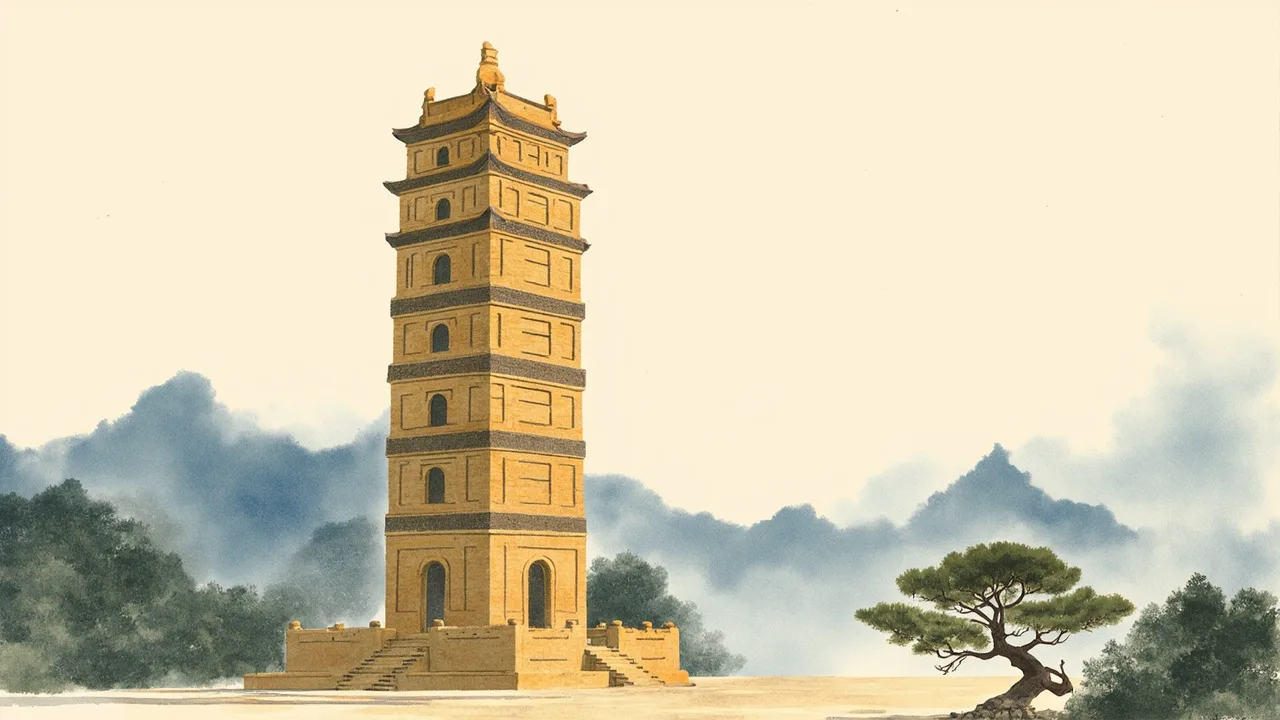
Chinese Pagodas: From Indian Stupa to Timber Tower
A Chinese pagoda is easy to recognize, yet its story began far from China. The architectural ancestor was the Indian stupa, a Buddhist monument associated with relics, memory, and the presence of the Buddha. As Buddhism traveled through Central Asia into China, the stupa met Chinese building traditions. The result was not a simple copy. Chinese builders translated the idea into towers, often with multiple floors, balconies, projecting roofs, and materials suited to local craft.
That translation took time. Early Chinese pagodas could be associated with towers and pavilions, while later examples became distinct in brick, stone, wood, and glazed tile. Some were built for relics; others marked temples, commemorated patrons, or became landmarks. Their interior spaces could be narrow, solid, hollow, or arranged around a central core. A pagoda’s shape tells you something about its period, but it does not tell the whole story.
The four pagodas discussed here show that variety. The Giant Wild Goose Pagoda in Xi’an is a brick landmark tied to the Tang capital and the translation of Buddhist texts. The Iron Pagoda in Kaifeng is actually brick and demonstrates the precision of Song construction. Yingxian’s Wooden Pagoda is a famous timber survivor. Songyue Temple Pagoda, much earlier, has a rare twelve-sided plan.
From Indian stupa to Chinese tower
The earliest Buddhist stupas developed around the practice of preserving and honoring relics. A stupa was not originally a tower that visitors climbed for a view. It was a sacred mound or monument approached through ritual movement, often with worshippers circling it. Its shape carried ideas about the Buddha, the cosmos, and enlightened presence.
When Buddhism reached China, translators had to explain unfamiliar teachings and builders had to give unfamiliar sacred forms a local body. Chinese architecture already had watchtowers, multistory pavilions, timber frames, tiled roofs, and courtyard compounds. The pagoda grew through the meeting of those traditions with the relic monument.
Early written accounts describe tall Buddhist towers, many made of wood. Timber was familiar to Chinese builders and allowed dramatic height, broad eaves, and layered roofs. It also brought danger. Fire, war, rot, lightning, and repeated rebuilding destroyed many early examples. Brick and stone offered greater resistance, though builders often imitated timber features in masonry.
The pagoda’s vertical form changed how a Buddhist temple appeared in the landscape. A courtyard hall was experienced horizontally, through gates and successive spaces. A pagoda could be seen from far away. It marked sacred territory and announced a temple’s presence to travelers long before they reached the gate.
Pagoda forms varied by time and region. Some have square plans, others octagonal, hexagonal, circular, or twelve-sided. Dense-eave pagodas appear to have many closely stacked roof lines. Pavilion-style pagodas create clearer stories and balconies. Some Tibetan and Himalayan forms retain shapes closer to the stupa mound and dome. The English word “pagoda” covers more architectural diversity than most visitors expect.
Relics remained important, but pagodas could also store scriptures, images, and commemorative objects. Their function expanded without losing the association with Buddhism. Even when a pagoda became a city landmark, its religious history remained part of the building’s identity.
Giant Wild Goose Pagoda in Xi’an
The Giant Wild Goose Pagoda, or Dayanta, stands in Xi’an, the city known as Chang’an during the Tang dynasty. It was first built in 652 at Da Ci’en Temple. Its history is closely connected with the monk Xuanzang, who traveled to India, returned with Buddhist texts, and led translation work at the Tang capital.
The pagoda helped house texts and religious materials brought from abroad. That purpose makes it a monument to translation as much as to architecture. Xuanzang’s journey was physically demanding, politically important, and intellectually ambitious. The familiar fictional adventures of Journey to the West grew much later around a transformed version of his story.
The building seen today reflects reconstruction and repair. Its square brick mass, seven stories, and relatively restrained profile differ from the curved, delicate silhouette many Americans picture when they hear “pagoda.” The walls rise with slight tapering, and each level is marked by projecting brickwork and arched openings.
Its plain strength suits the Tang association, though “plain” should not be confused with unsophisticated. Building a tall masonry structure that survives earthquakes and centuries of repair requires careful understanding of load, materials, and proportion. The pagoda has tilted and been stabilized over time, a reminder that historic buildings remain physical objects under stress.
When you visit, do not look only upward. The surrounding temple complex, inscriptions, statues, incense, and movement of worshippers help place the tower in a living religious setting. Modern plazas and tourism infrastructure create another layer. Xi’an residents may encounter the pagoda as a heritage icon, a neighborhood landmark, a religious monument, or a backdrop to evening walks.
The name itself has several traditional explanations, and the stories should be treated as legends rather than firm architectural documentation. What is certain is the pagoda’s connection to Tang Buddhism and the enormous translation project that shaped East Asian Buddhist learning.
Iron, wood, and the engineering of survival
Kaifeng’s Iron Pagoda is not made of iron. It was completed in 1049 during the Northern Song and built from brick faced with dark glazed tiles. The brownish, iron-like color produced the popular name. Up close, the exterior reveals molded tiles with Buddhist images and decorative patterns.
The octagonal tower has multiple stories and closely layered eaves. Its material resists some hazards that destroyed timber structures, though it has still faced floods, earthquakes, storms, and war. Kaifeng itself has a difficult relationship with the Yellow River, whose floods repeatedly changed the city. The pagoda’s survival feels remarkable because so much around it has been rebuilt.
The glazed surface is functional as well as decorative. Fired ceramic protects masonry while creating color and texture. Sunlight changes the tower’s appearance, and the repeating tiles reward close viewing. Calling it the Iron Pagoda may set up the wrong expectation, but discovering the real material is part of the pleasure.
Yingxian’s Wooden Pagoda offers a very different experience. Officially called the Sakyamuni Pagoda of Fogong Temple, it was built in 1056 during the Liao dynasty in present-day Shanxi. It is one of the world’s oldest and tallest surviving wooden pagodas.
The tower uses a complex timber frame and bracket sets, or dougong, to distribute weight. Although it appears to have five main exterior stories, interior levels and balconies make its structure more complicated. The central arrangement, columns, brackets, and layered floors work together rather than relying on a solid masonry wall.
No nails is a phrase often used in popular descriptions of traditional timber architecture, but it can mislead. Wooden joinery and brackets are the main story; the exact presence of metal fasteners in repairs or details is not the measure of the building’s genius. The achievement lies in a system that can carry enormous loads and flex under stress.
The pagoda has survived earthquakes, warfare, weather, and centuries of intervention, but survival does not mean invulnerability. Conservation specialists must manage deformation, damaged members, insects, moisture, visitor pressure, and the difficult question of how much to replace. A wooden monument remains alive in a technical sense: its material expands, contracts, and ages.
Songyue Temple and reading a pagoda on site
Songyue Temple Pagoda stands near Mount Song in Henan and dates to 523, during the Northern Wei. It is one of China’s oldest surviving brick pagodas. Its twelve-sided plan is unusual, and its dense eaves create a tall, tapering profile. Small arched niches and decorative brickwork connect the building with early Buddhist architecture.
The structure helps you see a stage in the adaptation from Indian and Central Asian forms to a Chinese pagoda vocabulary. Its outline does not resemble the later multistory timber pavilion as closely as some famous towers do. The dense roof lines gather upward around the body, giving the monument a strong vertical pull.
Brick construction preserved it when so many timber buildings vanished, but the brickwork also records repair. Historic monuments are rarely untouched originals. They accumulate replacement material, reinforcement, weathering, inscriptions, and changing ground conditions. “Authentic” should not mean frozen on the day of completion.
When looking at any pagoda, begin with the plan. Is it square, octagonal, round, or many-sided? Then count visible stories carefully, knowing that eaves may not match usable interior floors. Look at the material. Brick can imitate wooden beams and brackets; glazed tile can look metallic; plaster can conceal masonry.
Next, consider the temple setting. Is the pagoda on the central axis or placed to one side? Is it the main visual focus? Can visitors enter? Are relics, images, or scriptures associated with it? The answers change across periods and sites.
Finally, notice the skyline. A pagoda was built to be seen. Mountains, city walls, rivers, and surrounding roofs affect its meaning. Modern high-rises may dwarf a tower that once dominated an entire district. Photographs taken from close range can hide that change, so walk around if the site permits.
A few useful ways to keep learning
A Chinese architecture field guide is the best general purchase because it explains plans, bracket sets, roof types, and materials. A photo book on Buddhist sites in China can help you compare regional forms. For a hands-on understanding of structure, a wooden dougong model kit is more educational than a generic pagoda souvenir. A travel guide to Xi’an, Kaifeng, Shanxi, and Henan will help you turn the four monuments into a real itinerary. These are affiliate recommendations; a retailer may pay a small commission without changing your price.
A compact pair of travel binoculars is useful for seeing glazed tiles, carved figures, brackets, and upper-level repairs without ignoring site barriers. A grid-page sketchbook encourages you to draw the tower’s proportions. Sketching reveals asymmetry and structural detail that a quick phone photograph misses.
Check current access rules before visiting. Historic pagodas sometimes close interiors for conservation. Respect barriers and religious activity, and never treat an old brick or wood surface as a place to leave a name.
Visiting Chinese Pagodas: A Modern Traveler’s Checklist
If a trip to China lets you visit even two of these towers, plan them as different experiences rather than checklist stops. The Giant Wild Goose Pagoda in Xi’an sits inside a busy modern district; you will probably arrive by metro, walk through Da Ci’en Temple, and exit into a fountain-lit plaza at night. The Iron Pagoda in Kaifeng is best approached on foot from the older parts of the city, and Yingxian Wooden Pagoda rewards a longer detour into Shanxi, where the air is drier and the surrounding wooden temple compounds feel like a quieter century entirely.
Buy tickets in advance for Xi’an in spring and autumn. The Dayanta site closes certain interior levels for conservation on a rotating schedule, and the surrounding Da Ci’en Temple area can have long queues around sunset. Late morning tends to be lighter than midday. Bring water, comfortable shoes for uneven stone, and a light layer for shaded temple halls even in summer. Binoculars help you read carved brick detail and any active conservation scaffolding from the ground floor.
In Kaifeng, the Iron Pagoda Park is best in late afternoon when the low sun hits the glazed brown tiles and the surface seems almost metallic, which explains the popular name. Expect gardens, small lakes, and several reconstructed auxiliary halls that you can walk through in a single afternoon. Iron Pagoda’s interior is not normally open to the public for safety reasons, so plan to admire the exterior rather than climb inside.
Yingxian Wooden Pagoda sits in Fogong Temple in Shanxi, and visiting it well requires a full half-day. The tower itself is roped off, and for good reason: it has leaned for centuries and continues to settle. Read the signboards that explain the bracket sets before walking around; afterward, the structure reads like a careful essay in wood rather than a mysterious silhouette. A local guide who can point out the layered interior floors through viewing windows makes the visit far richer than a self-guided loop.
Songyue Temple Pagoda, near Mount Song in Henan, is the quietest of the four. Most visitors pair it with the Shaolin Temple area and the historic Songyang Academy nearby. Because the tower is so much older than the others, slow down and look at the brickwork without expecting the polished park atmosphere of Kaifeng. Carry a light scarf for wind on the plateau.
Across all four, respect ropes and barriers, never climb decorative balustrades, and treat carved surfaces as evidence rather than backdrops. A pair of compact binoculars, a 5x magnification or so, helps you see glazed tiles, bracket joints, and upper-story repairs from a respectful distance without leaning over fences.
For clothing, anything you would wear to walk a European old town works: closed shoes, modest layers for indoor halls, and a hat or umbrella for sun. A small daypack with water, snacks, tissues, and your passport copy makes temple visits much easier. If you sketch, bring a small grid notebook; drawing a single bracket set teaches you more about Chinese joinery than an hour of photographing.
If you can plan one trip, three days in Xi’an and a high-speed rail transfer to Kaifeng gives you both Tang brick and Song glazed tile. Add two more days north into Shanxi if Yingxian fits your route. Songyue Temple Pagoda works best as a focused detour on a longer Henan loop with the Shaolin area.
Closing thoughts
The Chinese pagoda is not an isolated shape invented all at once. It grew from the Indian stupa through Buddhist travel, translation, Chinese timber craft, masonry engineering, and centuries of regional experiment. The Giant Wild Goose Pagoda, Iron Pagoda, Yingxian Wooden Pagoda, and Songyue Temple Pagoda look different because Chinese architecture was never one fixed formula. Each tower is a record of belief, material, risk, and repair.