Traditional Chinese Painting: Brushstrokes of Eternity
There’s something deeply calming about looking at a traditional Chinese painting. Maybe it’s the way mist floats between mountain peaks, or how a single brushstroke can suggest an entire plum blossom branch. Whatever it is, these works have been drawing viewers in for over two thousand years—and they still have the power to stop you in your tracks.
If you’ve ever wandered through a museum and found yourself lingering longer in front of Asian art than the European galleries, you’re not alone. Traditional Chinese painting has a way of pulling you in, inviting you to look closer, to contemplate, to feel something that words can’t quite capture. Whether you’re a lifelong art enthusiast or just curious about different artistic traditions, there’s a richness here that’s waiting to be discovered.
What Makes Chinese Painting Different
Here’s the first thing that might surprise you about traditional Chinese painting: it’s not really about making pictures that look exactly like real things. Western painting, especially since the Renaissance, has been all about perspective, realism, and capturing the world as our eyes see it. Chinese painting took a completely different path—one that’s rooted in philosophy rather than optics.
The goal isn’t to copy nature. It’s to capture the spirit of nature, to convey the feeling or essence of a scene rather than its photographic reality. This might sound abstract, but it becomes remarkably clear when you look at the works themselves. A Chinese painter might show you a bamboo forest where you can almost feel the wind moving through the stalks, or a pair of birds on a branch that somehow conveys the quiet intimacy of spring morning.
This approach comes from some deeply Chinese ideas about how art and life connect. The philosophy of Daoism, with its emphasis on living in harmony with nature, played a huge role. So did the teachings of Confucius, who saw artistic expression as a path to moral cultivation. When a Chinese painter sits down to work, they’re not just making something pretty—they’re engaging in a practice that’s meant to refine their character and connect them to something larger than themselves.
The Philosophy Behind the Brush
To really understand Chinese painting, you need to understand a few key ideas that have shaped it for centuries. These aren’t just artistic theories—they’re ways of looking at the world that run through Chinese culture like a thread.
Qi (气): This concept, often translated as “vital energy” or “spirit,” is everywhere in Chinese thought. In painting, qi is what gives a work life. A painting with good qi feels alive, dynamic, breathing. A painting without it can be technically perfect but somehow flat or dead. Learning to see and create qi is what separates good painters from great ones—it’s something you feel more than explain.
The Unity of Heaven and Human (天人合一): This ancient idea says that humans are not separate from nature but are part of it, connected to the larger patterns of the universe. When you look at a great Chinese landscape, you’re not just seeing mountains and water—you’re seeing the relationship between human beings and the natural world, between the small self and the vast cosmos.
Spirit Resonance (神韵): This is what Chinese critics look for in art—the inner vitality that makes a work come alive. It’s similar to what we might call “presence” or “soul” in English, but the Chinese have a more specific idea. A painting can have perfect technique but lack spirit resonance, and it will feel empty. Conversely, a work with daring simplicity and genuine feeling might have “spirit resonance” even if the technique is less polished.
These ideas might seem philosophical and distant, but they have very practical implications for how Chinese paintings are made. They explain why Chinese painters developed their unique approaches to composition, brushwork, and the use of empty space—all of which we’ll explore in the sections to come.
The Four Treasures: Tools of the Trade
Every craft has its essential tools, and Chinese painting is no exception. For centuries, artists have worked with what’s called the “Four Treasures”—the four basic items that no Chinese painter can do without.
The Brush (笔 - bǐ): Just like with calligraphy, the Chinese painting brush is a marvel of simple design. Made from animal hair—typically wolf, goat, rabbit, or even weasel—attached to a bamboo handle, these brushes come in many sizes and shapes. Some have pointed tips for fine, delicate work; others have flat, wide tips for broad strokes. The key is that the tip can be pressed flat or kept pointed, allowing the painter to create everything from bold, confident sweeps to wispy, hair-fine lines. A good brush feels responsive in your hand, almost like an extension of your thoughts.
The Ink (墨 - mò): Traditional Chinese ink comes in solid sticks or cakes, made from pine soot mixed with animal glue. Before painting, the artist grinds the ink stick on an inkstone with a bit of water, creating a liquid that ranges from deep black to diluted gray. This might seem like a lot of trouble, but there’s a real reason for it—the freshly ground ink has a quality that bottled ink simply can’t match. It’s richer, more alive, with subtle variations that give paintings their characteristic depth.
The Inkstone (砚 - yàn): This is the stone slab used for grinding ink. Traditional inkstones are carved from fine-grained sedimentary stone, often with decorative designs carved into the base. The surface is ground smooth, and over years of use, it develops a polished quality that helps create smooth, even ink. A fine old inkstone is a treasured possession, often passed down through generations.
The Paper (纸 - zhǐ): Traditional Chinese painting uses rice paper (or more accurately, mulberry bark paper), which has a unique texture that absorbs ink beautifully. The paper is strong yet absorbent, allowing ink to soak in and create subtle gradations of tone. Different types of paper suit different styles—some painters prefer a rougher paper that creates interesting textures, others choose smoother paper for more controlled work.
These four tools have remained essentially unchanged for centuries. There’s something beautiful about that continuity—a painter today uses the same basic materials that masters used a thousand years ago. The tools connect you to a tradition that stretches back through countless generations of artists.
Styles and Techniques: Finding Your Voice
Chinese painting isn’t one single style but rather a family of approaches that have developed over millennia. Understanding the main categories can help you appreciate what you’re looking at—and maybe even guide you if you decide to try it yourself.
Landscape Painting (山水画 - shānshuǐ huà)
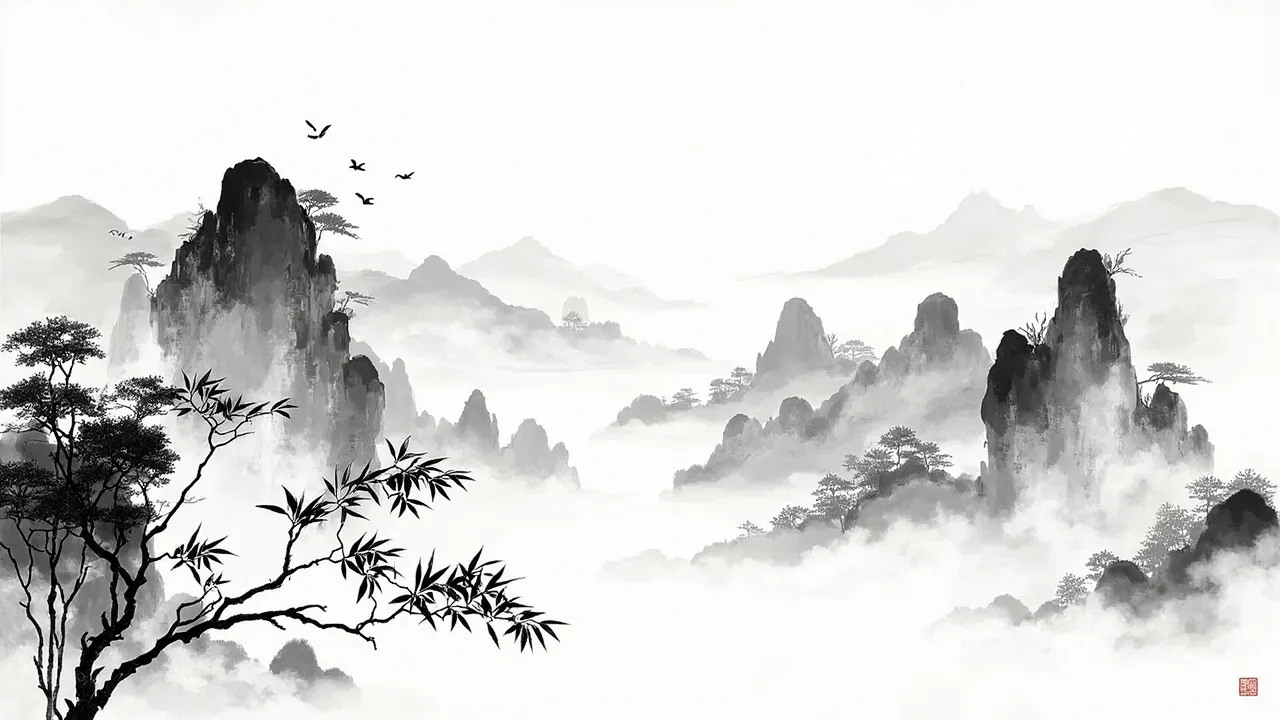
This is perhaps the most famous style of Chinese painting—the sweeping landscapes that show mountains rising through mist, rivers winding through valleys, and tiny figures contemplating the vastness of nature. These aren’t meant to be accurate depictions of specific places, though artists sometimes painted real locations. Instead, they’re idealizations, combinations of the most beautiful elements that a painter had seen or imagined.
Landscape painting developed during the Tang and Song dynasties, and it became the supreme genre of Chinese art—the form that painters aspired to master. The greatest landscape painters were considered not just artists but philosophers and even sages, because their work was seen as reflecting deep understanding of nature and the universe.
The techniques used are wonderfully varied. Artists might use “boneless” style, where the form of rocks and mountains is suggested through wash and texture rather than outlines. Or they might use the “blue-and-green” style, with mineral pigments creating vibrant, jewel-like colors. The “ink wash” style, using only black ink in various dilutions, became especially admired for its subtlety and expressiveness.
Bird-and-Flower Painting (花鸟画 - huāniǎo huà)
If landscape painting represented the grand, cosmic view of nature, bird-and-flower painting zoomed in on the intimate details. These works show flowers, plants, birds, insects, fish—everything from majestic eagles to tiny crickets hiding in the grass.
This style has a long history and was particularly beloved during the Song dynasty, when court painters created incredibly detailed, realistic images of the natural world. But it also developed in a more free-spirited direction, with artists using bold, spontaneous brushwork to capture the essence of their subjects rather than every anatomical detail.
Bird-and-flower painting often carries symbolic meaning. A peacock might represent dignity; plum blossoms symbolize perseverance (since they bloom in winter); a crane suggests longevity and wisdom. Understanding these symbols adds another layer of meaning to the works.
Figure Painting (人物画 - rénwù huà)
Figure painting in China has a history stretching back to ancient times, with wall paintings in tombs dating back millennia. Unlike Western portraiture, which often focuses on capturing an accurate likeness, Chinese figure painting has traditionally been more interested in showing the character, spirit, or social role of the subject.
During different periods, figure painting emphasized different qualities. Sometimes the goal was elegance and refinement, showing idealized beauties or scholarly gentlemen. Other times, painters turned to more populist subjects—farmers working in fields, children playing,民间 scenes of everyday life. Buddhist and Daoist deities, historical figures, and legendary heroes all became subjects for figure painting.
Free Brush and Detailed Brush
Beyond these subject categories, Chinese painting also distinguishes between different approaches to technique. Gongbi (工笔) or “detailed brush” style uses fine, precise lines and layered colors to create highly polished, realistic images. This approach requires tremendous patience and technical skill—artists might work on a single painting for months, building up color gradually.
In contrast, Xieyi (写意) or “free brush” style emphasizes spontaneity and expression over precise detail. Artists work quickly, using bold strokes and the natural behavior of ink on paper to capture the spirit of their subject. This approach is closer to what Westerners might call “impressionistic”—it’s about suggestion rather than description, feeling rather than fact.
Most traditional painters learned both approaches and used them for different purposes. A single artist might work in detailed brush for some projects and free brush for others—or even combine both in one painting.
Famous Artists and Masterpieces
Chinese painting has produced countless masters whose works are still revered today. While a complete list would fill volumes, knowing a few key names can help you navigate this rich tradition.
Gu Kaizhi (顾恺之, 344-405 CE): One of the earliest great masters whose work survives, Gu Kaizhi is considered the father of Chinese figure painting. His silk handscrolls, such as the “Admonitions of the Instructress to the Court Ladies,” show figures with elegant, flowing lines and subtle expressions that convey complex emotions.
Zhang Zeduan (张择端, 1086-1145): His masterpiece “Along the River During the Qingming Festival” is one of the most famous paintings in the world. This enormous handscroll (over 25 feet long) shows the daily life of the capital city Kaifeng in incredible detail—boats on the river, shops along the streets, people of all classes going about their lives. It’s like a photograph of a whole city, made centuries before photography existed.
Wang Ximeng (王希孟, 1096-1119): Almost impossibly, this artist created one of the greatest landscape paintings in Chinese history when he was still a teenager. His “A Thousand Li of Rivers and Mountains” is a massive handscroll over 50 feet long, showing a breathtaking landscape in vivid blue-and-green colors. He died young, but his single masterpiece ensured his eternal reputation.
Xia Gui (夏圭, 1180-1230): One of the great masters of the Song dynasty, Xia Gui was famous for his bold, abbreviated brushwork. His landscapes seem almost impressionistic, using dynamic strokes and dramatic angles to create a sense of energy and movement. He’s often grouped with his contemporary Ma Yuan, and their style is sometimes called the “Ma-Xia” tradition.
Wu Zhen (吴镇, 1280-1354): During the Yuan dynasty, when Mongol rule displaced the native Song dynasty, many painters turned to landscape art as a form of personal expression and cultural identity. Wu Zhen was one of the Four Masters of the Yuan dynasty, known for his powerful, moody ink paintings of bamboo—his “bamboo in the wind” is particularly famous.
Zhong Shichun (仲世俊) and Lin Liang (林良): Moving into the Ming dynasty, these artists revolutionized bird-and-flower painting by combining the elegance of earlier styles with new boldness and dynamism. Lin Liang especially was known for his dramatic eagles and other birds of prey, painted with sweeping, confident strokes.
Zheng Xie (郑燮, 1693-1765): Better known by his courtesy name Zheng Banqiao, this Qing dynasty painter is most famous for his bamboo—yet another example of how a single subject could sustain a whole career of artistic exploration. His bamboo paintings are admired for their combination of technical mastery and lively personality.
These are just a few highlights from a tradition spanning thousands of years and thousands of artists. Every era, every region, every individual painter brought something new to the conversation, making Chinese painting an endlessly rich field to explore.
Learning Chinese Painting: A Path for You
Maybe after reading all this, you’re thinking you’d like to try it yourself. Good news: you can start exploring Chinese painting without traveling to China or spending a fortune on equipment. Here’s how to begin.
Start Simple
You don’t need to tackle a full landscape on your first attempt. Many beginners start with simple subjects—perhaps a single plum blossom branch, a few bamboo stalks, or a simple fish. These classic subjects have been painted for centuries precisely because they allow you to explore fundamental techniques without overwhelming complexity.
Basic Supplies
For beginners, you don’t need the finest traditional materials. Good student-grade supplies work well and cost much less:
- A few brushes in different sizes (a medium pointed brush and a larger flat brush will get you started)
- A cheap inkstick and inkstone, or bottled Chinese ink as a convenience alternative
- Xuan paper (the traditional rice paper) or practice paper
- A felt or plastic backing sheet to protect your work surface
As you develop, you might invest in better materials—but start simple and see if you enjoy the process.
Fundamental Techniques
Chinese painting has some basic techniques that appear over and over:
The Press-Raise: This is the most fundamental brush technique. You press down to create a thick line, then raise the brush to create a thin one. Practice making strokes that start thick and end thin, or vice versa. This single technique can suggest branches, leaves, mountain ridges, and countless other forms.
The Dot: Chinese painting has dozens of different “dots”—brushstrokes that end with a tapping motion to create different shapes. The “pine dot” suggests pine needles; the “dot with the tip” creates rounded leaf shapes. Different schools have different dot vocabularies.
Ink Loading: This means loading your brush with different concentrations of ink—deep black at the tip, lighter ink behind it, or vice versa. Then, as you paint, the colors gradually shift, creating rich, living surfaces.
Wash: This is diluted ink (or color) applied broadly to create backgrounds, suggest atmosphere, or build up form. It’s similar to watercolor technique and requires practice to control.
Finding Guidance
Books can teach you the basics, but nothing replaces watching a skilled painter work. Look for demonstration videos online, or better yet, seek out classes in your area. Many cities have Chinese cultural centers or art schools that offer Chinese painting instruction.
If you’re near a museum with a Chinese painting collection, go spend time with the works. Look at how the masters handled their brushes. Notice how they composed their pictures, how they used empty space, how they balanced detail and suggestion.
A Practice, Not Just a Hobby
Here’s something important to understand: in Chinese tradition, painting is not just a skill you learn but a practice you cultivate. The goal isn’t to produce perfect finished works but to develop your own artistic voice over time. This means being patient with yourself, enjoying the process as much as the product, and understanding that mastery takes years—even a lifetime.
Many Chinese painters view their practice almost like meditation—a way to calm the mind, focus attention, and connect with something larger than everyday concerns. Whether or not you approach it quite that way, this spirit can help you enjoy the journey rather than just chasing results.
The Living Tradition
Traditional Chinese painting isn’t just a historical curiosity—it’s a living art form that continues to evolve today. Contemporary Chinese painters work in every style imaginable, from strictly traditional to wildly experimental. Some painters devote their lives to mastering the techniques of ancient masters; others use traditional tools and aesthetics to explore modern concerns.
Outside China, interest in Chinese painting has grown tremendously. Artists around the world are exploring its techniques and philosophy. Museums worldwide have major collections. Books, videos, and classes make it more accessible than ever.
Yet for all this modernization, the core principles remain. Chinese painting still values spirit over mere technical skill. It still sees art as a path to something beyond the purely visual—connection to nature, cultivation of character, expression of inner states that words can’t capture. It still rewards patience, attention, and devotion.
When you look at a traditional Chinese painting, you’re not just seeing ink on paper. You’re seeing a conversation that’s been going on for thousands of years, across continents and centuries. You’re seeing how one person tried to capture something of the world around them and the world within them. And you’re seeing a way of looking at life that remains deeply relevant, even in our modern age of screens and instant gratification.
So the next time you encounter a Chinese painting—online, in a book, or standing in front of the real thing—take a moment to really look. Let yourself sink into the misty mountains, the dancing branches, the birds frozen mid-flight. Let the empty spaces speak to you. And remember: you’re participating in an ancient tradition of contemplation, beauty, and connection to something larger than yourself.
That might be the deepest lesson of Chinese painting—not how to make pretty pictures, but how to see the world more fully, more beautifully, more like an artist sees it. And that’s a gift that lasts a lifetime.
Keywords: Chinese painting, traditional Chinese art, ink wash painting, guohua, Chinese brush painting