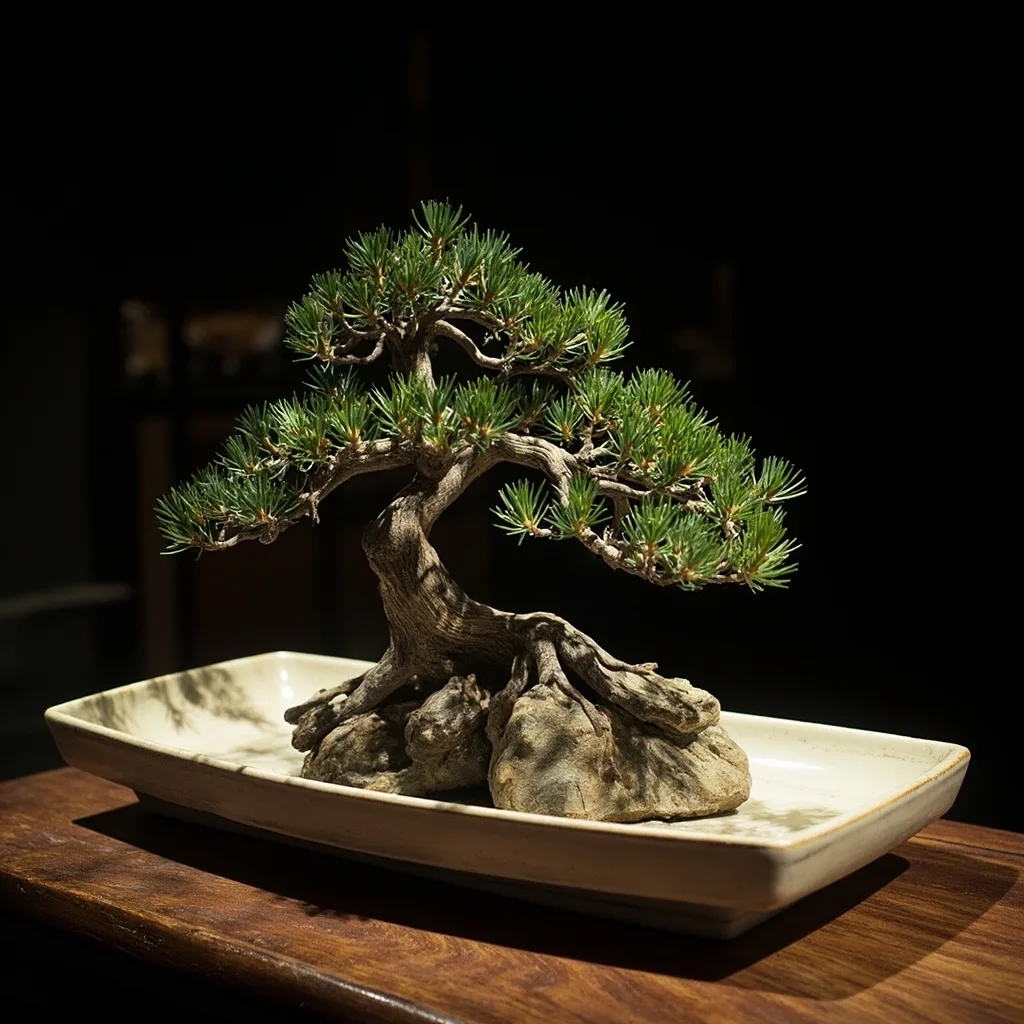
When a Chinese gardener spends thirty years coaxing a single pine tree into a shape that looks like it survived a lightning strike — but survived beautifully, all twisted patience and wind-bred character — they’re practicing penjing. It’s easy to call it Chinese bonsai and leave it at that, but doing so erases something important. Bonsai, the Japanese word that most Westerners know, is a direct descendant of penjing — a grandson, not a parent. The Chinese tradition is older, wider in its ambitions, and in many ways stranger. While Japanese bonsai tends toward the refined and the restrained, Chinese penjing includes miniature mountains, entire forest scenes, and trees paired with rocks in combinations that tell stories about the relationship between strength and fragility, permanence and change.
Penjing literally means “potted scenery” or “potted landscape.” The character pen (盆) means basin or pot; jing (景) means scenery or landscape. Where a Japanese bonsai artist aims to create a single tree that embodies nature’s grandeur in miniature, a Chinese penjing artist might create a three-inch mountain with a few pine needles growing from its peak, or a whole valley scene with rocks, water features, and multiple trees arranged to suggest an entire landscape. The container is the world. And that world can be anything from a single gnarled tree to an entire compressed geography.
This article covers the history of Chinese penjing, the four major regional schools that developed distinct styles, the philosophy that underlies the art, and practical guidance for Western readers who want to start collecting or even creating their own penjing.
A Thousand Years of Miniature Mountains
Penjing’s roots go back to the Tang Dynasty (618-907 CE), when Chinese scholars and painters began cultivating plants in containers not just for food or medicine, but for contemplation. The earliest references appear in paintings and poetry from the 8th and 9th centuries, where scholars are depicted sitting near potted trees in their gardens, using them as objects of meditation. By the Song Dynasty (960-1279), the practice had developed into something recognizable as an art form, with documented accounts of trees being trained into specific shapes over decades.
The Ming Dynasty (1368-1644) saw penjing truly flourish. Treatises were written on the subject, and the first systematic approaches to tree shaping began to emerge. The idea that a tree could be trained to look like it had survived centuries of wind and weathering — that the appearance of age was something you could cultivate deliberately — represents a profound shift in how Chinese artists thought about time and nature. You weren’t just growing a tree; you were compressing a century into a pot, making visible the invisible force of time acting on living material.
What distinguishes Chinese penjing from later Japanese bonsai is scope. The Chinese never limited themselves to single trees. From early on, Chinese practitioners created shan shui penjing — landscape penjing — which used rocks, small trees, and sometimes miniature buildings or figures to evoke entire mountain-and-water scenes. A common shan shui composition might show a rocky cliff face with a cascade dropping into a tiny pool, flanked by windswept pines on either side. The whole scene might occupy a pot the size of a dinner plate. This ambition to contain an entire landscape — not just a tree — is distinctly Chinese and remains one of the most striking aspects of the tradition.
The Four Schools: Regional Styles with Distinct Personalities
Over centuries, four regional styles crystallized, each shaped by local climate, available plant species, and regional aesthetic preferences. These are known as the four major penjing schools: Yangzhou (扬州), Suzhou (苏州), Sichuan (川派), and Lingnan (岭南派). Each has its own philosophy, preferred species, and characteristic shapes.
Yangzhou penjing is the most flamboyant and theatrical of the four. Based in the city of Yangzhou on the Yangtze River, this school favors dramatic, exaggerated shapes — trees twisted into near-loops, roots exposed in wild configurations, trunks leaning at improbable angles. Yangzhou artists are known for their willingness to push a tree’s natural form into something almost abstract, creating shapes that look like they belong in a Salvador Dalí painting more than a garden. The preferred species include pines, cypress, and junipers, trained to develop thick, gnarled trunks through careful pruning and wiring. Yangzhou penjing is about the theatrical assertion of artistic will over the material.
Suzhou penjing takes the opposite approach. Where Yangzhou is dramatic, Suzhou is refined. Suzhou, the garden city famous for its classical gardens (now UNESCO World Heritage sites), developed a penjing style that emphasizes elegance, subtlety, and a close relationship with the natural forms you’d find in the hills around Suzhou. Suzhou artists favor softwoods — maples, elms, and apricots — and train them with patient, incremental pruning rather than aggressive bending. The goal is a tree that looks like it grew naturally into a beautiful shape, not one that was forced there. Suzhou penjing tends toward the refined, the graceful, and the quietly beautiful.
Sichuan penjing, from the mountainous southwestern province, developed in isolation from the coastal traditions and shows a distinct character. Sichuan artists work primarily with cypress and juniper species native to the region, and they favor shapes that mimic the contorted, wind-swept forms found on the cliffs of the Yangtze River gorge. The Sichuan style is known for its emphasis on deadwood — exposed, bleached trunks that look ancient and weathered — and for compositions that include multiple trees in a single pot, arranged to suggest a forest clinging to a mountainside. The Sichuan approach feels rugged and elemental, closer in spirit to the landscapes that surround it.
Lingnan penjing from the Guangdong and Fujian region is the youngest of the major schools, developing primarily in the 20th century, but it has become enormously influential, particularly in Southeast Asia and among modern practitioners worldwide. The Lingnan school is known for its “cultivation-first” approach — an emphasis on vigorous, healthy growth as the foundation of beauty, combined with careful pruning to develop ramification (the fine branching structure that gives a tree its sense of age). Lingnan artists favor rapid-growing tropical species like banyan, Ficus, and various subtropical plants that can be grown year-round in warm climates. The Lingnan style tends toward the naturalistic, with an emphasis on developing lush canopy growth that suggests a healthy, thriving tree rather than a stressed or stunted one.
Understanding these four schools is useful for collectors because it helps explain the range of what “penjing” can mean. If you encounter a Yangzhou-style piece, you’re looking at something theatrical and larger-than-life. A Suzhou piece will draw you into subtlety and refined proportion. Sichuan work hits you with rugged drama. Lingnan pieces feel alive and luxuriant. None is better than the others — they’re different artistic personalities expressed through the same medium.
The Philosophy: Time, Patience, and the Compression of Nature
Chinese penjing is inseparable from Daoist and Chan (Zen) Buddhist ideas about the relationship between humans and nature. The core concept is that a penjing is not a representation of nature — it’s a actual piece of nature, living and growing, that has been shaped by human intention to express certain qualities. The artist doesn’t impose arbitrary shapes on the tree; they work with the tree’s own growth patterns and inclinations to bring out qualities that are already present, latent in the material.
This is why the best penjing take decades. A tree that has been training for forty years has a different quality than one trained for ten. The branching structure becomes more intricate, the trunk develops more character, the roots spread in more interesting configurations. Time is the invisible material. You can’t rush it. A penjing artist might spend fifteen years developing a single branch, pruning it, wiring it, letting it grow, pruning it again, until it does exactly what they want — which is usually to look as though it grew that way naturally, through decades of wind and weather and competition for light.
The compression is philosophically important. In traditional Chinese garden design, the goal is to contain the infinite — to make a small space suggest a larger world, to make a few elements suggest a complete landscape. Penjing takes this to its logical extreme. A good shan shui penjing should make you feel like you could step into it, like the tiny pine on that rock is the beginning of a whole forest if you just walk far enough. The art is in the suggestion, not the literal completeness.
There’s also a strong element of personal expression in penjing, much more so than in Japanese bonsai. Where Japanese bonsai has relatively strict aesthetic rules about proportion, angle, and shape, Chinese penjing allows — even celebrates — individual artistic personality. Two Yangzhou masters might create entirely different shapes from the same species, and both would be considered valid expressions of the art. The tree is a medium for the artist’s vision, not a standardized product to be judged against a fixed template.
Collecting Penjing: What Westerners Should Know
If you’re interested in collecting penjing — either finished pieces or materials to train yourself — the modern market offers more access than ever, but it also offers more ways to go wrong.
The first thing to understand is that genuine antique or vintage penjing commands extremely high prices. A Chinese penjing tree trained for sixty or a hundred years is a living artwork, and its price reflects decades of the artist’s time and skill. These pieces are generally found through specialized dealers, auction houses, and high-end nurseries that deal in specimen plants. If you’re starting out, set your expectations accordingly: a beautiful, healthy penjing in the $200-$500 range is a reasonable beginner piece; don’t expect to find a museum-quality specimen without spending four or five figures.
For most Western collectors, the practical entry point is either started material — young trees that have been in training for five to fifteen years — or raw material: nursery stock that hasn’t been trained yet but has good potential. Started material is better for learning because you can see how the previous artist shaped the tree and continue the work. Raw material is more affordable but requires more knowledge to evaluate and more patience to develop.
When evaluating a potential purchase, look at the following: the nebari (the visible root spread at the base of the tree — a good nebari should look like a solid, exposed root plate, evenly spread in all directions), the trunk movement (does it have interesting, non-linear movement, or is it straight and boring?), the branch structure (are there multiple branches at different heights, with good spacing?), and the overall health of the foliage. A healthy penjing should have dense, vibrant foliage or needles appropriate to the species. Yellowing, sparse, or wilting foliage usually indicates root problems.
A few species are particularly well-suited to Western growing conditions. Chinese juniper (Juniperus chinensis) is probably the most forgiving species for beginners — it’s hardy, takes well to pruning, and develops interesting deadwood naturally. Chinese elm (Ulmus parvifolia) is another excellent choice, particularly for those in milder climates; it grows quickly, recovers well from pruning mistakes, and produces beautiful small leaves and fine branching. Japanese black pine is more challenging but produces stunning results in the right hands and is a favorite of serious practitioners.
Starting Your Own Penjing: A Practical Path
You don’t need to spend decades to start developing penjing as a practice. Many enthusiasts begin by acquiring a young tree and its first pot, then committing to its development over time. The act of training a tree changes how you perceive trees in general — you start noticing branch angles, trunk movement, the way wind shapes exposed ridges, the patience of old trees growing out of cliff faces. It’s one of those hobbies that rewards close observation.
If you want to try your hand at creating a basic landscape penjing, start with a rock and a few plants rather than a tree. The classic beginner composition is a piece of limestone or granite (available at aquarium or rock supply shops) with moss and small groundcover plants growing in crevices. This teaches you about composition — how to arrange elements so they suggest a landscape — without the decades-long commitment of tree training. Once you have the composition eye, you can apply it to more ambitious projects.
The tools for penjing are relatively simple: sharp pruning shears for fine work, a pair of concave cutters for removing larger branches cleanly (the wound heals better), aluminum or copper wire for guiding branch growth, and a good substrate mix that drains well. Most importantly, you need patience — more patience than any other quality. A penjing that took thirty years to develop is not going to be matched by anything you can buy ready-made. But the process of developing it is the art, and that’s available to anyone willing to begin.
For further reading, there are several English-language books on Chinese penjing worth having. Luca and Alexandra Fratini’s comprehensive volumes on the subject are considered the standard references, and the China National Silk Road penjing museum publications offer good documentation of the major schools and their characteristic approaches.