- “Beginner Chinese pipa (rosewood, snakewood, 4-string, with picks) — entry-level traditional instrument”
- “Dunhuang Spring Pipaxie series introductory PU book of pipa music (English/Chinese) — sheet music for Chinese folk tunes”
- “Chinese pipa instructional DVD or streaming subscription (e.g., pipa master classes) — learning aid”
- “Snakewood pipa pick (set of 5) — replacement picks for practice and performance”
- “Compact travel pipa gig bag (padded, water-resistant) — protection when commuting to lessons”
The Chinese Pipa: How a Persian Lute Became China’s Most Soulful String Voice
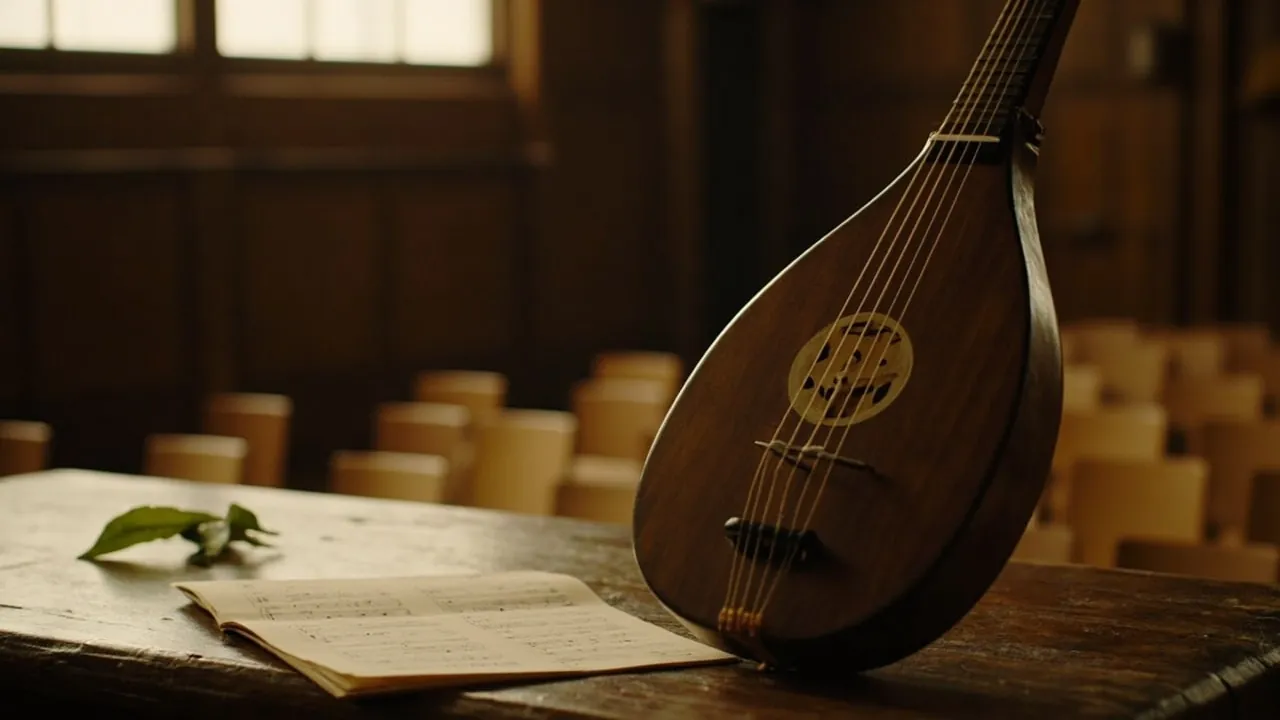
Walk into any Chinese tea house on a slow Tuesday afternoon and you might hear the sharp, glassy tink of a pear-shaped lute being tuned. That’s the pipa — and if you’ve never paid much attention to it before, I’d argue it’s the most quietly extraordinary instrument in China. Not the loudest (that’s the suona). Not the most famous abroad (the erhu usually wins). But the most expressive, the most literary, the one a thousand years of poets and emperors and Silk Road travelers all agreed was worth writing about.
I’ve been circling this instrument for years and the story just keeps getting deeper the further back you dig. The pipa isn’t really “Chinese” in the way most people assume. It’s a wanderer. It walked into China from Persia, picked up court manners in Kucha, was worshipped at the Tang imperial palace, immortalized in the most famous poem in Chinese literature, and then — somehow — got handed to a girl in Hangzhou who plays it barefoot in front of chamber orchestras in Boston. That’s the thread I want to pull on here.
The Long Walk from Persia: How the Pipa Reached China
The modern pipa looks nothing like the lute that left the Iranian plateau. And yet, if you trace the family tree, that’s exactly where it starts.
The direct ancestor is the barbat — a short-necked, deep-bellied lute played in Sasanian Persia (roughly 224–651 CE). The barbat had a wooden bowl-shaped back, an angled peghead, and a warm, woody voice. Sasanian art shows Persian nobles cradling it at banquets. When the Arab conquests kicked off in the 600s, Sasanian musicians, artists, and craftsmen scattered east — many of them along the Silk Road, into the oasis cities of Central Asia.
The next stop was Kucha (龟兹 in Chinese), a Buddhist kingdom in what is now Xinjiang. Kucha was, for several centuries, one of the strangest cultural crossroads in the world. Sogdian merchants, Indian monks, Persian refugees, and Chinese officials all passed through. Music was one of the things they traded. In Kucha, the barbat was being rebuilt. The Sogdians experimented with a bent-back lute called the pipa (or something close — the name was almost certainly a Sogdian or Turkic loanword, possibly related to barbat itself, though Chinese sources sometimes gloss it as “playing the western style” because the players plucked p’i-p’a style, outwards). Chinese monks traveling west to fetch Buddhist sutras in the 4th, 5th, and 6th centuries came home with new chants, new icons, and new instruments. By the Northern and Southern Dynasties period, the pipa had entered Chinese court music officially.
Crucially, the pipa as it arrived was not yet the instrument we recognize today. The early pipa was held horizontally, plucked with a plectrum, more like an oud. It wasn’t until the Tang dynasty (618–907 CE) that the playing position shifted upright, the neck stretched, and the modern four-string form began to settle in. There were also five-string and even six-string versions that thrived in the Tang court and then mostly vanished for a millennium — a mystery we’ll come back to.
The Tang Golden Age: When the Pipa Ruled Chang’an
The Tang capital of Chang’an (modern Xi’an) was, by some measures, the largest city on Earth between the 7th and 9th centuries — maybe 800,000 to a million people packed inside the walls. And the pipa was everywhere.
Tang poetry reads like a who’s-who of pipa players. Bai Juyi (白居易) wrote about at least nine different musicians. Cao Polatian (曹婆婆, literally “Cao the Old Lady”), a palace performer under Emperor Xuanzong, was said to teach new pieces overnight by having students sleep beside her so the melodies would drift into their dreams. (Probably apocryphal, but I love it.) Wu Manhua (吴蛮) — no relation to modern pipa star Wu Man, who came back to this same surname about 1,300 years later — was a court virtuoso praised for speed and for tremolo. Tang poets compared her playing to wind through pine needles.
And the most glamorous pipa player of all wasn’t technically a professional musician. She was Yang Guifei (杨贵妃), Emperor Xuanzong’s beloved consort, the woman whose beauty supposedly made flowers close and fish forget to swim (Li Bai’s hyperbole, not mine). Historical accounts credit her with being a competent pipa player. The full Tang vibe — that high cosmopolitan mix of Silk Road luxury, court music, and Buddhist meditation — basically runs on pipa tracks.
This is why the pipa feels different from the erhu or the guzheng, even now. The erhu was always the people’s instrument, the weeping fiddle of village weddings and street-corner laments. The guzheng was the scholar’s instrument, played indoors, alone, in a quiet room. The pipa was the cosmopolitan instrument — the one that belonged at court banquets, in palace orchestras, on banquet boats floating through southern canals. It carries that heritage in the way it sounds: a little theatrical, a little virtuosic, always asking to be heard.
The Poem That Saved an Instrument: Bai Juyi’s “Song of the Pipa Player”
Here’s the part that makes me a little emotional, every time I read it.
In 816 CE, the Tang poet Bai Juyi was demoted to a minor post at Jiujiang, on the Yangtze, far from Chang’an. One night he was sending off a friend at a riverbank pavilion when he heard someone playing pipa — and the music was so strikingly good that he invited the musician in, ordered wine, asked her to play more, and wrote a poem about it. That poem is 《琵琶行》(Pipa Xing), the “Song of the Pipa Player,” a 616-character narrative ballad. It remains one of the most famous Chinese poems ever written. If a Chinese speaker of any age can quote one poem by heart, it’s probably this one.
Two reasons it matters for pipa history. First, Bai Juyi describes the instrument’s technique in technical detail. He names five specific playing styles — sao (扫, sweeping), zhi (擘, thumb flick), tan (弹, single pluck), dou (斗, side-of-finger strike), and fu (拂, upward brush) — and these terms are still taught to pipa students in conservatories today. Reading his poem is essentially a Tang-era technique textbook wrapped in a love story. The performance diction predates every surviving conservatory method.
Second, and this is the part that hits you in the chest: Bai Juyi turned a pipa performance into a story about exile, age, and the failure of ambition. The pipa player in the poem used to be a courtesan in the capital; now she is, like the poet, a faded wanderer on the Yangtze. The instrument speaks for both of them. Here’s the line everyone in China knows, a few hundred characters in:
I am an old tune from the capital, and you are an old man from the capital; we were never introduced in our prime, but meet now by this river as strangers in decline.
(Translators fight over this couplet for centuries. Mine is loose. But the ache is right.)
The passage that most musicians quote is the description of her playing near the end:
“Like a sudden sandstorm in a sea of clouds, like a torrent washing through a winter waterfall, like pearls tumbling onto a jade plate, like an oriole hiding in the magnolias.”
(“大弦嘈嘈如急雨,小弦切切如私语… 间关莺语花底滑,幽咽泉流冰下难…” — “the thick strings crash like sudden rain, the thin strings whisper like private words… a warble of orioles slipping smooth through flowers, a hidden spring beneath the ice finds it hard to keep flowing…”)
She paused, lowered her strings, and let loose — the sound finished, but the sorrow lingered.
(“别有幽愁暗恨生,此时无声胜有声” — literally “a hidden sorrow rises in her; this moment of no sound surpasses all sound.”)
That last couplet — “this silence is better than sound” — is what every pipa teacher in China still says to their students when describing the most important moment of a performance. Bai Juyi didn’t just write about a pipa. He wrote the rulebook for pipa emotion. Every player since 816 has been measured against his lines.
If you only ever hear one pipa piece in your life, listen to anything that’s been recorded under the title 《琵琶行》 and you’ll hear the Tang poets’ instrument being played by people who are still chasing the feeling Bai Juyi described. It’s a direct line, 1,200 years long.
The Quiet Centuries: Lute, Guangling, and the Survival of a Song
After the Tang collapsed in 907, the pipa didn’t vanish, but it did go quiet. Centuries of war, foreign invasion, and dynastic churn in the Song, Yuan, and Ming periods meant that pipa music increasingly moved from palace halls to smaller venues — chamber music, traveling opera troupes, and especially the jiangnan south, where silk-and-string culture survived the wars better than the north did.
Several pipa pieces from this period are still performed, almost unchanged, today. 《十面埋伏》(Shi Mian Mai Fu), the famous “Ambush from Ten Sides,” describes the Battle of Gaixia in 202 BCE where Han forces trapped Xiang Yu. Its drum-on-strings effects — scraping tremolos, slapped wood blocks, sudden silences — turned the pipa into a one-instrument percussion kit. 《霸王卸甲》(Bawang Xie Jia), “Chu King Removes His Armor,” retells the same battle from Xiang Yu’s side, and it’s a more melancholy piece. Listening to both back to back is one of the great experiences in Chinese music.
And then there’s 《广陵散》(Guangling San) — the famous piece around which an entire constellation of pipa, guqin, and xun scholarship orbits. It’s the most dramatic musical murder story in Chinese literature: Ji Kang (嵇康), one of the Seven Sages of the Bamboo Grove, refused to serve a corrupt court in 262 CE, was executed, and the Guangling San reportedly died with him. (It was rediscovered later, though scholars still argue about which version.) The pipa doesn’t own Guangling San (the guqin does), but pipa arrangements keep appearing because every Chinese lute player eventually tries their hand at it.
I’m bringing up these pieces because I want you to understand that the pipa doesn’t just survive in historical record. It survives in repertoire still being played today, in pubs, in concert halls, in YouTube tutorials from teenagers in Hangzhou. The instrument and its music are unbroken.
The Modern Era: Wu Man, Lin Hai, and a Pipa on the World Stage
The pipa in the 20th and 21st centuries is doing something remarkable: it’s exporting itself.
Wu Man (吴蛮, b. 1963), and yes, the name echoes the Tang court player Wu Manhua across a millennium — has arguably done more to make the pipa a global instrument than anyone since Bai Juyi. Born in Hangzhou, conservatory-trained in Beijing, she moved to New York in 1990 and started doing what serious pipa virtuosos of the previous generation hadn’t quite done: writing and premiering new Western chamber works for the pipa. She has commissioned and premiered pieces by Tan Dun, Lou Harrison, Bright Sheng, Chen Yi, Philip Glass, and others. She has performed with the Boston Symphony, the Shanghai Symphony, with Yo-Yo Ma’s Silk Road Ensemble, and on a tour that brought her instruments literally onto the world’s biggest chamber festivals.
Wu Man’s recordings are where I’d start if you’re curious what contemporary pipa sounds like. Her album Imperfect Sound with the Shanghai Symphony explores contemporary pipa in orchestral contexts. Her Silk Road Ensemble albums fold pipa into a kind of global chamber music that doesn’t pretend pipa is a folk curiosity — it treats it as a peer of violin and piano.
Then there’s the Pipa Xing phenomenon of the 2000s. The instrumental piece 《琵琶语》(Pipa Yu, “Pipa Words”) by composer Lin Hai (林海) — originally composed for the 2001 film The Floating Landscape, then remixed and rereleased as an album — became, almost by accident, the most-broadcast Chinese new-age instrumental of the 2000s. Cafés, spas, airport lounges, and meditation apps have all played it. If you have ever been in a Chinese-themed airport lounge anywhere in the world and heard soft pipa music, there’s a non-trivial chance it was Lin Hai. It’s the closest thing the pipa has to a hit single.
The third thread is the most academic and, frankly, the most fun: the Tang revival. Over the last thirty years, conservatories and museums in China, Japan, and the US have been studying medieval and Tang-period Chinese art, the Nara instrument collection in Japan (a set of instruments sent to Japan in the 8th century and preserved in a Shōsōin storehouse), and Dunhuang cave paintings — and out of that work have come rebuilt 5-string and 6-string pipas, instruments that almost certainly existed in the Tang court but were lost by the Song. Modern luthiers led by people like Zheng Ruzhong in Shanghai and researchers at the Central Conservatory have built them, played them, and started writing new music for them. The Tang pipa is being recovered, not invented. That’s a different kind of revival than Wu Man’s chamber music or Lin Hai’s ambient hit, but it’s all the same instrument, still telling new stories.
What It Sounds Like, and Why It Hits Different
Here’s the part where I’d normally give you a technical breakdown. I’ll keep it short because anyone can find a YouTube video in five seconds. The pipa has a clear, percussive attack — the pick striking the string creates a snap that decays into a woody ring. That two-stage envelope is why pipa passages in larger ensembles always cut through. The four strings are tuned in fifths (historically; modern players often use fourths or other settings depending on the piece and the region). The finger-picks — historically bone, now usually snakewood or bamboo — let the player do tricks impossible on a bare-handed lute: rapid tremolo, two-handed counterpoint, drum-on-body percussion, and the famous portamento slides that imitate the human voice swooping up or down.
The emotional range is what surprises Western listeners most. A single pipa piece can go from whispering to thundering in thirty seconds. Shi Mian Mai Fu starts with a single calm note, builds to a rolling war-drum effect through tremolo, then erupts into metallic clash — all on the same instrument in the same player’s hands. I’ve watched audiences go quiet during pipa solos who couldn’t name a single Chinese string instrument five minutes earlier. There’s something about the pipa’s voice that talks to ears that don’t even know they’re being talked to.
A Closing Thought, and an Invitation
Here’s what I’d ask of you, if you’ve read this far: before you think of the pipa as some dusty Chinese artifact, think of it as one of the great survivor stories in music. It’s a Persian lute played by Sogdian merchants on the Silk Road. A courtesan’s favorite instrument in Tang Chang’an. The thing a Tang poet immortalized in the most famous poem in the language. The vehicle for an 18th-century battle piece still performed today. And — in Wu Man’s hands — a chamber music instrument that can sit alongside a violin in a new work and make sense there. Same four strings. Two thousand years. That’s not survival. That’s a career.
If you listen once and it clicks, you’ll be hearing a voice that’s been singing for twenty centuries without going out of tune — even when the dynasties did.