Chinese Spring Festival: Traditions, Food, and Celebration
Every year, around late January or early February, something remarkable happens. Roughly one-sixth of the world’s population—over a billion people—simultaneously stops what they’re doing and turns their attention toward family, tradition, and renewal. This is the Chinese Spring Festival, also called Lunar New Year or Chinese New Year, and it’s the most important holiday in the Chinese calendar.
For Americans, it might be easiest to think of the Spring Festival as Thanksgiving, Christmas, and New Year’s Eve all wrapped into one mega-celebration that lasts for about two weeks. It’s a time when millions of migrant workers travel back to their hometowns, when families gather from across the country (and the world), when every home gets a thorough cleaning, and when the entire country seems to erupt in red decorations, fireworks, and feasting.
Understanding the Spring Festival gives you a window into core Chinese values—family, prosperity, good fortune, and respect for ancestors—that remain central to Chinese culture even in our modern, globalized world. Let me walk you through what makes this celebration so special.
The Story Behind the Festival
The Chinese Spring Festival has roots stretching back over 4,000 years, to ancient agricultural celebrations marking the end of winter and the beginning of spring planting. The festival as we know it today evolved from these early rituals, incorporating elements from mythology, religion, and folk tradition into the complex celebration we see now.
The most famous legend associated with the festival is the story of Nian (年), a monstrous beast that lived in the sea and emerged once a year to devour villagers. According to legend, Nian was terrified of the color red and loud noises—which is why red decorations and fireworks became central to the celebrations. An old wise man taught the villagers to scare away Nian by setting off firecrackers and hanging red lanterns and decorations. The tradition stuck, and today, red and noise remain the defining visual and auditory elements of the Spring Festival.
The festival is timed according to the Chinese lunar calendar, which means the date shifts each year—typically falling somewhere between January 21 and February 20. Each year is also associated with one of the twelve animals of the Chinese zodiac, cycling through Rat, Ox, Tiger, Rabbit, Dragon, Snake, Horse, Goat, Monkey, Rooster, Dog, and Pig. Your zodiac animal is determined by the year you were born, and Chinese people take considerable interest in which animal governs each year.
The Spring Festival celebration actually lasts for about fifteen days, from the first day of the lunar month to the Lantern Festival on the fifteenth day. However, the most intensive celebrations happen during the first few days, especially the除夕 (Chúxī)—the eve of the new year, which is essentially the Chinese New Year’s Eve.
The Reunion Dinner: The Most Important Meal of the Year
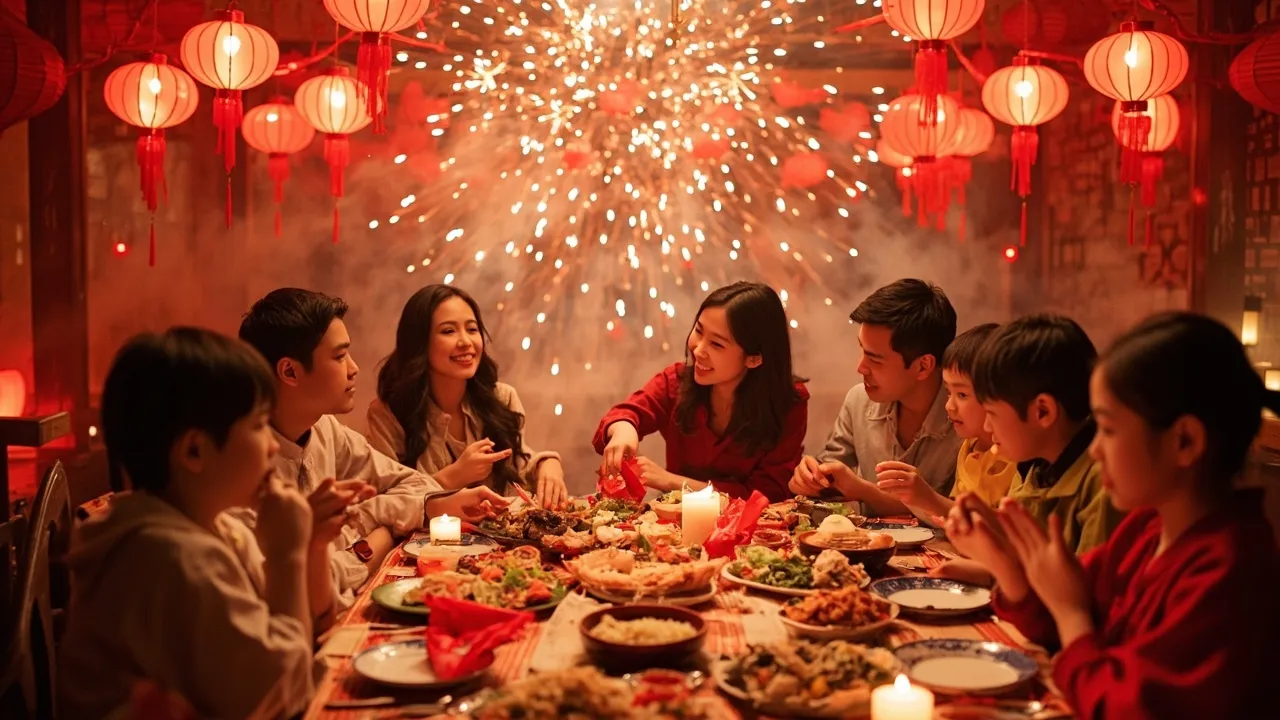
If you do nothing else during the Spring Festival, you will have this meal. The reunion dinner (年夜饭, nián yè fàn) on Chinese New Year’s Eve is perhaps the most significant tradition of all—a massive family feast where every family member who can possibly make it comes home to be together.
This dinner is taken extraordinarily seriously. Workers will travel for days to make it home. Restaurants book up months in advance for families who can’t host at home. The meal itself typically features multiple courses—often ten or more—that are loaded with symbolic meaning. Every dish has a purpose beyond just tasting good.
Fish (鱼, yú) is absolutely essential, and you’ll almost always see a whole fish on the table, served with the head and tail intact. The Chinese word for fish, “yu,” sounds like the word for “surplus” or “abundance,” so eating fish symbolizes wishing for abundance in the coming year. Often, the fish is not completely eaten—leaving some leftovers symbolizes that you’ll have surplus throughout the year.
Dumplings (饺子, jiǎozi) are another must-have, especially in northern China. Their shape, resembling ancient gold ingots, symbolizes wealth. Families often make dumplings together on New Year’s Eve, and some families hide a coin inside one dumpling—anyone who finds it is said to have good luck for the coming year.
Noodles represent longevity, and they’re served uncut to wish for a long life. Sweet rice balls (汤圆, tāngyuán) are eaten because their name sounds like “reunion” and “completeness.” The round shape symbolizes family togetherness.
Other common dishes include whole chicken (symbolizing completeness and prosperity), Buddha’s delight (a vegetarian dish made with various lucky ingredients), fatty pork (symbolizing prosperity), and numerous vegetable dishes whose names sound like positive words. It’s a meal where every bite carries a wish.
Red Envelopes and Other Traditions
Once the reunion dinner is finished, another beloved tradition takes center stage: the giving of red envelopes (红包, hóngbāo). These are small red envelopes, often decorated with gold characters or elaborate designs, containing money—usually in even numbers, as odd numbers are associated with funeral offerings.
The tradition comes from the ancient practice of giving coins threaded on a red string to children, to ward off evil spirits and bring good fortune. Over time, the coins became paper money, and the string became an envelope. Today, red envelopes are given to children and unmarried adults by married relatives, friends, and even employers. The money inside is a gift of good wishes, and the red color itself symbolizes luck and happiness.
The amount inside varies enormously depending on family means and regional customs, but there’s definitely a social element to it—people often talk about how much they gave or received. In recent years, digital red envelopes sent through apps like WeChat have become extremely popular, especially among younger people.
Beyond the dinner and red envelopes, the Spring Festival is packed with other traditions. Families thoroughly clean their homes in the days before New Year’s Day, sweeping away bad luck and making room for good fortune to arrive. This cleaning is done before New Year’s Eve—cleaning on New Year’s Day itself is considered bad luck, as you’d be sweeping away your new year’s good fortune.
Door god paintings (门神, ménshén) are hung on front doors, depicting fierce warrior figures who protect the home from evil spirits. Spring festival couplets (春联, chūnlián)—poetic verses written in black ink on red paper—are hung on door frames, expressing wishes for luck, happiness, and prosperity. The character “福” (fú), meaning “blessing” or “good fortune,” is everywhere, often displayed upside-down because the character for “upside-down” (倒, dào) sounds like the character for “arrival” (到, dào)—so an upside-down福 symbol means “good fortune has arrived.”
Fireworks and firecrackers are set off throughout the celebration, especially at midnight on New Year’s Eve, to scare away evil spirits and celebrate the new year. In recent years, many major Chinese cities have restricted fireworks due to pollution and safety concerns, but the tradition remains deeply important in smaller towns and rural areas.
The Fifteen Days of Celebration
The Spring Festival doesn’t end on January 1st—it just gets started. The celebrations continue for fifteen days, each with its own traditions and activities.
The first few days after New Year’s are spent visiting relatives and friends, exchanging greetings, and eating. People say “新年好” (xīn nián hǎo) or “恭喜发财” (gōng xǐ fā cái)—“Wishing you prosperity” to each other. Many businesses stay closed during this period, and the streets can be surprisingly quiet as families retreat to their hometowns.
The fifth day, called “Po Wu” (破五) or “Breaking the Five,” is when businesspeople traditionally resume work and shopkeepers reopen their stores. It’s considered bad luck to work on the first four days, so the fifth is a big day for getting back to normal life.
The fifteenth and final day is the Lantern Festival (元宵节, Yuánxiāo jié), which marks the end of the Spring Festival celebrations. On this night, people gather to view lanterns of all shapes and sizes—traditional red lanterns, elaborate animal shapes, and even creative modern designs. The festival also features dragon dances, lion dances, and the eating of sweet rice balls (tangyuan). Interestingly, the Lantern Festival is also sometimes considered Chinese Valentine’s Day, as it’s traditionally a day when young people can meet and socialize.
Experiencing the Spring Festival Today
If you’re in a major American city with a significant Chinese population, you’ll find the Spring Festival celebrations increasingly vibrant and accessible. Chinatowns across the country—San Francisco, New York, Los Angeles, Boston—host parades with dragon and lion dances, street fairs, and special restaurant menus. Many Chinese-American families maintain the traditions they brought from their ancestral villages, creating a living connection to Chinese culture.
For those interested in experiencing the festival in China itself, it’s quite an adventure. The Spring Festival travel rush—called “chunyun” (春运)—is the world’s largest annual human migration, with billions of trips made over the roughly 40-day period around the holiday. Flights and trains book up months in advance, and the roads can be incredibly congested. But the energy and excitement of the celebrations make it worthwhile.
Chinese cities, especially Beijing, Shanghai, and Guangzhou, put on impressive displays during the holiday. Public squares feature massive lantern installations, temples host special ceremonies, and shopping districts get elaborate decorations. Many families set off their own fireworks (where permitted), and the entire country seems to glow with red.
There’s also a growing tradition of “反向春运” (fǎnxiàng chūnyùn)—“reverse Spring Festival travel”—where older parents travel to where their children work, rather than waiting for the children to come home. This reflects changing family dynamics in modern China, as younger workers may have families or jobs that make the traditional hometown visit difficult.
Making It Your Own
You don’t need to be Chinese to enjoy some Spring Festival traditions. Here are a few ways to bring some of this celebration into your own life:
Eat a symbolic meal. You don’t have to make traditional Chinese food—though if you do, fish and dumplings are great choices. But you could also create your own symbolic meal with foods that represent wishes for the coming year. The key is the intention: cooking and sharing a meaningful meal with people you love.
Set intentions for the new year. The Spring Festival is fundamentally about renewal and fresh starts. Take some time to think about what you want the coming year to look like, and set intentions accordingly. The festival’s emphasis on family and connection is a good reminder to nurture those relationships.
Learn about the zodiac. The animal of the year can be a fun conversation starter and a way to connect with Chinese friends and colleagues. You might be surprised how interested people are in discussing their zodiac sign and what it supposedly says about their personality.
Visit a Chinatown celebration. If you’re near a major city with a Chinese community, check out the local Spring Festival celebrations. The lion dances, street fairs, and special events are often open to everyone and offer a wonderful window into this rich cultural tradition.
The Zodiac Animals: Your Chinese Personality?
One of the most fun aspects of the Spring Festival is discovering your Chinese zodiac animal. There are twelve animals in the cycle, each associated with certain personality traits and, supposedly, luck in different areas of life.
Rat people are said to be clever, quick-witted, and resourceful—great at seizing opportunities. Ox people are reliable, hardworking, and determined, though sometimes stubborn. Tigers are brave, confident, and competitive, but they can also be arrogant. Rabbits are gentle, kind, and artistic, with a tendency toward being picky.
Dragons are the most prestigious animal—people born in Dragon years are considered lucky and are often seen as leaders. Snakes are mysterious, intelligent, and somewhat mysterious. Horse people are energetic, independent, and love travel. Goats are gentle, empathetic, and creative, though sometimes seen as indecisive.
Monkeys are smart, playful, and mischievous. Roosters are observant, brave, and talented, but can be critical. Dogs are loyal, honest, and friendly—man’s best friend in zodiac form. Finally, Pigs are honest, generous, and hard-working, though they can be naive.
Interestingly, there’s also a system of “compatibility” in the Chinese zodiac—certain animals get along better than others, and some pairings are considered especially unlucky. Some Chinese families even take zodiac compatibility into account when arranging marriages, though this is becoming less common in modern times.
The Great Spring Festival Migration
One of the most remarkable aspects of the modern Spring Festival is the massive movement of people that surrounds it. The “chunyun” (春运)—literally “Spring Festival transport”—is recognized as the largest annual human migration in the world.
During the roughly 40-day period around the holiday, Chinese travelers make over 3 billion trips. That’s more than double the entire population of the planet. Most of these trips are by train, with the high-speed rail network carrying hundreds of millions of passengers. The railways operate around the clock, adding extra trains and even converting some freight cars to passenger use.
The logistics involved are staggering. Chinese railway authorities deploy every available train, and special “Spring Festival trains” are added to routes serving major migrant worker destinations. Ticket scalping was once a huge problem—people would literally camp at train stations for days to secure tickets—but the rollout of online booking has largely solved this.
For many migrant workers, this journey represents the only time all year they see their families. The emotional weight of this homecoming is palpable—workers who have spent months or years in distant cities, sometimes living in dormitories and sending money home to their families, finally get to hold their children again and see their parents’ faces. The reunions are often tearful, joyful affairs.
In recent years, this migration has begun to shift. The younger generation, with better education and different expectations, sometimes chooses to stay in the cities where they’ve built lives. Some bring their parents to live with them rather than returning home. And the COVID-19 pandemic, which disrupted travel for several years, accelerated some of these changes while also making many people appreciate family time even more.
The Sounds of Spring Festival
If you could close your eyes and imagine the Spring Festival, what would you hear? For me, it’s the constant crackle of firecrackers, the rumble of drums in a lion dance, the call of vendors selling their wares, and the overlap of conversations in noisy family gatherings.
Fireworks and firecrackers are absolutely central to the celebration. The noise is meant to scare away evil spirits—the Nian beast from legend—and to celebrate the arrival of the new year. In the hours around midnight on New Year’s Eve, the sound is nearly continuous, a rolling thunder of explosions that can be heard for miles.
The lion dance is another essential soundtrack. The “lion” is operated by two dancers—one controlling the head, one the body—and accompanied by a drum, cymbals, and a gong. The dance mimics a lion’s movements: prowling, drinking, sleeping, waking. At businesses and homes, the lion “eats” lettuce (which sounds like “greens” or “fortune”) and spits it out, bringing good luck. The drums provide a rhythmic heartbeat to the performance.
In the home, the sounds are different but equally evocative. The clatter of chopsticks and bowls at the reunion dinner. The bubbling of the hot pot. The excited chatter of children who won’t have to go to school for a week. The老年人的笑声—grandparents laughing at their grandchildren’s games. These sounds, layered together, create the unique audio texture of the festival.
Beyond China: Spring Festival Around the World
The Spring Festival is no longer just a Chinese celebration—it’s gone global. Chinese communities around the world observe the holiday, and in some places, it’s become a major public event.
In Singapore and Malaysia, the Spring Festival (called “Chinese New Year” there) is a public holiday, and the celebrations rival those in mainland China. The streets are decorated, there are elaborate temple fairs, and families gather for reunion dinners just as they would in China.
In Taiwan, the celebrations are similar to those in mainland China, with some regional variations. The island also has its own unique traditions, including the practice of eating “niangao” (sticky rice cake) on the day before New Year’s Eve—a tradition that comes from Fujian province, where many Taiwanese families have roots.
In Hong Kong, the Spring Festival is especially vibrant. The city hosts massive flower markets, elaborate lantern displays, and fireworks over Victoria Harbour. The atmosphere is festive and crowded, with people shopping for new clothes, visiting temples, and eating their way through the holiday.
In the United States, Spring Festival celebrations have grown dramatically in recent decades. Chinatowns in major cities host parades with lion dances, martial arts demonstrations, and performances. Schools with significant Chinese-American populations often hold celebrations. And mainstream American culture has begun to take notice—you’ll see Spring Festival decorations in shopping malls, special menu items at restaurants, and even themed products at major retailers.
In London, the largest Chinese New Year celebration outside Asia takes place in Trafalgar Square and the surrounding streets. Over 700,000 people attend each year to watch the parade, eat food from dozens of vendors, and enjoy performances. Similar large celebrations happen in Sydney, Toronto, San Francisco, and other cities with significant Chinese populations.