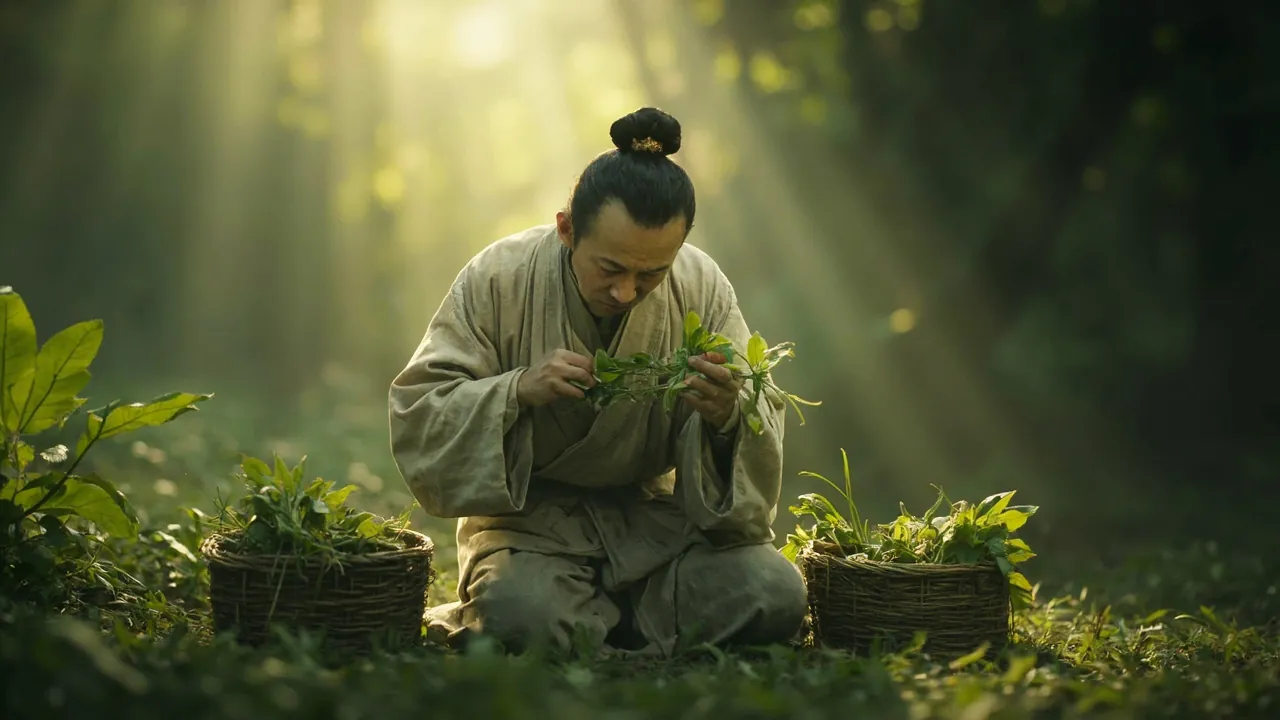
category: Chinese Culture tags: [“Chinese Sword”, “Jian”, “Martial Arts”, “Chinese Weapons”, “Ancient China”, “Wushu”, “Swordsmanship”] image: /images/chinese-sword.jpg categories: [Chinese Culture] alt_text: “Illustration depicting the chinese jian sword, in a traditional Chinese cultural setting” affiliate_products: [chinese-sword-replica, silk-fabric-scarf, chinese-history-book, chinese-poetry-collection]
There is a shape that has haunted the Chinese imagination for over three thousand years. It’s slim, elegant, double-edged, and roughly the length of a man’s arm. It has been carried into battle by kings and farmers alike, wielded by poets in moments of fury and by monks in search of enlightenment. It has been forged in hidden mountain workshops, traded across the Silk Road, buried with emperors, and displayed in the homes of scholars who had never learned to fight a day in their lives. This is the jian (剑), and it is far more than a weapon. In Chinese culture, the jian is a philosophy, an art form, and a symbol of something that transcends the physical entirely.
Westerners often confuse the jian with the broader category of “Chinese sword,” but the distinction matters. The jian is specifically the double-edged straight sword — as opposed to the dao, which is the single-edged curved blade more commonly associated with cavalry and infantry combat. Where the dao is powerful and direct, the jian is subtle and precise. It demands technical mastery, timing, and a quality of attention that transforms the person who carries one. This is why, across Chinese history, the jian has been associated with the elite — not necessarily the social elite, but the spiritually and artistically elite. Scholars who practiced calligraphy were said to move the brush with the same fluidity as a sword. Poets carried jian as extensions of their creative will. Martial artists who mastered the jian were said to have achieved a state of unity between body and blade that bordered on the mystical.
Ancient Origins: The Jian in Early Chinese History
The earliest jian-like weapons in China appear during the Shang Dynasty (c. 1600–1046 BCE), though these early blades were bronze and considerably shorter than the steel swords that would later define the tradition. The transition from bronze to steel is one of the most significant technological shifts in Chinese military history, and it happened during the Warring States period (475–221 BCE) and was largely complete by the time of the Qin and Han dynasties.
The reason for the shift was practical: steel is harder, lighter, and able to hold a sharper edge than bronze, and as metallurgy improved across the Warring States period, smiths began experimenting with increasingly sophisticated forging techniques. The most famous of these was百炼钢 (bǎiliàn gāng, “hundred-times refined steel”) — a process in which steel was folded and hammered repeatedly to remove impurities and create a blade of extraordinary strength and flexibility. A sword forged using this technique could be bent almost double and spring back to straight, a property that made it invaluable in close combat.
One of the most famous early jian comes from the tomb of the Marquis of Zeng, buried around 5th century BCE. This sword — still sharp and gleaming after nearly twenty-five centuries underground — is a masterwork of early metallurgy, its blade displaying the characteristic uniform grain structure that indicates expert heat treatment. The sword’s decorative collar is inlaid with a zigzag pattern of gold and copper, and an inscription on the blade identifies its maker. Swords like this were not mass-produced. Each one was a unique object, the product of a master smith whose reputation traveled with the blade.
During the Spring and Autumn period (770–476 BCE) and the Warring States period, the jian became increasingly associated with the aristocratic warrior class. Knights who could afford high-quality weapons commissioned custom blades from renowned smiths, and certain families of sword-makers acquired legendary reputations. The most famous of these was the Ou Ye (欧冶) family of Yue Kingdom, who are credited with forging some of the most celebrated swords of ancient China, including the legendary湛卢 (Zhànlú) and太阿 (Tài’ē). The Yue kingdom, located in modern Zhejiang province, was famous for its water-separated valleys, abundant iron ore, and exceptional smithing tradition — a combination of natural and human resources that produced swords of unmatched quality.
The Legendary Swords of Ancient China
Chinese history is rich with legendary swords, each carrying its own story and symbolic weight. These blades were never merely weapons; they were political objects, spiritual artifacts, and focal points for national identity.
The story of干将莫邪 (Gānjiàng Mòyé) is perhaps the most famous sword legend in Chinese culture. According to the tale, the swordsmith Ganjiang and his wife Moye were commissioned by the King of Wu to create a pair of extraordinary swords. Ganjiang threw himself into the forge, sacrificing his own body into the molten metal to achieve the perfect blend. The resulting swords were named after the two lovers, and the legend has it that the sword Moye traveled the world, eventually finding its way to the hands of an emperor, while Ganjiang remained hidden. The story combines themes of craftsmanship, sacrifice, romantic love, and the almost supernatural qualities attributed to the finest blades.
泰阿 (Tài’ē) is another legendary sword associated with the state of Chu. Legend holds that this sword was forged by the famed smith Ou Ye at the request of the King of Chu, and that when the King of Qin laid siege to Chu’s capital, the sword was surrendered as tribute. According to tradition, the Tài’ē contained the spirit of the cosmos itself — a claim that sounds extravagant until you understand that the best Chinese swords were understood not as tools but as living entities, imbued with a quality that their wielders experienced as spiritual presence.
龙泉剑 (Lóngquán Jiàn, “Dragon Spring Sword”) is not a single legendary blade but a tradition of sword-making that continues to this day. The city of Longquan in Zhejiang province became a center of jian production during the Song Dynasty (960–1279 CE), and the swords produced there — characterized by their distinctive water-patterned blades and exceptional balance — became the most sought-after martial arts swords in China. The Longquan sword-making tradition has been continuously maintained for nearly a thousand years, and today the city’s artisans produce swords that are used by martial artists, collected by museums, and presented as state gifts.
Swordsmanship as Art: The Practice of the Jian
In Chinese martial arts tradition, the jian occupies a special position. It is widely regarded as the most technically demanding of all Chinese weapons, requiring a level of precision and control that its wielders describe as more similar to dance than to fighting. Where the dao relies on power and momentum, the jian relies on timing, angle, and an almost meditative quality of attention.
Traditional jian training begins with fundamental forms (套路, tàolù) — sequences of movements that train the body to move with the blade in natural, flowing patterns. These forms, which can last from two to five minutes, emphasize the five essential cuts of jian combat:刺 (cì, thrust), 劈 (pī, hack/chop), 撩 (liāo, flick upward), 斩 (zhǎn, slice), and 挂 (guà, parry/draw). But within these basic categories, there is infinite variation, and the true master’s art lies in the transitions between cuts — the moments when one technique flows into the next without any perceptible pause.
Wudang swordsmanship is particularly famous for its philosophical approach to the blade. Based on the Taoist martial arts traditions of Mount Wudang, Wudang jian practice emphasizes softness and yielding — the principle of using the opponent’s energy against them rather than meeting force with force. The sword, in this tradition, is not so much a weapon as an instrument of Taoist cultivation, and practitioners often describe their training as a form of moving meditation.
The太极剑 (Tàijí Jiàn, “Tai Chi Sword”) is perhaps the most widely practiced sword form in the world today, having spread far beyond China through the global popularity of Tai Chi. The Tai Chi Sword form mirrors the slow, flowing movements of hand-form Tai Chi, but with a sword in hand. The effect is hypnotic — the practitioner’s body seems to dissolve into the movement, the blade tracing invisible patterns in the air. It’s a practice that can be approached as a martial art, a meditation, or simply as a beautiful art form, and it speaks to the jian’s unique capacity to function at the intersection of combat, spirituality, and aesthetics.
Shaolin swordsmanship represents a contrasting approach — more direct, more explosive, incorporating the Shaolin tradition’s characteristic acrobatics and power generation. Shaolin sword forms are fast, dynamic, and physically demanding, and they reflect the monastery’s broader approach to martial training, which treats physical conditioning as inseparable from spiritual development.
The Jian in Chinese Culture, Art, and Philosophy
Beyond the martial context, the jian permeated Chinese high culture in ways that are still visible today. The poet who carries a sword, the scholar who hangs a jian on his wall, the newlywed couple who includes a sword in their ceremony — all of these are drawing on a symbolic vocabulary that has been accumulating for over two thousand years.
In classical Chinese poetry, the sword appears constantly as a symbol of loyalty, courage, personal integrity, and the willingness to act decisively in defense of one’s principles. Li Bai, the great Tang Dynasty poet (whose life we covered in another article), was famously a swordsman as well as a poet, and his poems are full of the sword as metaphor. In his famous work侠客行 (Xiákè Xíng, “Song of the Knight-Errant”), he celebrates the anonymous swordsman who lives by his own code:
十步杀一人, 千里不留行。 事了拂衣去, 深藏身与名。
(Kill a man with every ten steps — / a thousand miles, never stopped by anything. / When the deed is done, brush the dust from your clothes, / hide your body and your name deep.)
This is the romantic image of the swordsman in Chinese culture: the figure of justice and action, who lives outside the conventional social order, operates by his own moral code, and does not seek recognition or reward. The swordsman (剑客, jiànkè) occupies a special place in the Chinese moral imagination, and the jian is the instrument through which this idealized self is expressed.
In the Confucian tradition, meanwhile, the sword represented something more subtle. The Scholar-Official (士, shì) class, which dominated Chinese government for over two millennia, traditionally practiced archery and swordsmanship as part of their physical education, alongside calligraphy, music, and the Confucian classics. The sword was understood as a complement to the pen — a symbol that the scholar, for all his literary refinement, was also capable of decisive action when circumstances demanded it. Many famous officials and poets were also noted swordsmen, and the combination of literary cultivation and martial skill was considered ideal.
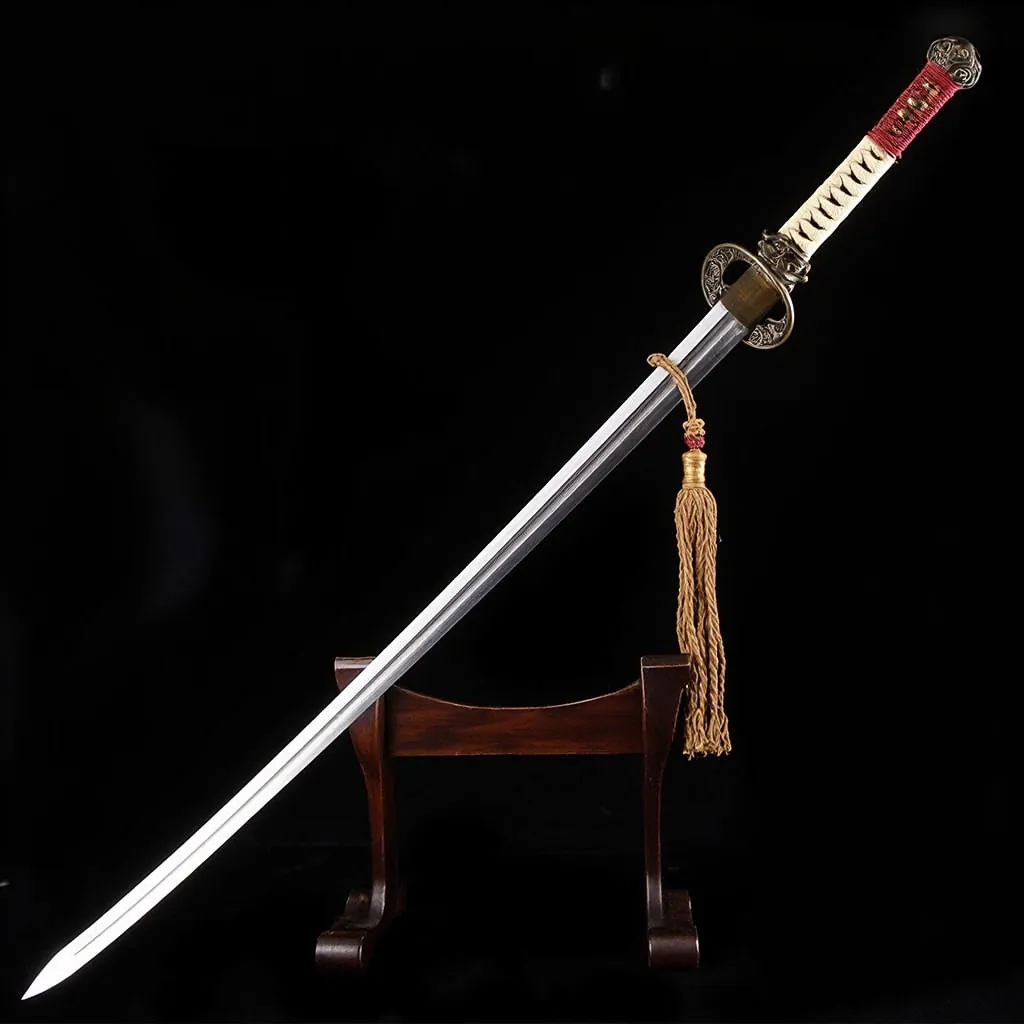
The decorative jian — a sword not intended for combat but for display, ceremony, or feng shui — is another important cultural artifact. Decorative swords are often displayed in homes and businesses as symbols of protection, courage, and positive energy. In feng shui practice, a sword hung on a wall is said to deflect negative energy (sha qi) and promote the flow of beneficial sheng qi. These display swords are typically elaborately decorated, with intricately etched or inlaid blades, tasseled hilts, and scabbards covered in silk or lacquered wood.
Modern Revival: The Jian in the Contemporary World
The 20th century was hard on Chinese martial arts, and the jian suffered along with everything else. The Cultural Revolution (1966–1976) saw martial arts practice suppressed as “feudal superstition,” and many traditional practices went underground or were lost entirely. But as China reopened in the 1980s and began to rediscover its cultural heritage, martial arts — and the jian in particular — experienced a significant revival.
Today, jian practice is flourishing in China and around the world. Wushu (martial arts) has been officially promoted as a sport by the Chinese government, and the jian is one of the five primary weapons in competitive wushu. International competitions feature standardized jian forms that showcase the blade’s speed, precision, and elegance, and Chinese national teams routinely win gold medals in these events. Meanwhile, traditional styles — Wudang, Shaolin, Yang-style Tai Chi Sword, Chen-style — continue to be taught in schools and private studios across China, North America, Europe, and Southeast Asia.
For collectors, the modern market offers a wide range of options, from mass-produced decorative swords to museum-quality collector pieces hand-forged using traditional techniques. A genuine Longquan-forged jian, made by a certified master using traditional methods and materials, can cost several thousand dollars — but for a serious practitioner or collector, it represents a genuine connection to a tradition that stretches back centuries.
Whether you’re interested in martial arts, Chinese history, or the sheer aesthetic beauty of a perfectly balanced blade, the jian offers something that few other objects can match. It is a piece of Chinese civilization that you can hold in your hand, that responds to your body when you move, and that connects you, through its weight and balance and edge, to thousands of years of continuous tradition.
Recommended Products:
Authentic Longquan Forged Steel Jian - Traditional Style — A hand-forged steel jian from the Longquan sword-making tradition, featuring a folded-steel blade, hardwood scabbard, and traditional brass fittings. Suitable for martial arts practice and display.
Wudang Jian Martial Arts Training DVD — A comprehensive instructional video covering the fundamental forms and principles of Wudang swordsmanship, taught by a certified Wudang disciple and filmed at the Wudang Mountains.
Bronze Jian Replica - Han Dynasty Style — An accurately reproduced bronze sword based on archaeological finds from the Han Dynasty, designed for collectors and history enthusiasts who want to own a piece of ancient Chinese martial arts heritage.
Jade Hilted Display Jian - Silk Scabbard — An elaborate decorative jian with a jade-mounted hilt, silk-wrapped scabbard, and finely etched blade, suitable for feng shui display or as a statement piece in a home library or study.
The Jian in Chinese Culture and History - Academic Text — A scholarly exploration of the jian’s role in Chinese civilization, covering its history, metallurgy, martial applications, and cultural significance. An essential read for serious enthusiasts.
The jian is one of those objects that carries its history in its weight. When you hold a well-made jian — feel the balance shift as the blade describes its arc through the air, hear the whisper of steel as it cuts — you’re not just handling a weapon. You’re holding a tradition that connects the Warring States battlefield to the Tai Chi park at dawn, from the poetry of Li Bai to the demonstrations at the Olympics. It’s a living art, and like all living arts, it rewards the attention you bring to it. Whether you train with it, collect it, or simply admire it from across a room, the jian has something to offer — a glimpse of what human hands and human dedication can achieve when they commit fully to mastery.