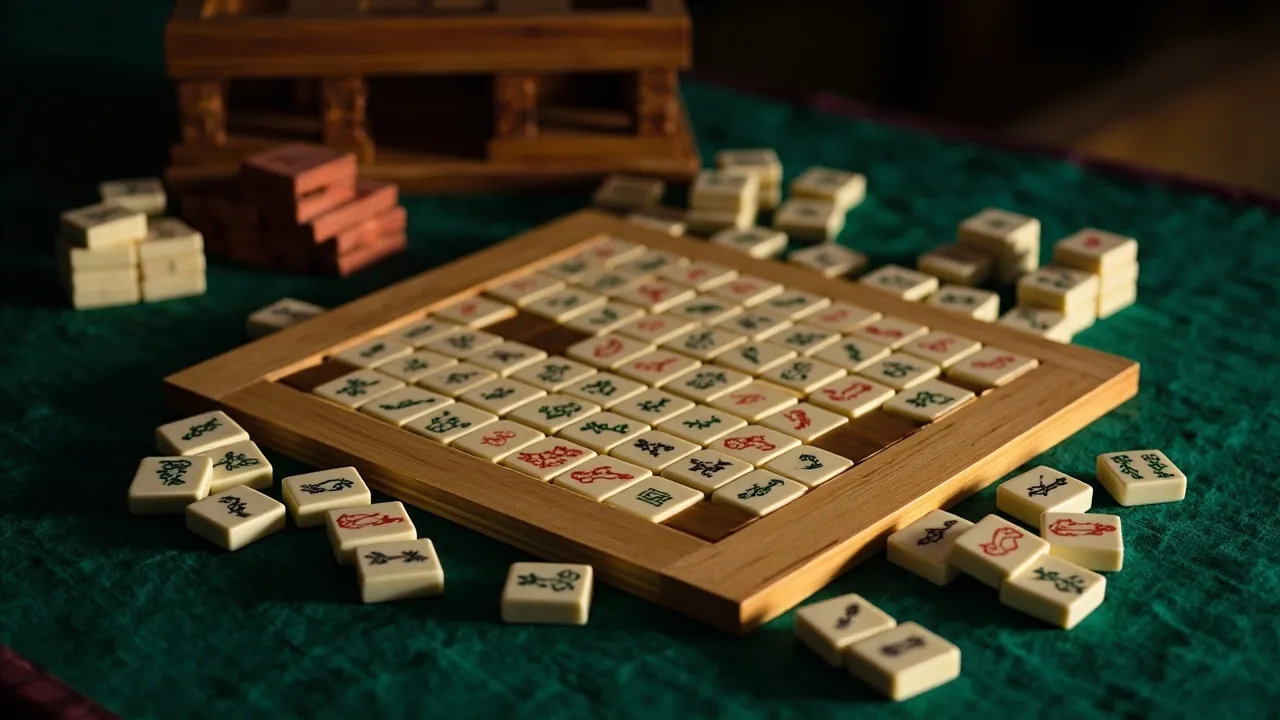
If you’ve ever sat around a table with friends, clicking tiles and swapping stories into the late hours, you’ve already touched on a tradition that stretches back thousands of years. Traditional Chinese games aren’t just pastimes—they’re windows into the culture, philosophy, and daily life of one of the world’s oldest civilizations. From the noisy click of Mahjong tiles to the quiet intensity of a Weiqi match, these games have entertained generations and continue to bring people together today.
Mahjong: The Game of Tiles
Walk into any Chinese community around the world, and you’ll likely hear the distinctive clack of Mahjong tiles being shuffled and played. This game, which dates back to the Qing Dynasty in the 19th century, has become synonymous with Chinese gaming culture—not just in China, but in living rooms and community centers from Los Angeles to London.
Mahjong is played with 144 tiles made from bamboo, bone, or ivory, each bearing Chinese characters and symbols. The tiles are divided into three suits (dots, bamboo, and characters), plus winds, dragons, and special flowers and seasons. Four players sit around a table, taking turns drawing and discarding tiles until one player completes a valid hand.
What makes Mahjong so enduring? For starters, it’s a perfect blend of luck and skill. You need good tiles to win, but knowing when to discard, which combinations to pursue, and how to read your opponents’ strategies separates the casual players from the masters. The game also carries strong social connotations. In China, it’s not unusual for families to spend entire afternoons playing Mahjong during holidays, with the click of tiles serving as background music to conversation and laughter.
The game has evolved considerably since its origins. Regional variations exist throughout China, and the version most Americans know differs somewhat from the classic Sichuan or Cantonese styles. Online and mobile Mahjong has introduced the game to millions of new players, though nothing quite replaces the tactile experience of handling real tiles with friends gathered around a table.
How to Play Mahjong
The basic gameplay is straightforward once you understand the tile types. Each player starts with 13 tiles and draws a 14th each turn, then discards a tile they don’t need. The goal is to form four melds (either three-of-a-kind or runs of consecutive tiles) plus a pair. When a player declares “Mahjong!” with a complete hand, the round ends and scores are calculated.
What adds complexity is the scoring system. Hands can be worth different point values based on how they were completed, what special combinations are present, and various other factors. A player who wins by drawing the winning tile themselves gets different points than one who wins from another player’s discard. This creates interesting strategic choices—should you go for a simple winning hand quickly, or aim for a higher-scoring but harder-to-achieve combination?
The social dynamics of Mahjong are just as important as the rules themselves. It’s common for players to chat, snack, and enjoy each other’s company while playing. In many ways, the game is simply an excuse for gathering—a framework that organizes the social occasion rather than the main attraction. This explains why Mahjong sessions can last for hours, with multiple rounds played and re-played as the afternoon turns to evening.
Chinese Chess (Xiangqi)
If you’ve ever played Western chess, Chinese chess will feel both familiar and entirely new. Known as Xiangqi (象棋), this ancient game shares the same basic premise—two armies facing off across a board, each trying to checkmate the opponent’s commander. But the similarities largely end there, making Chinese chess a fascinating journey into a different strategic tradition.
The board itself is striking. It’s divided by a “river” running horizontally across the middle, with a “palace” zone on each side marked by an X pattern. The pieces—soldiers, elephants, horses, chariots, cannons, and generals—move differently than their Western counterparts. The Elephant, for instance, moves two squares diagonally and cannot cross the river, while the Advisor moves only one square diagonally but must stay within the palace.
The most distinctive feature of Chinese chess is the river itself. Once your pieces cross into enemy territory, soldiers transform from defensive pieces to aggressive attackers, gaining the ability to move forward, sideways, or take one step forward—unlike their limited forward-only movement on your side of the board. This creates fascinating strategic tensions, as you must decide when to push your soldiers across and risk losing their defensive capabilities.
The Cannon (pao) is perhaps the most unusual piece in Chinese chess. It moves like a Chariot—horizontally or vertically any number of squares—but can only capture by “jumping” over exactly one other piece (of either color) to land on and capture a piece beyond. This makes Cannons powerful long-range weapons that can strike from surprising angles, but only when the board is set up correctly.
The Strategy Behind Xiangqi
Chinese chess rewards patience and positional thinking more than aggressive tactics. While quick attacks can work against beginners, experienced players understand that controlling the center of the board, protecting their general, and creating threats are more sustainable strategies. The game often features long positional struggles where neither player can find a decisive breakthrough.
Professional Xiangqi has developed an extensive body of opening theory, though it’s less codified than Western chess openings. Players study classic games, memorize typical pawn structures, and learn standard tactical patterns. Tournaments attract thousands of competitors at various levels, from local community events to national championships with significant prizes.
One interesting aspect of Chinese chess culture is the prevalence of street players. In parks throughout China, you’ll find tables set up where enthusiasts gather to play and watch. These informal settings allow players of all levels to compete and learn from each other, creating a vibrant grassroots culture around the game.
Weiqi (Go): The Surrounding Game
Weiqi, known as Go in Japan and Baduk in Korea, is often called the oldest board game continuously played in the world. Archaeological evidence suggests it originated in China over 2,500 years ago, making it older than chess, backgammon, or any other board game you might name. Yet despite its ancient origins, Weiqi remains remarkably popular today, with millions of players worldwide and professional tournaments offering substantial prizes.
The rules of Weiqi are famously simple—so simple that they can be explained in under five minutes. Two players take turns placing black and white stones on the intersections of a 19x19 grid. The goal is to surround more territory than your opponent. Stones group together, and when a group is completely surrounded by enemy stones with no “liberties” (empty adjacent points) remaining, it gets captured and removed from the board.
This apparent simplicity is deeply deceptive. The strategic depth of Weiqi is virtually infinite, which is precisely why it has captivated players for millennia. The game teaches patience, long-term thinking, and the value of position over material. Unlike chess, where capturing pieces often leads to immediate gains, in Weiqi the true value of a move may not become clear until dozens of moves later.
The Philosophy of Weiqi
The game also carries profound philosophical weight in Chinese culture. The black and white stones represent the interplay of yin and yang, the complementary forces that make up existence. The empty board represents potential, and each move creates reality from nothingness. Many Chinese scholars and artists have played Weiqi, finding in it a meditation on life, strategy, and the nature of conflict itself.
Weiqi is often compared to military strategy, and indeed classic Chinese military texts draw parallels to the game. The concepts of territory, influence, timing, and sacrifice all apply equally to Weiqi and to actual warfare. Yet the game also teaches peaceful resolution—the best games often end with one player recognizing defeat before any stones are captured, avoiding unnecessary conflict.
In recent years, Weiqi has gained new popularity thanks to artificial intelligence. When Google’s AlphaGo program defeated top human players in 2016, it marked a watershed moment—not the end of human play, as some feared, but a new chapter in our relationship with the game. Players now study AI-generated moves, finding deeper understanding in ancient patterns, proving that Weiqi’s appeal truly is timeless.
Traditional Children’s Games
While Mahjong, Chinese chess, and Weiqi dominate the adult gaming landscape, Chinese children have their own rich tradition of games passed down through generations. These games, often played in schoolyards and neighborhood corners, reflect Chinese culture, values, and daily life in ways both subtle and obvious.
One beloved game is Jian Zi (毽子)—shuttlecock kicking. Players keep a weighted shuttlecock aloft using only their feet, knees, and heads, competing to see who can keep it going the longest or perform the most impressive tricks. The shuttlecock itself is often handmade, with colorful feathers attached to a weighted base. This game improves coordination and balance while providing endless entertainment. In some regions, Jian Zi is so popular that whole communities gather for competitions, with players of all ages joining in.
Tiao Fang (跳房), or hopscotch as we might call it, has Chinese origins stretching back centuries. Children draw numbered squares on the ground and hop through the pattern, retrieving small objects thrown into each square. The specific patterns and rules vary by region, but the basic spirit—combining physical activity with counting and strategy—remains consistent. This game helps young children develop number recognition and physical coordination while providing plenty of outdoor fun.
Another classic is Meng Qi (蒙棋), a hide-and-seek variant that combines tagging with strategic movement. One player is “it” and must tag others, who try to reach a designated safe zone. What makes it interesting is the element of deception—players often pretend to go one direction before darting another way, teaching children both physical skills and psychological manipulation.
Games of Skill and Chance
Chinese children also enjoy various games of chance and skill that have been passed down for generations. Diu Shou Juan (丢手绢), or “throwing the handkerchief,” involves one child running around a circle while holding a handkerchief, trying to drop it behind another player without being caught. This game teaches stealth, speed, and awareness while providing plenty of laughter.
Yun Shen (翻绳), or string figure games, uses a loop of string manipulated between two players to create various shapes. These shapes often represent animals, objects, or geometric patterns, and players take turns creating increasingly complex figures. This quiet game develops fine motor skills and patience, and it’s a favorite during long winter evenings when children are stuck indoors.
These traditional games served important purposes beyond mere entertainment. They helped children develop physical coordination, social skills, and strategic thinking. They also reinforced cultural values—working together, respecting elders, and perseverance through difficulty. While modern video games and smartphones have captured much of children’s attention, these traditional games still thrive in schools and communities, keeping ancient traditions alive one generation at a time.
Conclusion
Traditional Chinese games offer far more than entertainment. They provide a window into Chinese history, philosophy, and social life that few other cultural artifacts can match. Whether you’re shuffling Mahjong tiles with family, contemplating your next move in Xiangqi, or placing your first stones in a Weiqi game, you’re participating in traditions that have brought joy to millions across centuries.
What makes these games particularly appealing is their accessibility. You don’t need to speak Chinese or understand Chinese history to enjoy them. The strategies, the social connections, the satisfying click of tiles or stone on wood—these are universal pleasures that transcend cultural boundaries. So why not pick one and give it a try? Your next favorite game might be waiting across the board.
Ready to explore more of Chinese culture? Check out our articles on traditional Chinese festivals, Chinese tea ceremony, and the fascinating history of the Chinese zodiac.