A 4,000-year-old fight over empty space
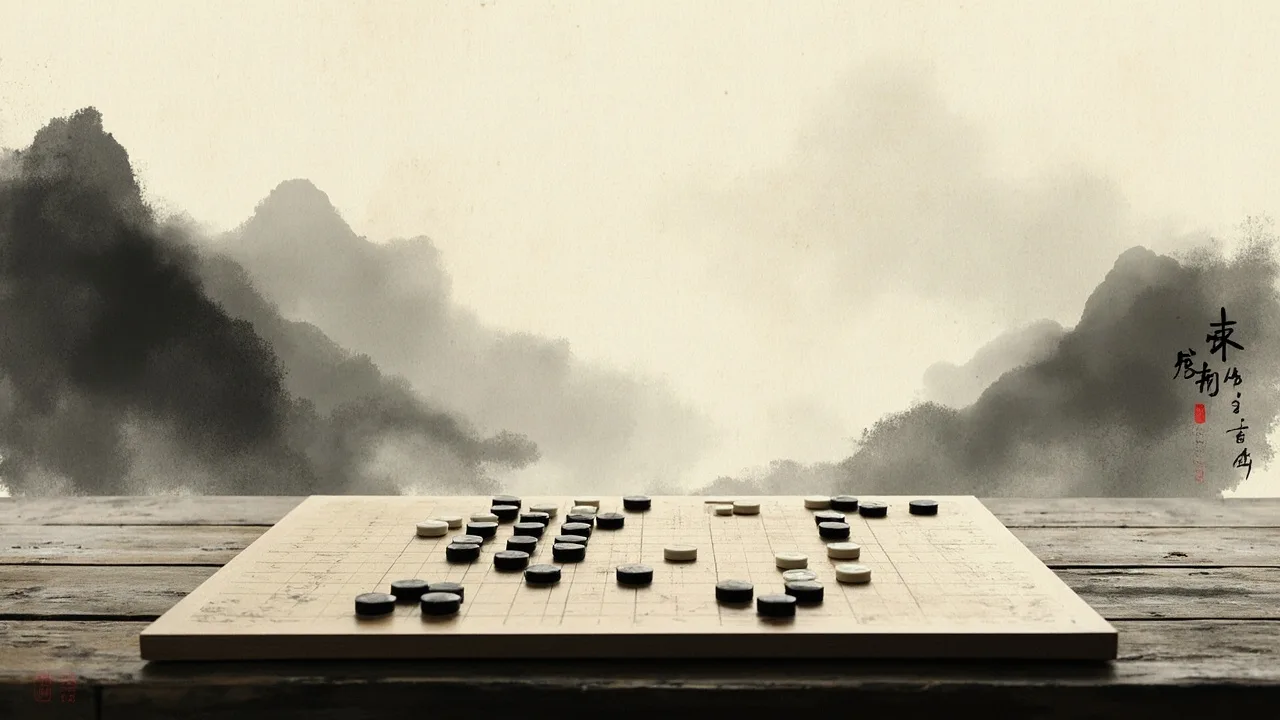
If chess feels like a battle between armies and checkers feels like a kids’ afternoon, weiqi feels like a conversation between two generals staring at a blank map. You put a stone down. Your opponent puts a stone down. You keep going. The board fills up slowly, and whoever controls the most empty space at the end wins.
That is the whole game, technically. The reason it took me years to understand is that the strategy behind those moves is impossibly deep. A 19×19 grid has more possible positions than there are atoms in the universe — a real, defensible scientific estimate, not a poetic exaggeration. The game has been played, in one form or another, for roughly 4,000 years. Chinese, Korean, and Japanese players treat it less as a hobby and more as a lifelong study, on the same level as calligraphy or tea.
In the West we usually call it Go (that’s the Japanese pronunciation). In China it’s called weiqi (围棋), which literally means “the encircling game.” The board is a goban. The stones are usually made of slate (black) and clamshell (white). And when I tell American friends about it, the first question is always the same: how is it different from chess?
The short answer: in chess, you try to kill the king. In weiqi, you try to keep the king alive long enough to claim the most land.
The rules you’ll learn in fifteen minutes
You can teach weiqi to a child in about ten minutes. You can spend a lifetime not mastering it. Here’s the short version:
Two players. Black goes first. On your turn, you place one stone on any empty intersection on the 19×19 board (361 in total). Stones don’t move once placed. You’re trying to do two things at once: surround the most empty territory, and capture your opponent’s stones by cutting off their last liberties (the empty points next to a stone or group). Surround a stone completely — no empty points touching it, no friendly stones next to it — and your opponent picks it off the board as a prisoner.
That’s it. No piece values. No pawns, knights, or bishops doing different things. Just one type of stone per side, identical except for color, on a grid. The asymmetry comes from the players, not the pieces.
A few terms you’ll hear a lot:
- Liberty: an empty point adjacent to a stone or connected group of stones. When a group has zero liberties, it’s captured.
- Eye: a single empty point inside a group of your own stones. Two eyes and a group is “alive” — your opponent can never capture it, because playing inside an eye would reduce your own group’s liberties to zero.
- Ko: a rule against immediately repeating the previous board position, which prevents infinite back-and-forth captures.
- Komi: a compensation of about 7.5 points given to White at the start, because Black moves first. Without komi, the first-player advantage would be too big.
The game ends when both players pass (meaning neither side thinks they can do better), and then you count territory: empty points you control, plus any prisoners you’ve captured. Most games last somewhere between 150 and 300 moves. The longest official professional game on record is over 400 moves and lasted more than 16 hours.
If you’ve played the board game Othello, you’ll find some of the surrounding concepts familiar. If you’ve played chess, you’ll find the lack of piece variety almost disorienting at first. The point is: every move is just a stone on a grid, but the patterns you can build with them are essentially infinite.
Why Chinese thinkers saw a battlefield in the empty board
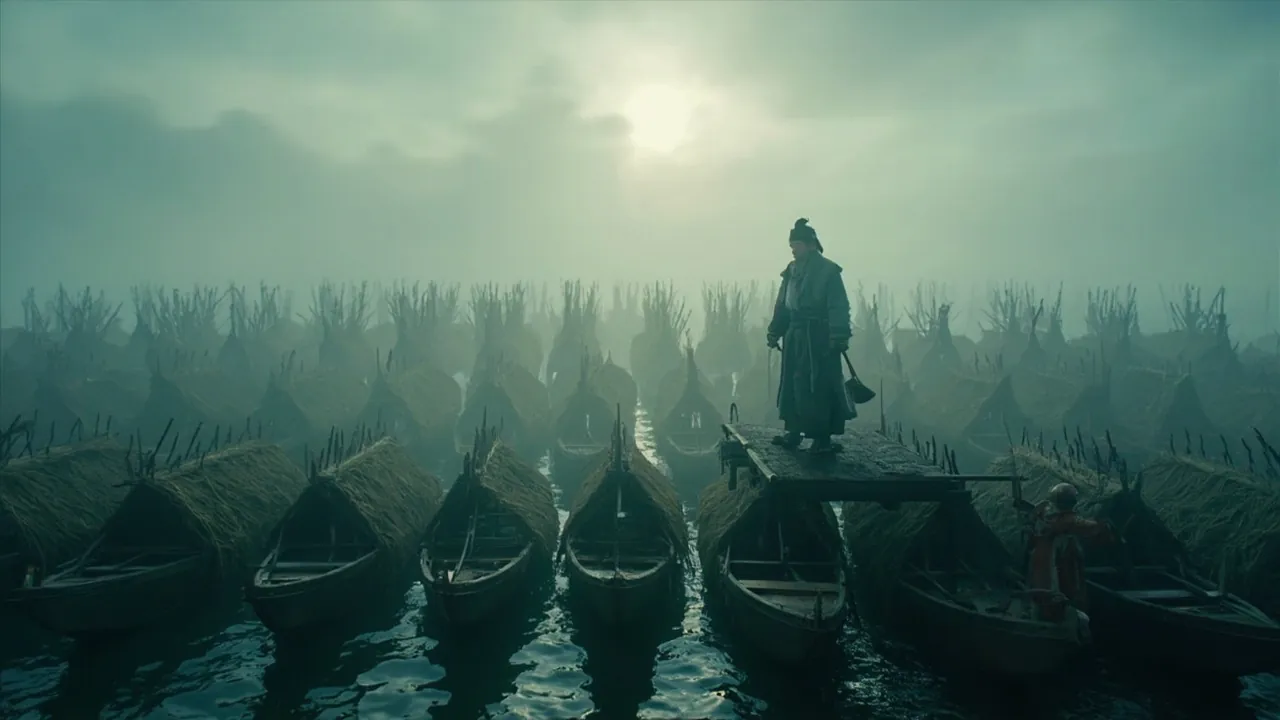
There’s a reason weiqi has been called the “Art of War in miniature.” Sun Tzu’s The Art of War — written in China roughly 2,500 years ago, right around the time weiqi was becoming standardized — contains lines that read like a weiqi commentary.
“All warfare is based on deception,” Sun Tzu wrote. In weiqi, you often play quiet moves in one corner while building a trap across the board. Your opponent has to read the whole position, not just the local fight.
“He who knows when he can fight and when he cannot will be victorious.” In weiqi you learn quickly when to fight for a contested group and when to abandon it. A stone you don’t save can become territory elsewhere.
“The best soldier is not the most warlike.” A weiqi player who plays loudly — grabbing every group, fighting every fight — usually loses to a quieter player who picks their battles.
The Daoist classic Zhuangzi (庄子), written in the 4th century BCE, contains one of the earliest weiqi metaphors: “When the well-frog sees the great ocean, he is amazed; when the well-frog sees weiqi, he is even more amazed.” Confucius himself is said to have taught weiqi, and his student Zi Gong reportedly complained that he couldn’t keep up with the old master’s strategies. (Confucius replied, “You cannot even beat me in weiqi — how could you govern a state?”)
By the Tang dynasty (618–907 CE), weiqi was so woven into Chinese intellectual life that imperial officials were promoted partly on their skill at it. A Tang-era official named Wang Baozhen once petitioned the emperor for a vacation, claiming his “weiqi game was at a critical stage.” He got the time off. The game crossed to Japan around the same period, where it became a beloved aristocratic pastime; to Korea, where the still-running Baduk tradition produced world champions; and later to the rest of Asia.
The interesting part is that the game has barely changed in two thousand years. Modern stones look the same as Tang dynasty ones. Modern boards are made of the same kaya wood. The rules you learn in 2026 are the rules someone learned in 826 CE.
March 2016: the night the world watched weiqi
For most of the 20th century, weiqi had a reputation as the board game AI couldn’t crack. IBM’s Deep Blue beat world chess champion Garry Kasparov in 1997. Two decades later, the best computer programs were still losing to professional weiqi players.
Then came AlphaGo.
In March 2016, a London-based AI company called DeepMind (owned by Google) put its program up against Lee Sedol, the Korean 9-dan player widely considered one of the best weiqi players of his generation. Lee had won more than a dozen international titles. He was 33 years old, near the peak of his career. The match was five games, held at the Four Seasons hotel in Seoul, with a million-dollar prize.
AlphaGo won 4–1.
The second game — move 37 — was the moment everything changed. AlphaGo played a stone on the fifth line of the board, on the right side. Commentators live and on Chinese streaming platforms (which had millions of viewers) thought it was a mistake. Even Lee Sedol stood up from his chair, walked out of the room, and came back pale. “It was a very surprising move,” he said afterward. “I thought it was a bug.”
It wasn’t. The stone turned out to be decisive. AlphaGo had seen something no human had ever played — something it had partly figured out by playing millions of games against itself.
The match became the most-watched weiqi event in history. In China, more than 60 million people watched at least part of it online. Lee Sedol later said it was one of the defining experiences of his life. After the loss, he retired from competitive play for several years (he came back, briefly, in 2024 with a single farewell game against an AI opponent he ultimately lost).
What AlphaGo proved wasn’t just that computers could play weiqi well. It proved that computers could play weiqi differently — finding strategies human players had ignored for centuries. Top professionals started studying AlphaGo’s games the way jazz musicians study John Coltrane. New openings were invented. Old proverbs like “in the opening, play on the third line, not the fourth” turned out to be wrong.
How weiqi is played today (and where you can start)
In China, Korea, and Japan, weiqi is taught to children the way chess used to be taught in America. The Chinese city of Lankao has been called the “weiqi capital,” with public boards in parks and pro players who start training before age 10. Korea runs a nationwide youth league. Japan still holds the Honinbo title, one of the oldest continuous sporting tournaments in the world (since 1941 in its modern form, with earlier iterations going back centuries).
In America, the American Go Association has been around since 1949. Universities — Harvard, MIT, Princeton — have long had weiqi clubs. New York, San Francisco, and Seattle have strong local scenes. Online platforms like OGS (Online Go Server), KGS, and the Chinese apps FoxGo and 弈城 (Yicheng) host millions of casual players. You can play a stranger in China in ten seconds, for free, no download required.
If you want to try it yourself:
- An inexpensive starter set (~$15–$30) gets you a 9×9 plastic board, two colors of stones, and a thin instruction sheet. A 9×9 game lasts maybe 20 minutes and teaches you the basic shapes.
- A mid-range wooden board with slate stones (~$80–$150) is a lifetime purchase. The board is usually kaya or spruce, the stones are slate and clamshell. A good one feels like a piece of furniture.
- Reading recommendations: The Protractor by Kaoru Iwamoto for an elegant introduction; Opening Theory Made Easy for players who want to stop losing in the first 30 moves; Lessons in the Fundamentals of Go by Toshio Kasanui for the middle-game; and Go and Go-moku by Edward Lasker (a 1908 American classic) for a historic view.
- Apps: BadukPop, AI Sensei, and the aforementioned FoxGo will match you against opponents at your level and let you review your games with AI analysis.
Most cities with a Chinese or Korean community will have at least one weiqi club. Most major cities will have at least one Go meetup regardless — it’s one of the most internationally-minded hobbies you can pick up, because the game is the same in every language.
Why I keep coming back to it
I learned weiqi by accident in my twenties, from a friend who had picked it up in college. He beat me 21 times before I won a game. I think about that game more than I’d like to admit — a small, ugly scrap on the side of the board where I’d somehow cut off his stones and claimed a corner that looked dead. He sat back, looked at the board for a long minute, and said: “Now you understand why people play for sixty years.”
That is, I think, the right way to put it. Weiqi is not a game you finish. It’s a game you sit with. It teaches a kind of patience I don’t get anywhere else: the willingness to make a move, sit with your hands folded, and trust that you’ll see the consequences in three moves, or thirty, or three hundred. In a country that runs on notification sounds and four-second attention spans, that feels increasingly rare.
It’s also one of the oldest things humans still do together. When you sit across the board from someone — black bowl, white bowl, the clack of stones on kaya — you’re doing something a Tang dynasty poet did, that a Korean monk did in 1100, that an old man in a Beijing park does every Sunday morning. The board has not changed. The stones have not changed. The only thing that changes is who’s playing.
If you’ve ever wanted to understand a Chinese cultural tradition that doesn’t require a museum ticket, this is a good place to start.