- name: “The Poetry of the Chinese: A Versified Translation of Tang and Sung Poems” url: “https://www.amazon.com/dp/1618040984" asin: “1618040984” description: “A comprehensive bilingual anthology of Tang and Song Dynasty poetry — including Li Bai, Du Fu, and the classical forms that shaped Chinese literary tradition.”
- name: “The Wandering Lake: A Novel” url: “https://www.amazon.com/dp/1933389784" asin: “1933389784” description: “A spare, poetic novel by one of contemporary China’s most celebrated writers — for readers interested in modern Chinese literature and Wuhan’s cultural heritage.”
- name: “China’s Cosmopolitan Empire: The Tang Dynasty (History of Ancient China)” url: “https://www.amazon.com/dp/0674064011" asin: “0674064011” description: “A comprehensive scholarly account of the Tang Dynasty — the era that produced the poets and culture celebrated at Yellow Crane Tower.”
- name: “365 Tao: Daily Meditations” url: “https://www.amazon.com/dp/0062502239" asin: “0062502239” description: “A year of daily meditations exploring Taoist wisdom — for readers drawn to the philosophical tradition behind Wuhan’s river culture.”
- name: “Li Shi Min, Founding the Tang Dynasty” url: “https://www.amazon.com/dp/0875869785" asin: “0875869785” description: “The story of the Tang Dynasty’s founding emperor — the strategic genius behind China’s most cosmopolitan historical era.”
Here is a riddle: what is the most famous building in China that most people have never actually seen?
The answer is Yellow Crane Tower. It is not in Beijing, not on the UNESCO list, not on the itinerary of most foreign tourists. It is in Wuhan, a city of 11 million people in central China that most Westerners have heard of only because of 2020. But mention the name huanghelou to any educated Chinese person and watch their face change. This building has been in their literature, their art, their collective memory since they were children.
The tower has been destroyed and rebuilt at least seven times. It has been a military watchtower, a Buddhist shrine, a Taoist observatory, a tourist attraction, and a symbol of national resilience. It has been written about by some of the greatest poets in Chinese history. And it is currently a 1957 concrete reconstruction that preservationists criticize and tourists love. None of that is the interesting part. The interesting part is how a single poem made a building immortal.
A Tower by the River
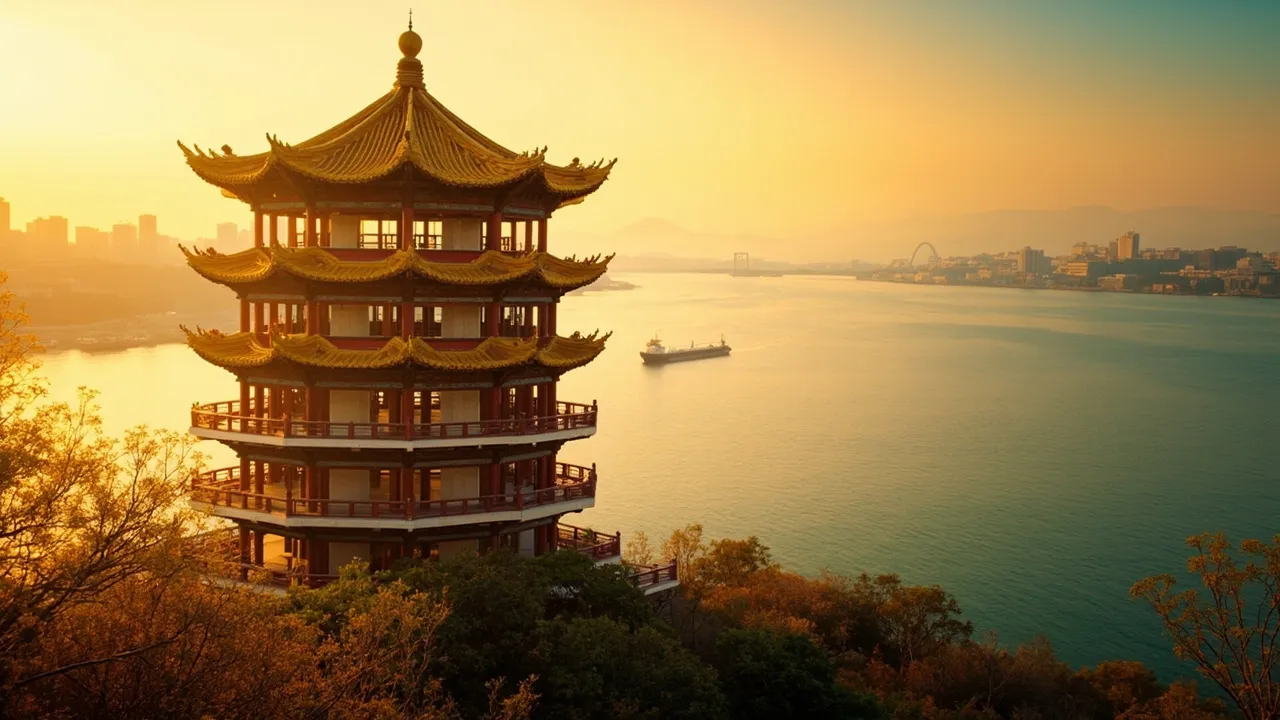
Yellow Crane Tower sits on Snake Hill (she shan), a peninsula that juts into the Yangtze River where the Han River joins it from the north. The location matters. Wuhan was, and is, one of the great river junctions of China — the place where goods and people moved between central China and the east, where the river traffic of the Yangtze system met the overland routes to the north and south. A tower on this hill would have been visible for miles in every direction, the natural place to watch for approaching ships.
The original tower was built in 223 CE, during the Three Kingdoms period, as a military observation post for the Wu kingdom. Wu was one of three kingdoms competing for control of China after the collapse of the Han Dynasty, and the Yangtze was its main defensive barrier. The tower’s early function was practical: watch for enemy boats.
The “Yellow Crane” name has a local legend attached to it, which is probably not historically true but is almost certainly better than the historical truth. The story goes that a yellow crane once flew out of a tavern near the hill, rose into the sky, and never returned. The tavern owner — or the poet who wrote about him — took this as a sign. The bird became associated with the location, the location became associated with the bird, and eventually the tower inherited the name. Whether or not the story happened, it is the right kind of story for this place. Yellow Crane Tower has always been about departure, absence, and what remains after something beautiful leaves.
The tower’s 1,800-year existence is a record of destruction and reconstruction that mirrors the broader history of China. It was destroyed by war, by fire, by neglect, by the slow violence of decay. Each time, it was rebuilt — not exactly as it was before, but close enough. Each generation reimagined it, adjusted its proportions, changed its details, and called it Yellow Crane Tower anyway. The building is a palimpsest of Chinese architectural taste.
The Poem That Made the Tower
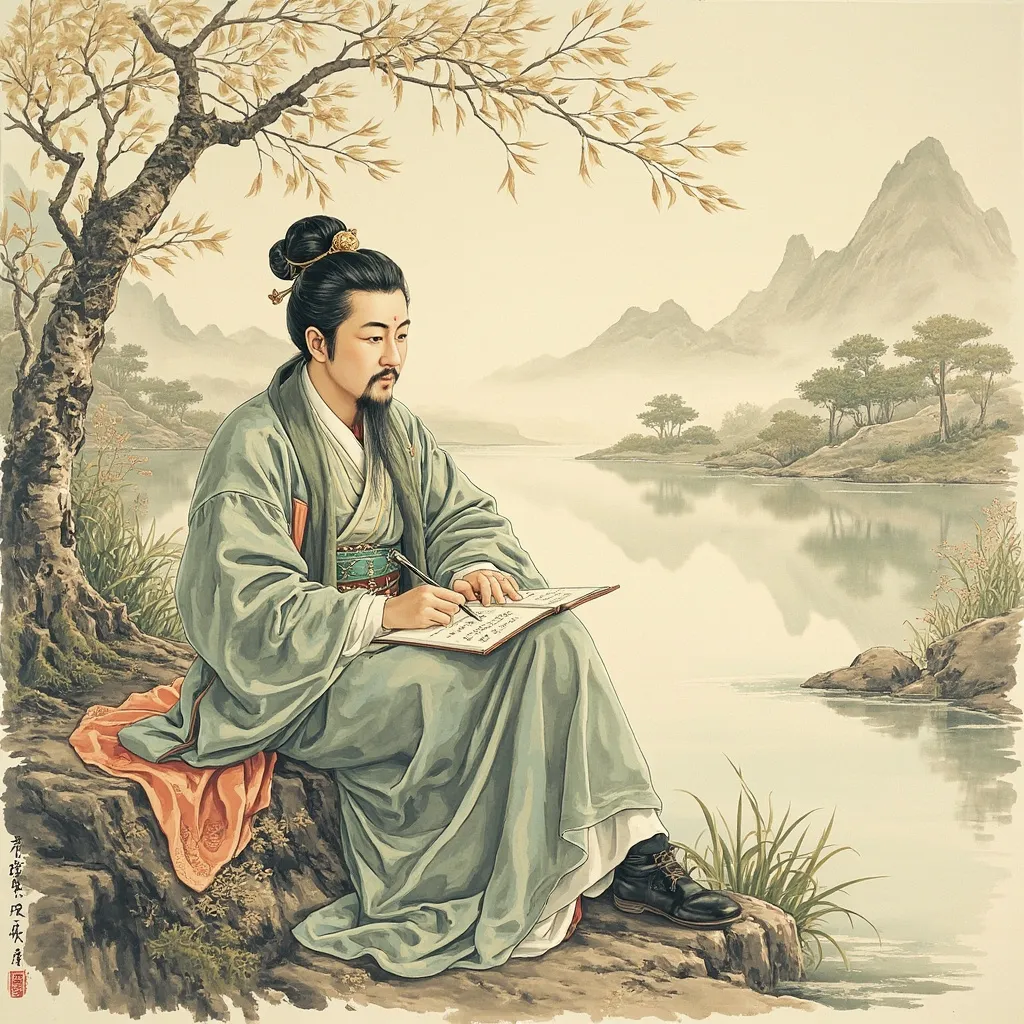
In approximately 730 CE, a poet named Cui Hao was drinking in Wuhan. This is the kind of biographical detail that sounds like a joke but is actually the entire story.
Cui Hao was a mid-level Tang Dynasty official, reasonably well-known in his time but not one of the major figures of Chinese literary history. He was visiting the Yellow Crane Tower, either for official reasons or because he was between official reasons, and he was drinking. At some point he looked at the tower, looked at the river, and wrote a poem that has been called the most famous single poem in Chinese literature — or at least, one of the two most famous, depending on who you ask.
Here is the famous couplet, in translation: The ancients rode the yellow crane away, here remains only the Yellow Crane Tower.
That is the whole poem in miniature. Everyone who has ever studied Chinese literature knows this couplet. It is taught to children. It appears on tea tins and keychains and tourist refrigerator magnets. It is, in the most literal sense, the reason the tower still stands — because a poem about its absence turned out to be more durable than any building material.
The rest of the poem continues in this vein of quiet devastation: the crane is gone, the clouds are white, I look at the river and think about old friends, I don’t know which way to turn. It is a poem about loss and the specific kind of loneliness that comes from being in a beautiful place without the people you want there.
Cui Hao’s poem became so famous that Mao Zedong reportedly refused to write his own poem about the tower when he visited in 1927, reportedly saying that the original was “unimprovable.” Whether or not Mao actually said this, the anecdote tells us something real about how Chinese literary culture treats certain texts — as canonical, as finished, as beyond revision. The poem is the tower now. The tower is just the building that holds the poem’s memory.
Li Bai — the poet who is arguably China’s most beloved writer — also wrote about Yellow Crane Tower, and his poem is frequently cited as a contrast to Cui Hao’s. The standard story is that Li Bai visited the tower shortly after Cui Hao, tried to write something in response, and produced something inferior — so inferior, in fact, that he reportedly declined to finish it. This story is probably not true. Li Bai’s poem is good. It is different from Cui Hao’s — more outward-looking, more about the view than the feeling — but it is not inferior. The legend about Li Bai’s failure is more interesting than the poem itself would have been, if he had actually failed, which he probably didn’t.
What matters is that two of the greatest Tang Dynasty poets both chose the same building as the place to say something important about impermanence. The tower by the river became, through this literary attention, the place in China where you go to think about the past and feel sad about it.
The Tower as China’s Nostalgia Machine
There is a Chinese literary concept — huaigu — that translates roughly as “thinking of the ancient” or “nostalgia for the past.” It is one of the most important themes in Chinese poetry, and it has no clean Western equivalent. It is not exactly nostalgia as the word is used in English — it is more specific, more formalized. Huaigu means going to a place where something historically significant happened and writing a poem about it. The place and the poem are inseparable. The place is the occasion; the poem is the point.
Yellow Crane Tower is the canonical huáigǔ site. If you want to write a poem about the past, about loss, about the way everything changes, you go to Yellow Crane Tower and you join a line that includes Cui Hao, Li Bai, and roughly a thousand years of literary tradition behind them.
What makes this culturally significant is that huáigǔ is not just an aesthetic preference. It is a value system. The tradition says that the past is more interesting than the present, that the people who came before us understood things we have forgotten, that there is wisdom in ruins. This is not passive melancholy — it is an active intellectual orientation. Chinese scholars and poets used the huáigǔ tradition to connect their own moment to a longer story, to feel part of something larger than their individual experience.
The tower accumulated meaning across dynasties. In the Song Dynasty, it was rebuilt slightly differently. In the Yuan, the Ming, the Qing — each rebuild reflected the architectural tastes of its time, but the cultural meaning remained constant. The tower was always the place where you thought about the past. The building was just the support structure for the tradition.
Mao Zedong wrote a poem about Yellow Crane Tower in 1927, after the failure of the Nationalist-Communist united front in Shanghai. His poem is different from the Tang versions — it is angrier, more political, more explicitly about the present moment rather than the ancient past. But Mao knew exactly what he was doing by using this location. He was placing himself in the huáigǔ tradition while also breaking from it. The tower gave his poem a weight it could not have earned on its own.
The Modern Tower
The current Yellow Crane Tower was rebuilt in 1957 and reconstructed again in 1985. It is 51.4 meters tall — roughly the height of a 15-story building — and has five stories arranged in an octagonal plan with yellow glazed tiles, which is the traditional Chinese pavilion style. It is not the original. It is not even close to the original, architecturally speaking. It is a 20th-century recreation of something that existed in a 3rd-century form, a 7th-century form, a 14th-century form, and several others in between.
Preservationists have opinions about this, some of them heated. The tower that stands today was built with modern materials and techniques, in a location that is slightly different from the historical sites, for a purpose — mass tourism — that the original builders could not have imagined. It is, in architectural terms, a replica. The question of whether replicas count as heritage is a genuine debate in the preservation field, and Yellow Crane Tower sits squarely in the middle of it.
But here is what the preservationists are missing, if they are missing it: the tower was always a symbol before it was a building. The poems made it that way. People have been coming to Wuhan to see Yellow Crane Tower for 1,800 years, and they have been coming primarily because of the poems. The building is the excuse. The tradition is the destination.
Wuhan itself is worth knowing something about. With 11 million people, it is one of the largest cities in central China and a major industrial hub — sometimes called the “Chicago of China” because of its role as a transportation and manufacturing center. It sits at the intersection of the Yangtze and Han rivers, which made it strategically important for the same reasons the original tower was placed there. In 2020, Wuhan became globally known for a different reason: it was the origin point of the COVID-19 pandemic.
During the 2020 lockdown, Yellow Crane Tower was closed. The Yangtze ran quietly. The tower stood empty on its hill, photographed by drones and shared around the world as a symbol of a city holding its breath. For a few months, the building that had been a symbol of impermanence and departure became a symbol of endurance and absence — the crane that was still gone.
When the city reopened, the tower reopened with it. People came back. The locks that couples had left on the railings over the centuries were still there. The poems were still there. The river was still there. The building had been rebuilt seven times, and it would presumably be rebuilt an eighth time if necessary, because that is what this particular structure does.
Why the Tower Endures
I keep coming back to the same question: how does a building survive its own repeated destruction?
The answer, in this case, is that the building never really survived. What survived was the idea of the building — the particular emotional and cultural function it served. Cui Hao’s poem did not require the original tower to exist. It required only the location, the river, and the feeling. The feeling was real, and it has not changed in 1,300 years.
Yellow Crane Tower is not famous for its architecture. It is not on anyone’s list of the most beautiful buildings in China. It is famous for the poems written about it, which means it is famous for something that cannot be destroyed by fire or war or the slow decay of old wood. The poems are the tower now. The building is just their house.
This is a Chinese solution to a universal problem — how to make something last. The Western approach is usually to build in stone, to make the structure as permanent as possible. The Chinese approach, at least in this case, was to build in something more durable than stone: language. The tower keeps being rebuilt because the poems keep being read. The poems keep being read because they say something true about the way loss works, about the way we need places to go to think about the people who are gone.
The yellow crane, as it happens, never came back. That is the point.