Chopsticks Etiquette: The 10 Things You Should Never Do at a Chinese Table
You’re at your first real Chinese dinner — maybe a hot pot place in Flushing, a wedding banquet in Guangzhou, or your in-laws’ New Year reunion dinner in Anhui. The food arrives, everyone reaches for their chopsticks at the same time, and within ninety seconds you’ve committed three separate social crimes without realizing it. Nobody said anything. Your host’s smile got a little tighter. Your partner kicked you under the table.
The thing about chopsticks etiquette is that it’s almost entirely invisible if you don’t know to look for it. Chinese hosts almost never correct foreigners in the moment, because correcting a guest causes the host to lose face. So you walk away thinking everything went fine. Then you get a polite text three days later asking if you’d like to come again “some other time.”
This is the cheat sheet I wish I’d had before my first round-table banquet — the ten mistakes that will get you talked about after you leave the room, where the taboos came from, and the small handful of habits that mark you as someone who’s been paying attention.
Why Chopsticks Have So Many Rules
Chopsticks (筷子, kuàizi) have been used in China for at least 3,000 years. The earliest artifacts matching chopsticks are bronze pieces from the Shang dynasty (roughly 1200 BCE), recovered from sites like the Yin Ruins in Henan — though the earliest clear written reference doesn’t appear until the Han Feizi (a Warring States-period philosophical text, ~3rd century BCE) (Wikipedia: Chopsticks). They weren’t just utensils. They were ritual objects — buried with the dead, used at ancestor offerings. So the rules aren’t arbitrary politeness; they’re fragments of a much older language about life, death, and how to behave in someone else’s home.
When you stick a chopstick vertically into a bowl of rice, you’re not being “rude” in the casual American sense. You’re recreating the shape of the incense sticks burned at funerals to feed hungry ghosts. The whole table reads that image instantly.
The 10 Things You Should Never Do
1. ❌ Don’t stick your chopsticks upright in food
The single most universally recognized chopsticks taboo across East Asia.
The rule: Chopsticks go flat — on the rest, across the bowl edge, on the table. They never stand vertically in food, especially not in rice.
Why: That shape is exactly how incense sticks are placed at a funeral altar, bundled upright in a bowl of rice to feed the dead. A standing chopstick in a rice bowl is a tiny funeral shrine on the dinner table. Every Chinese person at the table sees it the same way.
The exception that isn’t: Sticking chopsticks into a takeaway container to hold the lid open is so common that some younger diners are less strict. Don’t read this as permission.
2. ❌ Don’t drum your chopsticks on the table or bowl
The rule: Never tap or drum your chopsticks against the table, bowl, or plate. Even as a joke. Even to call the waiter. Especially not rhythmically.
Why: It echoes the gesture of beggars on the street in old China — poor travelers would tap bowls and chopsticks together to signal “please, give me food.” Drum-tapping is also said to summon misfortune.
What to do instead: To get a waiter’s attention, say “服务员” (fúwùyuán, “waiter, please”) and make eye contact. Don’t beatbox with your chopsticks.
3. ❌ Don’t stab food with your chopsticks
The rule: Chopsticks pick up food. They don’t spear it like a fork, don’t poke holes in tofu to “stabilize” it, and don’t impale a slippery dumpling as a shortcut for pinching.
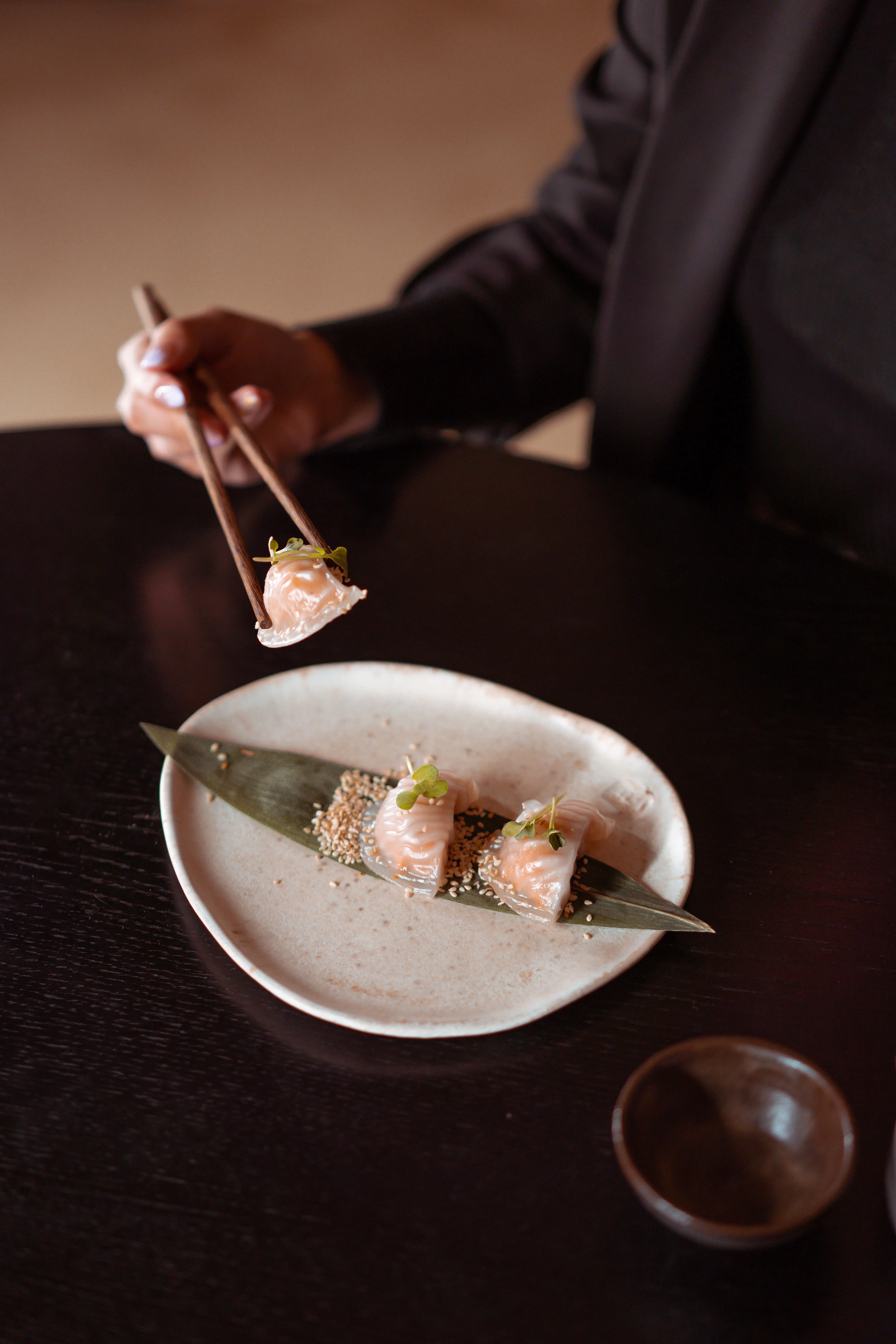
Why: Two reasons. A single upright chopstick with meat on the end reads as a funeral offering (same taboo as #1). And it’s bad technique — stabbing a slippery har gow is the chopsticks equivalent of stabbing spaghetti onto a fork. Everyone at the table knows you don’t know how to use the tool.
What to do instead: For slippery items, use the wider back end as a gentle scoop, or brace the dumpling against your bowl. For leafy greens, pinch a small bundle.
4. ❌ Don’t cross your chopsticks
The rule: When you set your chopsticks down, lay them parallel. Don’t leave them crossed in an X on the rest or across the bowl.
Why: Crossed chopsticks visually echo the + shape used in funeral decoration and on some Chinese grave goods. Not a strict taboo in many modern settings, but reads as careless at formal dinners. This one carries more weight at formal dinners and business banquets than at a casual weeknight — but it’s free to just lay them parallel, so do that.
What to do instead: Always return chopsticks to the rest in the same direction, tips pointing left, both sticks side by side.
5. ❌ Don’t point with your chopsticks
The rule: Don’t use your chopsticks as a pointer when talking. Don’t gesture at people, dishes, or the lazy Susan with chopsticks in hand.
Why: Chopsticks that just came out of your mouth shouldn’t be aimed at another human face. The American habit of holding utensils while talking is considered gross in Chinese households. Set them down.
6. ❌ Don’t flip the fish
The rule: When eating a whole fish (and at most real Chinese meals the fish is served whole, head and tail intact), don’t flip it over to get to the bottom meat. Eat the top, lift the spine out, then eat the bottom.
Why: “Flipping the fish” (翻鱼, fān yú) is a homophone pun for “flipping the boat” (翻舟, fān zhōu). Fishing communities have considered this taboo for centuries — it symbolically wishes shipwreck on fishermen. Particularly strict in Guangdong, Fujian, and Zhejiang — where the pun is literal, since these are fishing provinces; inland diners won’t all notice.
What to do instead: Slide your chopsticks under the spine from the head end, lift the whole backbone in one piece, set it aside on your plate. If you can’t, ask the host — they’ll do it for you with a quick “我来” (wǒ lái, “let me”).
7. ❌ Don’t serve from your chopsticks to someone else’s mouth
The rule: Never use your own chopsticks to put food directly into another person’s mouth or bowl. Even if your grandmother always did it to you.
Why: Formal restaurants have used public serving chopsticks (公筷, gōngkuài) for decades. The pandemic mainstreamed them at family tables: the government encouraged 公筷公勺 (gōngkuài gōngsháo, “public chopsticks and serving spoons”) in restaurants, and many families adopted it at home. The pre-2020 casual intimacy of family chopsticks going mouth-to-mouth is now considered dated.
What to do instead: Use the serving chopsticks. If there aren’t any, ask “有公筷吗?” (yǒu gōngkuài ma?). If you’re the host, set them out. Western diners are usually grateful when you do.
8. ❌ Don’t lick your chopsticks
The rule: No licking. No sucking. No wiping the tips on your tongue. No “tasting” sauce by running chopsticks through your mouth.
Why: Same logic as not licking your fork — poor manners anywhere — plus the hygiene point: the tips go back into shared dishes or, for serving chopsticks, into food other people will eat. Universally enforced because everyone can see it.
9. ❌ Don’t use one chopstick as a skewer
The rule: Don’t hold one chopstick still and stab food onto the other as a shish kebab. Don’t grip them in a fist like a knife. Don’t pinch one in your palm and wave the other like a single pick.
Why: It looks like a weapon, it’s the chopsticks equivalent of eating rice with your hands at a Michelin restaurant, and it marks you as someone who never learned the basics. If a child did it, you’d correct them. If a 35-year-old did it at a banquet, the host would smile and remember it forever.
What the actual grip is: One chopstick stationary between the base of the thumb and the ring finger, the other held like a pencil between thumb and index finger, the middle finger as a fulcrum. Fifteen minutes of practice at home before your trip.
10. ❌ Don’t wave chopsticks around while talking
The rule: When telling a long story, making a toast, or arguing a point — set your chopsticks down. Don’t keep them in your hand and wave them around. Don’t tap them against the bowl for emphasis.
Why: Same logic as #5, plus noise: chopsticks tapping while someone is talking drowns out the conversation. There’s also an older layer — at formal dinners, holding chopsticks while someone senior is speaking reads as not fully attentive.
What to do instead: Chopsticks down on the rest when you’re not actively eating. Eat. Set them down. Talk. Pick them up. Eat. The rhythm takes a meal or two to internalize.
China vs. Japan vs. Korea: How Chopstick Manners Actually Differ
Japan is the strictest of the three. You never pass food chopstick-to-chopstick — that’s done at funerals when passing bones between cremation urns, so it’s a hard taboo at joyful meals, especially weddings and New Year. Chopsticks are laid tip-left on the rest, never across the top of a rice bowl. You can pick up the rice bowl and hold it close to your mouth — Chinese diners almost never do this.
Korea uses flat metal (stainless steel since WWII, brass before that) or polished wooden chopsticks paired with a long flat spoon. Same chopsticks-to-chopsticks passing taboo at funerals, and gesturing with chopsticks while elders speak is considered bad form. At modern Korean meals, exchange chopsticks visibly before touching shared banchan; chopsticks sit to the left of the spoon, and during ancestral memorial prep (제사 jesa) the right-hand stick of each pair is laid in a fixed direction.
China is the most regionally varied. Northerners tend to use longer wooden chopsticks; southerners (especially Cantonese diners) prefer shorter tapered bamboo. The serving-chopsticks (gōngkuài) practice is now standard across most of mainland China. Taiwan, Hong Kong, Singapore, and the diaspora follow similar etiquette with small local variations.
The American habit, for comparison: Most American chopsticks mistakes fall into three buckets — the fist grip (one chopstick in the fist, the other stabbed through food like a skewer); stabbing food as a workaround for pinching; and leaving chopsticks standing in a takeaway rice bowl. That last one doesn’t carry the funeral taboo in a US context but marks you as a tourist at any sit-down Chinese meal.
Real-World Scenarios: When the Rules Actually Matter
Your partner’s family reunion dinner. Highest stakes. Every rule applies. If your partner’s mother gives you a piece of fish directly with her own chopsticks, she’s being warm — but don’t reciprocate. Take it with your own chopsticks, or use the serving ones. The pandemic awareness of gōngkuài is real and persistent, especially among older Chinese diners.
A business banquet. Formal. Chopsticks placement matters more. The fish-flipping rule is enforced more strictly at coastal business dinners. Set out serving chopsticks and a serving spoon before the first dish arrives. Your guests will notice.
Mid-meal toasts. At weddings and Chinese New Year, set your chopsticks down when someone is giving a toast. If you’re giving one, set yours down first, then raise your glass. A small sip with both hands on the glass is the graceful way to participate if you don’t want full baijiu.
Funerals and ancestor offerings. Almost all of the chopsticks taboos apply in their strictest form. Chopsticks are never standing in rice at these events. If you attend one as a non-Chinese guest, watch and follow what the family does.
A casual weeknight dinner with friends. This is where the rules relax most. Drum-tapping might get a laugh. Stabbing a slippery dumpling is tolerated, especially among younger diners. You can still mess up — licking the tips, crossing them on the rest, or holding them while telling a long story will all be quietly noted — but this is where you have the most room to be human.
FAQ: Quick Answers
Is it rude to eat rice with my hands in China? Not really for specific street foods (rou jia mo), but at a sit-down dinner with rice in a bowl, chopsticks or spoon are expected. Use the spoon for congee.
What if I can’t pick something up? Ask. “我夹不起来” (wǒ jiā bù qǐlái, “I can’t pick this up”) with a small smile gets a laugh and someone reaching to help. Don’t stab it as a workaround.
Is it okay to ask for a fork? In a tourist restaurant, yes. In someone’s home, no. Eat slowly, ask for help, and bring your own chopsticks practice next time. A bamboo chopsticks starter set at home, used for a few meals before your trip, will save you from most of this embarrassment.
Can I take my leftovers home? Mainland restaurants are increasingly doggy-bagging (打包, dǎbāo). Hong Kong and Taiwan, less so. Don’t take leftover fish home — flipping fish in the box triggers the boat-flipping taboo on the way out.
Quick Reference Card
- Flat, never vertical. On the rest, not in the rice.
- No drumming. No tapping, no begging-sounds.
- No stabbing. Pick up food, don’t spear it.
- No crossing. Lay them parallel on the rest.
- No pointing. Set them down when you talk.
- Don’t flip the fish. Lift the spine.
- Use serving chopsticks. Especially at family or business meals.
- No licking. Ever.
- No fist grip. Pencil grip, one chopstick stationary.
- Set them down between bites. Eat, set, talk, eat.
One rule to remember: the chopsticks rest exists for a reason. Using it is the fastest way to mark yourself as someone who knows what they’re doing.
Practical Takeaways: What to Bring, What to Read
Here’s the gear that actually helps.
A pair of bamboo chopsticks at home, used a few times a week, builds muscle memory faster than any etiquette book. The bamboo weight is forgiving on beginners. If you travel a lot, a reusable chopsticks set with a hard case — metal or bamboo, fits in a laptop sleeve — solves half the “oh no, the only option is a fork” problem before it starts. And if you want the cultural backstory rather than just the rules, a short etiquette guide is worth a slow weekend read.
When setting a Chinese dinner at home for friends, grab a few small ceramic chopstick rests and a matched Chinese soup spoon set. The rests solve the “where do I put my chopsticks?” problem behind half the etiquette violations above. The spoons handle soupy dishes cleanly and take the pressure off the chopsticks for first-timers.
You don’t need all of these. You need a working chopstick grip and one good bamboo pair. The rest is polish.
Final Thoughts
Most chopsticks etiquette isn’t about the chopsticks. It’s about reading the room. The Chinese table is a small social universe with its own rules about who’s served first, who pours for whom, and how to handle the moment when the host puts the last piece of the best dish directly on your rice bowl as a sign of honor. Chopsticks are the most visible part.
You’ll still mess up. Everyone does. The point isn’t perfection — it’s that when you set your chopsticks down neatly on the rest, don’t stick them in the rice, and ask for serving chopsticks at a family meal, the people around you will relax. They’ll pour you more tea. They’ll tell you the family stories. That’s the real reward for getting the small things right.
If this was useful, you might also enjoy my guide to Yum Cha and Dim Sum in Cantonese teahouses — trolley service, what to order, how to pour tea for elders without spilling. Got a question I missed? Drop it in the comments.
Until next time — set the chopsticks down, pick up the tea, and let your host eat first.
— Jaie