Confucianism: The Ancient Philosophy That Shaped East Asian Civilization
Walk through any major city in China, Japan, Korea, or Vietnam, and you’ll encounter the legacy of Confucius whether you realize it or not. The way people show respect to elders, the emphasis on education and hard work, the value placed on social harmony over individual expression—all these cultural patterns trace their roots back to a philosopher who lived over 2,500 years ago. Confucianism isn’t just a historical curiosity; it’s a living tradition that continues to shape the values and behaviors of billions of people. For Americans seeking to understand East Asian cultures, grasping Confucian thought offers essential context for everything from business relationships to family dynamics.
The Man Behind the Philosophy: Life of Kong Qiu
Before exploring what Confucianism teaches, understanding the person behind it helps bring the philosophy to life. Confucius, known in Chinese as Kongzi (Master Kong), was born in 551 BCE in the state of Lu, located in present-day Shandong Province. His birth name was Kong Qiu, and he would eventually become known to the Western world by the Latinized version of his title.
Confucius came from a modest background. His father died when Confucius was young, leaving the family in straightened circumstances. Despite this, Confucius received an education and eventually entered government service. He held various official positions, including Minister of Justice in Lu, but his political career never achieved the influence he desired. The political chaos of his era, with warfare between competing states and moral decline among rulers, deeply troubled him.
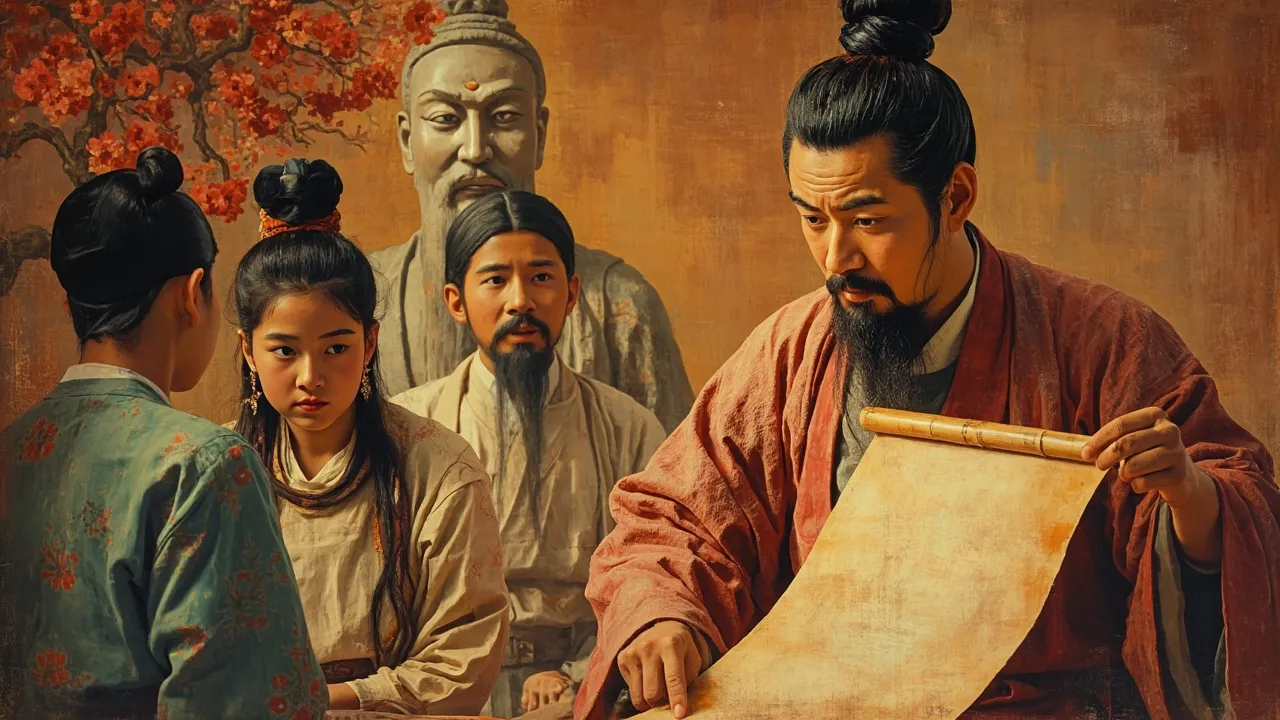
Frustrated by the corruption and incompetence he witnessed in government, Confucius devoted himself to teaching. He attracted a following of students who traveled with him, learning not just academic subjects but practical wisdom for living an ethical life. According to historical records, Confucius had around 3,000 students over his lifetime, with seventy-two considered his closest disciples. These students recorded his teachings and conversations, eventually compiling them into the Analects (Lunyu), which remains the primary source for understanding Confucius’s thought.
The Analects presents Confucius not as a systematic philosopher but as a practical teacher concerned with ethics, proper conduct, and good governance. His teachings emphasize personal virtue, social responsibility, and the cultivation of moral character. Unlike many religious founders, Confucius focused on this-worldly concerns—how to live well, how to be a good person, how to create a just society—rather than metaphysical questions about the afterlife or ultimate reality.
Confucius died in 479 BCE, believing that his teachings had failed to achieve political transformation. He could not have imagined that within a few centuries, his philosophy would become the official ideology of the Chinese empire, nor that it would spread throughout East Asia to become one of the most influential ethical traditions in human history.
Core Principles: The Five Relationships and the Path of Ren
Confucian thought centers on several key concepts that together form a comprehensive ethical framework. Understanding these ideas opens the door to grasping why this philosophy held such appeal across Chinese society and beyond.
At the heart of Confucian ethics lies the concept of ren, often translated as “benevolence,” “humaneness,” or “compassion.” Ren represents the highest moral virtue, the quality of being truly human in the fullest sense. It involves caring for others, treating them with respect and kindness, and acting for the common good. Confucius described it as “loving others,” and his follower Mencius would later elaborate ren as the central virtue that distinguishes humans from animals.
But ren isn’t simply a vague feeling of goodwill. It expresses itself through li, the proper forms of ritual and social conduct. Li encompasses the details of appropriate behavior in every social situation—how to address elders, how to conduct ceremonies, how to interact with friends and strangers alike. For Confucius, virtue isn’t abstract; it manifests in concrete actions and established patterns of interaction. Learning li, the proper forms, was essential to moral development.
Confucian ethics organizes human relationships according to five fundamental types: ruler and subject, parent and child, husband and wife, elder sibling and younger sibling, and friend to friend. Each relationship carries mutual obligations. A ruler must govern with benevolence; a subject must serve with loyalty. Parents must love and guide their children; children must respect and care for their parents. These relationships form the basic structure of society, and proper conduct within them creates social harmony.
The concept of xiao, usually translated as “filial piety,” holds particular importance. Children owe their parents reverence, obedience, and care. This duty isn’t merely emotional—it includes following parental guidance, honoring the family lineage, and caring for aging parents. Confucius considered filial piety the foundation of all virtue, the root from which other moral qualities grow. A person who cannot properly honor their parents, he suggested, cannot be trusted to honor anyone or anything else.
Confucius also emphasized the importance of education and continuous self-cultivation. He believed that anyone could become a junzi, a “noble person” or “superior person,” through diligent effort. The junzi contrasts with the xiaoren, the “small person” or “petty person”—someone concerned only with personal advantage. The superior person seeks moral improvement, fulfills responsibilities, and maintains integrity even when no one is watching. This emphasis on the possibility of moral growth through education became a cornerstone of Chinese cultural attitudes toward learning and self-improvement.
The Analects and Sacred Texts: Window into Confucian Thought
The Analects provides the primary window into Confucius’s teachings. This collection of brief sayings and conversations doesn’t present systematic philosophy but rather the practical wisdom the master shared with his students over decades of teaching. Understanding its approach helps explain how Confucianism could adapt to such diverse contexts across space and time.
The text divides into twenty chapters, each presumably recording teachings from different periods of Confucius’s career. Passages range from single-sentence observations to brief dialogues that illuminate specific points. “The master said, ‘To learn and then do, isn’t that a pleasure?’” captures the joy of learning applied. “The master said, ‘A man who is not constant in character—what can he accomplish?’” emphasizes the importance of reliability. Each snippet offers a moment of insight, leaving readers to integrate them into a larger framework.
Several passages illustrate Confucian thinking about core values. On honesty: “Do not do to others what you do not want done to yourself.” This negative formulation of the Golden Rule appeared in Confucius’s teaching centuries before similar formulations emerged in Western traditions. On governance: “Lead the people by regulations and keep them orderly by punishments, and the people will evade you and have no shame. Lead them by virtue and keep them orderly by li, and they will have a sense of shame and also correct themselves.” Confucius consistently prioritized moral example over coercive rule.
The Great Learning (Daxue) and Doctrine of the Mean (Zhongyong), both originally chapters in the Book of Rites, became foundational Confucian texts through Zhu Xi’s editing in the twelfth century. These works elaborated the psychological and metaphysical dimensions of Confucian thought, presenting a systematic path of self-cultivation. The Great Learning outlines a progression from investigating things to perfecting virtue, while the Doctrine of the Mean explores the path of balanced moral conduct.
The Mencius, a collection of conversations and debates attributed to Mengzi (Mencius), a major disciple two generations after Confucius, expands Confucian teaching on human nature and political philosophy. Mencius argued that human nature is fundamentally good, that all people possess the seeds of moral virtue. This optimistic anthropology contrasted with the pessimistic view of another philosopher, Xunzi, who argued that human nature is naturally selfish and requires rigorous education to become virtuous. This debate about human nature would shape Chinese thought for millennia.
Confucianism Through the Ages: Adaptation and Enduring Influence
Confucianism didn’t remain static after Confucius’s death. Over two and a half millennia, it evolved dramatically, absorbing new elements, adapting to changing circumstances, and responding to critics—all while maintaining its essential character as an ethical and social philosophy.
During the Han Dynasty (206 BCE–220 CE), Confucianism became state ideology. Emperor Wu officially endorsed Confucianism as the basis for government, establishing academies to train officials in Confucian classics. This political endorsement, while elevating Confucianism to unprecedented influence, also subordinated it to state service. Scholars became bureaucrats, and philosophical inquiry often served ideological purposes.
The Tang and Song Dynasties saw the emergence of neo-Confucianism, a philosophical synthesis that incorporated Buddhist and Taoist elements while reasserting Confucian values. Scholars like Zhu Xi (1130-1200) systematized Confucian thought, creating the version that would become orthodox. Their commentaries on the classics, particularly the Four Books (Analects, Mencius, Great Learning, Doctrine of the Mean), became the basis for the civil service examination system that selecting Chinese government officials for over six hundred years.
This examination system ensured that every educated person in China studied Confucian texts. The values embedded in those texts—respect for hierarchy, emphasis on education, concern for social harmony, duty to family—became deeply embedded in Chinese culture. Even those who passed the exams and became officials often failed to live up to Confucian ideals, but the ideals themselves remained powerful cultural reference points.
Confucianism spread beyond China through cultural diffusion and deliberate adoption. Korea adopted Confucianism as its official ideology during the Joseon Dynasty (1392-1897), building temples and academies that remain cultural landmarks. Japan absorbed Confucian ideas through Korean and Chinese contacts, where they influenced samurai ethics and later Tokugawa political philosophy. Vietnam developed its own Confucian tradition, with the temple of Confucius in Hanoi testifying to its historical importance. Each culture adapted Confucianism to its context, creating distinctive local variations while maintaining core commitments.
The twentieth century brought dramatic challenges to Confucianism in all East Asian societies. Chinese intellectuals associated it with feudal oppression and anti-modern traditionalism. Revolutionary movements in China, Korea, and Vietnam attacked Confucian ideas as obstacles to progress. The Cultural Revolution in China (1966-1976) specifically targeted Confucian institutions and symbols. Yet Confucian values persisted in family relationships, educational attitudes, and social expectations even where official ideology rejected them.
Contemporary East Asia shows renewed interest in Confucianism, though often in reformulated forms. Business leaders find lessons in Confucian approaches to loyalty and long-term relationships. Educators revisit Confucian insights on learning and character formation. Political theorists debate Confucian contributions to good governance. The philosophy that seemed doomed a century ago has demonstrated remarkable resilience, adapting to modern contexts while maintaining its core concern with ethical living and social harmony.
Confucianism in the Modern World: Relevance and Application
What does Confucianism mean for Americans today, whether they’re studying Chinese culture, seeking personal wisdom, or simply curious about this influential tradition? Several dimensions of Confucian thought speak to contemporary concerns.
The Confucian emphasis on relationship and responsibility offers a counterpoint to hyperindividualistic American culture. While Western Enlightenment thinking often prioritizes individual rights and autonomous self-determination, Confucianism grounds identity in relationships. You’re not simply an individual making independent choices—you’re a son or daughter, a parent, a friend, a colleague, a citizen. These relationships bring obligations but also meaning and support. Many Americans feel the lack of community and connection in modern life; Confucianism provides vocabulary for understanding why relationships matter.
Confucian thinking about education and self-cultivation resonates with contemporary discussions of lifelong learning and personal development. The belief that anyone can improve through effort, that character is built through practice, that learning should be continuous—these values align with what many Americans seek in their own growth journeys. The Confucian junzi ideal, the person of moral refinement and social responsibility, offers an alternative to both selfish individualism and self-abnegating self-denial.
The emphasis on social harmony and proper conduct in li seems increasingly relevant in a polarized age. Confucius taught that peaceful coexistence requires attention to how we treat others, not just what we believe. Ritual propriety—understanding and following the conventions of polite interaction—wasn’t mere formality for him but essential to ethical living. In a time when public discourse often descends to insult and contempt, Confucian respect for the forms of civil interaction offers something valuable.
Critics fairly note that Confucianism has been used to justify authoritarianism, suppress individual expression, and maintain oppressive hierarchies, particularly regarding gender. Traditional Confucian society expected women to submit to male authority throughout their lives—first to fathers, then to husbands, finally to sons. These aspects of the tradition deserve clear-eyed acknowledgment rather than nostalgic celebration. At the same time, recognizing how Confucian values have been twisted to serve oppression doesn’t require rejecting everything the tradition offers.
For Americans exploring Confucianism, the best approach is probably what Confucius himself would have recommended: learn, reflect, and apply what makes sense. The tradition offers rich resources for thinking about ethics, relationships, education, and personal growth. Its historical failures deserve honest examination. Its ongoing influence in East Asian societies offers evidence of its power to shape civilization. Whether one ultimately embraces or rejects Confucian teachings, understanding them provides essential context for engaging with Chinese culture and the broader East Asian world.