In the small city of Qufu, in Shandong Province, there is a temple complex that has been continuously built upon, expanded, and venerated for nearly two and a half thousand years. The temple was first constructed in 478 BCE, the year after its subject died—a student of the great philosopher laid a simple memorial tablet on his teacher’s grave, and from that gesture grew one of the most architecturally ambitious and culturally significant sites in all of China. Today, the Confucius Temple at Qufu receives millions of visitors each year, most of them Chinese schoolchildren on mandatory educational trips, but also scholars, tourists, and practitioners of Confucian philosophy from around the world. It is a place where the ancient and the living overlap in a way that few historical sites can match.
Confucius died in 479 BCE, at an age the historical sources variably put between seventy and seventy-three. He had spent most of his adult life traveling from one warring state to another, trying to convince rulers to adopt his vision of ethical governance—a world in which rulers governed by moral example, families operated on filial piety and reciprocal obligation, and society as a whole was held together by ritual propriety and shared ethical commitments. He met with limited success in his lifetime. No ruler gave him a genuine state to run. He died in something close to discouragement, his teachings rejected by the very people who most needed them.
But within a few centuries of his death, Confucius had become the most important intellectual figure in Chinese civilization. His descendants—the Kong family—were granted noble titles by one dynasty after another. The temple built on his grave became the center of a cult of veneration that saw emperors personally participate in sacrifices conducted in his honor. And the estate that grew up around the temple—the Family Mansion of the Kongs and the Cemetery of Confucius—became the largest continuous family estate in the world, maintained for over nine hundred years by a single family line. In 1994, UNESCO designated all three sites—the Temple, the Cemetery, and the Family Mansion—as a combined World Heritage property, recognizing them as irreplaceable witnesses to a philosophical tradition that has shaped more human beings than perhaps any other in history.
A Temple Built Around a Grave: Why Confucius Got Something Other Civilians Never Did
The story of the Confucius Temple begins, somewhat improbably, with a grave. When Confucius died in 479 BCE, he was buried on the banks of the Sishui River near the town of Qufu, in what is now Shandong Province. His students—traditionally said to number three thousand, with seventy-two particularly close disciples—mourned him and held memorial rites at the site. One of those students, a man named Zisi who was Confucius’s grandson, reportedly placed a memorial tablet on the grave. This was a simple act, but it established a physical presence at the burial site that would, over the following centuries, grow into the vast temple complex that exists today.
Why did Confucius get a temple? In the Warring States period when he died, temples and altars were normally reserved for kings, nobles, and important state deities. Commoners did not have temples. The idea that a private individual—a teacher, no less, who had never held real political power—would be honored with a dedicated shrine was unusual. But Confucius’s students believed their teacher deserved such recognition, and over time their devotion translated into a persistent tradition of building at the grave site. The Han Dynasty, which unified China in 206 BCE, was particularly enthusiastic about commemorating Confucius. Emperors began granting official recognition, and the simple grave shrine became something more substantial.
The practice of venerating Confucius at his grave evolved into something very similar to a religious cult—but one sanctioned by the state rather than spontaneous. [product_affiliate: “analects-english-translation” | https://example.com/analects-english-translation | $18.99 | “The Analects is Confucius’s recorded teachings—the foundational text of the philosophy that built the temple and shaped an entire civilization”] The temple at Qufu was not just a memorial; it became a functioning religious site where regular sacrifices were performed, where trained musicians played ritual music, and where monks or officials maintained a continuous presence. This was not unique to Confucius—other notable philosophers received similar treatment—but Confucius received the most elaborate and the most durable version of this honor. Over the next two thousand years, nearly every Chinese dynasty, without exception, contributed to the expansion and decoration of the temple. The structure you see today is a palimpsest of imperial interventions—a building that has been rebuilt, enlarged, and beautified by dozens of different dynasties, each one trying to demonstrate its own piety and its own commitment to the Confucian tradition.
The Temple of Confucius (孔庙): From a Simple Tomb Shrine to 466 Rooms
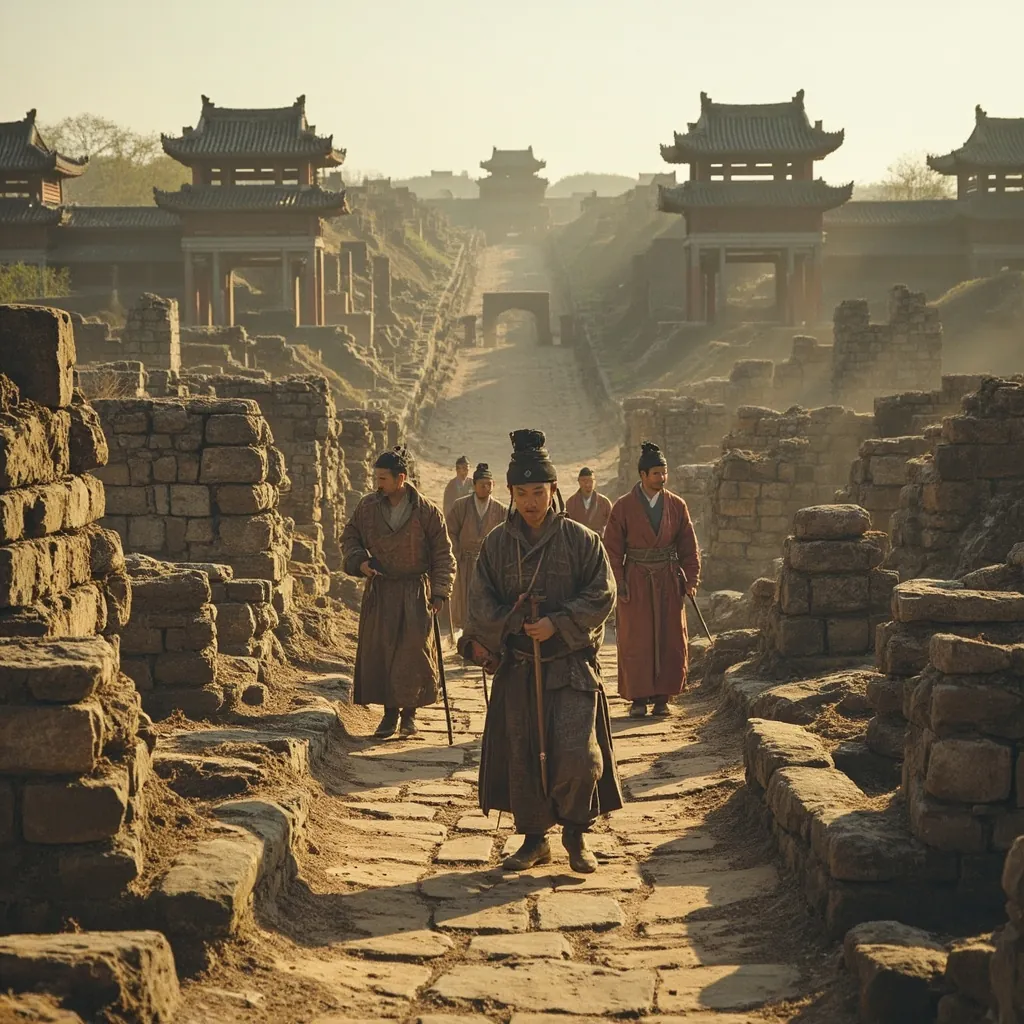
The Temple of Confucius as it exists today is a massive complex covering roughly 9.5 hectares (about 24 acres) in the center of Qufu. It runs from south to north along a central axis that is nearly a kilometer long, making it one of the largest temple complexes in China. The entrance is marked by a first gate called the Lingxing Gate, beyond which visitors pass through a series of courtyards, each one marked by elaborate gates, stone bridges, and ancient trees. The architecture follows the strict symmetry that characterizes the best of Chinese palace and temple design—a central axis with paired structures on either side, everything scaled and proportioned according to rank and function.
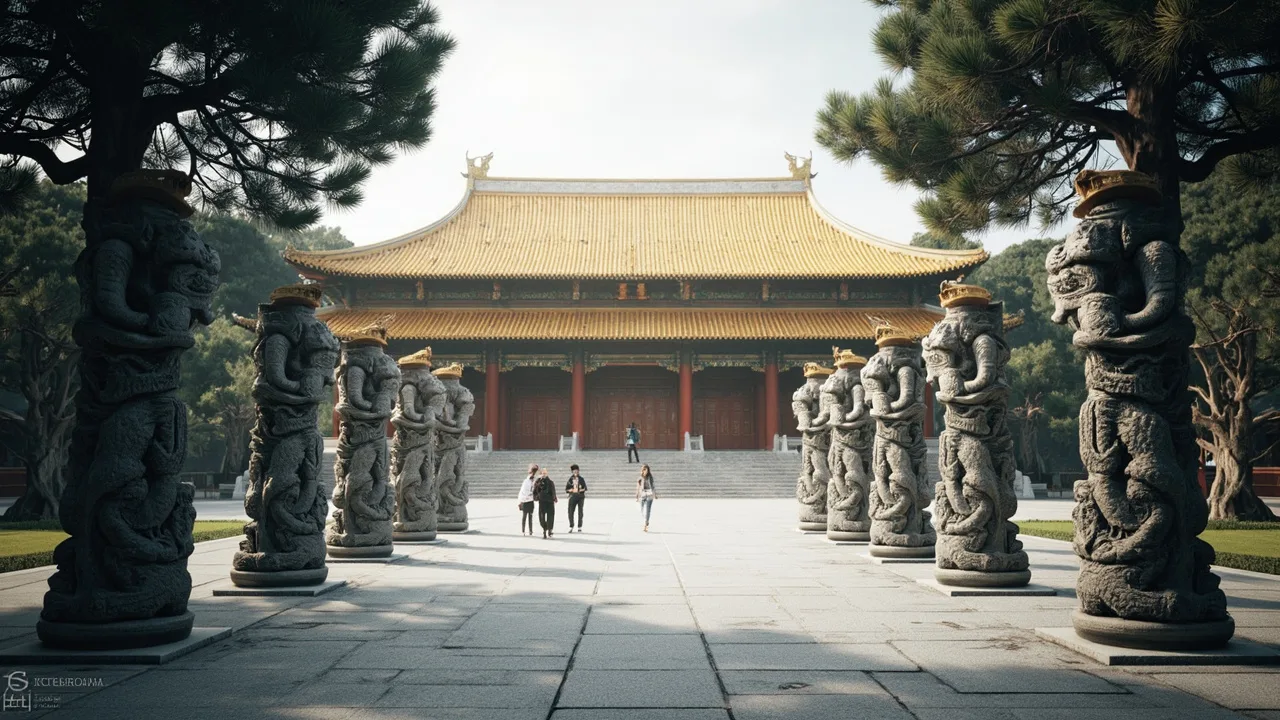
The most important building in the complex is the Dacheng Hall (大成殿), the main sacrificial hall where Confucius himself is venerated. [product_affiliate: “confucian-classic-art-print” | https://example.com/confucian-classic-art-print | $39.99 | “A classical Chinese painting reproduction of Confucian imagery brings the visual culture of the temple into your home”] The name “Dacheng” means “Great Achievement,” and it was coined in 1104 CE by the Song Dynasty emperor who decided that Confucius had achieved the ultimate in human wisdom—matching the sage kings of antiquity. The current Dacheng Hall dates from the early Qing Dynasty (early 1700s) and is supported by forty-eight pillars, each one carved from a single piece of pine and each one covered in detailed relief carvings of dragons, clouds, and coiling water—a level of craftsmanship that took teams of artisans years to complete. The hall’s roof is covered in yellow glazed tiles, the color reserved for imperial and sacred buildings, and its dimensions dwarf everything around it.
Around the Dacheng Hall, the temple complex includes dozens of subsidiary halls, pavilions, and altars dedicated to Confucius’s disciples and to the many scholars and officials who contributed to the Confucian tradition over the centuries. There are also dedicated music halls where ritual performances using period instruments are sometimes staged, especially during the annual celebration of Confucius’s birthday (祭孔大典, typically in late September). The complex holds more than one thousand stele—stone inscriptions carved with text—that document everything from imperial visits to examination results to historical events. The oldest stele date to the Tang Dynasty (618–907 CE), making them more than a thousand years old. Together, they form one of the largest collections of historical stone inscriptions in China.
The temple also contains several notable trees—particularly the famous Dragon Cypress (柏树) that allegedly dates to the Han Dynasty, making it more than two thousand years old. The tree is named for the way its trunk and branches twist and coil in patterns that locals interpreted as dragon-like. It sits in a courtyard near the back of the complex and is one of the most photographed objects at the site.
The Cemetery of Confucius (孔林): 200 Acres of Descendants and Stone Statues
The Cemetery of Confucius lies about one kilometer north of the temple complex, across the city of Qufu, and covers approximately 85 hectares (around 200 acres). It is the largest, oldest, and most continuously maintained cemetery of a single family in the world. Confucius was buried here in 479 BCE, and every generation of his descendants—from the moment the Kong family was granted hereditary titles by the Han Dynasty onward—has been buried in the same cemetery. The result is a forest that is also a cemetery, a green space that has been continuously managed and protected for over two thousand years.
Within the cemetery, the graves are organized by generation and family line, with the oldest graves closest to the original burial site and later generations spreading outward in concentric rings. The earliest graves are marked by simple mounds or modest stone tablets. Later graves—particularly those of more recent noble generations—are elaborate tomb structures with stone shrines, spirit paths, and elaborate memorial markers. Scattered throughout the cemetery are dozens of stone statues—figures representing officials, animals, and mythological creatures that traditionally accompanied Chinese burials to protect the dead and demonstrate the status of the deceased’s family. These stone statues, many of them dating to the Ming and Qing dynasties, are considered important examples of Chinese funerary art.
The cemetery is not just for Confucius himself. It holds the graves of tens of thousands of Kong descendants—some sources put the total at over 200,000, though not all graves are individually marked or maintained. [product_affiliate: “jade-pendant” | https://example.com/jade-pendant | $52.99 | “Jade has been associated with Confucian virtue for millennia—a jade pendant connects you to the philosophical tradition that the Kong family embodied”] Among them are several notable figures: Kong Sheng, a descendant who served as a high official during the Han Dynasty; Kong Teng, another Han-era descendant who helped develop Confucianism into the state ideology it would become; and numerous others whose graves represent the continued influence of the Kong family across Chinese history. Walking through the cemetery, you are walking through a two-thousand-year-old archive of a single family’s history.
The cemetery is also ecologically significant. Because it has been continuously protected and managed for over two millennia, it has developed into a dense forest with several species of ancient trees that are rare or absent elsewhere in the region. The Chinese government has designated portions of it as a nature reserve, recognizing its value not just as a historical site but as a living ecosystem.
The Family Mansion of the Kongs (孔府): Where the Direct Descendants Lived for 900 Years
The Family Mansion of the Kongs sits between the Temple and the Cemetery, and it served as the official residence of Confucius’s direct-line descendants for over nine hundred years—from the Song Dynasty through the early years of the Republic of China, when the last hereditary “Duke of Yansheng” (the title given to the senior Kong descendant) was forced to abandon the property. The mansion is enormous—roughly 8 hectares (20 acres) with 463 rooms, making it one of the largest aristocratic manor complexes in China.
The architecture of the Family Mansion reflects both the high status of the Kong family and the Confucian values they were supposed to embody. [product_affiliate: “chinese-calligraphy-brush-set” | https://example.com/chinese-calligraphy-brush-set | $29.99 | “Confucius considered calligraphy one of civilization’s refinements—a quality brush set lets you practice the art form he championed”] The layout follows the classical Chinese principle of gendered separation—male and female spaces are clearly delineated, with the public and official rooms in the front of the complex and the private family quarters in the back. The main gates open onto a series of reception halls where the Kong descendants, as hereditary nobles, would receive visitors, conduct official business, and perform the ceremonial duties that came with their title. The rear courtyards contain living quarters, kitchens, gardens, and the family school where Kong children were educated in the Confucian classics.
The mansion was repeatedly rebuilt and expanded as the Kong family’s status grew. By the Ming and Qing dynasties, it had become a miniature city within the city of Qufu—a self-contained compound with its own offices, archives, kitchens, stores, and even a prison for disciplining family members who violated Confucian moral codes. It holds massive collections of documents, calligraphy, and artifacts accumulated over centuries—though many items were lost, damaged, or stolen during the turbulence of the twentieth century.
What makes the Family Mansion particularly interesting from a cultural perspective is the tension it embodies. The Kong family were, in theory, the living embodiments of Confucian virtue—humble, filial, devoted to learning, uninterested in the trappings of power for their own sake. In practice, they were hereditary aristocrats who lived in considerable luxury, maintained a private army, owned vast estates, and wielded real political influence in the region around Qufu. This tension between Confucian ideal and aristocratic reality runs through the entire history of the site, and it is visible in the architecture itself—the public rooms are modest by the standards of major Chinese noble residences, while the private quarters reveal a more comfortable standard of living.
What It’s Like to Visit Today, and Why Every Chinese Schoolchild Comes at Least Once
If you visit the Confucius Temple today, you will find a site that manages to be both deeply authentic and heavily managed for tourism. The temple complex is well-maintained, with clearly marked pathways, informative plaques in Chinese and English, and a steady flow of visitors throughout the year. The peak periods are during the annual birthday celebration in late September and during Chinese New Year, when the temple fills with pilgrims performing traditional rites. The rest of the year, it is a surprisingly tranquil space—the sheer scale of the complex means that even on busy days, you can find quiet courtyards where the only sound is wind in the ancient cypress trees.
The experience of walking through the temple from south to north—from the first gate to the final courtyard—is an exercise in scale and proportion that rewards attention. The complex was designed so that each successive courtyard and gate would make the visitor feel a growing sense of awe and reverence, building toward the climactic sight of the Dacheng Hall. The buildings grow larger, the decorations more elaborate, the sense of sacred space more concentrated. Standing before the Dacheng Hall, looking up at its massive yellow-tiled roof and dragon-carved pillars, you can understand why this site has drawn pilgrims for two and a half millennia.
Nearly every Chinese child visits Qufu at least once during their school years—it’s a standard field trip destination, and many adults return decades later with their own children. The annual Confucius祭祀 ceremony on September 28, his supposed birthday, draws thousands of dignitaries and scholars, and the site has been honored by emperors, presidents, and popes over the centuries.