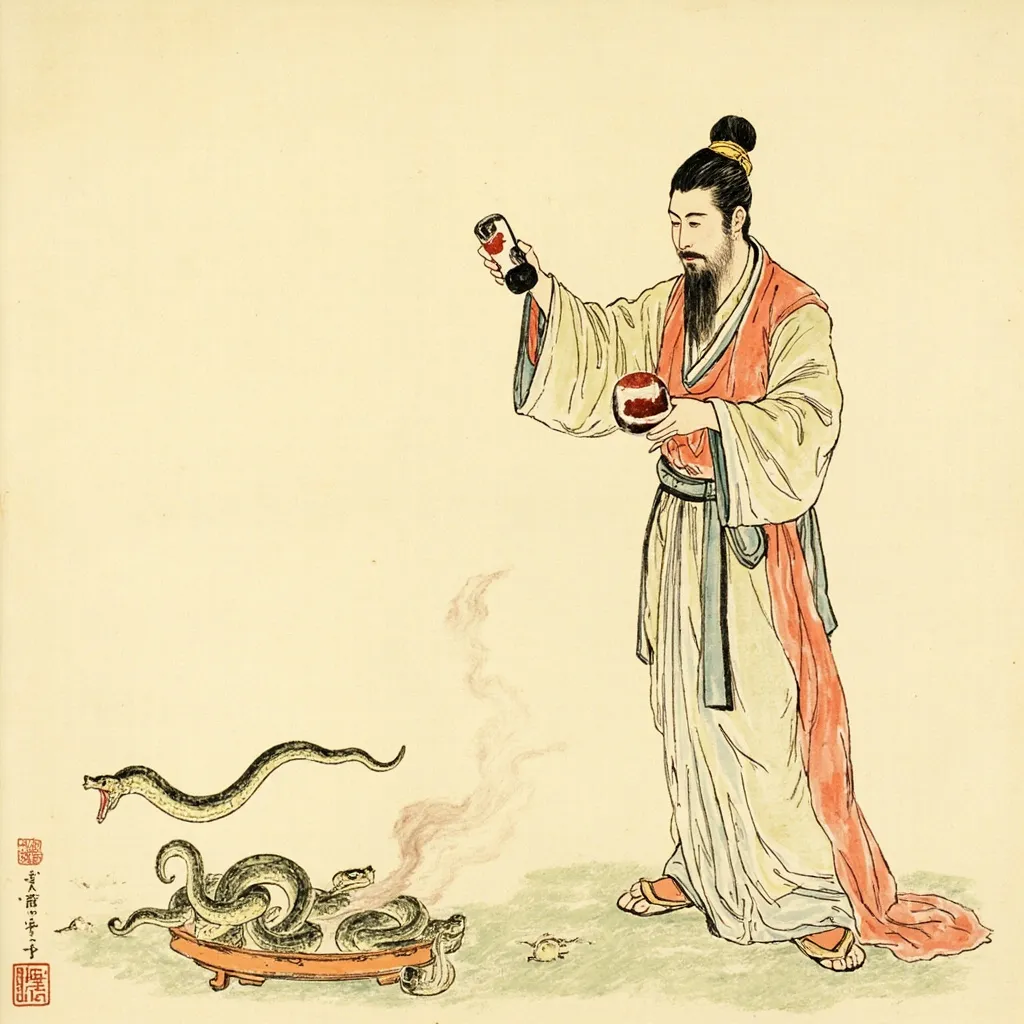
Covering Your Ears While Stealing a Bell: The Chinese Idiom About Self-Deception
Here’s a riddle for you: a thief wants to steal a brass bell that makes a loud noise when touched. What’s his brilliant plan? He covers his own ears. Why? So he won’t hear the bell ringing.
If you laughed at that — and you should have — then you already understand the Chinese idiom yǎn ěr dào líng: 掩耳盗铃, “covering your ears while stealing a bell.” It’s one of the oldest and most pointed metaphors in Chinese culture for what happens when someone decides that not knowing something is the same as that thing not being true.
The logic is airtight — if you’re deaf to the sound, then logically you can’t be caught by it, right? Except the person trying to steal the bell isn’t the only one who can hear it. The whole household can hear it. The neighbors can hear it. Everyone in the village can hear it. The thief is standing there, ears covered, convinced he’s invisible because he’s put his hands over his own head. It’s absurd. And yet the pattern it describes — ignoring reality because acknowledging it is inconvenient — is so common that we still reference it thousands of years later.
The Original Story: A Thief, A Bell, and Two Seconds of Overconfidence
The story appears in texts dating back to the Warring States period, around the third century BCE. It’s attributed to various sources in the philosophical tradition — some versions place it in the Han Feizi, a text devoted to legalist philosophy and practical statecraft, which makes sense because Han Feizi had a particular fondness for stories that illustrated the gap between wishful thinking and reality.
Here’s how the tale goes:
A man in a small state spots a beautiful bell in a neighbor’s courtyard. This wasn’t just any bell — it was large, made of fine bronze, and had a tone so rich and clear that it could be heard across the village when struck. The man wanted it. Not for any practical reason — he wasn’t going to ring it at dawn or call the village to meetings. He simply wanted the bell itself, the metal, the craftsmanship. He planned to melt it down and sell it for profit.
But there was a problem. The bell was heavy, firmly mounted, and — most inconveniently — loudly audible. Whenever the bell moved or was struck, it produced a sound that would alert anyone nearby instantly. The man thought about how to remove the bell without making noise. He considered dismantling the mounting, wrapping the bell in cloth, oiling the mechanism. None of these solutions addressed the core problem: the bell would ring.
Then he had what he thought was a brilliant insight. If he covered his own ears, he wouldn’t be able to hear the bell. If he couldn’t hear the bell, then the bell was, for all practical purposes, silent. He’d solved the problem.
So he covered his ears and began working on the bell.
Predictably, the bell rang. The household woke up. Neighbors came running. The thief was caught before he’d gotten the bell more than a few inches off its mounting.
The absurdity of his reasoning was immediately apparent to everyone — except, apparently, to him. The story doesn’t tell us what happened to the thief, but we can imagine the neighbors’ reaction: half-anger, half-disbelief. How could anyone be so foolish? But the philosopher recording the story wasn’t really interested in the thief’s fate. He was interested in the logic, and the way flawed logic can feel completely sound when you’re sufficiently motivated.
The Anatomy of Self-Deception
What makes 掩耳盗铃 such a durable metaphor is that it captures something fundamentally human and deeply uncomfortable: the ability to believe what we want to believe when the alternative is inconvenient.
The thief in the story wasn’t stupid. You don’t plan a burglary by thinking through the mechanics of bell removal without being reasonably clever. What he was, was motivated. He wanted the bell. That want was strong enough to override his ability to think clearly about consequences. So he constructed a reality in which covering his ears was a reasonable solution — because the alternative was admitting that the theft was impossible without being detected.
Psychologists have a name for this: motivated reasoning. It’s the process by which people evaluate evidence, analyze arguments, and form beliefs not based on what’s true but based on what they want to be true. The thief wanted the bell. Therefore, in his mind, the problem of the bell’s sound had to be solved. His solution — covering his own ears — was the product of a mind that had already decided the bell was his, and was working backward to find a way to make that reality happen.
The ancient Chinese were surprisingly sophisticated about this. The philosopher Han Feizi, who likely first recorded the story, was writing for rulers — men and women who wielded enormous power and faced constant temptation to believe flattering lies rather than uncomfortable truths. His point with the bell thief was surgical: self-deception is the most dangerous form of foolishness, because the fool doesn’t know they’re being foolish. A person who lacks intelligence at least has the potential to be corrected by evidence. A person who has decided that evidence doesn’t matter — because it’s inconvenient — has closed that door.
Why the Story Still Resonates
Jump forward two and a half millennia, and you’ll find the bell thief’s descendants everywhere. They’re in boardrooms where executives ignore warning signs because acknowledging them would require difficult decisions. They’re in households where someone keeps a habit that’s clearly damaging because “it’s not that bad” or “I can stop anytime.” They’re in politics, where inconvenient data gets dismissed as fake, and in personal relationships, where red flags get reframed as “just the way they are.”
The bell thief pattern shows up in what researchers sometimes call normalcy bias — the tendency to assume that because things have been fine up until now, they’ll continue to be fine. The homeowner who’s been putting off replacing the old electrical wiring because “it’s worked fine for thirty years.” The person who keeps smoking because “my grandmother smoked and lived to ninety.” The company that ignores a disruptive technology because “our core customers don’t want it.” Each of these is a variation on the same theme: if I don’t look at the problem, the problem isn’t there.
What’s particularly sharp about the Chinese idiom is how it captures the privacy of self-deception. The thief’s reasoning was technically private — only he was convinced by it. Everyone else could see the flaw instantly. This is the essence of self-deception: you become the only person who believes your own story. The whole world can see the bell ringing while you’re standing there with your hands over your ears, convinced you’ve solved the problem.
In cognitive science, this relates to confirmation bias — the tendency to seek out information that confirms what we already believe while ignoring information that challenges it. But 掩耳盗铃 goes a step beyond mere confirmation bias. The thief wasn’t just ignoring evidence that contradicted his plan. He was actively doing something — covering his ears — that he believed would change the external reality. He thought his subjective action could alter the objective world. That’s not just self-deception; it’s a kind of magical thinking.
Historical Examples of the Bell Thief
The Han Feizi text is full of rulers who behaved exactly like the bell thief, with consequences that were rather more severe than getting caught by angry neighbors.
One famous example involves a king who was deeply in denial about the military strength of a neighboring state. His advisors brought him intelligence reports — scouts, defectors, trade data — all pointing to the same conclusion: the neighboring state was mobilizing for war and had assembled a formidable army. The king didn’t want to go to war. War was expensive, disruptive, and dangerous. So he did what the bell thief did: he decided the evidence didn’t exist.
He dismissed his most credible advisors. He stopped reading the intelligence reports. He surrounded himself with officials who told him what he wanted to hear. When the neighboring state finally invaded, his army was unprepared, his fortifications were undermanned, and the kingdom fell within months. The story is a parable, but it’s a parable that reflects real patterns in the collapse of states throughout Chinese history. The dynasty that ignored the signs — the Ming dynasty that dismissed early European contact as irrelevant, the Qing court that reframed military defeats as temporary setbacks — all fell, at least in part, to a version of the bell thief’s logic.
There’s also a literary tradition around this idiom. Tang Dynasty poets loved to write about rulers who lived in gilded palaces,隔绝 from the suffering of their people, certain that the empire was prosperous because their court told them so. The image of the emperor, surrounded by sycophants, hands firmly over his ears, singing his own praises — it’s a vivid one, and Chinese writers used it again and again to critique power that had become disconnected from reality.
The Modern Bell Thief
If you think contemporary society has evolved past the bell thief logic, spend five minutes reading the news.
Climate change is perhaps the most globally scaled example of 掩耳盗铃 currently in operation. The scientific consensus on human-caused climate change has been clear for decades. The data is voluminous, the mechanisms are well-understood, and the evidence is visible in shrinking glaciers, rising seas, and increasingly severe weather events. And yet, large segments of the population — and the governments that represent them — continue to behave as if the problem doesn’t exist. The parallel to covering your ears is almost too on-the-nose: if we don’t acknowledge the problem, we won’t have to deal with it. The bell rings, but we’ve decided not to hear it.
On a more personal scale, consider the person who ignores physical symptoms that clearly warrant medical attention. “It’s probably nothing.” “It’ll go away on its own.” “I don’t want to know if something is wrong.” Each of these is a version of the bell thief’s logic: the disease exists whether or not you get it diagnosed, but by refusing to look, you preserve the feeling of being well. The problem is that diseases, like bells, don’t care whether you acknowledge them.
In finance, the dot-com bubble had its share of bell thieves — investors who knew, somewhere deep down, that valuations were disconnected from reality but kept investing because everyone else was doing it and they didn’t want to miss out. The 2008 financial crisis was built on bell thief logic: banks that knew the mortgage-backed securities they were selling were dangerously overleveraged, but covered their ears (and their prospectuses) and kept the music playing as long as they could.
Even in relationships, the pattern is familiar. Someone receives feedback from a partner — “I feel like you don’t listen to me” — and rather than examining the behavior, they explain it away, dismiss it, or cover their ears with some version of “that’s not who I am.” The problem in the relationship continues because one party has decided unilaterally that there isn’t one.
The Difference Between Caution and Self-Deception
Here’s where things get complicated. Not all ignoring of information is bell-thief behavior. Sometimes discretion is the better part of valor. Sometimes the signal really is noise.
The key distinction, according to both the original fable and modern psychology, is why you’re ignoring something. The bell thief wasn’t ignoring the sound because he had good reason to think it wasn’t meaningful. He was ignoring it because he wanted the bell and couldn’t tolerate any information that complicated the acquisition. His motivation — pure greed — was coloring his perception of reality.
Compare this to someone who receives unsolicited criticism that’s clearly coming from a place of bad faith or personal animosity. Ignoring that criticism might be a reasonable response — not because all criticism should be dismissed, but because the source and context mean the criticism isn’t carrying genuine information. The bell thief’s ears weren’t just covered; they were covered for a self-serving reason.
The test, then, isn’t whether you’re ignoring information. It’s whether you’re ignoring information because accepting it would be inconvenient, or because you have genuine reasons to believe the information isn’t reliable. One is self-deception. The other is discernment. The line between them can be blurry, which is part of why the bell thief makes such a useful reference point — he reminds us to ask the hard question: Am I not hearing this because there’s nothing to hear, or because I don’t want to hear it?
Learning to Listen When the Bell Rings
So how do you catch yourself in the act of bell-thief thinking? It’s genuinely difficult, because the whole point of self-deception is that you don’t know you’re doing it.
One useful practice is steel-manning — the discipline of articulating the strongest version of the opposing argument before dismissing it. If you find yourself saying “that warning doesn’t apply to our situation,” force yourself to write out the best case for why it does apply. If you can’t construct a convincing counter-argument, that’s data. If the only reason you can find to dismiss the evidence is that accepting it would be inconvenient, that’s a red flag.
Another practice is pre-mortem analysis — a technique popularized by psychologist Gary Klein, in which you imagine a future failure and work backward to identify what caused it. Before starting a project, gather the team and ask: “It’s six months from now and the project has completely failed. Why did it fail?” This forces participants to take the bell’s ringing seriously before the thief has committed to the theft.
There’s also something to be said for cultivating relationships where people are genuinely incentivized to tell you what you don’t want to hear. The bell thief was isolated — no one around him had any reason to intervene before he’d made his move. In our own lives, we tend to self-select environments where our beliefs are reinforced. Seeking out people who disagree with us — not to convince them, but to stress-test our own thinking — is a structural antidote to self-deception.
Conclusion: The Bell Is Always Ringing
The man who covered his ears and walked up to the bell thought he had solved his problem. In his mind, he had. The bell was his. He simply had to reach out and take it. The fact that the rest of the world heard him coming was, in his reasoning, irrelevant — because he couldn’t hear himself.
That’s the trap that 掩耳盗铃 exposes so elegantly. Self-deception doesn’t just cloud your vision — it gives you a false confidence that you’re seeing clearly when you’re not. The bell thief would have laughed at the suggestion that he was fooling himself. He was, in his own mind, being perfectly logical. That’s the most dangerous kind of wrong: the kind that feels completely right.
The next time you catch yourself dismissing inconvenient information, reframing uncomfortable facts, or explaining away warning signs because accepting them would be too difficult — pause. Ask yourself who benefits from your ignorance. Usually, the answer is no one but you — and only in the very short term. The bell is ringing. It was always ringing. Pretending otherwise doesn’t change the sound.
Disclosure: This article contains affiliate links. We earn a commission on qualifying purchases.