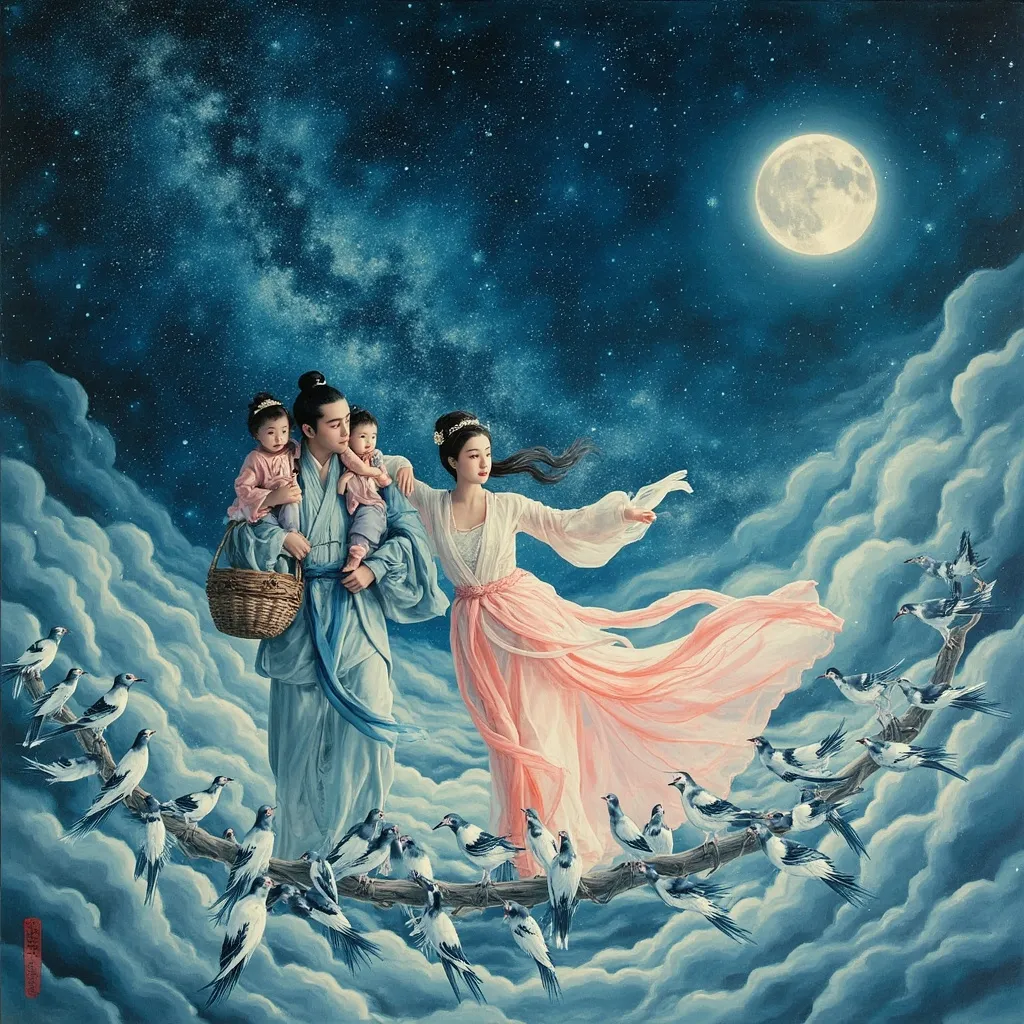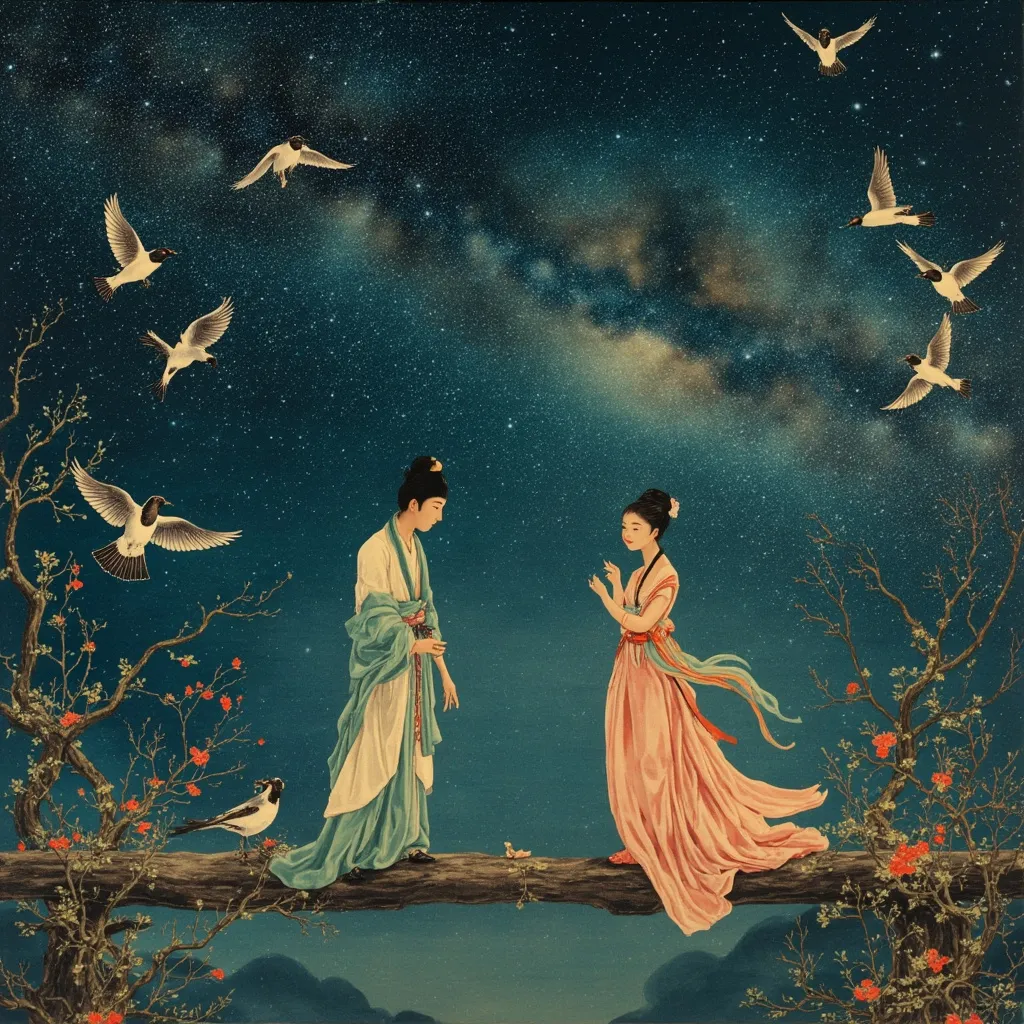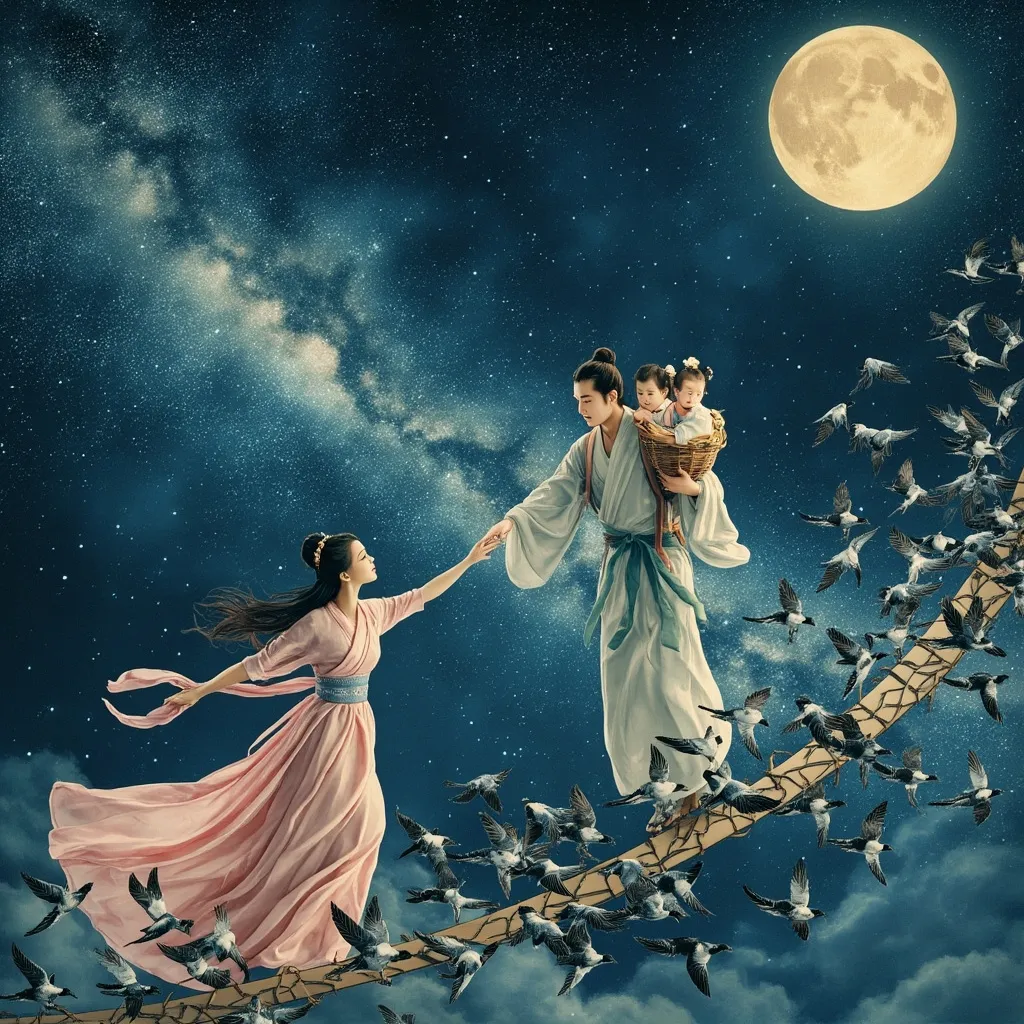
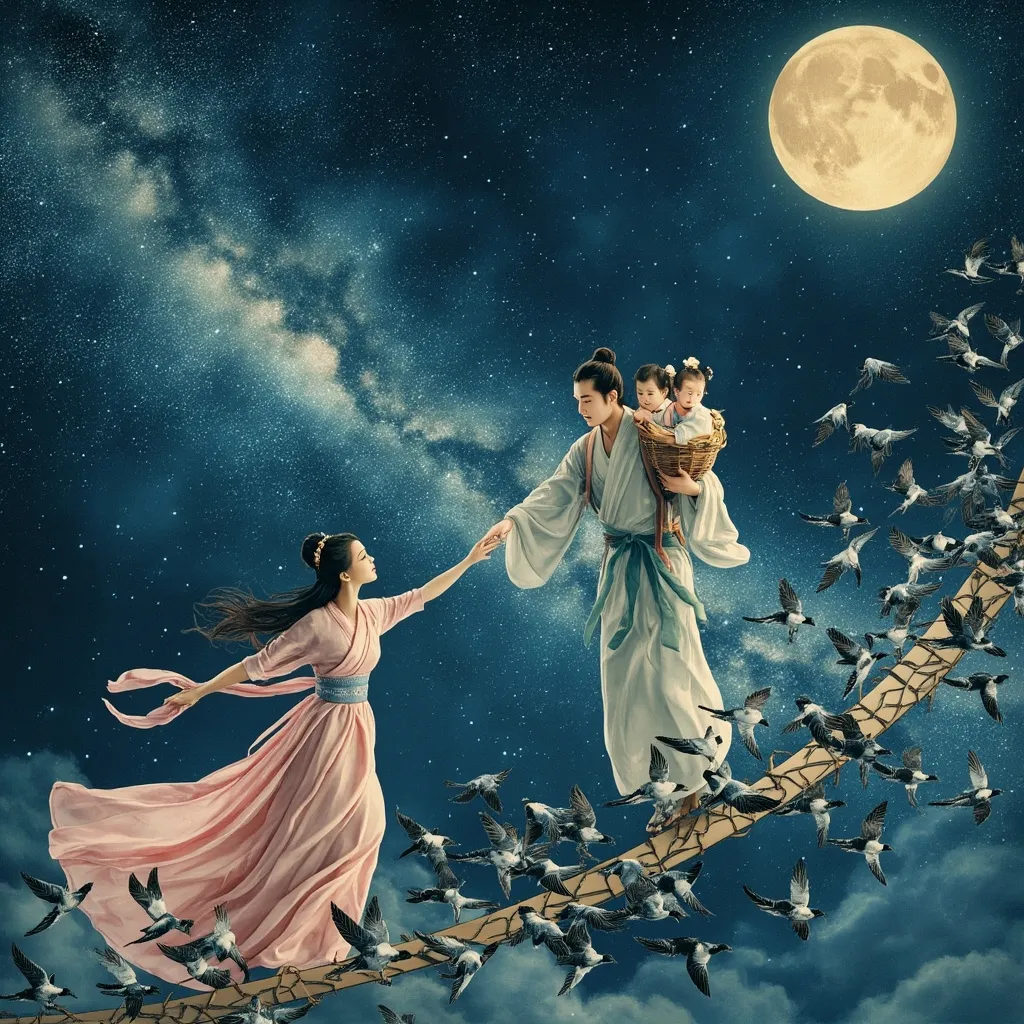
Long ago, in the heavens above, a weaver girl and a cowherd fell deeply in love. Their romance was so beautiful that the gods grew jealous, and they were banished to opposite sides of the sky—separated by the vast Milky Way. But once a year, on the seventh day of the seventh lunar month, magpies form a bridge across the stars, and the lovers are reunited for a single, precious night. This is the story behind Qixi Festival, China’s most romantic celebration, often called Chinese Valentine’s Day.
The Legend of Niulang and Zhinü
The story of the Cowherd and Weaver Girl (Niulang and Zhinü) is China’s most beloved love tale, a myth told for over 2,000 years. It’s a story about forbidden love, separation, and the enduring hope that true connection can bridge any distance — even the vastness of the cosmos.
The tale begins in the celestial realm, where Zhinü was one of seven sisters — beautiful fairy spirits who served the Queen Mother of the West, a powerful goddess who ruled over the heavens. Zhinü was the most talented of the sisters, known throughout the heavens for her extraordinary weaving skills. She could create fabrics so magnificent that clouds themselves seemed pale in comparison. Her weaving kept the heavens beautiful, producing the colorful sunset skies and the delicate mists that draped across the mountains below.
Despite her divine beauty and talents, Zhinü felt something missing in her celestial life. She yearned for something more — for adventure, for connection, for love.
One summer day, Zhinü and her six sisters escaped from their celestial duties to bathe in a peaceful lake on Earth. The water was crystal clear, the surroundings peaceful — a welcome escape from the rigid routines of heaven. What they didn’t know was that a young man named Niulang was watching from behind a grove of trees.
The Origin Story
Niulang was a humble cowherd, a poor orphan who lived with his elder brother and sister-in-law. His family treated him poorly, giving him the worst room in the house and making him sleep among the cattle. Despite his difficult life, Niulang was kind-hearted and honest, with a gentle spirit that hid beneath his worn clothing.
When Niulang saw the seven fairy sisters descending from the clouds to bathe, he was struck by their beauty — particularly the youngest and most graceful of them all. He watched in wonder until suddenly, one of the sisters spotted him hiding in the bushes. The fairies shrieked and hurried to cover themselves, immediately preparing to flee back to heaven.
But one sister — Zhinü — hesitated. She saw something special in the young cowherd’s eyes. Perhaps it was his honesty, or his gentleness, or simply the fact that he looked at her not with greed or desire, but with genuine wonder and respect. In that moment, something sparked between them.
The fairies fled back to heaven, but Zhinü left behind her magical celestial robe — the garment that allowed her to return to the sky. Niulang found the beautiful robe and, when Zhinü returned to retrieve it, he used it as an opportunity to speak with her. Their conversation turned into hours, and those hours turned into days. Zhinü forgot about returning to heaven. She had found something she never expected: genuine human connection and love.
The two young people fell deeply in love. Zhinü chose to abandon her celestial life to stay on Earth with Niulang. They married in a simple ceremony, and Zhinü abandoned her weaving duties in heaven to become a farmer’s wife. Together, they built a modest life filled with love — not wealth, but something far more precious.
They were happy, genuinely and completely happy, for several years. Zhinü learned to work the fields, and Niulang learned to appreciate the simple beauty of having someone who truly loved him. They had two children together, a son and a daughter, and life seemed perfect.
But the gods in heaven were not pleased.
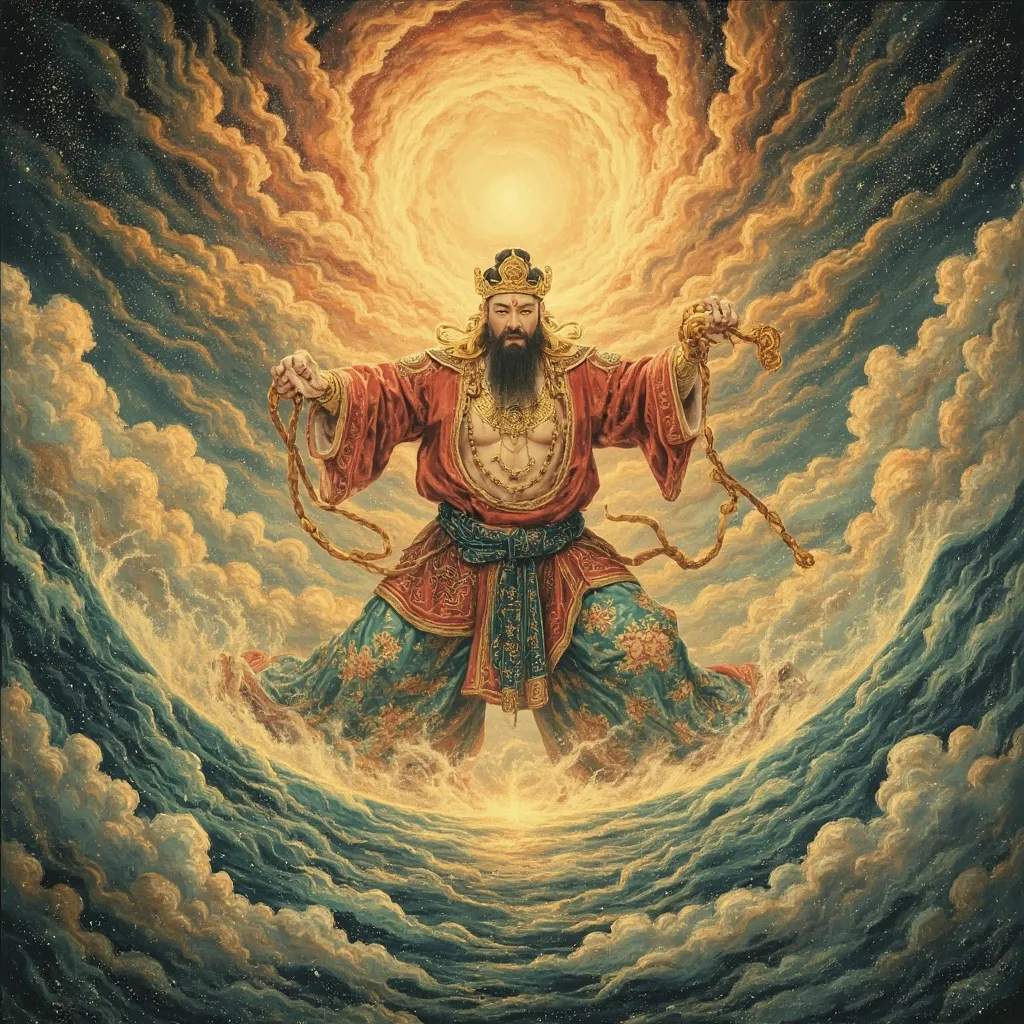
The Queen Mother of the West discovered that her favorite weaver girl had abandoned her duties and married a mortal. Furious at this breach of divine order, she sent celestial soldiers to drag Zhinü back to heaven. Niulang tried to run after his wife, but the soldiers were too powerful. He could only watch in despair as his beloved was carried away into the clouds.
However, the couple’s two children — their love’s sacred fruit — clung to their mother during the abduction. The Queen Mother, seeing the children’s desperate cries, relented slightly and allowed them to go with Zhinü. But she separated the family nonetheless: Zhinü was taken to one side of the sky, and Niulang was banished to the other.
The Milky Way — the “heavenly river” in Chinese mythology — now flowed between them, an unbridgeable chasm of stars. The two lovers could see each other across the vast darkness, but they could never reach each other. They could only gaze across the cosmic river and weep.
Moved by their devotion, however, the Queen Mother relented one more time. She permitted the lovers to meet once a year — on the seventh day of the seventh lunar month. On this single night each year, magpies from across the world fly to the heavens and form a living bridge with their wings. Niulang and Zhinü can cross this bridge to be together, if only for one night.
This is why Qixi Festival, celebrated on the seventh day of the seventh lunar month, is known as Chinese Valentine’s Day. It’s a celebration of love that conquers all obstacles, even the vastness of the cosmos itself.
The Story Behind Qixi Festival
Qixi Festival (七夕节) falls on the seventh day of the seventh lunar month — usually in August on the Western calendar. In 2026, Qixi occurs on August 19th. The festival has been celebrated in China for over 2,000 years, with roots dating back to the Han Dynasty (206 B.C. – 220 A.D.).
The earliest written references to this legend appear in poems from the Classic of Poetry, China’s oldest collection of poetry, compiled around the 11th century B.C. Over the centuries, the story evolved and became more elaborate, eventually taking on the form we know today.
But Qixi is more than just a romantic celebration. Historically, it was also a festival for young women. In ancient China, girls would gather on this night to demonstrate their weaving and needlework skills — honoring Zhinü’s role as the celestial weaver. They would pray for skill in their crafts and, not so subtly, for good fortune in finding romantic love. Young women would make wishes upon the stars, believing that Zhinü would intercede on their behalf.
In some regions, girls would place needles on the surface of water to test their dexterity — the needles floating on the water’s surface symbolizing good luck and skill in domestic arts. This tradition gave Qixi another name: the “Double Seventh” Festival or “Daughter’s Festival.”
Traditional Qixi Celebrations
Traditional Qixi celebrations were rich with customs and rituals, many of which continue today in modified forms:
Worshiping Zhinü: In some regions, families — especially young women — would set up altars to honor the Weaver Girl. They would offer fruits, flowers, and incense, praying for romance, fertility, or domestic skills.
Needle-threading ceremonies: On Qixi night, women would compete to thread needles first, believing that doing so would bring them good luck and dexterity in their needlework. The fastest threaders were considered the most skilled housewives.
Watermelon offerings: Watermelon was considered essential for Qixi celebrations because its many seeds symbolized fertility and abundance. Families would cut open watermelons and enjoy them together, sometimes making wishes over the fruit.
Stargazing: Young couples and families would go outside on Qixi night to look up at the stars. They could see Vega (Zhinü’s star) and Altair (Niulang’s star) on opposite sides of the Milky Way. If the sky was clear, they believed the couple’s reunion would be successful.
Love poems and letters: Scholars and romantics would write poetry honoring the lovers, and young couples might exchange letters or gifts — much like Valentine’s Day cards.
The Legend in Modern Culture
Today, Qixi Festival has evolved into China’s version of Valentine’s Day, complete with flowers, romantic dinners, and gifts. Young couples celebrate their love on this day, and it’s become one of the most popular dates for weddings and proposals in China.
The legend has inspired countless works of art, literature, films, and television dramas. The story has been adapted into operas, ballets, and even video games. Each year, Chinese television networks broadcast special programs honoring the romantic story, and shopping centers decorate with imagery of the star-crossed lovers.
In recent years, Qixi has also become increasingly commercialized, much like Valentine’s Day in the West. Restaurants offer special romantic dinners, florists sell commemorative bouquets, and jewelry stores promote “Qixi specials.” For many young Chinese, Qixi is simply a day to celebrate romance with their partners — though the ancient mythology adds a layer of poetic meaning that Western Valentine’s Day lacks.
The astronomical elements of the story add another fascinating layer. The stars Vega and Altair are real stars, visible in the summer night sky in the Northern Hemisphere. They form two corners of the “Summer Triangle,” a prominent asterism that includes Deneb. The Milky Way truly does separate them — a beautiful coincidence that makes the legend feel even more meaningful when you gaze up at the night sky.
Magpies play a crucial role in the story because, in Chinese culture, these birds are considered sacred — they bring good fortune, and their appearance is seen as a positive omen. The image of thousands of magpies uniting to form a bridge for true love is one of the most poetic images in Chinese mythology.
Conclusion
The legend of Niulang and Zhinü is more than just a romantic fairy tale — it’s a story that speaks to something deep in the human experience. It tells us that love is worth waiting for, that devotion can bridge any distance, and that hope endures even when separation seems permanent.
For over two millennia, the Chinese people have told this story, passed it down through generations, and found meaning in its timeless themes. Whether you celebrate Qixi Festival with a romantic dinner, simply appreciate the beautiful mythology, or look up at the summer sky to find the two lover stars, you’re participating in a tradition that connects modern life to ancient storytelling.
So this Qixi, take a moment to think about Niulang and Zhinü — two people who loved each other so deeply that even the gods couldn’t keep them apart, if only for one night each year. In their story, we see our own hopes and dreams reflected back at us: the desire to find love, to hold onto it, and to believe that true connection can overcome any obstacle.
After all, isn’t that what love is all about?
This Qixi, whether you’re celebrating with a partner or simply enjoying the beauty of the story, may your love be as enduring as the stars.
📚 Recommended Reading & Products
*Disclosure: This article contains affiliate links. We earn a commission on qualifying purchases.