slug: cowherd-weaver description: “Explore the romantic legend of the Cowherd and Weaver Girl, two lovers separated by the Milky Way who meet only once a year on Qixi Festival, the Chinese Valentine’s Day.” keywords: [‘Cowherd and Weaver Girl’, ‘Qixi Festival’, “Chinese Valentine’s Day”, ‘Milky Way’, ‘Chinese mythology’, ’love story’, ‘牛郎织女’] categories: [‘Chinese Mythology’, ‘Romantic Legends’] tags: [‘mythology’, ‘romance’, ’love’, ‘stars’, ‘festival’, ‘ancient china’] image: “/images/cowherd-weaver.jpg” alt_text: “Lovers meeting across the Milky Way bridge of magpies” author: Jaie affiliate_products:
- name: “Qixi Festival Love Charm Bracelet” url: “https://example.com/love-bracelet" description: “Heartfelt bracelet inspired by the romantic Qixi Festival”
- name: “Milky Way Star Map Print” url: “https://example.com/star-map" description: “Beautiful print showing Vega and Altair across the Milky Way”
- name: “Traditional Chinese Wedding Fan” url: “https://example.com/wedding-fan" description: “Elegant silk fan featuring romantic couple designs”
- name: “Chinese Astrology and Love Guide Book” url: “https://example.com/astrology-love" description: “Discover how Chinese astrology influences romantic compatibility”
- name: “Crystal Love Token Set” url: “https://example.com/crystal-token" description: “Heart-shaped crystals representing eternal love”
The Cowherd and the Weaver Girl: China’s Valentine’s Day Story
In the vast heavens above, where stars form rivers and constellations tell stories, there exists the most romantic tale in all of Chinese mythology—the story of the Cowherd and the Weaver Girl. Their love, forbidden and eternal, has inspired poets and lovers for thousands of years. Every summer, when the Milky Way spans the night sky, their story reminds us that true love can survive any separation.
When Stars Fell in Love
Long ago, before the world was as we know it, there lived a young man called Niu Lang, which means “Cowherd.” He was poor but honest, working diligently to care for his beloved ox. His parents had died when he was young, leaving him with nothing but his faithful companion and a small thatched cottage.
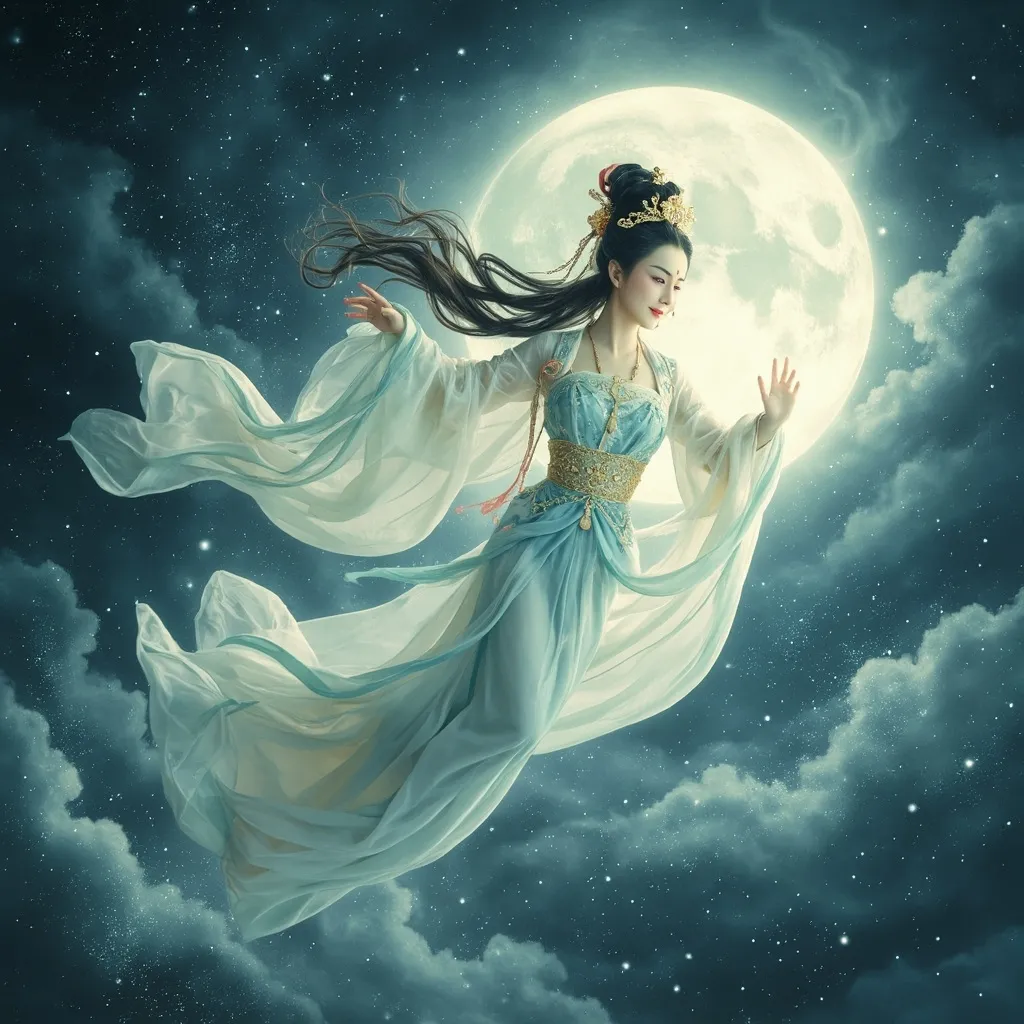
Nearby, there lived seven sisters—the fairy weavers who created the beautiful colors of the sunset. The youngest and most beautiful of them was Zhi Nü, the Weaver Girl. She spent her days weaving clouds and rainbow fabrics for the heavens, but she longed for something more—for human warmth and genuine love.
One day, Zhi Nü grew curious about the mortal world below. Sneaking away from her sisters, she descended to earth and met young Niu Lang. He was kind and sincere, treating her with a gentleness she had never experienced among the gods. And she was beautiful and lively, bringing joy to his simple life.
They fell deeply in love, and soon married. Niu Lang worked in the fields while Zhi Nü tended their home. Together, they were poor but incredibly happy. Their life was simple, but it was filled with love—and isn’t that what matters most?
The ox, who had been a celestial creature before being banished to earth, watched over the couple with approval. He had seen many mortals in his long existence, but never a love so pure and genuine.
The Wrath of Heaven
But the gods did not approve of this union. How could a mortal marry a fairy? The Jade Emperor, ruler of the heavens, was furious when he learned what had happened. He ordered the Celestial Army to bring Zhi Nü back to heaven immediately.
When the soldiers came for her, Zhi Nü had no choice but to go. She looked at her beloved husband, at their humble home, at the life they had built together—all of it torn away in an instant. The soldiers dragged her back to the heavens, leaving Niu Lang alone on earth with only his ox for comfort.
The separation was devastating. Zhi Nü was forced to resume her duties as a weaver, creating sunsets and rainbows for the heavens. But her thoughts were always on earth, on the husband she had been forced to leave behind. Her weaving suffered, her colors grew dull, and the other fairies knew something was wrong.
On earth, Niu Lang was equally devastated. He neglected his fields, spending his days staring at the sky, hoping for some sign of his beloved. The ox, seeing his master’s despair, finally spoke.
The Ox’s Sacrifice
The loyal ox spoke to Niu Lang in his dying moments. The animal had been a god once, punished for a crime and condemned to live as a beast of burden. Before he died, he told Niu Lang that if the man would make a coat from his hide and wear it, he could fly to heaven to find his wife.
Niu Lang, devastated by his ox’s death, did as he was told. He wrapped himself in the ox hide and flew toward the heavens, seeking his beloved wife. The coat allowed him to float upward, carrying him closer and closer to the celestial realm where his beloved Zhi Nü waited.
When the Jade Emperor saw Niu Lang ascending to the heavens, he was FURIOUS. Not only had this mortal married his granddaughter, but now he dared to pursue her into the celestial realm? The Emperor commanded the creation of the River of Stars—a vast celestial river that would forever separate the lovers.
The river was impossibly wide, its waters flowing with stars and cosmic fire. No mortal or god could cross it. Zhi Nü was trapped on one side, Niu Lang on the other, forever separated by this cosmic barrier.
The Weaver Girl wept on her side of the river, weaving endlessly, her tears falling like rain. Niu Lang stood helpless on the other shore, watching his wife but unable to reach her. Year after year, they remained apart—two people deeply in love, separated by an uncrossable gulf.
The Silver River of Stars
The River of Stars, known in English as the Milky Way, stretches across the summer sky—a luminous band of countless stars that ancient Chinese astronomers observed with wonder. They noted two particularly bright stars flanking this river, and wove these observations into their mythology, creating a love story that has endured for millennia.
Vega, the brighter of the two stars on the eastern side, represents the Weaver Girl. Altair, on the western side, represents the Cowherd. In the summer months, these stars are visible all night, facing each other across the galactic river. Ancient poets observed them and wondered—could stars also feel love and longing?
Modern astronomy adds another layer to the myth. The stars are indeed separated by vast distances—Altair and Vega are separated by about 16 light years. Light itself, the fastest phenomenon in the universe, takes 16 years to travel between them. In cosmic terms, they are neighbors. In human terms, they are impossibly far apart.
The ancient Chinese understood something that modern science confirms—the universe is vast, beautiful, and full of mysteries. The Cowherd and Weaver Girl story represents humanity’s attempt to make sense of this vastness, to find meaning in the stars, and to express our deepest emotions through the language of the cosmos.
The Magpie Bridge
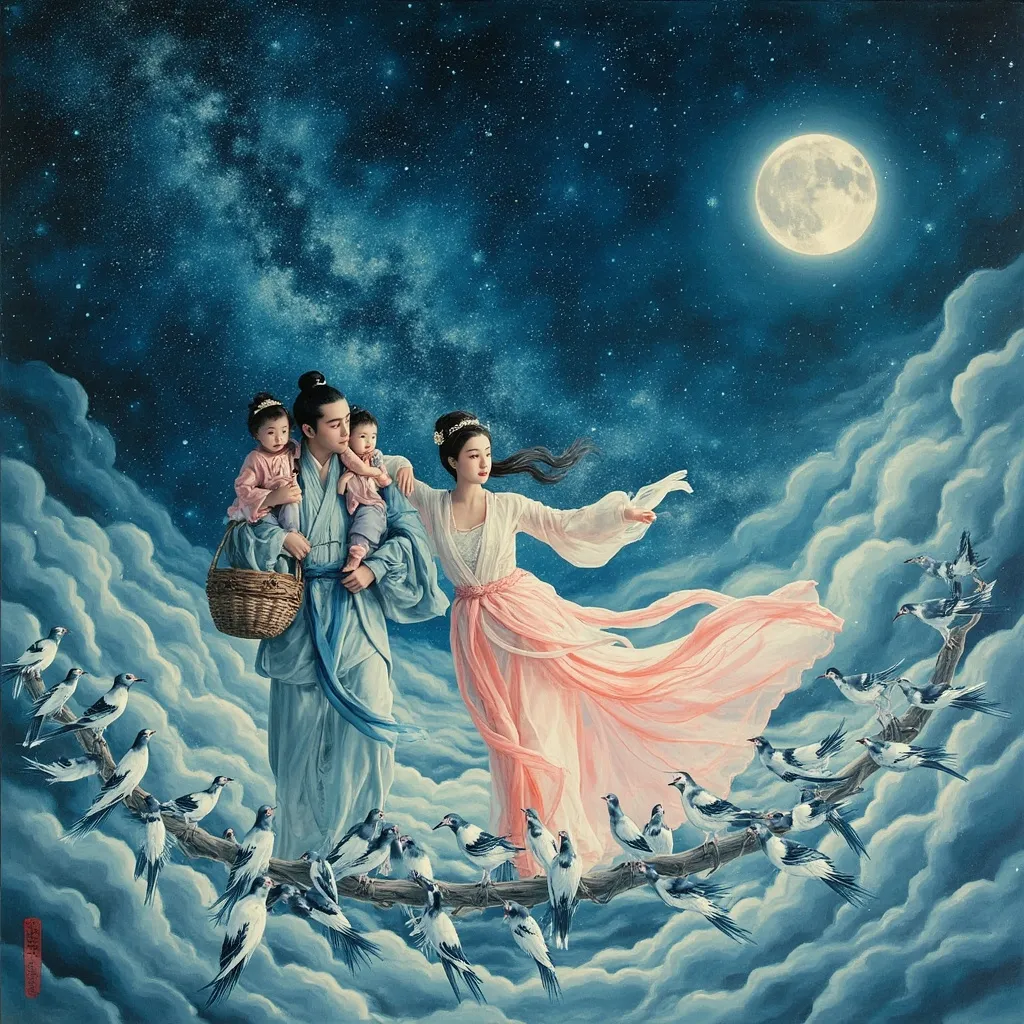
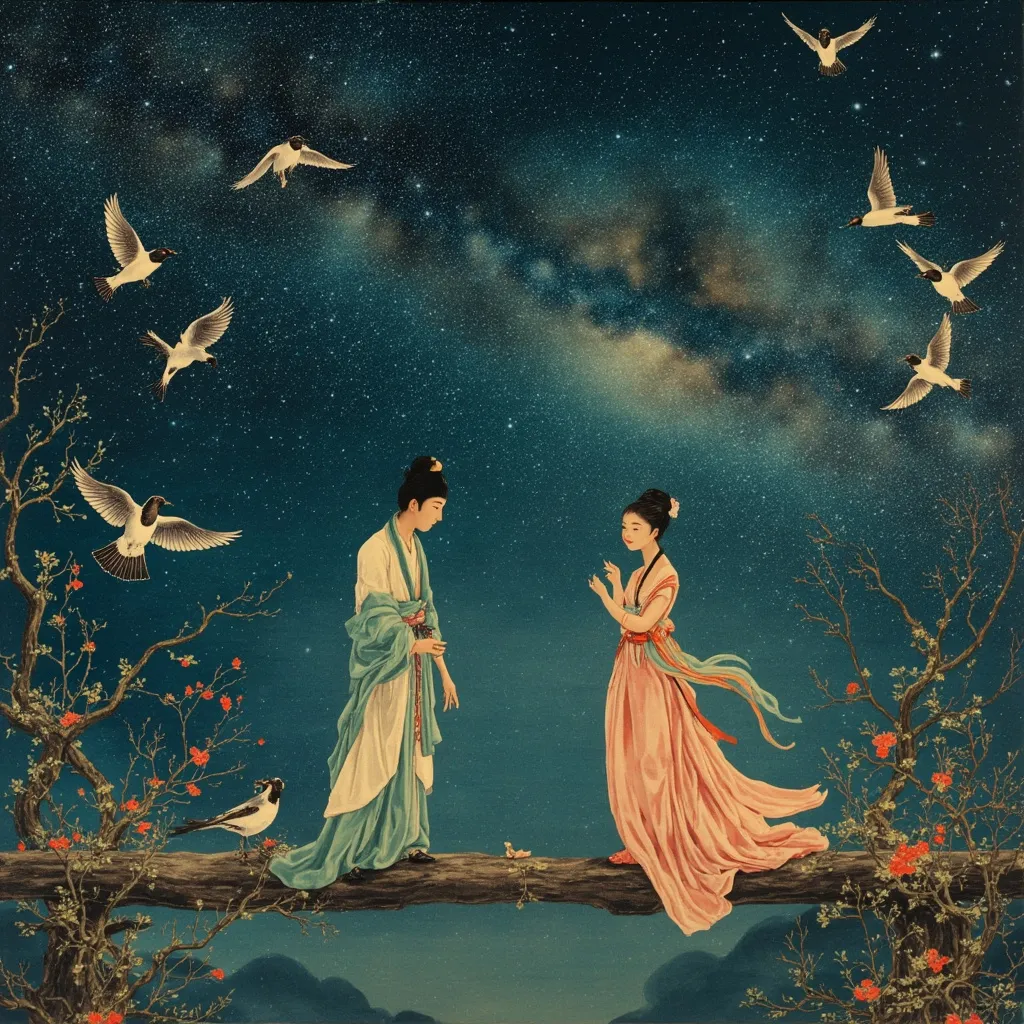
Their suffering touched the hearts of magpies across the land. Every year, on the seventh day of the seventh lunar month, the magpies would gather in their thousands and form a bridge across the River of Stars. For one precious day, Niu Lang and Zhi Nü could meet again, crossing the bridge to embrace each other once more.
The magpies’ sacrifice is an essential part of the story. These birds, considered lucky in Chinese culture, willingly give their feathers and even their lives to create the bridge that allows the lovers to reunite. Their selflessness embodies the same devotion that Niu Lang and Zhi Nü show to each other.
The bridge is fleeting—it exists for only a single day each year. But that single day is enough. The lovers savor every moment, knowing that another year of separation awaits them. This annual reunion has become a symbol of hope, proving that love can survive even the longest separations.
The Qixi Festival
Today, this legendary meeting is celebrated as Qixi Festival, also known as Chinese Valentine’s Day. It falls on the seventh day of the seventh lunar month—usually in August—when the magpies form their bridge and the lovers can reunite.
On this night, young couples in China celebrate their own love. They exchange gifts, make wishes on stars, and thank the magpies for their sacrifice. Single people pray to find love, asking the Weaver Girl and Cowherd to bless them with the same eternal devotion they share.
The festival has special significance for lovers. It’s a time to appreciate what one has, to cherish the bonds of love, and to remember that true devotion can overcome any obstacle—even the heavens themselves.
In modern China, Qixi has become increasingly popular. Jewelry stores advertise special romantic gifts. Restaurants fill with couples. Social media overflows with declarations of love. The ancient story has found new life in contemporary celebrations.
Love That Conquers All
The story of the Cowherd and Weaver Girl speaks to something universal—the belief that love is powerful enough to overcome any obstacle. The lovers are separated by the heavens themselves, yet their devotion never wavers. Year after year, they wait for their one day together, and year after year, the magpies come to help them.
Psychologists call this “attachment theory”—the idea that emotional bonds can survive great distances and long separations. Research shows that couples who maintain strong emotional connections can survive years apart. The key is faith, patience, and the belief that the separation is temporary.
The Cowherd and Weaver Girl teach us about perseverance in love. Niu Lang didn’t give up when he lost his wife—he found a way to reach her. When that way was blocked, they both continued to love each other from afar. And when they finally meet once a year, they make every moment count.
This is the essence of enduring love—not the absence of obstacles, but the determination to overcome them. Real love isn’t about being together every moment; it’s about remaining committed even when apart, about keeping the flame alive no matter what challenges arise.
The Deeper Meaning of Separation
The separation of Niu Lang and Zhi Nü represents universal human experiences: the separation of lovers by distance, of family members by circumstance, of friends by the passage of time. The Milky Way becomes a metaphor for any barrier that seems impossible to cross.
Yet the story offers hope. The magpies come every year without fail. The lovers meet every year without fail. This reliability speaks to the human need for certainty in uncertain times—we need to believe that some things will always happen, that some promises will always be kept.
The story also acknowledges that some separations cannot be overcome in this lifetime. Niu Lang and Zhi Nü can meet for only one day each year. They can never live together, never grow old together, never hold each other whenever they want. But their love is no less real for being separated.
This insight resonates with anyone who has experienced loss—whether through death, divorce, or simple distance. The Cowherd and Weaver Girl teach us that love doesn’t require physical presence to be real. Love lives in memory, in hope, in the constancy of emotional connection.
Modern Retellings and Cultural Impact
The legend continues to inspire new generations. Chinese dramas and movies frequently retell the story, often adding new elements while preserving the core message. The tale has been adapted into animations, video games, and even fashion lines.
In 2021, Chinese e-commerce giant Alibaba used the story in their annual shopping festival advertising, promoting products as gifts for Qixi. The legend has even influenced wedding traditions—many couples choose to marry on Qixi, believing their love will be blessed by the celestial couple.
The story has also traveled internationally. Western audiences, familiar with the similar tale of Orihime and Hikoboshi in Japanese mythology, appreciate the Chinese version for its unique cultural flavor. The theme of star-crossed lovers resonates universally, reminding us that love stories have been told in every culture since the beginning of human civilization.
Fashion designers draw inspiration from the story’s imagery—the magpie bridge, the river of stars, the weaver’s loom. These motifs appear in wedding dresses, engagement rings, and anniversary gifts, connecting ancient myth to modern romantic rituals.
Scientific Connections
The Milky Way, which inspired this beautiful myth, is our galactic home—a massive spiral galaxy containing hundreds of billions of stars. On clear summer nights, the band of light stretching across the sky represents the combined glow of millions of stars too distant to see individually.
Chinese astronomers documented the positions of Vega and Altair thousands of years ago, noting their brightness and their position relative to the Milky Way. These observations formed the basis of the myth, which transformed astronomical facts into human drama.
Today, we know that stars like Vega and Altair have planetary systems of their own. Could there be beings on planets orbiting these stars, looking up at our sun and wondering about us? The ancient myth reminds us that we are not alone in wondering, not alone in transforming the cosmos into stories of love and longing.
Conclusion
The legend of the Cowherd and Weaver Girl is more than just a love story—it’s a meditation on devotion, patience, and the triumph of love over impossible circumstances.
When you look at the Milky Way on a summer night, think of this ancient tale. Think of a man and woman so deeply in love that even the heavens couldn’t separate them permanently. Think of magpies sacrificing themselves each year to bring the lovers together. Think of a love that remains strong after centuries, inspiring new generations.
May you find your own Weaver Girl or Cowherd—someone who will wait for you, who will cross any river to be with you, and who will love you not just on special days, but forever.
The stars above remind us that love is eternal. And in the space between stars, where magpies fly and lovers meet, the Cowherd and Weaver Girl continue their eternal dance, inspiring us all to believe in the power of love.