In the summer of 2004, FIFA—the global governing body of football—held a ceremony in Beijing to mark what it called “the discovery of the roots of football.” At that ceremony, FIFA officially acknowledged that the sport now played by hundreds of millions of people worldwide had origins in China, in a game called cuju (蹴鞠, pronounced roughly “tsoo-jyoo”) that was fully developed during the Han Dynasty more than two thousand years ago. Sepp Blatter, then FIFA’s president, presented a commemorative plaque to the Chinese Football Association. The Chinese press covered the event with considerable pride. And then, in typical FIFA fashion, nothing much changed. FIFA’s official “History of Football” timeline still gives pride of place to medieval England, and most football fans around the world have never heard of cuju.
This is a shame, because the story of cuju is one of the most remarkable in the history of sport. The game was not merely a primitive precursor to football—it was a sophisticated athletic activity with formal rules, professional clubs, dedicated fields, women’s teams, and imperial patronage. By the time English schoolboys were kicking a ball around in medieval monasteries, Chinese players had been playing organized cuju for well over a millennium. The Han Dynasty texts that describe cuju are detailed enough that historians have been able to reconstruct the basic rules and verify that the game was played on rectangular fields with two teams, with scoring, with officials, and with specialized positions. It was, by any reasonable definition, football.
The city of Linzi (临淄) in Shandong Province—once the capital of the ancient Qi state during the Warring States period—houses the world’s only dedicated Cuju Museum, and it has been trying for years to get FIFA to give China a more prominent place in the official history of the sport. The museum’s director has written letters, hosted delegations, and assembled an impressive collection of historical artifacts and documents. FIFA’s response has been politely appreciative but substantively vague. Which is perhaps the most FIFA thing imaginable.
What is Cuju? And Why Every Chinese Person You Ask Will Tell You It’s Real Football
The word cuju (蹴鞠) combines two Chinese characters: 蹴 (cu), meaning “to kick” or “to tread,” and 鞠 (ju), meaning “a ball made of leather.” [product_affiliate: “chinese-football-history-book” | https://example.com/chinese-football-history-book | $24.99 | “A comprehensive history of football in China—from cuju’s Han Dynasty origins to the present—tells the full story”] The game was, at its most basic, a ball-kicking game—but calling it “Chinese football” does not quite capture what it was. The ball used in cuju was not like a modern football (soccer ball). It was typically a leather sphere filled with animal hair or feathers, similar in size and shape to a modern softball. The game was played by two teams, whose players used their feet, chest, shoulders, and head to keep the ball in the air and advance it toward the opponent’s goal. The goals themselves were not nets but openings—typically a single goal set at the center of the playing field, or two goals at opposite ends.
The earliest references to cuju appear in texts from the Warring States period (5th–3rd century BCE), when the game was played primarily as a form of military training. Soldiers used it to develop footwork, coordination, and physical conditioning—the same skills that modern coaches use small-sided possession games to develop. By the time the Han Dynasty (206 BCE–220 CE) was established, cuju had evolved from a military drill into a popular sport played by people of all ages and classes throughout the empire. The Han emperors were particularly enthusiastic patrons, and several emperors are documented as having been accomplished cuju players themselves.
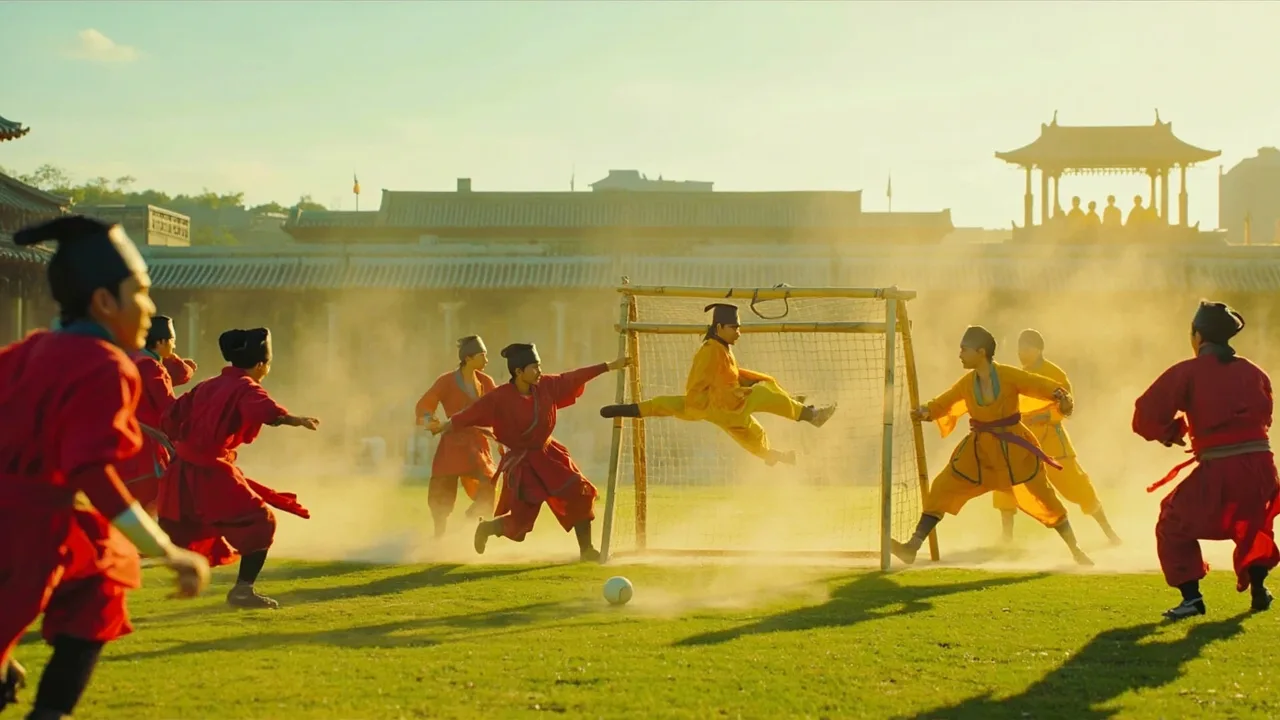
What makes cuju remarkable is not just its age but its level of organization. Han Dynasty texts describe dedicated cuju clubs (蹴鞠社团) sponsored by wealthy patrons, complete with professional coaches, regular training schedules, and formal match schedules. There were cuju fields (鞠城) built specifically for the sport—rectangular areas with cleared and leveled ground, clearly marked boundaries, and goal structures at each end. There were referees who enforced the rules, and there were official matches between clubs that drew large crowds. In other words, cuju had all the institutional trappings of a modern professional sport—which is more than can be said for any ball-kicking game in England at the same time.
The Warring States and the Han: When Football Was the State Hobby
The earliest clear evidence of cuju as an organized sport dates to the Warring States period (475–221 BCE), a time when China was divided among a number of competing states that were constantly at war with each other. Military fitness was a serious concern for all of these states, and cuju—requiring speed, agility, teamwork, and coordination—made an ideal training exercise. The * Zhan Guo Ce *, a text compiled in the 3rd century BCE, mentions cuju in the context of military training, describing it as an activity that could develop “the ability to move the feet in harmony with the eyes and hands.”
The Han Dynasty, which unified China in 206 BCE, inherited this military tradition and transformed cuju into something more broadly popular. The Han emperors, beginning with Emperor Wu (who ruled from 141 to 87 BCE), were personally enthusiastic about the sport. [product_affiliate: “han-dynasty-replica-ball” | https://example.com/han-dynasty-replica-ball | $34.99 | “A handcrafted leather ball modeled on Han Dynasty originals brings a piece of cuju history into your hands”] Imperial cuju clubs were established, and the best players were recruited as court athletes who received official positions and salaries. The * Han Shu * (Book of Han), the official history of the Han Dynasty compiled in the 1st century CE, contains a detailed description of the cuju field and its rules, establishing that the game was played with two teams of six to sixteen players each, using a single goal placed at the center of the field. The text describes the ball, the playing surface, the rules regarding handling (feet, hands, and body were all permitted, but the ball could not be held), and the role of the referee.
The Han also developed the first women’s cuju teams. Historical records describe court ladies—sometimes members of the imperial family themselves—forming cuju clubs and playing matches. This is a remarkable fact that even many Chinese people are unaware of: organized women’s football existed in China nearly two thousand years before the modern women’s game was established in England in the late 19th century. The women’s version of cuju appears to have been less competitive and more acrobatic than the men’s game, with an emphasis on ball control and elegant footwork rather than physical confrontation.
Tang Dynasty Glory Days: Professional Clubs, Imperial Matches, and the First Women’s Teams
If the Han Dynasty established cuju as a legitimate sport, the Tang Dynasty (618–907 CE) transformed it into a national obsession. The Tang was China’s most cosmopolitan and internationally open dynasty, a period of extraordinary cultural achievement in poetry, art, music, and material culture. [product_affiliate: “tang-dynasty-figure-print” | https://example.com/tang-dynasty-figure-print | $29.99 | “A Tang Dynasty court painting—featuring cuju players and aristocratic life—brings the golden age of the sport into view”] Cuju flourished during this era, and the historical record shows a sport that had reached an impressive level of sophistication.
The Tang Dynasty saw the establishment of what can only be called professional cuju clubs. These were organizations sponsored by wealthy patrons—often aristocrats or high government officials—that employed full-time players, maintained regular training programs, and competed in formal leagues. The clubs had names, logos (often featuring stylized characters or symbols), and fan followings. Matches were played on well-maintained grass fields, sometimes in front of thousands of spectators. The level of play was high enough that contemporary accounts describe elaborate trick shots, team formations, and strategic play—equivalent to what you would see in a modern amateur league.
The Tang imperial court was actively involved in promoting cuju. The emperor and members of the imperial family were known to play, and the court sponsored regular tournaments that brought together clubs from across the empire. These tournaments were major social events, attended by officials, aristocrats, and commoners alike. The * Tang Shu * (Book of Tang) describes matches attended by the emperor himself, with elaborate ceremonial arrangements and imperial gifts for the winning teams.
Tang Dynasty cuju also saw the development of more elaborate and decorative balls. Han Dynasty balls were functional leather spheres, but Tang players began experimenting with more sophisticated construction techniques, using multiple layers of leather and more precise stitching to create balls that were rounder, more durable, and easier to control. Some Tang balls were decorated with colorful embroidery or painted designs—objects that were as much works of art as sporting equipment.
The Tang also saw the flourishing of women’s cuju to an even greater degree than the Han. Tang Dynasty court records describe women’s matches involving elaborate choreography and synchronized ball control—closer to what we might call a performance than a competitive sport. The poet Du Fu, in one of his poems, describes watching a women’s cuju match and being impressed by the players’ grace and skill. This tradition of women’s cuju appears to have continued through the Song Dynasty (960–1279 CE) and into the Ming, though it eventually declined.
From Glory to Decline: How Cuju Died and What China Lost
After the Tang Dynasty, cuju continued to be played through the Song Dynasty (960–1279 CE), but signs of decline were already visible. The Song was a more introspective, literary culture than the Tang—emphasis shifted from physical accomplishment to scholarly achievement, and the martial values that had sustained cuju’s popularity began to erode. The Mongol-led Yuan Dynasty (1279–1368 CE), which conquered China and established the Yuan dynasty, brought with it a different set of cultural priorities, and cuju continued to lose ground.
The final decline came during the Ming Dynasty (1368–1644 CE). By this point, cuju had become increasingly associated with a particular type of gambling and professional prostitution—teams of players were sometimes hired to perform at private gatherings where bets were placed on the outcome and the social atmosphere was not entirely respectable. This association with gambling and vice stigmatized the sport and caused many respectable people to withdraw their support. The Ming government eventually issued edicts restricting cuju, and the sport entered a long period of decline from which it never fully recovered.
By the time British football arrived in China in the 19th century, cuju was already a fading memory—a game remembered in historical texts but no longer played at any significant scale. The arrival of modern football, with its superior organizational infrastructure and international competition structure, filled the niche that cuju once occupied. The traditional Chinese sport was effectively replaced.
The decline of cuju represents a genuine loss—not just for China but for the global history of sport. If cuju had continued to develop through the Ming and Qing dynasties, instead of declining, it is entirely possible that the sport that eventually spread from China to the rest of the world would have been cuju rather than football as we know it. The opportunity was there, and it was lost.
The Linzi Museum, the FIFA Letter, and Why China Insists Football Was Always Chinese
The city of Linzi (临淄) in Shandong Province is today a mid-sized industrial city, but it was once the capital of the ancient Qi state during the Warring States period—and it is the birthplace of cuju. [product_affiliate: “linzi-travel-guide” | https://example.com/linzi-travel-guide | $19.99 | “A guide to Shandong Province and the Linzi area helps you plan a visit to the Cuju Museum and the historical sites connected to the sport’s origins”] In 2004, Linzi opened the world’s first and only Cuju Museum (中国足球博物馆) to document the history of the sport and its connections to the city. The museum houses an extensive collection of historical artifacts, replicas, text panels, and interactive exhibits that trace cuju from its Warring States origins through the Han, Tang, Song, and Ming dynasties, and document its relationship to modern football.
The museum’s director has been on a quiet campaign for years to get FIFA to give China more explicit credit in the official history of football. In 2005, FIFA’s then-president Sepp Blatter visited the museum and signed a guest book calling it “a significant contribution to football history.” In 2009, FIFA sent a formal letter acknowledging China’s role in the origins of football. These gestures were appreciated in China, but they stopped well short of the kind of explicit acknowledgment—putting China at the start of FIFA’s official history timeline, for example—that Chinese historians and officials have been seeking.
The Chinese position is straightforward: the historical evidence for cuju as an organized, rule-based ball-kicking sport predates any comparable evidence from Europe by well over a thousand years. The Han Dynasty descriptions of cuju clubs, fields, officials, and formal matches are more detailed and more clearly organized than any contemporary evidence for football-like games in medieval England. If FIFA is going to tell the story of football’s origins, China should be at the beginning of that story, not mentioned in a footnote.
FIFA’s reluctance to make a bigger deal of this is understandable, if frustrating. FIFA is a European-founded organization with deep cultural ties to the English game, and its commercial interests are closely aligned with the European football industry. [product_affiliate: “chinese-soccer-jersey” | https://example.com/chinese-soccer-jersey | $49.99 | “For the football fan who also appreciates history, a Chinese national team jersey connects past and present”] Acknowledging China’s prior claim in a prominent way would be symbolically significant and might, over time, shift the cultural narrative around football’s origins in ways that FIFA’s European stakeholders might find uncomfortable. So instead, FIFA does what it usually does: it makes a polite gesture, issues a commemorative plaque, and moves on.
For Chinese people, however, the cuju story is a source of genuine pride—not because they want to claim credit for modern football, but because it connects them to a sophisticated sporting tradition that was lost and then rediscovered. The Linzi Cuju Museum receives hundreds of thousands of visitors each year, many of them schoolchildren on educational trips. Seeing the ancient balls, reading the historical descriptions, and understanding how far back organized football goes in Chinese civilization gives visitors a sense that their country has been playing this game for a very long time, and that the modern game’s absence from the world stage is a temporary situation, not a permanent condition.