In the spring of 206 BC, as the sun set over the栈道—the wooden plank roads that clung to the cliffsides of the Qin Mountains—a curious scene unfolded. Workers were dismantling the roadway. Local observers watched as supports were knocked loose, planks were pried up, and entire sections of the ancient highway that connected Sichuan to the rest of China were being systematically destroyed. The workers were part of an army—Liu Bang’s army, recently defeated by his rival Xiang Yu and forced into exile in the remote western kingdom of Sichuan. And on the orders of his brilliant general 韩信 (Han Xin), they were making a very public show of abandoning any hope of ever returning east.
But Han Xin was not a man who did things by accident.
What the watching eyes did not see—what they could not possibly have seen from their vantage points on the roads below—was the real plan. While Liu Bang’s men made an enormous, theatrical noise about destroying the only highway connecting Sichuan to the outside world, a separate force was moving in complete darkness along an entirely different route. A route that had been used for centuries but had been largely forgotten as a military pathway. A route that ran through the mountains near 陈仓—Chen Cang—that ancient fortress town that guarded the western entrance to the Guanzhong plain, the heartland of China itself.
This is the story behind 暗渡陈仓—àn dù chén cāng—which translates literally to “secretly crossing Chen Cang.” In modern Chinese, the idiom describes any situation where someone takes a covert path to achieve what everyone expects them to approach through the obvious, public route. It’s about misdirection. About doing one thing loudly while doing something else entirely in the dark.
The Context: After the Feast at Hong Gate
To understand why this deception was necessary, you need to remember where Liu Bang stood in the spring of 206 BC. He had just survived the infamous Feast at Hong Gate—鸿门宴—where his rival Xiang Yu had very nearly killed him on the advice of his strategist Fan Zeng. Through a combination of humility, political maneuvering, and some well-placed allies inside Xiang Yu’s own camp, Liu Bang had escaped with his life. But he had paid a steep price.
Xiang Yu had stripped Liu Bang of most of his territory and forced him into the remote kingdom of 四川 (Sichuan)—a region so isolated that it was sometimes called “the land of the four rivers” and was considered a kind of exile within the former Qin Empire. Liu Bang was given barely 100,000 soldiers and stationed far from the centers of power. Xiang Yu, for his part, returned east to his own territories with the vast bulk of the conquered Qin lands under his nominal control.
Liu Bang was supposed to be finished. He had survived, but barely, and in the ancient world survival without territory and armies was usually just a slower form of defeat. His soldiers were demoralized. His supplies were limited. And the one road that connected his new kingdom to the east—the栈道, the plank road through the mountains—was a vulnerability as much as a connection: any enemy who wanted to attack him would have an easy time following that same road into Sichuan.
Han Xin, who had recently joined Liu Bang’s service after a famous episode in which he’d been recognized by the advisor 萧何 (Xiao He) and promoted from obscurity, looked at this situation and saw opportunity where others saw only despair. Han Xin had studied military strategy extensively, and he understood something that Liu Bang’s other generals did not: the栈道 that everyone was watching was not the real path into or out of Sichuan.
The Misdirection: Burning the Plank Road
Han Xin’s plan was elegant in its simplicity. He understood that Xiang Yu, even in his moment of triumph, was distracted—busy fighting wars on multiple fronts, managing a vast coalition of regional lords who were only loyal to him insofar as they feared him, and generally governing an empire that was much harder to hold together than it had been to conquer. Xiang Yu would not be watching Liu Bang carefully. He would assume that Liu Bang, safely tucked away in Sichuan, was no longer a serious threat.
And Han Xin was going to exploit that assumption ruthlessly.
The first step was to make an unmistakable public gesture that would reach Xiang Yu’s ears: Liu Bang was going to “reconstruct” the mountain roads. Specifically, Han Xin announced that thousands of workers would be sent to repair the destroyed栈道—work that would take months, maybe years, given the scale of the destruction. The announcement was deliberate. It was meant to be heard by Xiang Yu’s spies, by any travelers who might carry news east, by anyone who was watching Liu Bang’s kingdom and wondering what he planned to do next.
The message was clear: Liu Bang was settling in for a long stay in Sichuan. He was not planning to fight his way back to power. He was going to be a regional lord, nothing more, and his first priority was making his territory more connected and more livable.
Han Xin then began the work of actually reconstructing the road. Workers appeared at the destroyed sections. Scaffolding went up. Lumber was cut and hauled. The noise was considerable and very, very public.
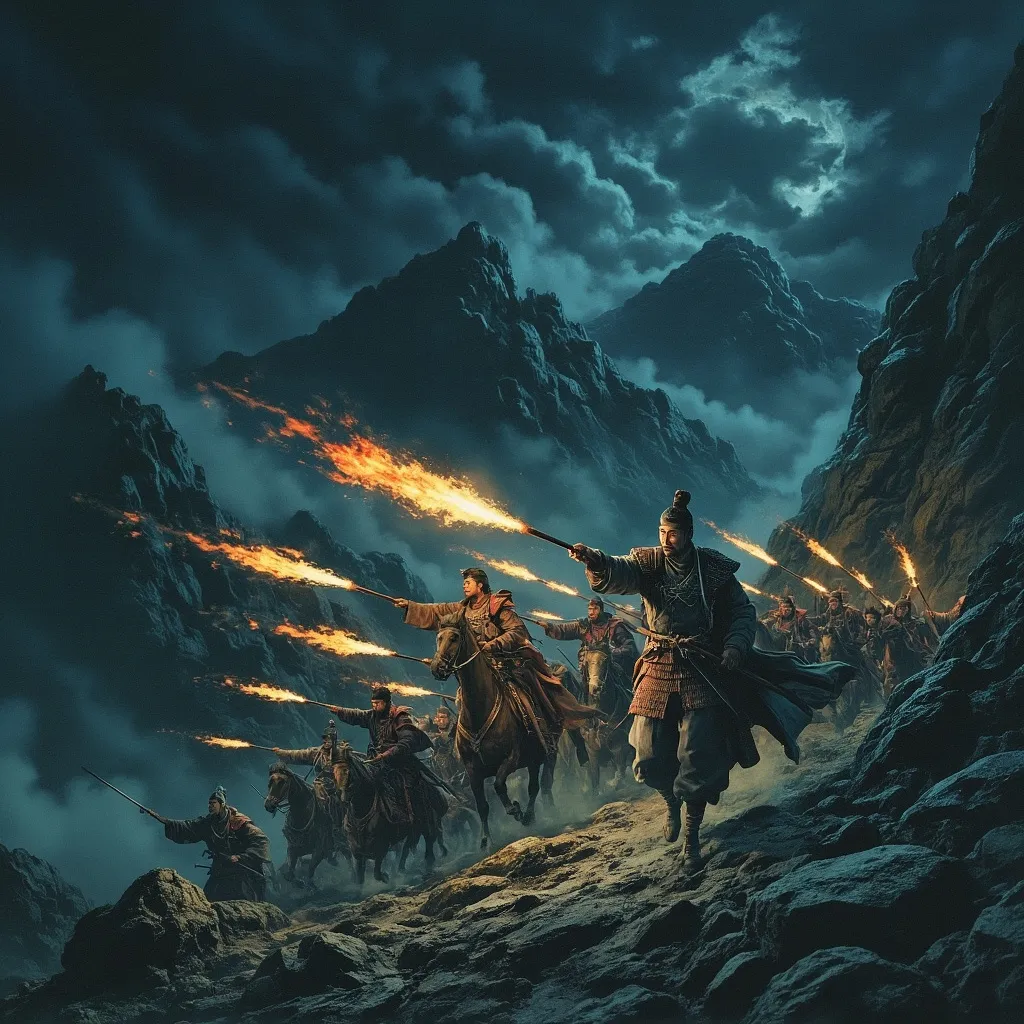
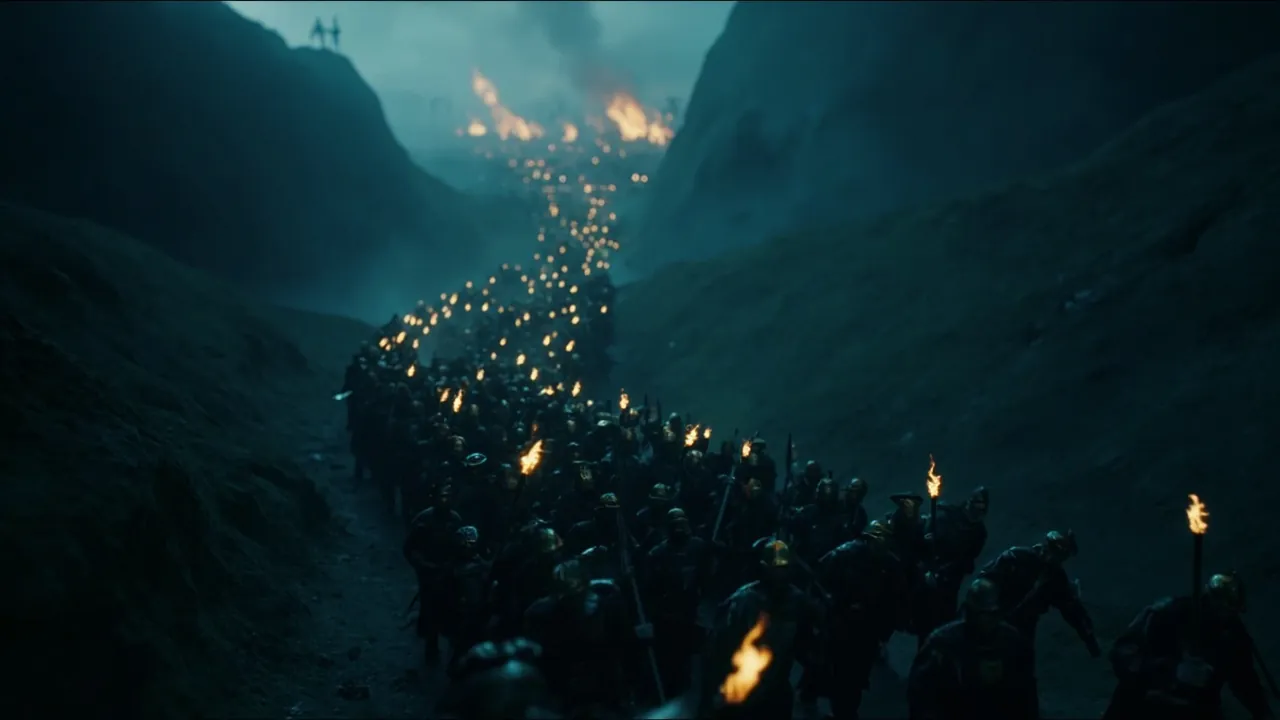
And while everyone watched the road being rebuilt, Han Xin sent a force of elite soldiers along an entirely different route. They traveled at night, through mountain paths that were difficult, treacherous, and almost completely unknown to anyone who hadn’t grown up in the region. These were not roads—they were barely trails, rocky and narrow and easily missed by anyone who wasn’t looking for them. Han Xin had studied these paths carefully. He had identified one that could move an army from Sichuan to the Guanzhong plain without ever touching the main highway, and he had kept that knowledge secret until the moment he was ready to use it.
The Attack: Emerging from Darkness
The plan’s timing was exquisite. Han Xin had calculated exactly how long it would take Xiang Yu’s forces to hear about the “reconstruction” project, process its implications, and begin to relax their guard. The moment they stopped watching Sichuan closely—really stop watching, not just nominally—the real strike would begin.
Han Xin emerged from the mountains near Chen Cang with an army that Xiang Yu’s local garrison had no idea existed. The fortress of Chen Cang was a key position—it controlled the main road from Sichuan into the Guanzhong heartland, and whoever held it held the key to opening the entire western front. The garrison there was small and unprepared, expecting trouble from the reconstructed栈道 if trouble came at all. Instead, trouble came from the mountains, from a direction that shouldn’t have been possible.
The battle was brief. Han Xin’s soldiers, fresh and prepared and carrying the momentum of a plan that had worked perfectly, overwhelmed the surprised defenders. Chen Cang fell. The road into the Guanzhong plain was open.
The news reached Xiang Yu too late. By the time he understood what had happened—that Liu Bang had never intended to stay in Sichuan, that the road reconstruction was an elaborate charade, that the real attack had come from the mountains through an all-but-unknown route—Han Xin had already pushed deep into Guanzhong with Liu Bang’s army at his back. The entire strategic situation had changed in a matter of weeks.
The Pattern: Misdirection as Strategy
What makes the story of 暗渡陈仓 so instructive is not just the specific tactical deception—it’s the underlying principle that Han Xin was applying. Misdirection is one of the oldest tools in both warfare and politics, and Han Xin used it with exceptional sophistication. He understood that human beings are wired to watch what is loud, what is obvious, what is making noise in front of them—and to neglect what is quiet, hidden, and happening in peripheral vision. By making the road reconstruction loud and obvious, Han Xin guaranteed that every pair of eyes watching Liu Bang’s kingdom would fixate on that project and ignore the mountains behind it.
The idiom 暗渡陈仓 has survived for more than two thousand years precisely because the pattern it describes—the pattern of doing something dramatic and visible as a cover for something quiet and decisive—keeps recurring in human affairs. A company announces a major product line while quietly acquiring its future competitors. A politician campaigns on one set of issues while building coalitions around another. A military force launches a feint at one position while moving troops through terrain no one thought to defend.
In every case, the principle is the same: the best way to get someone to look somewhere is to give them something more interesting to look at. Make enough noise about the obvious path, and the covert path becomes invisible even when it’s right in front of people.
The Broader Significance: Why Han Xin Was Different
Han Xin’s brilliance in this episode illustrates something that made him stand out among the great military minds of ancient China. Most generals won battles by being stronger, faster, or better-equipped than their opponents. Han Xin won battles by being smarter—by understanding what his enemies expected and then systematically subverting those expectations. He was not the kind of commander who put himself at the head of his army and charged; he was the kind who sat back, studied the situation, and found the path to victory that no one else had seen.
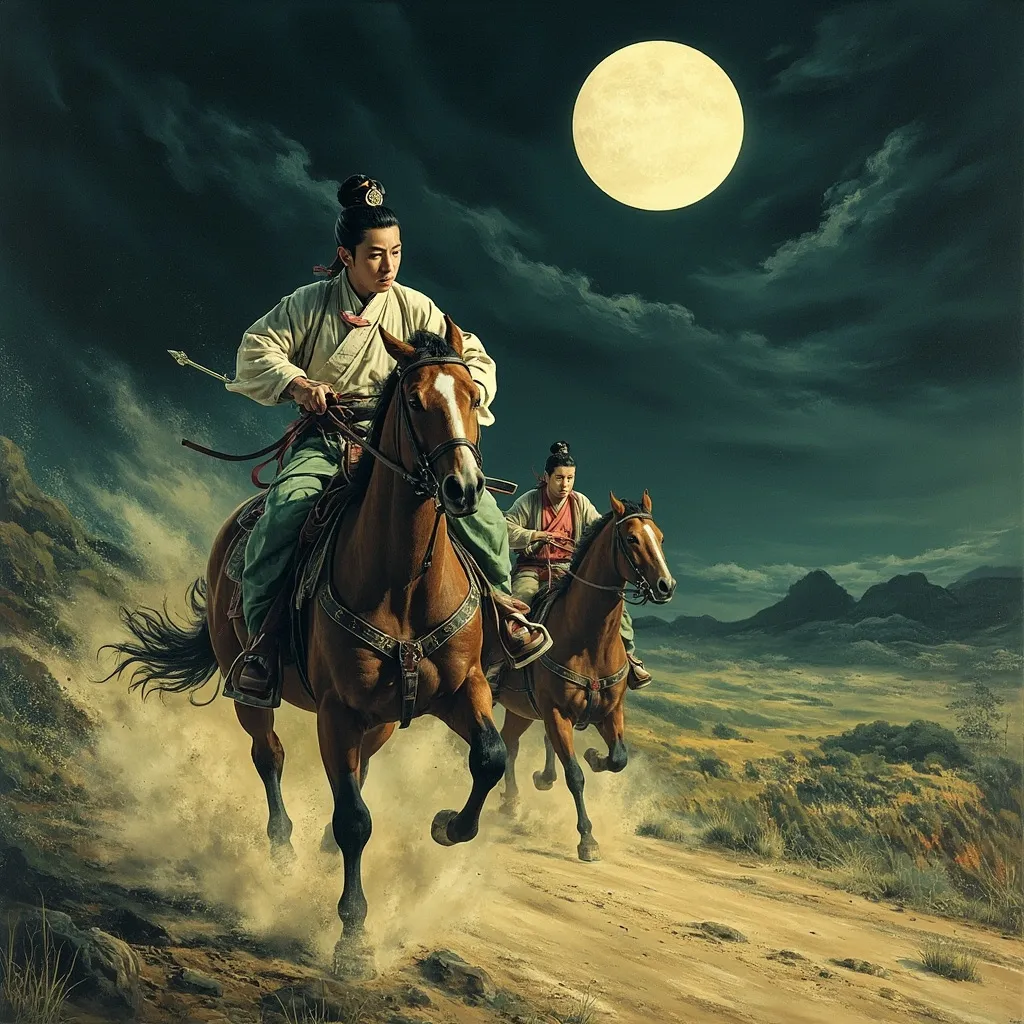
This is why Liu Bang’s advisor Xiao He had taken such a risk in recommending him. Han Xin had come to Liu Bang’s camp as an unknown—barely dressed, apparently poor, having once been humiliated by a local bully who made him crawl through his legs. He had tried to offer strategic advice to Liu Bang early on and been largely ignored. It was Xiao He who saw his potential and, famously, chased after him when Han Xin decided his talents were being wasted and left Liu Bang’s service. Xiao He rode out personally under the moonlight, caught up with Han Xin at a river crossing, and convinced him to return. This chase is the subject of another famous Chinese idiom—萧何月下追韩信—and the story of that night is worth understanding on its own.
But that is a story for another article.
What matters here is that Han Xin’s strategy at Chen Cang proved Xiao He right. Han Xin had looked at an impossible situation—a general in exile, stripped of territory, facing a vastly superior rival—and found the one path to victory that his enemy would never see coming. The “secret crossing of Chen Cang” was not just a military maneuver. It was a statement of philosophy: the best battles are won in the enemy’s mind before a single soldier is engaged.
What “暗渡陈仓” Means Today
In modern Chinese, 暗渡陈仓 is used to describe any action that appears to be one thing but is actually another—any situation where the public-facing activity is a cover for the real plan. The phrase carries a note of cleverness, even admiration: it suggests that the person executing the plan was smarter than whoever was watching. It is not entirely neutral—there’s a hint of “got away with something” in the expression—but it is mostly appreciative of the skill involved.
You might hear it used in business contexts: “That company,暗渡陈仓,bought out its main supplier while announcing a partnership.” You might hear it in personal contexts: “He said he was going to study abroad,暗渡陈仓,and actually moved to the same city as his ex.” The idiom has aged well because human nature hasn’t changed—we still watch the obvious, we still miss the hidden, and the people who know how to use that tendency still win.
The deeper wisdom of the phrase is about the relationship between perception and reality in strategy. Han Xin did not just attack Chen Cang. He first attacked the way Xiang Yu thought about the situation. He made Xiang Yu see what he expected to see—the slow reconstruction of a road, the settling-in of a defeated rival—and in doing so, he made it impossible for Xiang Yu to see what was actually happening. By the time Xiang Yu’s perception caught up with reality, the reality had already changed permanently.