slug: dayu-controlling-waters description: “Discover how Da Yu conquered China’s devastating floods not by building walls, but by learning to work with water’s nature—a legendary story of perseverance, wisdom, and harmony with nature.” keywords: [‘Da Yu’, ‘大禹治水’, ‘Chinese mythology’, ‘flood control’, ’tributary’, ‘ancient China’] categories: [‘Chinese Mythology’, ‘Cultural Heroes’] tags: [‘mythology’, ‘flood’, ‘hero’, ‘rivers’, ‘ancient china’] image: “/images/dayu-controlling-waters.jpg” alt_text: “Da Yu directing the waters of China with tools” author: Jaie affiliate_products:
- name: “Traditional Chinese Flood Control History Book” url: “https://example.com/flood-control-history" description: “Comprehensive history of flood management in ancient China”
- name: “Da Yu Bronze Figure Statue” url: “https://example.com/dayu-statue" description: “Handcast bronze statue of the legendary water control hero”
- name: “Yellow River Basin Map” url: “https://example.com/yellow-river-map" description: “Beautiful historical map of China’s great rivers”
- name: “Taoist Water Philosophy Book” url: “https://example.com/water-philosophy" description: “Explore the deep connections between water and Taoist thought”
- name: “Ancient Chinese Engineering Tools Replica Set” url: “https://example.com/engineering-tools" description: “Replica tools inspired by ancient Chinese water management”
Da Yu Controlling the Waters: The Hero Who Tamed China’s Rivers
In the earliest days of Chinese civilization, when the Yellow River swelled beyond its banks and drowned entire villages, one man rose to face the floodwaters. His name was Da Yu, and his battle against the waters would become one of the most celebrated stories in all of Chinese history. While other heroes wielded swords and bows, Da Yu wielded something far more powerful—patience, wisdom, and a deep understanding of nature itself.
The Great Flood
For generations, China suffered under devastating floods. The great rivers—the Yellow River and the Yangtze—regularly burst their banks, destroying crops, drowning livestock, and sweeping away entire communities. The waters seemed unstoppable, an irresistible force of nature that defied all human attempts at control.
The Yellow River, known as China’s Sorrow, carried enormous amounts of silt from the Loess Plateau, causing its bed to rise above the surrounding countryside. Unlike most rivers, which cut deeper into the earth as they flow, the Yellow River often flowed above the level of adjacent fields. The levees holding it back were constantly under pressure, and when they failed, catastrophe followed.
Historical records describe floods of unimaginable scale. Whole regions disappeared under water. Populations were forced to relocate, sometimes repeatedly. The floods didn’t just destroy property—they shaped the very course of Chinese civilization, influencing where people could safely settle and how political power might be organized.
Emperor Shun, ruling during this terrible time, sought a hero who could end the flooding once and for all. He called upon all capable men to present themselves. The job was dangerous—many had tried and failed, swept away by the relentless waters. But one man stepped forward: Da Yu, son of a man named Gun.
The Father’s Failure
Gun had attempted to control the floods using dikes and dams, building walls to hold back the water. His approach was logical—if water threatens to overflow, build barriers to contain it. Many had tried this approach before, and many had failed in the same way.
The problem with Gun’s method was fundamental: water cannot be contained indefinitely. It accumulates behind barriers, pressure builds, and eventually the walls break—often with greater force than if left alone. Gun’s barriers held for a time, but the water simply rose higher and broke through stronger. When they failed, the floods were even more devastating than before.
Gun was executed for his failure. In ancient China, failure in a sacred duty could be punished by death. The father’s mistakes would haunt his son, but they would also teach him invaluable lessons about what not to do.
The execution of Gun represents a harsh reality: in ancient times, rulers couldn’t afford to tolerate failure when people’s lives were at stake. The pressure on Da Yu must have been enormous. His father’s blood was on his hands, and the entire kingdom watched to see if he would succeed where his father had died trying.
Learning From Failure
Da Yu studied his father’s mistakes carefully. Gun had tried to force the water to go where humans wanted it to go. But water, Da Yu realized, could not be forced—it could only be guided. Instead of fighting the water’s nature, Da Yu would work with it.
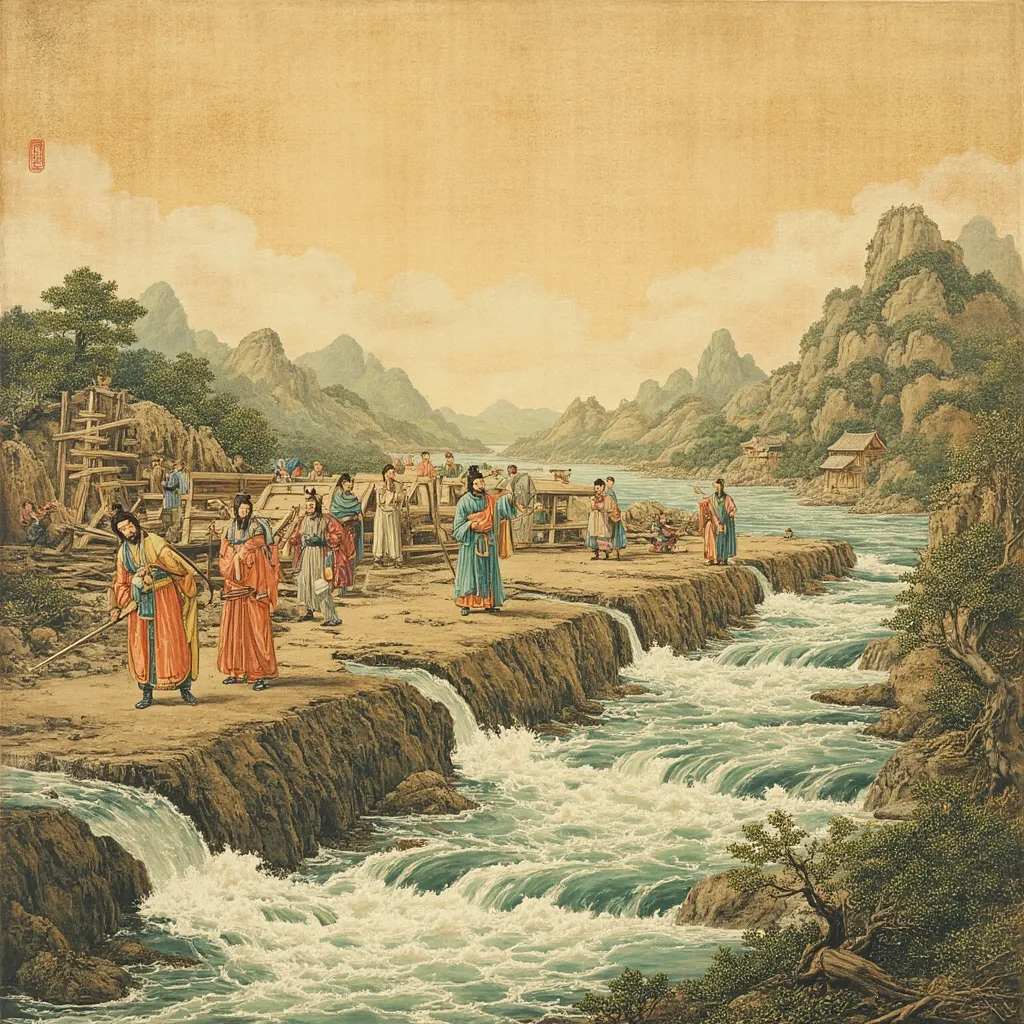
He began by carefully mapping the entire region, studying how the water flowed, where it pooled, and where it rushed. He learned to read the landscape, understanding that water naturally flows downhill, seeking the lowest path. Instead of blocking this path, Da Yu would clear it, allowing the water to flow more freely toward the sea.
This was a revolutionary approach. Rather than building walls against nature, Da Yu worked with nature itself. He dug channels and deepened riverbeds, creating pathways for the water to follow. He cleared rocks and debris that blocked natural drainage. He built terraced fields on hillsides to slow the flow of rainwater into the rivers.
Da Yu’s method was fundamentally different from his father’s. Where Gun sought to conquer nature, Da Yu sought to collaborate with it. Where Gun built walls, Da Yu built channels. This approach required more initial effort but produced sustainable, long-lasting results.
The Eight-Year Journey
Da Yu’s work took him away from home for an incredible eight years. During this time, he traveled across the entire flooded region, directing the excavation of channels, the clearing of riverbeds, and the construction of flood control systems.
The story of his dedication has become legendary. Da Yu passed his own home three times during his work but never stopped to visit his family. His dedication to his mission was absolute. His wife, waiting at home, is said to have made him his favorite meal and brought it to him at the worksite—but even then, Da Yu only had time to taste a single bite before returning to his work.
The legend has it that he grew old before his time, his skin weathered by sun and wind, his body worn thin by endless labor. But he never stopped, never wavered, never considered giving up. The suffering of his people drove him forward when exhaustion threatened to claim him.
The story demonstrates the level of sacrifice required to accomplish great things. Da Yu gave up everything—his comfort, his family life, his personal desires—for the sake of saving his people. This selflessness became a model for Chinese rulers throughout history.
The System of Rivers
By the time Da Yu completed his work, he had created an intricate system of water management that China still benefits from today. The Yellow River, which had terrorized communities for generations, now flowed calmly through its deepened channel. Floods still occurred but were manageable, their destructive power reduced by the system of channels and terraces Da Yu had constructed.
Da Yu divided the land into nine provinces, each with its own water management system. This administrative structure became the foundation of Chinese governance for millennia. The attention to infrastructure, to public works that served the common good, became a core value of Chinese civilization.
The success of Da Yu’s approach lay in its simplicity and sustainability. Rather than expensive, easily-broken dams, he created natural drainage systems that worked with the landscape. Rather than fighting water, he taught water where to go.
This division into provinces also established important precedents for Chinese governance. The idea that a central authority should manage water resources for the benefit of all—rather than allowing local lords to manage (or mismanage) their own territories—became a foundational principle of Chinese political philosophy.
The Philosophy of Water
Da Yu’s story carries deep philosophical meaning in Chinese culture. His approach became a metaphor for effective governance—leaders should guide their people like water, not force them. The concept of wu wei, or non-action, derives partly from observing how effective water management works.
In Taoist philosophy, water is the ultimate example of strength through gentleness. Water seems soft and yielding, yet over time, it can carve through mountains. It flows around obstacles rather than trying to destroy them. It always finds its way, patient and persistent.
Da Yu embodied these principles. He didn’t try to overpower the flood—he understood it, worked with it, and gradually channeled its energy into productive paths. This wisdom has influenced Chinese thinking for thousands of years.
The concept of “governing by non-action” doesn’t mean doing nothing—it means not forcing situations, not fighting against the natural flow of events. A leader who tries to force everything often creates more problems than they solve. A wise leader identifies the natural direction things are heading and helps them along, removing obstacles rather than building walls.
Modern Applications
Engineers today still apply Da Yu’s principles to water management. The Three Gorges Dam and countless other flood control projects in China trace their lineage to his ancient work. Urban planners study how Da Yu created sustainable systems rather than quick fixes.
Climate change has made Da Yu’s legacy more relevant than ever. As extreme weather events become more common, the need for sustainable water management grows. Da Yu’s patient, systematic approach offers lessons for modern challenges.
The principle of working with nature rather than against it has gained traction in environmental circles. Rather than building ever-higher sea walls, engineers now consider soft solutions like marsh restoration that can absorb floodwaters naturally. Da Yu would approve.
Modern flood management increasingly emphasizes natural and nature-based solutions. Restored wetlands, green infrastructure, and improved drainage systems all reflect Da Yu’s insight that water needs somewhere to go. Trying to keep water out entirely is futile; the solution is to give water a path.
The Dynasty That Followed
Da Yu’s success made him a legend, and his descendants would go on to found the Xia Dynasty—the first dynasty in Chinese history. This connection between water management and political legitimacy shaped Chinese civilization for millennia to come.
The founding of the Xia Dynasty represents a pivotal moment in Chinese history—the transition from legendary rulers to hereditary monarchs, from mythological times to historical times. Whether Da Yu was a real person or a composite figure assembled from multiple historical events, his story established templates that Chinese rulers would follow for thousands of years.
A ruler who controls the waters gains legitimacy. A ruler who fails to manage floods loses the “mandate of heaven.” This connection between governance and infrastructure, between political power and public works, remains a distinctive feature of Chinese political culture to this day.
The Symbolism of Perseverance
Beyond philosophy and governance, Da Yu’s story carries a message about perseverance that resonates with ordinary people. He failed not because he lacked skill but because his father had failed. Yet he picked himself up, learned from the failure, and eventually succeeded.
This message has inspired generations of Chinese people facing their own challenges. When students struggle with difficult exams, they think of Da Yu’s eight years of labor. When entrepreneurs face failure, they remember that Da Yu’s father also failed before Da Yu succeeded. The story teaches that setbacks are not the end—they are often the beginning of ultimate success.
The story also teaches the value of studying problems deeply before acting. Da Yu didn’t rush in with solutions—he spent time understanding the land, the water, and the nature of the challenge. Only then did he act, and his actions were effective because they were based on understanding rather than guesswork.
Lessons for Today
As climate change intensifies flooding worldwide, Da Yu’s story offers important lessons. The old approach of building higher walls and stronger dams has reached its limits. Modern engineers increasingly recognize that trying to completely control water is futile—what we can do is manage it, channel it, and give it space.
Da Yu’s division of the land into provinces also speaks to modern debates about federalism and local governance. How much authority should be centralized? How should resources be allocated across regions? These questions, first articulated in Da Yu’s administrative reforms, remain relevant today.
Perhaps most importantly, Da Yu’s story reminds us that great achievements require great sacrifice. The eight years he spent away from home, the bit of food he had time to eat, the physical toll of endless labor—all of these sacrifices produced results that benefited millions of people for thousands of years.
Conclusion
Da Yu’s legend endures because it represents the best of human qualities—intelligence, perseverance, self-sacrifice, and wisdom. He didn’t try to dominate nature; he learned from it and worked with it.
When we face our own floods—literal or metaphorical—Da Yu’s story reminds us that there is always a way forward. We need to understand the problem deeply, approach it with humility, and persist until we find a solution that works.
The next time you see a river flowing calmly to the sea, think of Da Yu. Think of the thousands of years his work protected the Chinese heartland. And think of the wisdom that allowed one man to tame the floods through patience and understanding.
For in the end, Da Yu’s greatest achievement wasn’t just controlling the waters—it was showing humanity how to live in harmony with nature itself.