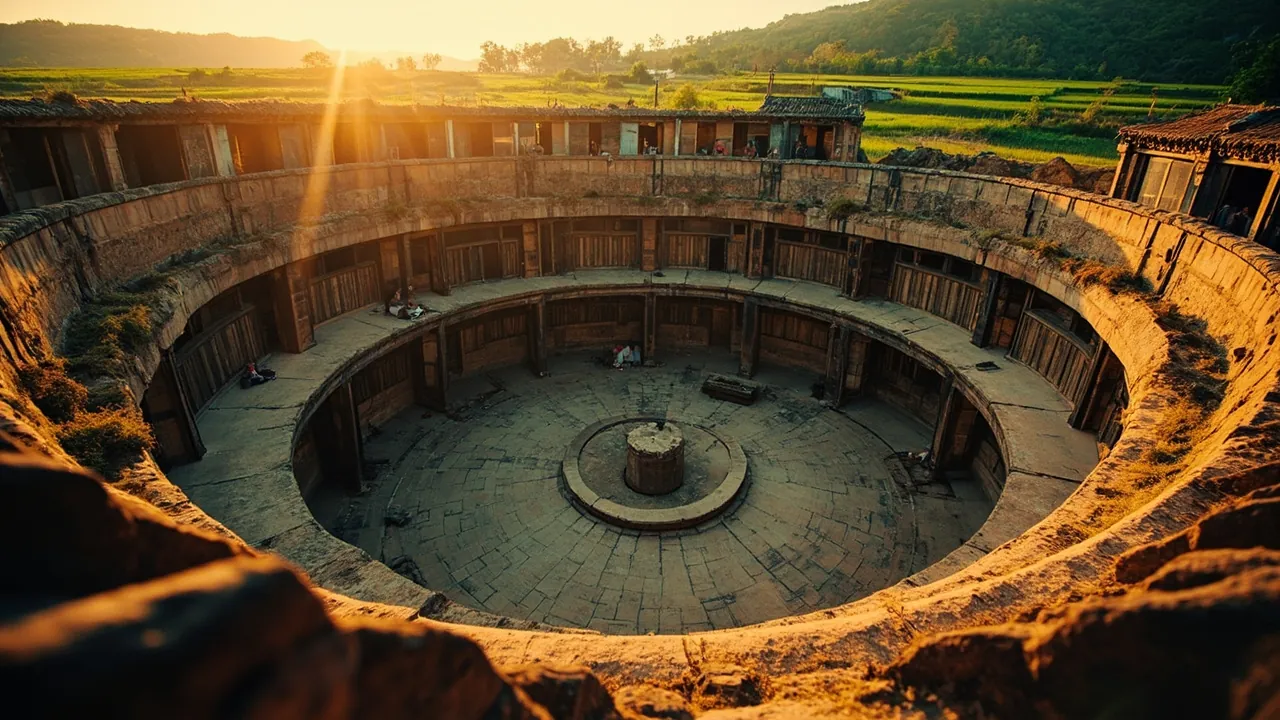
Imagine standing in a village square in the early morning mists of Guizhou province, surrounded by terraced rice fields and limestone karst mountains. A crowd begins to gather — not a small crowd, but hundreds of people, men and women, old and young, moving into formation with the casual ease of people who have done this their entire lives. There is no stage, no microphone, no conductor raising a baton. There is only the great wooden drum tower at the center of the village, the smell of wood smoke and river water, and then — the sound.
A single woman’s voice rises first, high and clear, carrying a melody that sounds like it comes from somewhere older than the mountains themselves. Then another voice joins, then another, layering harmonies in a pattern that has no parallel in Western music — not melody plus accompaniment, but multiple melodies interlocking simultaneously, creating a sonic architecture so complex that it took musicologists decades to understand what was happening.
This is the Dong Grand Song (侗族大歌, Dongzu Dage), and it is one of the most extraordinary musical traditions on earth. In 2009, it was inscribed on UNESCO’s Representative List of the Intangible Cultural Heritage of Humanity. But for the Dong people themselves, it is not heritage. It is Tuesday.
What Is the Dong Grand Song?
The Dong Grand Song is a polyphonic choral tradition native to the Dong people (also known as the Kam people), an ethnic group of roughly three million people living in the mountainous border region where Guizhou, Hunan, and Guangxi provinces meet in southwest China. It is called “Grand Song” because it is performed by large groups — sometimes hundreds, sometimes thousands — without any instrumental accompaniment, conductor, or written score.
What makes it musically unique is its structure. Western polyphony, from medieval Gregorian chant to modern jazz harmony, is built on the principle of one melody with supporting harmonies. Dong Grand Song operates differently: it uses multiple independent melodies sung simultaneously, creating an interlocking harmonic texture that Western musicologists have compared to Flemish Renaissance polychoral singing or certain forms of Bulgarian folk polyphony, but which has no exact equivalent anywhere else.
The result is a sound that is simultaneously ancient and strangely modern — it has been described as sounding like Bach fugues, like African American gospel, like ambient electronic music. It is a sound that does not fit neatly into any historical or cultural category, which may be why it has fascinated everyone who has encountered it.
The songs are not love songs or ceremonial pieces in the Western sense. They are nature songs — the Dong believe that their ancestors learned to sing by imitating birds, rivers, and wind. Many Grand Songs are explicitly about the natural world: the sound of the cuckoo, the rush of water over stones, the movement of clouds over mountains. To hear a Grand Song is to hear the landscape of Guizhou translated into human voice.
The History: A Living Tradition for a Thousand Years
The origins of the Dong Grand Song are shrouded in legend. The Dong people have no written script of their own — their history was transmitted orally, through song — and so the earliest references to Grand Song are in other Chinese texts and in the Dong people’s own oral traditions.
One popular story dates the tradition to around 200 BCE, when the Dong people’s ancestors were fleeing war and came upon a valley so beautiful that they decided to stop and settle. When they arrived, they found that the valley was already occupied — by birds. The birds had been singing there for so long that their songs had become part of the landscape itself. The Dong ancestors decided to learn from the birds, and Grand Song was born.
More reliable historical references appear in Chinese texts from the Song dynasty (960-1279 CE), which describe the Dong people as having a rich musical tradition. By the Ming dynasty (1368-1644), Grand Song was well established as the central performing art of Dong cultural life. European missionaries and scholars in the 19th and early 20th centuries encountered it and described it with a mixture of wonder and bewilderment — wonder at the sound, bewilderment at how such a complex tradition could exist without notation, formal training, or any of the institutional structures that Western music relied upon.
The tradition survived the Cultural Revolution (1966-1976), when many folk traditions were suppressed as “feudal superstition.” Grand Song went underground, performed quietly in family compounds rather than in public, but it never stopped. When the suppression ended, it re-emerged intact.
The Mechanics: How Thousands Sing Without a Conductor
One of the most remarkable aspects of the Dong Grand Song is its organization. There is no conductor, no score, no formal rehearsal. The songs are learned by oral transmission, passed down through generations by direct imitation. Young children learn by listening and joining in; older singers teach the younger ones; the tradition perpetuates itself through immersion rather than instruction.
The choral groups are organized by gender and age. Women’s Grand Song is the most famous internationally — high, clear, interlocking melodies performed by groups of women and girls. Men’s Grand Song is lower, more resonant, with a different harmonic vocabulary. There are also mixed groups and children’s groups.
Within a typical performance, singers stand in rows or arcs, often forming a circle around a leader. The leader — called the “lead singer” or sometimes the “mother voice” — initiates the melodies and provides the structural framework. The other singers respond in a call-and-response pattern, but unlike Western call-and-response, the responses are not simply echoing the lead. They are singing their own independent melodic lines that interlock with the lead to create the full polyphonic texture.
The songs are organized into categories: “river songs” (nimax), “mountain songs” (gax), “old songs” (alax), and “new songs” (sinx). Each category has its own melodic rules and social contexts. River songs are the most technically demanding and are considered the highest art form.
What makes this possible without a conductor is a principle the Dong call “listening to the voice beside you.” Every singer is constantly adjusting to the voices around them, maintaining their own line while fitting it into the whole. It is a kind of musical teamwork that requires extraordinary concentration and ears — but it is also deeply social, reinforcing community bonds with every performance.
The Drum Towers and Wind and Rain Bridges
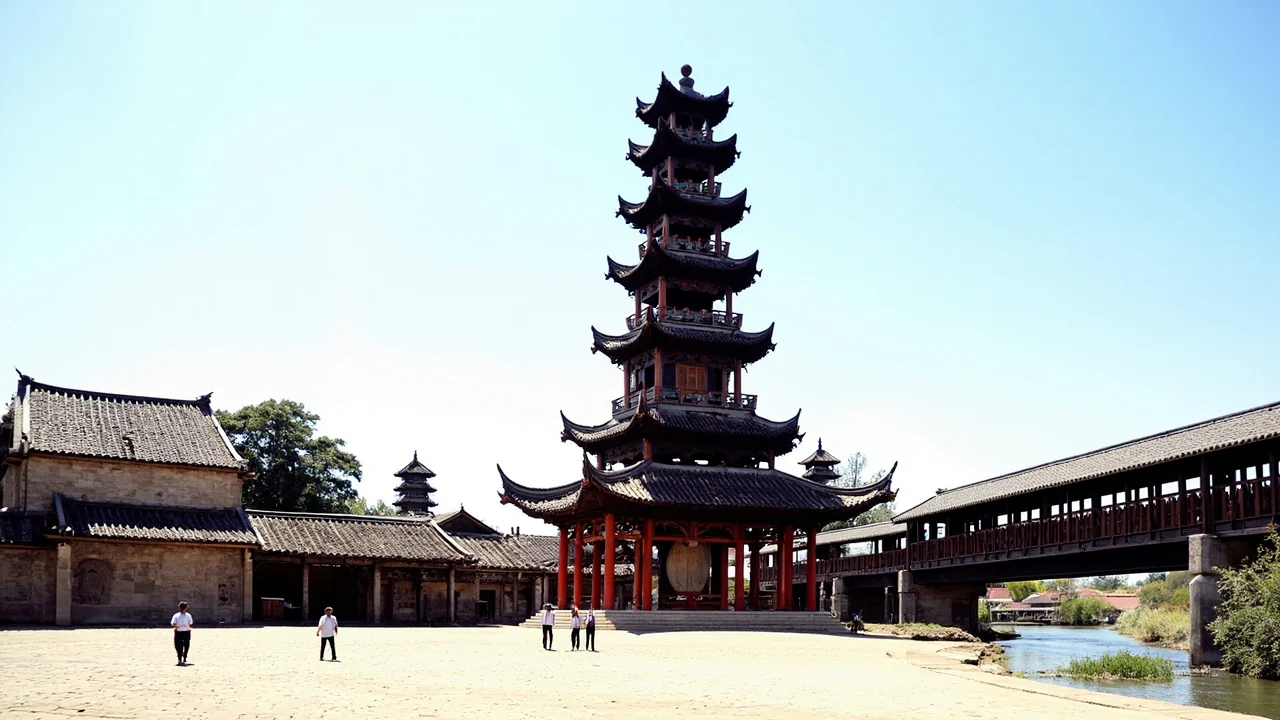
The physical setting of Grand Song performances is as important as the music itself. In every Dong village, the centerpiece is the drum tower (zhan lou, 鼓楼), a wooden pagoda-style structure that serves as the community’s meeting hall, its clock, and its stage. Drum towers are built entirely without nails — wooden pegs and joints hold them together — and they can rise nine stories high, decorated with carved lacquer and painted beams.
The drum tower is where Grand Song is performed, where community decisions are made, where festivals are held. It is the literal and symbolic heart of Dong village life.
Near the drum tower, you will often find a Wind and Rain Bridge (fengyu qiao, 风雨桥) — covered bridges that span the rivers that flow through Dong territory. These bridges are also built without nails, using cantilevered wooden brackets, and they provide shelter from the rain that falls heavily on the Guizhou mountains. They are places for informal singing as well: people crossing the bridge will often break into spontaneous Grand Song, the acoustics of the covered structure amplifying the voices.
The Tradition Today: A UNESCO Heritage
When UNESCO inscribed the Dong Grand Song on its Intangible Cultural Heritage list in 2009, it described the tradition as “one of the very few polyphonic choral traditions found in the world that is still practiced in its original form by a significant population.” The inscription recognized both the musical significance and the cultural context: Grand Song is not just a performance art but a complete social practice, embedded in Dong family life, community rituals, and seasonal festivals.
Today, there are efforts to preserve and transmit the tradition as young Dong people increasingly move to cities for work. Government support has helped establish Grand Song schools and competitions, and there are professional ensembles that perform for audiences outside the Dong territory. But the living tradition — the spontaneous performances in village drum towers, the intergenerational learning, the hundreds of voices rising at dawn over the rice fields — that continues in the villages, carried forward by the communities who have never stopped singing.
Visiting Dong Country
If you want to hear Grand Song in person, the best time to visit Dong country is during one of the major festivals. The most important is the Sino-Dong New Year (same period as Chinese New Year), when the entire community gathers for days of song, dance, and ceremony. Another major festival is the Brides’ Singing Gathering (jie lu), held annually in several Dong villages, where young women from surrounding villages come to sing Grand Song and young men come to listen and learn.
The best-preserved Dong villages for visitors include Zhaoxing (肇兴), which has five drum towers and is one of the largest Dong villages; Chengyang (程阳), famous for its Wind and Rain Bridge and regular Grand Song performances for tourists; and Luang (鸾), known for the purity of its traditional singing.
For those who cannot travel to Guizhou, there are excellent documentary recordings available, including UNESCO’s own audio archives and several field recordings made by ethnomusicologists. But nothing quite replaces the experience of standing in a drum tower square at dawn, surrounded by a thousand voices, feeling the sound move through you as it has moved through the mountains for a thousand years.
A Cultural Bridge
Americans may find a point of comparison in the shape-note singing tradition of the American South — large group singing without instruments, transmitted orally, organized around community gatherings, and producing a distinctive polyphonic sound that has no exact equivalent in European classical music. Like shape-note singing, Dong Grand Song is a communal art form that reinforces social bonds as much as it creates beautiful sound.
Another comparison might be to the a cappella traditions of African American colleges — the overlapping vocal harmonies, the call-and-response structures, the way a group becomes greater than the sum of its individual voices. In both traditions, the group is the instrument.
The deeper lesson of Dong Grand Song, though, is about what music is for. In Western art music traditions, music is often composed by individuals and performed by specialists for audiences. In Dong Grand Song, everyone sings, the community is both performer and audience, and the music is not separate from daily life — it is woven into it. That may be the most radical thing about this ancient tradition: it suggests that music is not a luxury or an entertainment but a fundamental way of being human together.
Conclusion
The Dong Grand Song is one of those traditions that reminds you how much sonic diversity exists in human culture, and how much of it remains unknown to people outside the communities that carry it. For over a thousand years, the Dong people have been creating something that musicologists are still trying to fully understand — a polyphonic choral tradition built not on paper and institutions but on ears, voices, and the persistent belief that the landscape itself can be sung.
If you ever find yourself in the mountains of Guizhou at dawn, and you hear voices rising from the mist, stop and listen. You will be hearing something that has been alive in that valley since before the Tang dynasty, before the Song, before most of the music we call classical. And it is still going.