Here’s a story that should make anyone who spends more than ten minutes getting ready in the morning feel a little uncomfortable. It’s a story from ancient China about a woman who looked at the most beautiful person in the world and decided to copy exactly what that beautiful person did. Not her clothing, not her jewelry, not her hairstyle — something far more subtle, far more personal, something that should have been beyond copying. The result was so disastrous that her name has been an insult for over two thousand years. Her legacy is being a cautionary tale, a byword for foolish imitation, a example of how trying too hard to be something you’re not can make everything worse.
The idiom is 东施效颦 — dōng shī xiào pín — which translates roughly to “Dongshi imitating Xishi’s frown.” Let that sink in for a moment. A woman’s name became a byword for foolish imitation. She’s not remembered for anything she did positively. She’s not remembered for her kindness, her intelligence, her accomplishments, her relationships. She’s remembered for failing to copy someone else, for trying to do something that was never going to work, for making herself ridiculous in the attempt. And the reason this story has survived so long, the reason it has echoed through Chinese culture for millennia, is that it illustrates something so fundamental about human nature that we keep making the same mistake, century after century, in ways both trivial and profound.
Meet Xishi: The Standard for Beauty
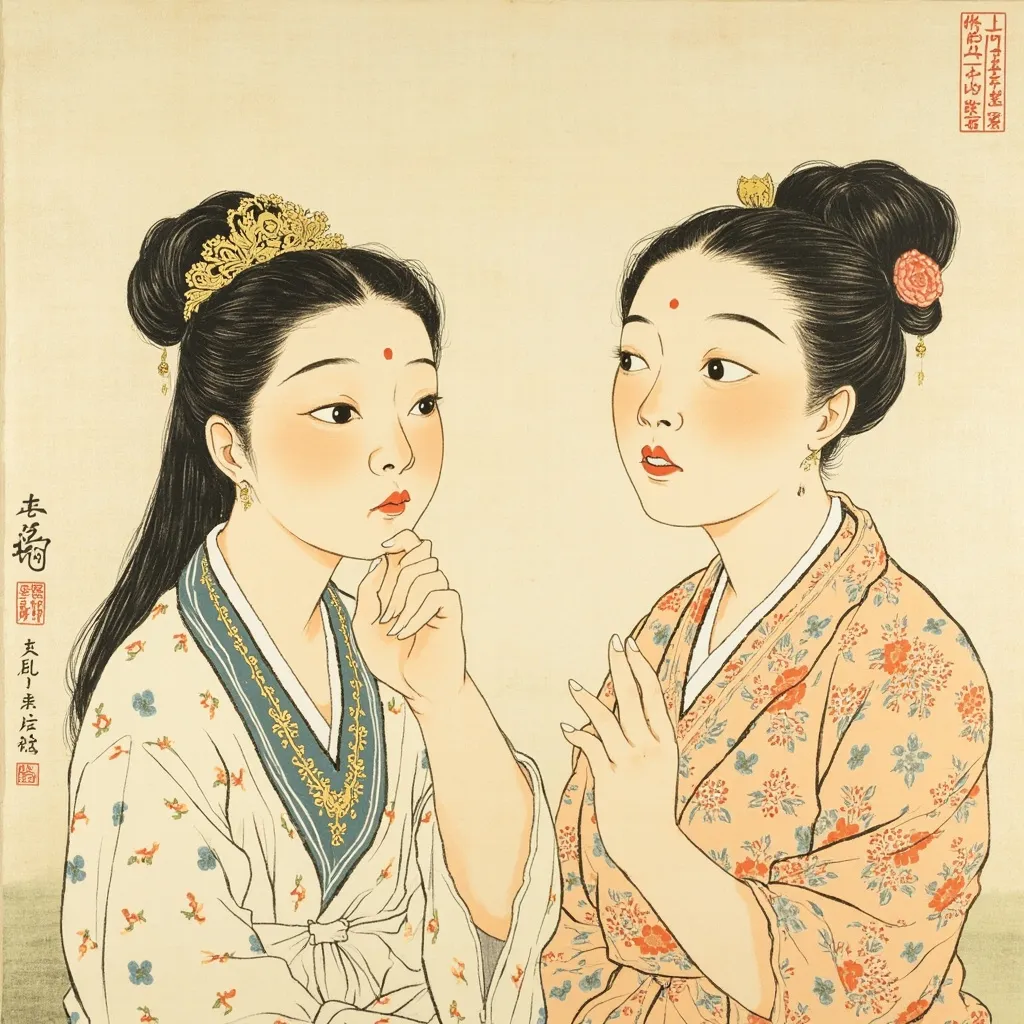
The story begins with Xishi, who is legendary in Chinese culture as one of the Four Great Beauties of ancient China — a select group of women whose appearance was so extraordinary that it supposedly could capsize kingdoms, whose beauty was considered so significant that it became a factor in the political calculations of kings and generals. She lived in the Spring and Autumn period, in the state of Yue (the same Yue whose king we met in the story of 卧薪尝胆). And she was considered so stunningly beautiful that when she walked through the streets, people would forget what they were doing just to look at her. Fishermen would lose track of their nets. Shopkeepers would neglect their customers. She was a walking traffic accident, a force of nature disguised as a woman.
Historical accounts describe her beauty in poetic terms that are frustratingly vague — skin like snow, features perfectly proportioned, a presence that made everything around her seem more luminous. We’re told she was beautiful but we’re never given a precise catalogue of what that beauty consisted of, which actually makes the story more powerful rather than less. Xishi’s beauty wasn’t just about individual features. It was about the total effect, the way all the elements combined into something that transcended the sum of their parts. It was about presence, about the indefinable quality that made people stop and stare.
But here’s the twist that makes the story work, the detail that transforms a simple beauty story into a philosophical fable with teeth: Xishi’s beauty wasn’t just about static appearance. It was about the way she moved through the world, including a particular expression she sometimes wore. Xishi had a slight frown — not a scowl, not a grimace, nothing extreme or unnatural. It was more like a subtle, almost unconscious expression of concentration or thoughtfulness that crossed her face when she was contemplating something, when she was deep in thought, when something had caught her attention and she was considering it. This was not a practiced expression. This was not a facial pose she had learned in front of a mirror. This was an organic manifestation of her interior life.
And apparently, this slight frown only added to her beauty. It gave her face a kind of dynamic quality, a sense of depth and interior life that made her seem even more attractive. A beautiful woman lost in thought, her brow slightly furrowed with concentration, was somehow more compelling than a beautiful woman with a blank, static expression. The frown wasn’t cosmetic. It was revelatory. It suggested a mind at work behind the beautiful face, and that suggestion was intoxicating.
Meet Dongshi: The Woman Who Should Have Left Well Enough Alone
Now, somewhere in the same region lived another woman whom history has mercifully not given a flattering nickname. She was commonly known as Dongshi — “Shi from the East Village” — and she was, by all accounts, not beautiful. Plain, homely, ordinary-looking in a way that didn’t turn heads, whatever word you want to use that isn’t too harsh. She was the kind of woman who would never stop traffic just by walking down the street. She would never make fishermen forget to pull their nets. She was, in the bluntest possible terms, ugly — not monstrous, not grotesque, just unremarkable in the face department, the kind of person who blends into crowds and gets overlooked in rooms full of strangers.
Dongshi, not surprisingly, was envious of Xishi. She had probably spent her whole life watching beautiful women receive attention, opportunities, and general treatment that she would never receive simply because of appearances. The world rewards beauty in a thousand small ways, and Dongshi had experienced none of them. She had watched Xishi walk through the market and seen the heads turn, the conversations stop, the men stumble over themselves. And she had walked through the same market and seen nothing, felt nothing, been nothing — just another face in the crowd, invisible in a way that beautiful women never are.
And when she heard about Xishi’s legendary beauty — including the distinctive frown that supposedly enhanced it, the expression that made her seem even more beautiful, the thoughtfurrowed brow that completed the picture of a woman whose beauty included depth — Dongshi made a decision that revealed a profound misunderstanding of how beauty works. She decided that if a slight frown made Xishi more beautiful, the same slight frown would make her more beautiful too. It was logical, in a narrow-minded way. It was the kind of logic that comes from confusing correlation with causation, from misunderstanding what makes something beautiful in the first place.
She started frowning. Not a natural frown, not a frown that came from genuine emotion or contemplation. She deliberately furrowed her brow in imitation of Xishi’s expression, presumably practicing in front of a mirror, working on the exact angle and depth of furrow that would achieve the same effect. She thought she could separate the frown from the face that wore it, treat it as an independent variable that could be transplanted from one context to another. She thought beauty was a technique.
The Results: Making a Bad Situation Worse
The story goes that when Dongshi began wandering around the village frowning in imitation of Xishi, people ran away from her. Not because they were confused about what she was doing — because it was obviously terrible, obviously forced, obviously wrong. A beautiful woman frowning has a certain mystique, a suggestion of the thoughts working behind those eyes. A plain woman frowning just looks like she’s in pain, or constipated, or having a difficult digestive day. The same facial expression, on a different face, produces an entirely different effect.
This is where the idiom gets its bite. 东施效颦 is used in Chinese to describe someone who tries to imitate something beautiful in a context where it doesn’t work, someone who makes themselves look worse rather than better through the attempt at improvement. It’s the classic definition of a bad copy — not just failing to achieve the original, but actively detracting from whatever appeal the original had.
Why This Keeps Happening: The Surface and the Source
Here’s the thing that makes Dongshi’s story so relatable, despite how obviously foolish she seems. Most people, in her position, would try something. Would see the beautiful woman getting attention and would want some of that attention for themselves. This is human nature.
What makes Dongshi foolish isn’t the attempt. It’s the misunderstanding that drove it. She thought the frown was the cause of Xishi’s beauty, when it was actually an effect. She thought she could extract the visible facial expression and transplant it onto her own face and get the same result. But Xishi’s frown worked because it was organically connected to who she was — a thoughtful woman with a rich interior life, whose expressions emerged naturally from genuine contemplation. It was a window into something real, and the window happened to be beautiful because what it was showing you was real and beautiful.
When Dongshi copied the surface feature without the underlying reality, she created something that looked identical on the surface but was fundamentally hollow. A frown without thoughtfulness is just a frown. She was trying to display an emotion she didn’t feel, to wear an expression that had no basis in her actual interior state. And people could tell.
This is the trap that social media and aspirational content have created in modern life. We see beautiful people and we try to replicate their surface features without understanding that those features are outputs of underlying systems. We grab the frown without the face that makes the frown beautiful.
The Deeper Problem: Insecurity Driving Imitation
Dongshi didn’t just admire Xishi’s beauty. She was insecure about her own appearance. She saw something she couldn’t have and rather than accepting her own situation or finding her own path to confidence, she tried to shortcut her way to the same result through direct imitation. She wanted the output without the input, the product without the process.
Being less attractive in a world that rewards attractiveness is genuinely difficult, and it’s not surprising that people would try to compensate. But Dongshi picked the one element of Xishi’s beauty that was most dependent on the underlying context — the expression that only worked because of the face and mind it came from — and tried to transplant it onto a completely different base.
Her error was thinking that beauty was purely a technical problem — that if she could just replicate the right facial expression, she would achieve the same result. But beauty isn’t a technique. It’s an emergent property of a whole person, and you can’t extract it from the person and apply it to someone else.
The real tragedy of Dongshi isn’t that she failed to become beautiful. It’s that she drew attention to her own plainness by highlighting the contrast. Before she started frowning, she was just an ordinary-looking woman who passed unnoticed in a crowd. After she started frowning, she was an ordinary-looking woman doing something bizarre and failing at it. She went from invisible to ridiculous.
Finding Your Own Style Instead of Copying Others
So what’s the alternative? If you’re not naturally beautiful like Xishi, what should you do — accept being invisible? Never try to improve?
The Dongshi story isn’t an argument against self-improvement. It’s an argument against surface-level copying of other people’s style without understanding the underlying reality that makes that style work. There’s a big difference between learning from someone else and trying to become someone else.
The women who actually develop distinctive appeal almost never get there by copying someone else. They get there by understanding themselves deeply enough to know what works for them, what fits their particular combination of features and history, and then cultivating that with confidence. They find their own version of beauty, not someone else’s.
Think about the most memorable people you’ve ever known. They probably weren’t trying to look like anyone else. They were leaning into something specific to who they were, and that specificity was exactly what made them interesting. Dongshi could have spent her energy developing whatever distinctive qualities she actually had. Instead, she spent it trying to be someone else and failing. She was so busy wanting to be Xishi that she never found out who she herself was.
What We Can Learn from Dongshi’s Mistake
The story of 东施效颦 has been used for thousands of years to warn people about the dangers of blind imitation. But let’s be honest: most of us need that warning more than we want to admit. We all have moments when we look at someone successful, someone beautiful, someone impressive, and think “why can’t I be like that?” And sometimes that thought leads us to useful reflection, to genuine growth, to developing qualities we admire in others. But sometimes it leads us to Dongshi’s mistake — to surface-level imitation that makes us look worse rather than better, to trying on someone else’s life as if it were a costume that would fit us as well as it fits them.
How many of us have adopted speech patterns from someone we admire without understanding the life experience that makes those speech patterns natural? The mentor who speaks with measured confidence might have earned that confidence through decades of experience — you can’t just borrow the cadence and expect the authority to come with it. How many of us have tried a “life hack” from a successful person without considering whether it fits our own circumstances? How many of us have looked at a beautiful person’s social media and tried to recreate the photo without the year of fitness, skincare, and confidence-building that preceded it?
The pattern is always the same. We see the output without understanding the system. We try to replicate the product without engaging with the process. We grab the frown without the face that makes the frown beautiful. We’re all a little bit like Dongshi, reaching for surface features that were never meant to be separated from the people who naturally possess them.
The antidote isn’t to stop admiring beautiful, successful, impressive people. Admiration is natural, and sometimes useful. The antidote is to shift from imitation to inspiration. Instead of asking “how can I copy this?” ask “what is this person doing that I could adapt to my own situation?” Instead of trying to wear someone else’s style, ask what principles might inform your own approach. Instead of looking at Xishi and wanting her frown, look at Xishi and wonder what it is about her life, her mind, her presence that makes everything about her — including the frown — seem beautiful.
Dongshi looked at Xishi and saw an opportunity for shortcut. She could have looked at Xishi and seen an opportunity for learning — for understanding what makes any person genuinely magnetic, and then applying those principles in her own life, in her own way, for her own face and body and mind. That would have been a much harder path, but it would have been a real one.
The next time you find yourself wanting to copy someone else’s approach — whether it’s their appearance, their business strategy, or their relationship style — remember Dongshi. Remember that the frown only works on the face that knows how to wear it. And ask yourself whether you’re trying to borrow a surface feature or actually understand the underlying reality. Because one of those paths leads to ridicule. And the other leads somewhere interesting.