Double Ninth Festival: Honoring Elders in Chinese Culture
There’s a moment every autumn when the air turns crisp, the hillsides glow with the last blooms of the season, and Chinese families pack small picnics and head for the mountains. It’s not a holiday most Americans have heard of, but it might be one of the most meaningful traditions you’ve never experienced. Welcome to the Double Ninth Festival—known in Chinese as Chongyang Festival (重阳节)—a day dedicated to honoring elders, appreciating autumn’s beauty, and carrying forward traditions that stretch back over two thousand years.
What Is Double Ninth?
The Double Ninth Festival falls on the ninth day of the ninth month of the Chinese lunar calendar. In 2026, that lands around October 18th. The name makes simple mathematical sense: it’s the ninth day of the ninth month—double nine, or “chongyang” in Mandarin. But this isn’t just about numbers. In Chinese culture, the number nine carries special weight. It’s the highest single digit, associated with yang energy—the positive, masculine, upward-moving force that represents vitality and longevity. Doubling it up was believed to amplify these auspicious qualities.
The festival goes by several names depending on who you ask. Some call it the Chrysanthemum Festival, since that’s the flower most associated with the holiday. Others call it the Climbing High Festival, referencing the most popular activity of the day. And in modern times, it’s widely recognized as Seniors’ Day or Elder Respect Day—a time to formally celebrate and appreciate the older generation.
For Chinese families, this is one of the quieter holidays. There’s no massive reunion dinner like Chinese New Year, no elaborate moon-watching like Mid-Autumn. Instead, there’s something gentler: a day to slow down, get outside, and show respect to the people who built the families we belong to today.
The Legend and Origins
Like many ancient Chinese festivals, the Double Ninth has roots wrapped in mythology. The most famous story involves a Han dynasty figure named Fei Changfang and his disciple, Huan Jing.
The legend goes something like this. Fei was a Taoist immortal who had mastered the art of avoiding misfortune. One year, he warned his student Huan Jing that danger was coming—a plague would sweep through their village. But there was a way to escape it, Fei explained. On the ninth day of the ninth month, Huan should gather his family, pack chrysanthemum wine and food, and climb a high mountain. They should stay there until sunset.
Huan did exactly as his teacher said. When they returned home, they found all their livestock dead—animals that had stayed in the lowlands had been struck by the plague. The family, having climbed high into the yang energy of the mountains, had been protected.
This story spread, and the tradition of climbing mountains on the ninth day of the ninth month became firmly established. Ancient Chinese people believed that heights carried special protective powers—that climbing up could literally lift you out of harm’s way. The practice of “escaping the plague” evolved into something broader: a general custom of seeking higher ground, both literally and symbolically, to invite good fortune and longevity into one’s life.
There’s also a poetry connection that makes this festival special. The great poet Tao Yuanming, who lived during the Jin dynasty around 365-427 AD, was famously obsessed with chrysanthemums. He left his government career to live as a farmer, writing poetry about simple country life and his beloved flowers. His poems celebrating chrysanthemums became so influential that they helped cement the flower’s association with this holiday. Even today, when Chinese people see chrysanthemums in autumn, they think of Tao Yuanming, of refined taste, of someone who chose a simpler, more authentic life.
How It’s Celebrated
What does an actual Double Ninth celebration look like? Let me walk you through the main traditions.
Mountain climbing and hiking. This is the signature activity. Families head to local hills or parks, often waking up early to catch the morning air. The idea is to literally rise above—to get to a high place and take in the autumn scenery. For elderly family members who might not manage steep trails, the tradition has adapted: many people simply visit a local hill or even walk to a high floor of a building. The spirit matters more than the altitude.
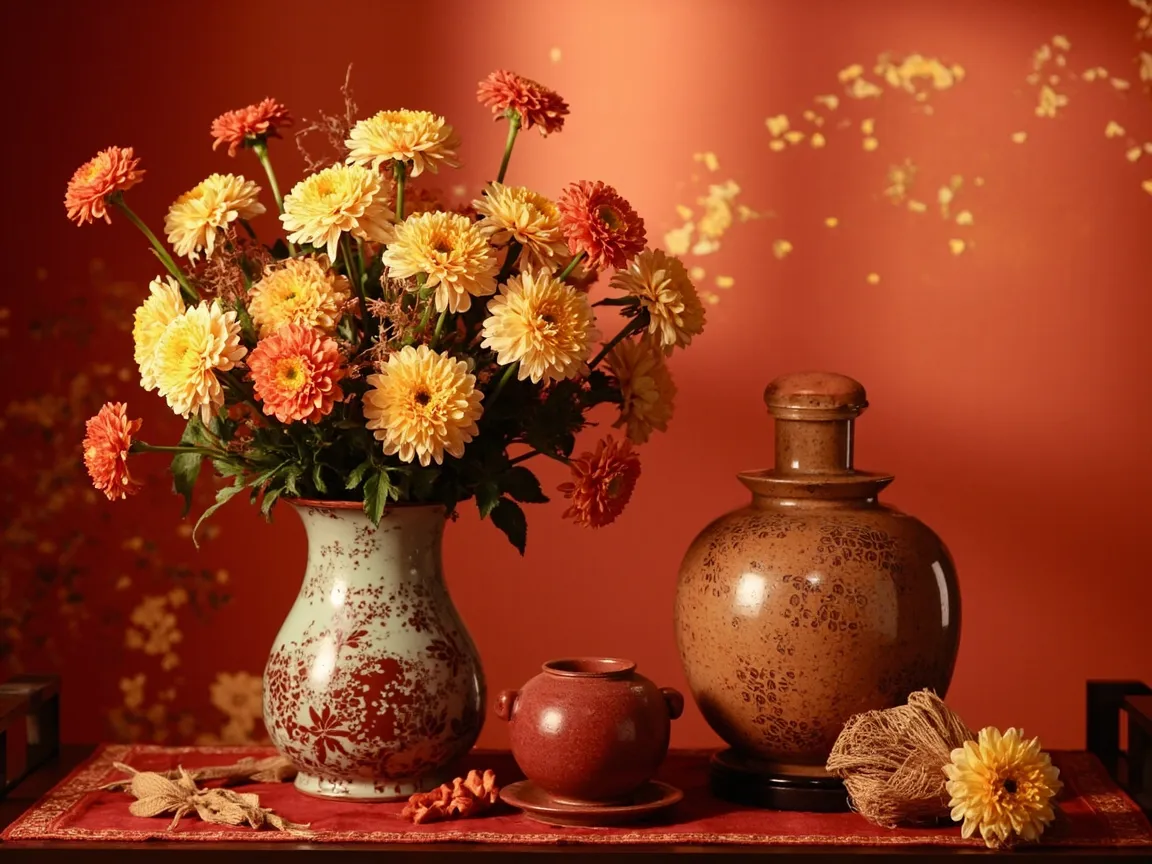
Chrysanthemum everything. The flower is everywhere during this festival. You’ll see chrysanthemum displays in parks, temples, and homes. People drink chrysanthemum tea—made from the dried petals, believed to help clear heat from the body and refresh the mind. Chrysanthemum wine, slightly sweet and fragrant, is also traditional, though these days many families substitute with tea or other beverages. The petals symbolize longevity and resilience; chrysanthemums bloom late in the year, surviving the first frosts, which makes them natural emblems of endurance.
Chongyang cakes. These are the holiday’s special food—dense, sweet rice cakes often layered with red bean paste or date paste. They’re sometimes called “rise cake” because the Chinese word for rise (gao) sounds like the word for tall or high, connecting back to the climbing tradition. In some regions, families make them at home; in others, they’re bought from bakeries and given as gifts to relatives, especially elderly ones.
Wearing cornels. Cornel (zhuyu in Chinese) is a medicinal berry that historically was believed to ward off diseases and bring good health. On Double Ninth, some people wear small sachets filled with cornel berries, or drink cornel-infused wine. This tradition is less common today than it used to be, but it still appears in more traditional communities.
Visiting elders. This is the modern heart of the holiday. Adult children and grandchildren make a point of visiting their elderly relatives—bringing gifts, helping with chores, or simply spending time together. In some communities, there are formal ceremonies honoring senior citizens, with performances, speeches, and community recognition. The younger generation serves tea to elders as a sign of respect.
Tomb sweeping. In Hong Kong and some other regions, Double Ninth is also a day for honoring deceased ancestors. Families visit gravesites, clean the areas around them, and leave offerings. This adds a more solemn note to the celebrations—a reminder that honoring elders extends beyond those still living.
Modern Significance
Here’s what strikes me most about the Double Ninth Festival: it’s a holiday that’s been reinvented for modern times without losing its soul.
China officially designated it as Seniors’ Day in 1989, modeling it after similar observances in Japan and South Korea. The message was simple but powerful: respect for elders is a core value, and it deserves a dedicated day of recognition. Since then, the holiday has become an occasion for government agencies, community organizations, and families to celebrate older adults.
Walk through any Chinese city on Double Ninth, and you’ll see the evidence. Senior centers host special events—dance performances, calligraphy exhibitions, health screenings. Companies market products specifically for gift-giving to elderly relatives. Public transportation often offers free rides to seniors on this day. The holiday has become both a cultural observance and a practical reminder: call your grandparents, visit your parents, don’t take the older people in your life for granted.
For Chinese immigrants in America, Double Ninth has become a way to stay connected to heritage while also bridging cultures. Many Chinese-American families use the day to teach children about family history, to cook traditional foods, or to simply gather in a way that honors both Chinese and American values of elder respect. It’s a holiday that translates remarkably well across cultures—because the underlying message, “honor the people who came before you,” resonates everywhere.
There’s also something quietly revolutionary about a holiday that celebrates getting older. In American culture, aging often feels like something to fight against or hide. The Double Ninth Festival flips that script entirely. Growing older isn’t a decline—it’s an achievement. It’s a rise, in fact. The higher you climb, the more you’ve overcome. The later you bloom, like the chrysanthemum, the stronger you must be.
Conclusion
The Double Ninth Festival may not be as famous outside China as the Lunar New Year or Mid-Autumn, but it offers something equally valuable: a structured, annual reminder to look up from our busy lives and acknowledge the people who made us who we are.
The traditions are simple. Climb a mountain—or at least go outside and look up. Drink some chrysanthemum tea. Eat a sweet cake. Call someone who taught you everything you know. These aren’t elaborate rituals, but they carry weight precisely because they’re modest. They fit into any life, any schedule, any family.
As autumn deepens and the year begins its long slide toward winter, the Double Ninth Festival arrives like a small lantern—reminding us that some things get better with time, that the people who have lived longest have the most to teach us, and that rising higher, whether up a mountain or through the years, is always worth celebrating.