At a Chinese wedding banquet, there is a good chance you will meet a dragon before dessert. It may curl around a porcelain teapot, shimmer in gold thread on a red backdrop, or face a long-tailed bird above the characters for “double happiness.” That bird is the fenghuang, often translated as the Chinese phoenix. Together, dragon and phoenix form one of China’s best-known visual blessings: long feng cheng xiang, or “the dragon and phoenix bring auspicious harmony.”
The phrase sounds grand, yet its emotional message is wonderfully ordinary. May two people fit together. May their household thrive. May strength be tempered by grace, and grace supported by strength. In Chinese decorative art, an image rarely exists only to look pretty. It can work like a sentence, and this pairing says something hopeful about relationships, family, public order, and the shape of a good life.
For American viewers, however, the design can be easy to misread. The dragon is not a villain guarding treasure, and the phoenix is not simply a bird that burns and rises from its ashes. Nor is the pair just an Asian version of a king and queen. Their meanings accumulated over thousands of years, shifting as myths, court customs, folk practices, and modern wedding culture overlapped.
Two Creatures with Long and Changing Histories
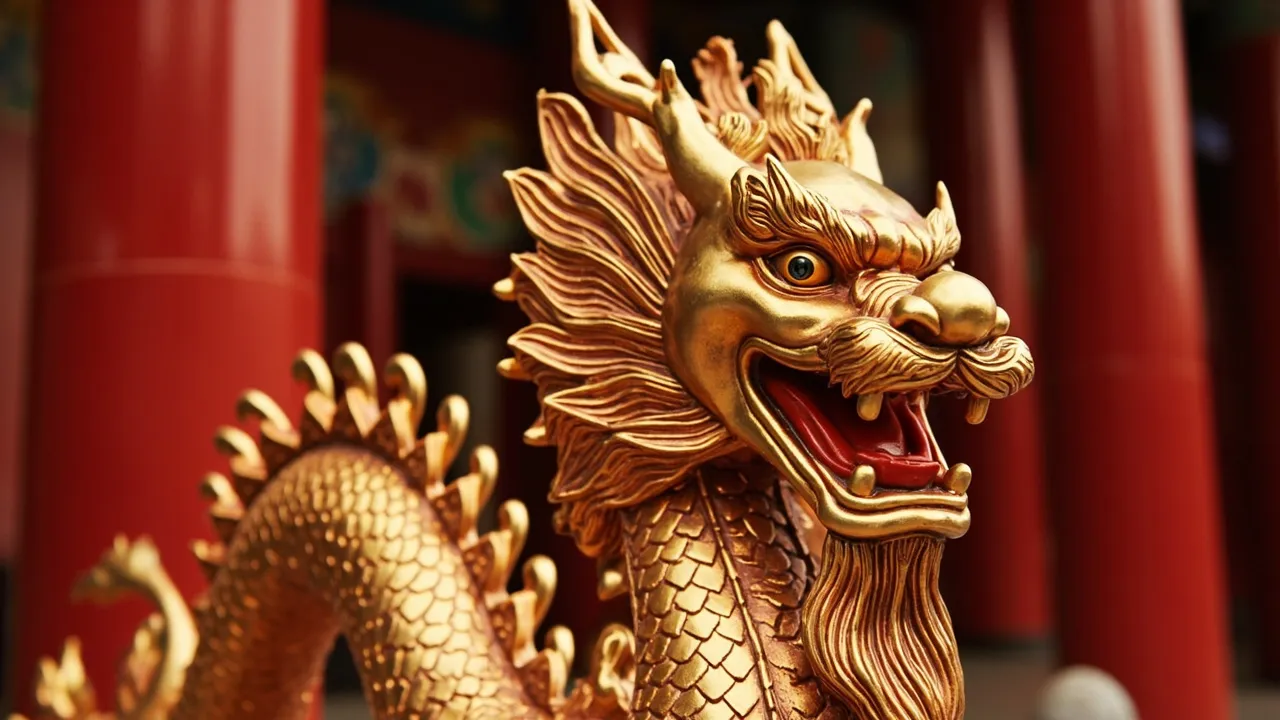
The Chinese dragon, long in Mandarin, is a composite being. Depending on the era and the artist, it may have a camel-like head, deer antlers, eagle claws, fish scales, a snake’s body, and whiskers sweeping back from its face. Those mixed features are not a zoological puzzle to be solved. They convey a creature able to cross boundaries: water and sky, visible and invisible, earthly rule and cosmic power.
Early dragonlike forms appear on Neolithic jade and pottery. Their exact meanings remain debated, which is worth remembering whenever someone claims that every Chinese symbol has one fixed definition. By the Bronze Age and imperial period, dragons were associated with rain, rivers, fertility, direction, authority, and extraordinary vitality. Agricultural communities appealed to dragon powers because rain could mean survival. Emperors later made the dragon a privileged emblem of sovereignty, especially in court robes, architecture, and ritual objects.
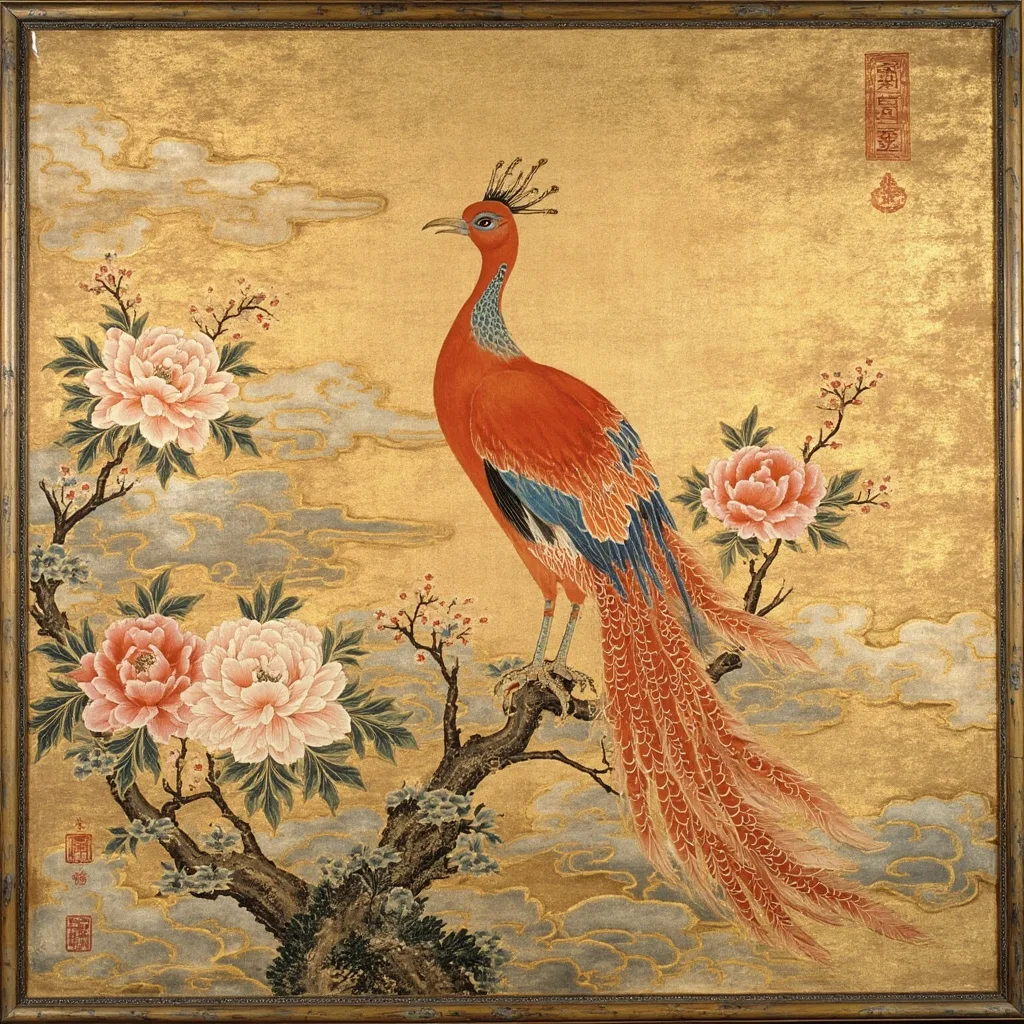
The fenghuang has an equally layered past. Ancient texts distinguish male feng and female huang, although the combined name eventually referred to one wondrous bird. Artistic descriptions give it parts drawn from several birds and animals: a pheasant’s body, a swallow’s jaw, a rooster’s beak, and splendid tail feathers. It was said to appear when the realm was peaceful or when a virtuous ruler governed well. That association made it an emblem of moral order, harmony, beauty, and rare excellence.
On early objects, the bird was not automatically female. Its later feminization developed gradually, particularly as the dragon became linked to the emperor and the fenghuang to the empress. Court culture helped establish a gendered pairing that filtered into wedding imagery. Still, “dragon equals man and phoenix equals woman” is only one chapter in a much longer story. Before that formula hardened, both creatures could embody broad cosmic and political ideals.
I once watched a museum visitor point to a phoenix on a textile and say, “So it died and came back?” The label did not help; it simply used the English word phoenix. The Chinese bird does not need a fiery death to become meaningful. Its wonder lies in its selective appearance. The fenghuang arrives when conditions are right—when virtue, peace, and balance make the world worthy of it.
That difference matters when dragon and fenghuang meet. They are not enemies locked in combat. They are exceptional beings occupying compatible symbolic worlds. One channels dynamic force, rain, and command; the other suggests ethical beauty, cultivated grace, and peace. Their encounter promises cooperation among different qualities rather than victory of one over the other.
From Imperial Authority to Marital Partnership
During the imperial era, clothing and palace decoration turned these creatures into signs of rank. Dragons on an emperor’s robes communicated far more than personal taste. Their number of claws, placement, and context could indicate status. The empress’s ceremonial wardrobe often featured fenghuang imagery, tying her role to dignity, feminine authority, and harmony within the court.
It is tempting to imagine that ordinary couples simply copied royal branding. Reality was less tidy. Court fashions, popular religion, workshop traditions, commercial ceramics, embroidery, opera costumes, and local customs continually influenced one another. Dragon-and-phoenix designs became available on objects that had no direct palace connection: quilts, hair ornaments, mirrors, furniture panels, bowls, carved screens, paper cuttings, and bridal clothing.
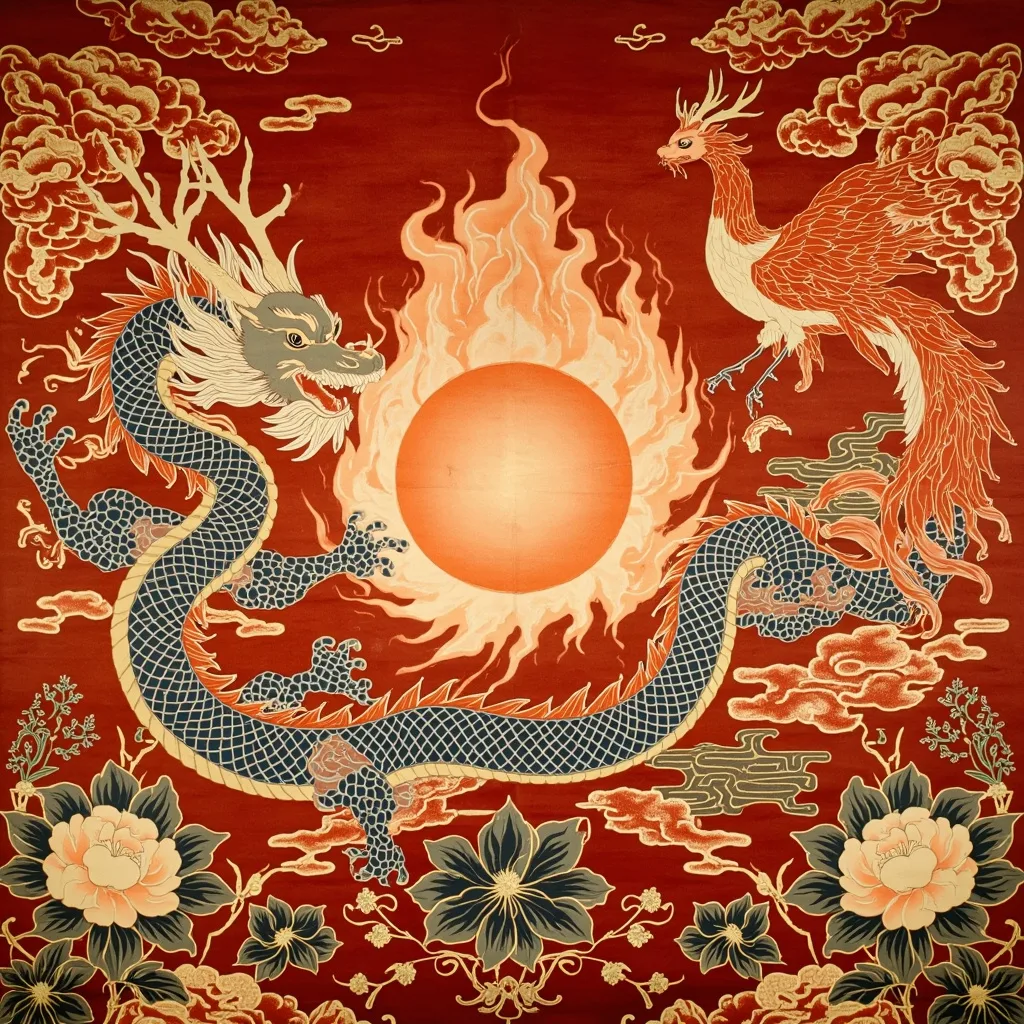
In wedding culture, the pair came to represent bride and groom. The dragon generally stood for the groom and the fenghuang for the bride. Yet the image worked best not as a hierarchy but as a union. Their bodies might face one another across a flaming pearl, circle a peony, or move through the same field of clouds. Composition is part of the message. If both creatures share the picture in balanced motion, they suggest a marriage in which distinctive powers create a larger harmony.
The phrase long feng pei, “a dragon-phoenix match,” can describe an excellent pairing. Another expression, ren zhong long feng, calls outstanding people “dragons and phoenixes among humans.” In other words, these creatures praise quality, not merely gender. On a wedding day, they elevate two regular people into auspicious protagonists. For a few hours, amid cameras, cousins, and too many courses of food, the couple occupies the center of a fortunate universe.
Red and gold intensify that universe. Red in Chinese celebrations evokes joy, luck, and life; gold implies brilliance and prosperity. A red backdrop printed with a gold dragon and fenghuang therefore combines several favorable signals. Add the “double happiness” character—two forms of the character xi, meaning joy—and the decor becomes almost exuberantly explicit.
Western wedding symbolism often leans toward purity, romantic individuality, and the couple’s private promise. Traditional Chinese symbolism tends to place marriage within a bigger network: families, descendants, household prosperity, seasonal renewal, and social continuity. That does not mean Chinese couples lack romantic feeling. It means the visual vocabulary around marriage historically carried communal hopes as well as personal ones.
Modern couples play with the convention. A banquet in Los Angeles might pair a white ceremony gown with a red qipao, a fitted Chinese dress, and project animated dragons and phoenixes behind the reception stage. A same-sex couple may keep the motif while rejecting its old male-female assignments. Some people select it mainly because grandparents recognize it; others love its graphic drama. Symbols survive not by remaining untouched, but by staying useful.
How to Read the Motif on Everyday Objects
Once you know the pair, you start spotting it everywhere. A dragon and fenghuang can be woven into silk, painted under porcelain glaze, carved in wood, stamped on gold jewelry, or outlined in red paper. Each material changes the effect. Embroidery emphasizes texture and virtuoso skill. Porcelain gives the design a domestic life at the table. Architectural carving makes the blessing feel protective and permanent.
Look first at what lies between the animals. A pearl or luminous disk may represent wisdom, perfection, thunder, or a precious source of energy. A peony—often called the “king of flowers” in Chinese tradition—adds wealth, honor, and sensual beauty. Lotus blossoms contribute purity and harmonious growth. Clouds signal the heavenly realm and also provide artists with wonderfully flexible ribbons that join a composition together.
Fruit can turn the image toward family wishes. Pomegranates, bursting with seeds, imply many descendants. Peaches are connected with longevity. Bats, surprising to American eyes, are lucky because the Chinese word for bat, fu, sounds like the word for good fortune. That wordplay is central to Chinese decorative culture. Images frequently function as rebuses, or visual puns, creating blessings through sound as well as sight.
Position matters too. A confrontational-looking pair may not be fighting. Chinese dragons often twist dramatically, claws extended and mouths open. The fenghuang’s feathers can flare with equal energy. Their intensity expresses vitality. Check whether they turn toward a shared object or mirror one another across a central axis. Symmetry usually supports a reading of balance and mutual regard.
On ceramics, the colors and painting method can offer clues about period and market, but identifying age from a motif alone is risky. Dragon-and-phoenix wares were made for imperial use, domestic consumers, export customers, and modern tourists. A reign mark on the base does not guarantee that an object was made during that reign. Collectors compare clay, glaze, brushwork, shape, wear, kiln technology, and documented provenance.
A family object may matter even when it is not antique. One friend keeps a bright, factory-made dragon-and-phoenix tea set that her parents received in the 1980s. Its monetary value is modest. Its family value is not. Every Lunar New Year it comes out of a padded box, and every year somebody retells the story of the wedding banquet where it was given. That repetition is exactly how symbolism becomes intimate.
If you use the motif in your home, context and care count more than rigid rules. A framed textile, ceramic plate, or pair of embroidered cushions can express admiration without pretending to be sacred ritual equipment. Learn what the image means, credit its cultural setting, and avoid treating all “Asian” dragons and phoenixes as interchangeable. Chinese, Japanese, Korean, Vietnamese, and other traditions share influences but have distinct histories.
A Symbol of Balance, Not a Simple Gender Code
The easiest summary says dragon is yang and phoenix is yin. It is useful, but incomplete. Yin and yang are relational forces: shaded and sunny, receptive and active, cool and warm, inward and outward. They are not moral opposites, and neither is inherently better. Each contains the possibility of the other, and harmony depends on change between them.
Dragon-and-phoenix art often borrows this logic. The dragon’s coiling body and command of clouds feel active and expansive. The fenghuang’s measured elegance suggests refined order. Yet the bird can be fiery, assertive, and solar, while the dragon can dwell in dark water and wait. Real Chinese iconography cheerfully exceeds neat charts.
That flexibility helps explain why the motif remains appealing. A healthy relationship does not require one permanently “strong” partner and one permanently “graceful” partner. People trade roles. One handles a crisis; the other restores calm. One takes a risk; the other sees a consequence that was missed. Dragon and phoenix can be read as a conversation between capacities present in both people.
There is also a public dimension. Historically, the appearance of a fenghuang indicated virtuous government, while a dragon could embody legitimate power and timely rain. Together they imagined a society where authority and ethics belonged in the same frame. That may sound idealistic. Auspicious art usually is. It shows the world not exactly as it exists, but as people hope it might become.
Some contemporary designers loosen the creatures from imperial splendor. They reduce them to clean lines on wedding invitations, render them in pastel colors, or combine the motif with Western floral arrangements. Purists sometimes complain, but adaptation has always been part of its history. Ming potters, Qing export painters, urban jewelers, rural embroiderers, and twenty-first-century graphic designers have all reshaped the pair for different eyes.
Still, not every dragon beside every bird means marital harmony. Museum labels, object function, date, and surrounding motifs should guide interpretation. A solitary fenghuang on a scholar’s object might praise talent or virtue. A dragon chasing a pearl may concern power or cosmic energy. Symbol dictionaries are starting points, not magic decoders.
Why the Dragon and Phoenix Still Feel Auspicious
Auspicious imagery does something practical: it gives hope a visible form. Weddings are uncertain beginnings. Families want a couple to be happy, financially secure, healthy, patient, and fortunate, but none of those outcomes can be guaranteed. A dragon and phoenix cannot provide insurance. They can gather those wishes into one memorable image.
The motif also makes room for difference. The creatures do not become identical when they unite. One keeps scales, antlers, claws, and serpentine motion; the other keeps feathers, wings, and a flowing tail. Harmony here is not sameness. It is coordinated distinction. That is a surprisingly modern lesson inside an ancient visual tradition.
If you see the pair at a wedding, you can offer the phrase long feng cheng xiang—roughly pronounced “loong fung chung shyahng”—but an English wish is perfectly respectful too: “May you bring out the best in one another.” That captures the design more honestly than any literal translation alone.
Continue Exploring Chinese Culture
The fenghuang deserves its own close look, especially its differences from the fire-born Western bird; see Fenghuang and Phoenix Mythology. For another foundational figure whose legends shaped Chinese ideas of identity, visit Huangdi, the Yellow Emperor. Our guide to Ming Blue-and-White Porcelain shows how auspicious motifs traveled across ceramics and world trade. You may also enjoy Li Bai, China’s Poetry Immortal, whose moonlit imagination reveals a very different side of Chinese cultural symbolism.