The Story: When Drawing Cake Became an Act of Desperation
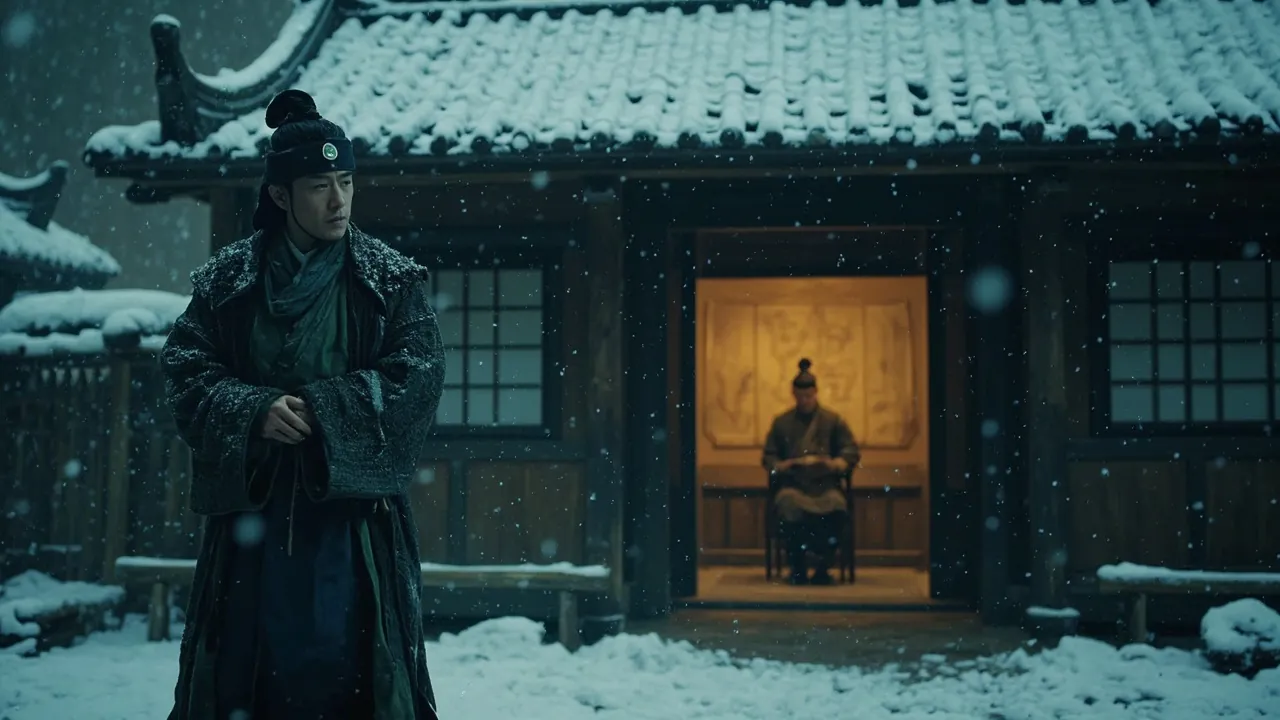
During the Three Kingdoms period of ancient China (around 220–280 AD), there lived a man named Xu Jeston who was as sharp-minded as he was hungry. Xu was not a warrior or a scholar — he was a government official, the kind of person who spent his days reviewing documents and attending meetings. But he had one weakness: an appetite that no salary could satisfy.
One evening, after a particularly grueling day of work, Xu returned home to find his pantry bare. His wife had not yet prepared dinner, and the kitchen held nothing but an empty pot and a cold hearth. His stomach growled like an angry dog.
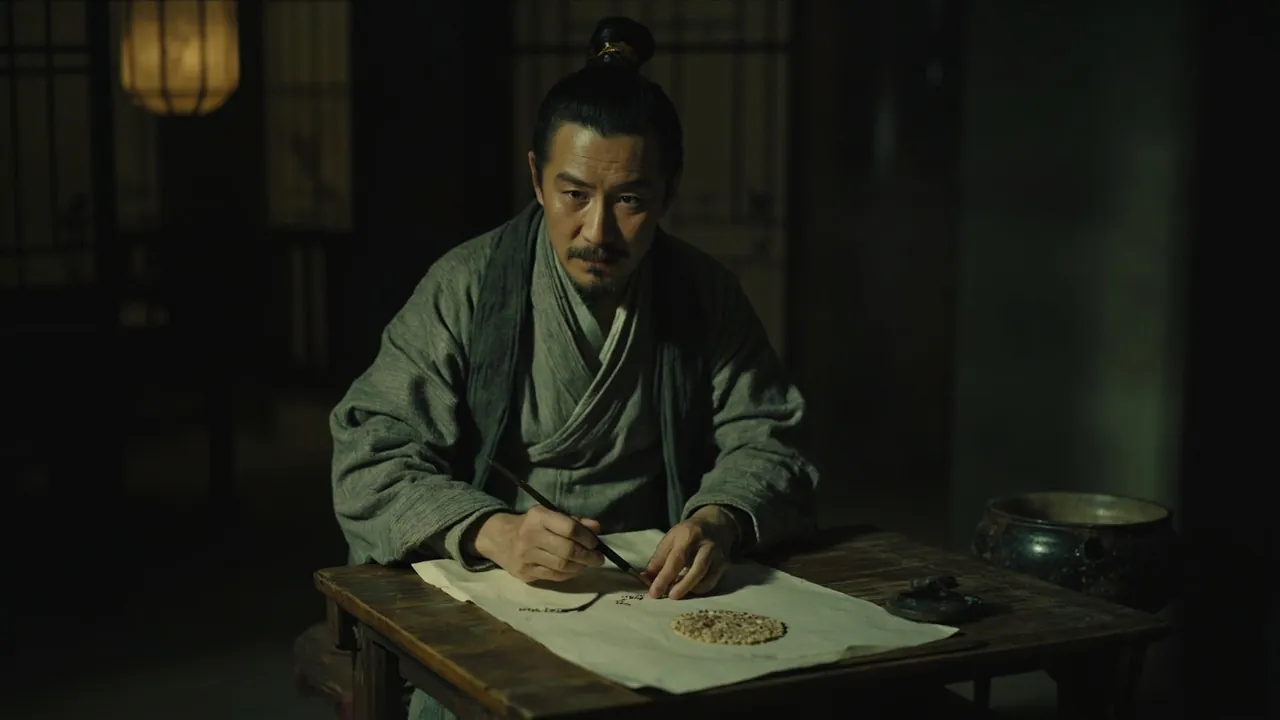
Rather than suffer in silence, Xu did something remarkable. He sat down at his low table, picked up a brush, dipped it in ink, and began to draw — carefully, deliberately — a round, golden cake on a piece of rice paper. He gave it beautiful spiral patterns, the kind you’d see on a proper sesame cake from the bakery. He even added steam rising from it.
Then, with enormous ceremony, he “ate” the drawing. He lifted it to his mouth, chewed the air, swallowed the nothing, and announced with complete satisfaction: “Delicious.”
His wife walked in halfway through this performance. She stared. She said nothing. She walked back out.
But here is the tragedy Xu didn’t yet understand: the more you feast on imagination, the hungrier you become in reality. The drawing could not nourish him. The ritual of pretending to eat only sharpened his awareness of what he lacked. By the time his wife finally served dinner an hour later, Xu was weaker, not stronger — because he had spent his energy on fantasy instead of action.
This is 画饼充饥 — huà bǐng chōng jī: “draw a cake to satisfy hunger.” It means using imaginary comfort to substitute for real solutions, and in the end, fooling no one but yourself.
What Does This Idiom Actually Mean?
At its core, 画饼充饥 describes the act of deriving comfort from something that has no real substance. The metaphor is precise and a little cruel: a drawn cake looks like food, smells like food in your imagination, but cannot feed anyone. No matter how beautifully you draw it, your stomach remains empty.
In modern Chinese, this idiom is used to criticize two related behaviors:
1. Relying on empty promises or illusory solutions. When someone offers you a “drawn cake” — a plan with no resources, a guarantee with no backing, an idea with no execution — they are giving you comfort without substance. In American English, we might say: “That’s like feeding someone a line of BS” or “That’s smoke and mirrors.”
2. Fooling yourself into believing that wishing for something is the same as working toward it. This is the more self-reflective use. You might catch yourself saying, “I’ll just visualize success and it will happen.” That’s drawing a cake. The Chinese version of this idiom cuts through the self-help optimism: visualization without action is still hunger.
The idiom carries a tone of gentle mockery. It’s not as harsh as calling someone a liar — it’s more like saying, “Friend, I appreciate the creativity, but that cake isn’t real.”
The Historical Context: Why Three Kingdoms Tales Stick in Chinese Culture
The Three Kingdoms period (220–280 AD) was an era of epic betrayal, battlefield strategy, and larger-than-life personalities — the kind of era that produces both great generals and great fools. Xu Jeston (or Xǔ Jì 盱, depending on the historical source) was likely a minor figure by comparison, the kind of official who didn’t make it into the famous novels.
But that makes the story more relatable, not less. The great heroes of Three Kingdoms stories — Liu Bei, Guan Yu, Cao Cao — did extraordinary things. Xu Jeston did something deeply human: he was hungry, he was proud, and he refused to admit weakness even to himself. The idiom survives precisely because it’s about ordinary human folly, not legendary heroism.
The story also carries a specific Chinese philosophical warning about the gap between form and substance (名与实, míng yǔ shí). Chinese moral philosophy has always been suspicious of things that look good but deliver nothing. A beautiful name on an empty box, a fancy title with no authority, a promise with no plan — all of these are “drawn cakes.” The idiom is part of a long cultural tradition that values substance over appearance.
How Americans Can Relate: Comfort Food vs. Actual Food
Here’s where American readers can see themselves in this old Chinese story.
Think about the last time someone told you, “Don’t worry, things will work out.” Sometimes that phrase lands like a real comfort — a friend who has your back, a plan that genuinely addresses the problem. But sometimes it’s just words. Sometimes the person saying it doesn’t have the power to change anything, doesn’t have a plan, and is simply trying to make you feel better without doing the hard work of actually helping.
That second kind of comfort is a drawn cake.
Or consider the way American pop culture sometimes handles difficult emotions. “Just think positive!” The idea that visualization alone attracts success — that if you can see yourself winning, the universe will somehow deliver it. The Three Kingdoms story would say: draw all the cakes you want, but your stomach still growls at midnight. Positive thinking without action is a beautifully decorated nothing.
There’s also a corporate version of this that resonates across cultures. When a manager says “We’re all family here” but then lays people off to hit quarterly numbers — drawn cake. When a company advertises a product with amazing features that the actual product doesn’t have — also drawn cake. The Chinese idiom gives you a precise label for this kind of hollow gesture.
Cultural Bridge: American Equivalents of Drawing Cakes
Americans have their own ways of describing the drawn-cake phenomenon, and comparing them reveals interesting cultural differences.
“Papering over the problem” — covering up a crack with wallpaper. The crack is still there. This is close to the Chinese idiom’s criticism of surface-level fixes.
“Throwing spaghetti at the wall” — trying things randomly and seeing what sticks. Unlike 画饼充饥, this American phrase at least implies action, but action without strategy — which the Chinese idiom would also critique.
“Hope is not a strategy” — a phrase used in military and business contexts. This is perhaps the most direct American equivalent to 画饼充饥. The idiom captures the same blunt truth: wishing does not move the ball forward.
“Empty calories” — food that tastes good but provides no real nutrition. This is almost exactly the Chinese idiom’s logic, applied to diet. A drawn cake fills you with the feeling of eating without any of the substance.
The difference in tone is notable: American sayings tend to be blunt and action-oriented (“Hope is not a strategy”). The Chinese idiom uses a gentle, almost humorous image — drawing a cake — to make the same critique. The Chinese version makes you smile even as it scolds you. That reflects something about how Chinese moral instruction often works: through story and imagery rather than direct confrontation.
Practical Applications: When to Use 画饼充饥 in English
You don’t need to speak Chinese to use this concept. Here are real situations where recognizing the “drawn cake” pattern helps:
Job interviews: A recruiter promises “a dynamic environment with lots of growth opportunity” but can’t tell you anything specific about the team, the projects, or the timeline for advancement. What you’re being offered is a drawn cake — nice to look at, but you can’t build a career on vague promises.
Financial planning: “Don’t worry, the market always comes back.” This isn’t wrong, but it ignores the specific conditions of your portfolio, your timeline, and your risk tolerance. It’s a drawn cake answer to a real question about money.
Relationship advice: “Just be yourself and the right person will come along.” Sometimes good advice, but if you’re not actively meeting people, developing yourself, or working on your own patterns, this is pure cake-drawing.
Self-improvement: Buying a gym membership and feeling proud about it. The membership is the drawing. The workout is the actual cake.
To use the idiom gracefully in conversation: “That’s the drawn-cake solution — it looks good on paper but nobody’s actually eating.” Or simply: “We’re drawing cakes over here while the hungry get hungrier.”
The Deeper Wisdom: Why Imaginary Food Is Worse Than No Food
Here is the part of the story that really lingers: Xu Jeston’s drawn cake didn’t just fail to nourish him — it actively made him worse.
Think about it. When you imagine eating, your body actually responds. Saliva forms. The digestive system “primes” itself. The brain signals satisfaction before food arrives, as part of the anticipation cycle. This is why the phrase “mouth-watering” exists — anticipation is real biology.
But when that imagined food never arrives, the primed system crashes. The body has prepared for calories that don’t come, and the hunger actually feels sharper afterward. The anticipation created by the drawing made Xu more aware of his empty stomach, not less.
This is the subtle, slightly dark genius of the Chinese idiom: false comfort doesn’t just fail to help — it actively makes the real problem worse. It raises your expectations, engages your hope, and then dashes them, leaving you more frustrated and depleted than if you’d simply accepted the hunger from the start.
In psychological terms, this is what modern researchers call “counterfactual thinking” — the mental simulation of alternatives to reality. Your brain processes “almost but not quite” as a loss, even when the almost was never real. The idiom captures a truth that took Western psychology decades to formalize: imagined alternatives can make real dissatisfaction more painful.