There’s something deeply human about trying to solve a real problem with an imaginary solution. We all do it from time to time — telling ourselves everything will be fine while having no actual plan, or painting a rosy picture when the reality is far grimmer. The Chinese idiom 画饼充饥 (huà bǐng chōng jī), which translates roughly to “drawing cakes to satisfy hunger,” captures this perfectly. It’s one of those sayings that has survived for centuries because it describes something so universally recognizable that it never gets old.
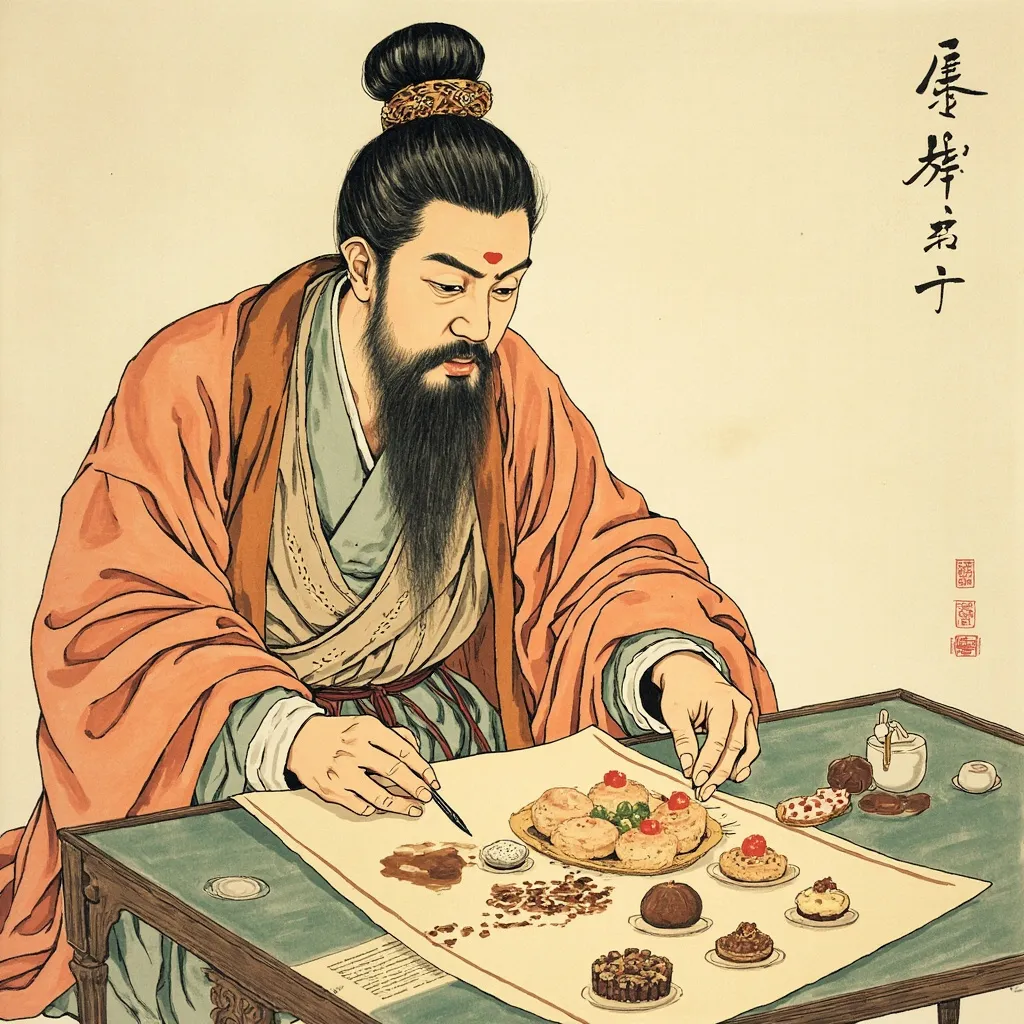
The image is almost comical when you first hear it: someone sitting hungry, frantically sketching pastries on a piece of paper and pretending to eat them. Ha! you think, what a ridiculous thing to do. But once you stop laughing, you realize you’ve probably done something functionally identical at least once in your life. Maybe you told yourself that looking at a travel magazine was basically the same as booking a trip. Maybe you spent an hour watching cooking videos while actually quite hungry yourself. Maybe you accepted a vague promise of future reward as a substitute for actually negotiating for what you deserved.
The line between clever coping and self-deception is thin, and 画饼充饥 walks right along it.
The Origin Story: A Desperate Official and His Imaginary Meal
The idiom traces back to a passage from the Book of Later Han (后汉书), an historical text compiled around the 5th century. The story isn’t about a starving peasant or a wandering monk — it’s about an official named Lü Shang during the Three Kingdoms period who found himself in a rather uncomfortable position.
Lü Shang served as a minister, which meant he had a title, a salary, and all the prestige that came with serving at court. The problem was that his actual authority didn’t match his official rank. He had the trappings of power without the substance. People respected his title, but no one actually listened to him or gave his opinions any real weight. He was, in modern terms, a figurehead — someone whose name appeared on org charts but whose phone calls went unreturned in meetings.
When guests came to visit, Lü Shang would receive them with elaborate courtesy — fine tea, comfortable seating, the whole ritual of hospitality that Chinese culture valued deeply. But when it came time to offer a proper meal, things fell apart. His household simply couldn’t afford to feed everyone lavishly, given that his position generated more reputation than actual income. The war chest was empty, the pantry was bare, but the guests had to be treated as befit a man of his station.
So instead of admitting this openly — instead of saying “I would love to feed you properly but I simply can’t afford it” — Lü Shang hit upon a creative solution. He would have servants bring out a tray and point to it, describing in vivid detail the wonderful dishes that were supposedly on it. “This is roasted duck, so tender it falls off the bone.” “This is braised pork belly, rich and fatty, marinated in five-spice and soy.” “This is steamed fish with ginger and scallions, caught fresh this morning from the river.” He painted word pictures of a feast, hoping his guests would somehow feel nourished by the description alone. He was quite literally asking people to fill their stomachs with imagination.
Unsurprisingly, no one left his residence any less hungry than when they arrived. The guests saw through the charade immediately — you can’t eat words, however beautifully spoken — and the story became a byword for superficial gestures that offer no real substance. The phrase 画饼充饥 entered the vocabulary, ready to be deployed whenever someone confused the appearance of provision with the reality of it.
What the Idiom Really Means: More Than Just Lying
At its core, 画饼充饥 describes mistaking the appearance of something for the reality of it. More specifically, it points to promises that sound wonderful but deliver nothing. When someone “draws a cake to satisfy hunger,” they’re offering comfort that has no actual filling, solutions that don’t actually solve problems, or commitments that exist only on paper.
The phrase has several layers worth examining. First, there’s the literal futility — drawing food doesn’t feed anyone. Second, there’s the element of self-deception — Lü Shang seems to genuinely believe his guests might be satisfied by description. Third, there’s the social performance aspect — maintaining appearances while suffering underneath. And fourth, there’s the ultimate failure — no matter how convincing the description, the hunger remains.
You hear this idiom applied in all kinds of situations. A manager might promise a promotion or bonus “coming soon” but never follow through — that’s drawing cakes. A company advertises amazing benefits but the fine print reveals endless restrictions, impossible conditions, or laughably low coverage caps — drawing cakes. A politician outlines grand plans with no realistic path to achieving them — also drawing cakes. A friend promises to help with your project “sometime next month” but never seems to have time — yet another example of the same pattern.
The beauty of this idiom lies in its imagery. Food is a universal need, and hunger is immediate and undeniable. Everyone knows what it feels like to be genuinely hungry, and everyone knows that no amount of looking at beautiful food will make the feeling go away. Drawing something to eat when you’re actually starving is so obviously futile that the metaphor lands hard every time. It cuts through polite deflection and names the thing for what it is: a comforting fiction dressed up as substance.
The Story in Context: Why the Original Situation Mattered
It’s worth pausing on the original setting, because it adds texture to the idiom that gets lost in casual usage. Lü Shang wasn’t a villain — he was a man trying to maintain dignity in a difficult situation. He had a position to uphold, guests to receive, and a household budget that simply didn’t match the expectations placed on him. His sin wasn’t malice; it was an inability to accept and communicate his actual limitations.
Rather than admit vulnerability, he chose a performance. He doubles down on theater rather than offering honest hospitality. “I know we’re poor, but let me describe abundance to you” is not a reasonable response to scarcity, but it feels like a reasonable response if you’re terrified of losing face.
That element of the story — the gap between appearance and reality, the social pressure to perform abundance when you’re experiencing actual scarcity — makes the idiom richer than a simple criticism of lying. It’s also a commentary on the way people manage impressions. Lü Shang wasn’t trying to deceive anyone maliciously. He was trying to protect his status, maintain face, and navigate a system that rewarded symbols of success over actual substance.
This nuance matters when you use the idiom today. When you call something 画饼充饥, you’re not necessarily accusing someone of deliberate fraud. You might be pointing out that they’ve convinced themselves that describing something well is the same as providing it. The self-deception angle is important — often the person doing the drawing genuinely believes the drawing has value. They’re not consciously conning anyone; they’ve just lost the ability to distinguish between representation and reality.
Modern Applications: When the Idiom Shows Up in Everyday Life
One of the remarkable things about classical Chinese idioms is how seamlessly they slide into modern conversation. 画饼充饥 is used constantly in Chinese-language media, business meetings, family discussions, and everyday chatter about politics and relationships.
In the business world, you’ll hear it attached to companies that promise transformative technology but deliver nothing that works. “Their whole strategy is just drawing cakes,” a critic might say, meaning the vision is vivid but the execution is nowhere to be found. Venture capitalists use it to warn each other about startups that have impressive pitch decks, charismatic founders, and slick websites but no actual product, no real customers, and no path to revenue. The promise is a cake; the hunger remains.
In personal relationships, the idiom applies to partners who say all the right things but never follow through. “He keeps talking about taking a trip together, but it’s just drawing cakes” means the words are nice but no one should book any flights. When “we should hang out sometime” never becomes an actual calendar invitation, that’s drawing cakes. When someone promises to change but their behavior remains exactly the same six months later, that’s also drawing cakes.
You’ll encounter it frequently in discussions about policy and governance. A proposal that sounds ambitious — universal healthcare, free college tuition, a trillion-dollar infrastructure plan — but has no funding mechanism, no implementation timeline, and no realistic path through Congress might be dismissed as 画饼充饥 by skeptics. The phrase lets critics signal that they see through the performance without having to spell out all the specific reasons the plan might fail.
The idiom even shows up in self-help contexts. Sometimes people use it to diagnose their own patterns — recognizing that they’ve been “drawing cakes” for themselves, believing motivational quotes were equivalent to actual behavior change, or imagining that visualizing success was a substitute for doing the work.
Learning to Use the Idiom Naturally in Conversation
If you’re studying Chinese, adding 画饼充饥 to your active vocabulary is a great move. It’s recognizable, widely understood, and adds color to your speech in both casual and formal contexts. Here are a handful of situations where it fits naturally:
When someone describes a plan that sounds exciting but has no concrete steps: “听起来不错,但总觉得有点画饼充饥。” — “It sounds good, but it feels like drawing cakes to satisfy hunger.”
When evaluating a job offer that promises future rewards but current compensation is low: “那些期权听起来很美,不过目前的基本工资实在太低,感觉还是画饼充饥。” — “Those stock options sound beautiful, but the base salary is too low — it still feels like drawing cakes.”
When commenting on a project’s outlook: “他们的愿景很大,但没有融资也没有用户,真的只是画饼充饥。” — “Their vision is big, but they have no funding and no users — it’s really just drawing cakes.”
When describing a friend’s perpetually deferred plans: “他每次都说下周请客,结果半年过去了还没兑现,简直是画饼充饥。” — “He says he’ll treat us next week every single time, and half a year has passed with nothing — it’s really just drawing cakes.”
The key to using idioms well is matching them to situations where the literal meaning resonates. Since the image of drawing food when you’re actually hungry is so concrete and relatable, you won’t struggle to find occasions to deploy it. The challenge is more about noticing when you’re in a 画饼充饥 situation yourself — and having the honesty to name it.
The Deeper Wisdom: Substance Over Show
What makes 画饼充饥 endure as a teaching tool is that it points to a timeless human temptation: the preference for looking good over being good, for sounding impressive over delivering results. Every era has its Lü Shangs — individuals and institutions that invest more in the performance of competence than in actually becoming competent.
The idiom invites a simple but challenging question: Are you drawing cakes, or are you feeding people? Are you offering real value, or just a convincing description of value you intend to provide someday? This isn’t a comfortable question to sit with, because most of us are guilty of drawing cakes at least sometimes. We promise more than we can deliver. We describe futures we’re not actually building. We manage impressions in ways that paper over gaps in substance.
The story reminds us that good intentions don’t shield us from the consequences of inadequate substance. Lü Shang wasn’t trying to hurt anyone. He was trying to cope with a genuinely difficult situation. But the guests were still hungry at the end of the meal, and the story still became a cautionary tale.
The ancient official who inspired this saying didn’t set out to become a symbol of hollowness. He was just a person trying to navigate impossible circumstances the best way he knew how. The story reminds us that trying very hard at the wrong strategy still produces the wrong results. At the end of the day, no matter how beautifully you describe a meal, people are still hungry. The cake you draw doesn’t feed anyone. Only actual food does that.