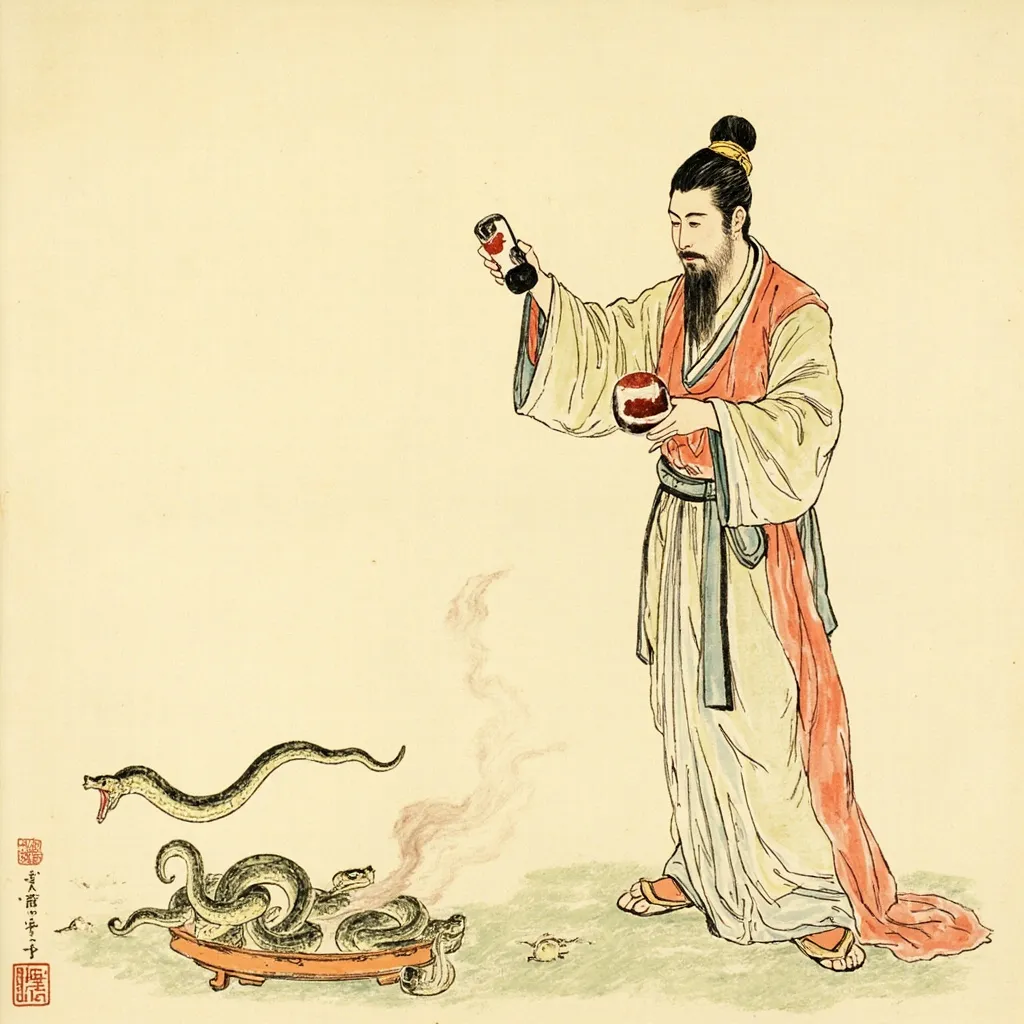
Drawing Snakes and Adding Feet: The Chinese Idiom That Predicted Modern Over-Engineering
There’s a particular kind of failure that doesn’t come from doing too little — it comes from doing too much. You know the feeling. You’ve finished a project, stepped back to admire it, and then — because you couldn’t resist — added one more thing. And that one more thing broke the whole thing. The ancient Chinese saw this pattern play out thousands of years ago, and they distilled it into a single, vivid image: a snake with feet.
The idiom is huà shé tiān zú — 画蛇添足 — literally “drawing snakes and adding feet.” The story behind it has been told in Chinese communities for over two thousand years, passed down through generations not just as entertainment but as a warning. And the weird thing is, it still feels brand new. Every time a software team ships a product that’s buried under layers of unnecessary features, every time a writer over-edits a piece until the original spark is gone, every time a home cook adds so many spices that none of them can be tasted — that’s 画蛇添足. We’ve all done it. We’ve all been the person who ruined a perfectly good thing by refusing to leave it alone.
The Original Story: A Drinking Contest Gone Wrong
The tale comes from the Warring States period, roughly 250 years before the birth of Christ, and it appears in the philosophical texts compiled during that era. Like many of the best fables, it’s set in a mundane scenario — a guild gathering, a friendly competition, wine as the prize.
A group of craftsmen — blacksmiths, carpenters, the kinds of people who worked with their hands — gathered for a celebration. At some point during the festivities, the host announced a contest to make things interesting. The rule was simple: whoever could draw a snake first would win the wine.
Now, drawing a snake sounds easy. You make a wavy line, add a forked tongue, maybe some scales. It doesn’t need to be pretty — it just needs to be first. The participants all crouched over the ground with their writing implements, scraping their styluses across clay or bamboo in their eagerness to claim the prize.
One man was particularly quick. He finished his snake well ahead of the others — a decent-looking serpent, coiled and ready, tongue flickering. He stood up, poured himself a cup of the prize wine, and started drinking. But as he waited for the others to finish, he looked at his snake and thought to himself: this looks a little plain. The snake had no feet.
Now, here’s where the ancient Chinese fabulist earns his keep. Instead of leaving well enough alone, the man picked up his stylus and began adding feet to his snake. One foot, then another, then a third. He was still working on the fourth when another participant finished and snatched the wine away.
“Why did you do that?” the winner demanded, gesturing at the half-footed snake. “I finished mine first, and you were still drawing feet. The rule was whoever draws the snake first wins the wine.”
The moral was obvious to everyone except the over-caffeinated snake-foot-drawer: a snake, by definition, has no feet. Adding them doesn’t make your drawing better — it makes it no longer a snake. You didn’t win the contest because you couldn’t recognize when you were done.
What the Idiom Actually Means
画蛇添足 has accumulated several layers of meaning over the centuries, and it’s worth unpacking each one because they all describe distinct but related failures.
The most direct meaning is ruining something through unnecessary addition. The instinct to keep adding, to keep polishing, to keep improving — that’s not always virtue. Sometimes it’s compulsion. The craftsman with the snake had already won. The work was done. But his brain couldn’t accept “done” — it needed “perfect,” and in chasing an imaginary perfection, he destroyed the actual victory he’d already secured.
A second, slightly different shade of meaning is overstepping and getting nothing. This is the version that maps most neatly onto modern business and project management. Scope creep, feature creep, adding bells and whistles that nobody asked for — these are all descendants of the snake-with-feet. The original deliverable was solid. The additions didn’t improve it; they just delayed it, bloated it, and ultimately made it worse than it would have been if you’d stopped at “good enough.”
There’s also a subtler interpretation: misunderstanding the nature of what you’re working with. The man thought he was improving his snake. But a snake, by its very definition, doesn’t have feet. By trying to improve the drawing with anatomical accuracy, he was actually betraying the fundamental nature of the subject. This maps onto what happens when people apply frameworks or standards that don’t fit the thing they’re working on — when you force a square peg into a round hole and call it innovation.
In modern Chinese, the idiom is used casually and frequently. Someone might say “你别画蛇添足了” — “Don’t add feet to the snake” — when a colleague is about to overcomplicate a simple process. Managers use it to warn teams against gold-plating a product. Parents use it on children who are “fixing” something that wasn’t broken. The idiom has survived because the behavior it describes is eternal.
Ancient Examples in Chinese History
The Warring States period was full of exactly this kind of political and military overreach. The period gets its name from the constant warfare between competing states, and one of the recurring patterns was kingdoms that won a battle and then overextended themselves trying to press the advantage.
The state of Qi is a classic example. After a significant military victory, the ruler of Qi decided to expand further — adding “feet” to an already successful campaign. The result was overextended supply lines, exhausted troops, and eventually a catastrophic defeat that set the state back decades. Generals who studied history would have recognized this as the snake-with-feet pattern: you win, you get greedy, you add feet to the snake, and suddenly you don’t have a snake anymore.
In the literary world, the Tang Dynasty poet Li Bai famously wrote about this tension between simplicity and excess. His poetry often celebrated the kind of direct, unadorned beauty that comes from knowing when to stop — and he was sharp in his criticism of writing that tried to do too much. Tang Dynasty literary critics developed an entire aesthetic around the concept of 留白 — “liu bai,” or “leaving white space.” The idea was that what you don’t say matters as much as what you do. A poem with too many words, like a painting with too many details, loses its power. The empty space isn’t emptiness — it’s breathing room. It’s knowing when you’re done.
This connects to a broader theme in Chinese art and philosophy: the idea that restraint is a form of respect. Adding too much to a piece of calligraphy — overdotting a character, overlining a stroke — shows not skill but lack of discipline. Master calligraphers speak of a single brushstroke that is “complete” the moment it lands. To go back over it is to destroy it. The best work knows when to stop.
Modern Manifestations: When We All Become the Snake-Drawer
Fast-forward to the twenty-first century, and the snake-with-feet pattern is everywhere. The tech industry alone could fill volumes with examples.
Consider the software product that launches with forty-seven features when users only needed three. The original product was clean, intuitive, useful. Then the product managers got involved. “What if we also had dark mode? What about a calendar integration? We should really add a social sharing feature — everyone’s doing social sharing.” Each individual feature sounded reasonable in isolation. Together, they buried the product’s core value under layers of interface bloat. The original snake — a tool people loved — became a creature with too many feet, and users wandered off to find something simpler.
Or think about the modern wedding. At some point, the core concept — two people making a commitment to each other, celebrated by their community — got buried under an avalanche of additions. The dress, the venue, the flowers, the photography, the videography, the honeymoon, the favors, the Save-the-Dates, the engagement party, the bridal shower, the rehearsal dinner. Each element started as a “nice to have.” Together, they created a year-long construction project that stressed out the couple, bankrupted their families, and produced a day so over-produced that nobody could actually remember what made it special. The snake had feet. The feet had toes.
Home renovations follow the same arc. You start with a simple plan — new paint, updated fixtures. Then someone suggests knocking down a wall. That requires a structural engineer. While you’re at it, you might as well redo the kitchen. The kitchen redo means new plumbing. The new plumbing means tearing up the floor. Six months later, you’re living in a construction zone, you’ve spent three times your budget, and the house is somehow less comfortable than when you started. You added feet to the snake.
Even in personal relationships, this pattern shows up. Someone gives you honest feedback — constructive criticism, the kind that could actually help you grow. Instead of taking it in and reflecting, you add defenses, explanations, justifications. You over-explain. You bury the useful kernel under layers of self-protective noise. The feedback becomes unreadable, exactly because you couldn’t leave it alone.
The Wisdom in Knowing When to Stop
What makes 画蛇添足 such a durable piece of wisdom isn’t the observation itself — it’s the specificity of the image. A snake with feet is instantly, absurdly funny. You can picture it. You can picture the man’s face when he realized what he’d done. And that image sticks with you in a way that a generic “don’t overcomplicate things” never could.
The Chinese idiom tradition is full of these vivid, slightly ridiculous images precisely because they work. 对牛弹琴 — “playing the lute to a cow” — describes the futility of trying to impress someone who can’t appreciate what you’re doing. 揠苗助长 — “pulling up seedlings to help them grow” — describes the damage of impatient over-intervention. Each one captures a pattern of behavior so precisely that once you learn the idiom, you start seeing the pattern everywhere.
The snake-with-feet lesson boils down to this: completion is its own form of achievement. In a culture that celebrates hustle, polish, and going the extra mile, the idea that sometimes the extra mile is the thing that ruins everything feels counterintuitive. But the craftsman in the original story didn’t lose because he was lazy or careless. He lost because he was too creative, too ambitious, too unable to accept that simple and finished was enough.
The Stoic philosopher Seneca wrote something similar: “It is not that we have a short time to live, but that we waste a lot of it.” The snake-drawer had a short time — just long enough to draw a snake and claim his prize. He wasted it by trying to fill the time with something unnecessary. The wine was already his. He reached for more and found less.
Practical Applications: How to Spot the Feet Before You Add Them
So how do you catch yourself before you add the feet? It’s harder than it sounds, because the impulse to add usually comes disguised as the impulse to improve. The man wasn’t trying to sabotage himself — he thought feet would make the snake better.
The first defense is to establish what “done” looks like before you start. In the original story, the goal was unambiguous: draw a snake, win the wine. The man lost because he redefined “done” mid-project. If he’d written “a snake that looks like a snake” on a literal checklist before starting, he’d have caught himself. Defining success criteria upfront — and writing them down — creates a barrier against the creeping redefinition of scope.
The second defense is to build in review points where you explicitly ask whether additional work is creating value or destroying it. In product management, this is called a “feature audit.” In writing, it’s the difference between editing (which refines) and rewriting (which replaces). The question to ask at every review point is blunt: Is this making the thing better, or is this making the thing different? Different isn’t always better.
The third defense is something that the best artists and craftspeople understand intuitively: trust the work once it’s ready. This is harder than it sounds. Most of us have an adversarial relationship with our own creations — we can always see the flaws, always imagine how it could be improved. But that impulse, applied without judgment, produces exactly the snake-with-feet problem. Sometimes the flaw you see is a feature from a different perspective. Sometimes “good enough” is genuinely good enough. Sometimes the most skillful thing you can do is put the brush down.
Conclusion: Leave the Feet Off
The craftsman who drew the snake in that ancient guild hall made a mistake that anyone could have made. He was ahead, he was confident, and he saw an opportunity to do a little more. That’s a feeling most of us recognize in ourselves — the part of the brain that spots imperfections in our own work and insists on fixing them, even when the work is already better than good enough.
The wisdom of 画蛇添足 isn’t that we should never improve things. It’s that improvement has a point of diminishing returns, and past that point, you’re not improving — you’re overworking. The snake with feet wasn’t better than the snake without. It was something else entirely. And the wine he lost was the price of not recognizing that.
Next time you catch yourself adding one more element to a project that’s already finished — one more feature, one more edit, one more layer of polish — pause and picture that ancient craftsman, stylus in hand, carefully drawing feet onto a serpent that never needed them. The wine is already yours. Put down the stylus.
Disclosure: This article contains affiliate links. We earn a commission on qualifying purchases.