Du Fu: The Poet Who Felt America’s Pain Before America Existed
A Complete Guide to Du Fu for American Readers
In the winter of 759, a thin man with tired eyes walked through the streets of Chengdu. He had no home, little money, and a family scattered by war somewhere to the north. He stopped at a small shrine dedicated to a general who had died four centuries earlier, and he wrote a poem that Americans would one day translate in their high school English classes — not because it was Chinese, but because it described exactly what it feels like to lose everything and still show up for other people.
That man was Du Fu, and his poem “The Shrine of King Zhu” is one reason he has been called the Shakespeare of Chinese literature. But Du Fu was more than a great writer. He was a window into how ordinary Chinese people experienced the collapse of their world during the An Lushan Rebellion, and his empathy for the powerless made him a voice that still resonates in the twenty-first century.
This guide is for American readers who want to understand who Du Fu really was, why his work still matters, and how to start reading him without being overwhelmed by a thousand years of commentary.
Background: The World Du Fu Was Born Into
Du Fu was born in 712 in the city of Gongyi, in what is now Henan Province, into a family that had produced scholars for generations. His father Du Shenyuan was a minor official, and his mother came from a lineage that traced itself back to the famous philosopher Du Shen. It was a respectable background — not aristocratic, but educated and connected.
The Tang Dynasty at its peak was one of the most cosmopolitan places on earth. The capital, Chang’an (modern Xi’an), was a city of over a million people where Buddhist monks debated with Taoist scholars, Persian merchants sold rugs in open markets, and the emperor ruled from a palace complex that took an hour to walk across. Poetry was not just an art form — it was a civil service requirement. If you wanted to be a government official, you had to pass poetry exams.
Du Fu was a child of this system. He began writing poems as a teenager and quickly showed unusual talent. By his early twenties he was traveling, meeting other poets, and dreaming of passing the imperial exams. He failed twice, in 735 and 745, and the second failure coincided with the death of his father, which cut off his financial support. For a while, Du Fu lived the life of a wandering scholar — poor, proud, and writing.
He met Li Bai (Li Po), the great romantic poet, sometime around 744 in Luoyang, and the two became friends. Li Bai was twelve years older, already famous, and something of a wild man. Du Fu was more serious, more political, more attentive to the world around him. They traveled together for a while, and Du Fu later wrote several poems about their friendship that are among the most touching accounts of male friendship in world literature. Li Bai once wrote a poem asking Du Fu not to wash his clothes for three years because he wanted to preserve his friend’s smell — an image that sounds strange in English but in Chinese carries real tenderness.
The An Lushan Rebellion and Du Fu’s Awakening
Everything changed in 755. An Lushan, a general of Sogdian and Turkic descent, declared himself emperor and marched on Chang’an with an army of perhaps 150,000 soldiers. The emperor, Xuanzong, fled. The city was sacked. An Lushan’s forces controlled the north for the next eight years.
Du Fu was in Chang’an when the rebellion broke out. He managed to escape south, where he eventually found his family — his wife, his children, his servant — huddled together in the wilderness, having fled the violence. He wrote a poem called “The Song of the Classical Wife” that is essentially a description of his family walking through a landscape devastated by war. It is not dramatic. It does not describe battles. It describes what it looks like when ordinary people’s lives are ground up by events they did not choose.
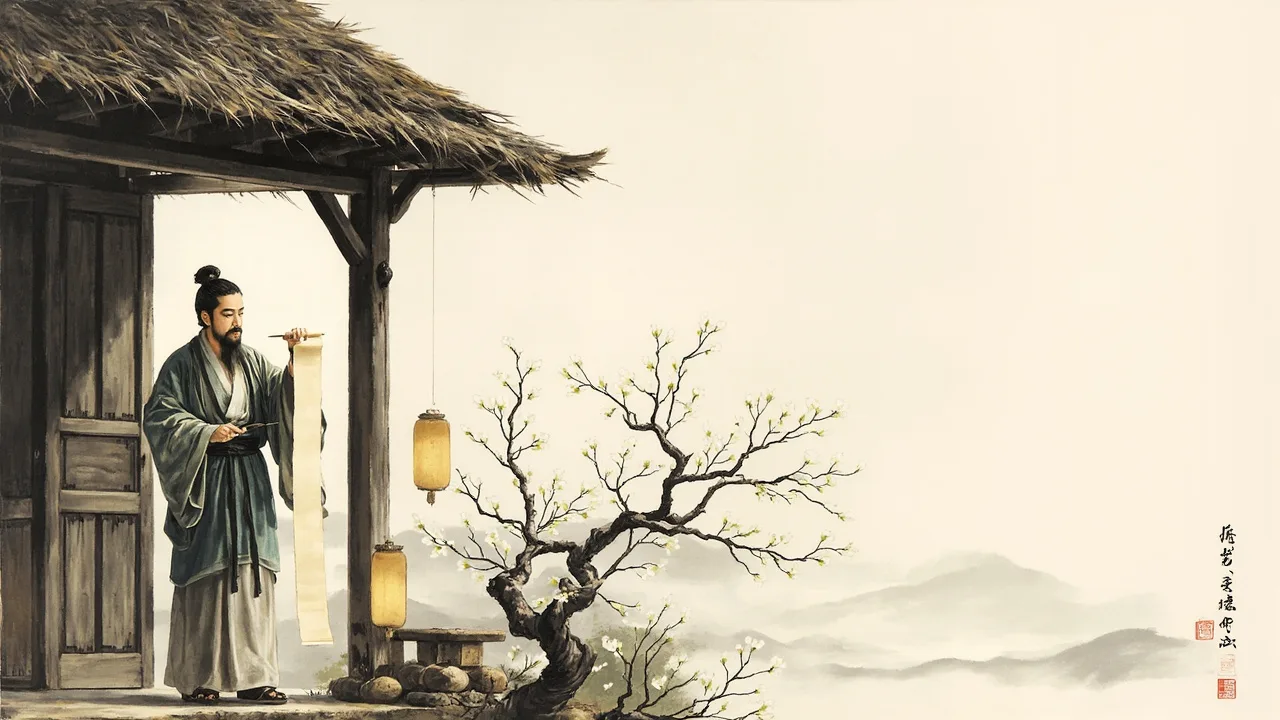
In 757, Du Fu was caught in the siege of Chang’an by An Lushan’s forces. He was briefly detained and then released. He eventually made his way to the southwestern city of Chengdu, where a warlord named Yan Huiqing gave him a small official post and a cottage to live in. The cottage sat next to a flower garden, and Du Fu wrote some of his most famous poems there — including the ones that would later become known as the “Du Fu Thatched Cottage poems.”
It was in Chengdu that Du Fu began to write the poems that would define his legacy: not love poems, not nature poems, but poems about what government failure does to regular people. In one poem, he described a newlywed couple being torn apart by the government’s forced labor draft. In another, he wrote about an old man whose home had been burned down and who was forced to flee into the hills while soldiers burned everything behind him. These were not abstract complaints. They were specific, observed, and written by a man who had experienced hunger himself.
Du Fu’s Poetry: What It Sounds Like in English
The challenge of translating Du Fu is legendary among scholars. Tang Dynasty poetry follows strict tonal and rhyme patterns that cannot be preserved in English. What can be preserved is the compression — the way Du Fu could pack an entire emotional situation into a handful of lines.
Here is a famous short poem, “Spring Prospect,” written in 757 while Du Fu was trapped in Chang’an during the An Lushan Rebellion. He had not yet escaped to Chengdu:
The nation is shattered, mountains and rivers remain. The city curls with spring grass, trees grow deep. In the third month the smoke of beacon fires rises, A letter from home weighs a thousand pounds.
The poem is about being stuck in a ruined capital while the war goes on, watching the seasons change and knowing your family is somewhere out there, unreachable. The “letter from home weighs a thousand pounds” is the kind of line that does not need explanation. Anyone who has waited for news from someone they love understands it immediately.
Here is a slightly longer poem, “The Shrine of King Zhu,” which I mentioned at the opening:
The general’s clear spirit never departed — The fifth month, hearing the cuckoo’s cry, I climbed these steps in the cold and thin air, Touched the bark of the pine and cypress. Rivers and valleys: the scene of battle. Where have the soldiers’ bones gone? A widow weeps at the foot of the mountain. At dusk the sound of the bamboo flute.
The poem is about visiting a shrine to a general who died four centuries earlier, during a period of civil war, and realizing that the same patterns — war, widowhood, bones left on the mountainside — are still happening. The general’s spirit has not departed because the suffering continues. The cuckoo, a bird associated with grief in Chinese poetry, calls in the cold spring air. The poet touches the ancient trees and thinks about what they have witnessed.
What makes Du Fu distinctive is that he does not write from the perspective of the general or the emperor. He writes from the perspective of the widow. He writes from the perspective of the old man whose house has been burned. He writes from the perspective of a poet who is himself hungry, frightened, and separated from his family. This is what makes him feel modern to American readers — he has what we might call a strong equity lens, paying attention to the people who are not in the room when decisions are made.
Du Fu’s Later Years and Legacy
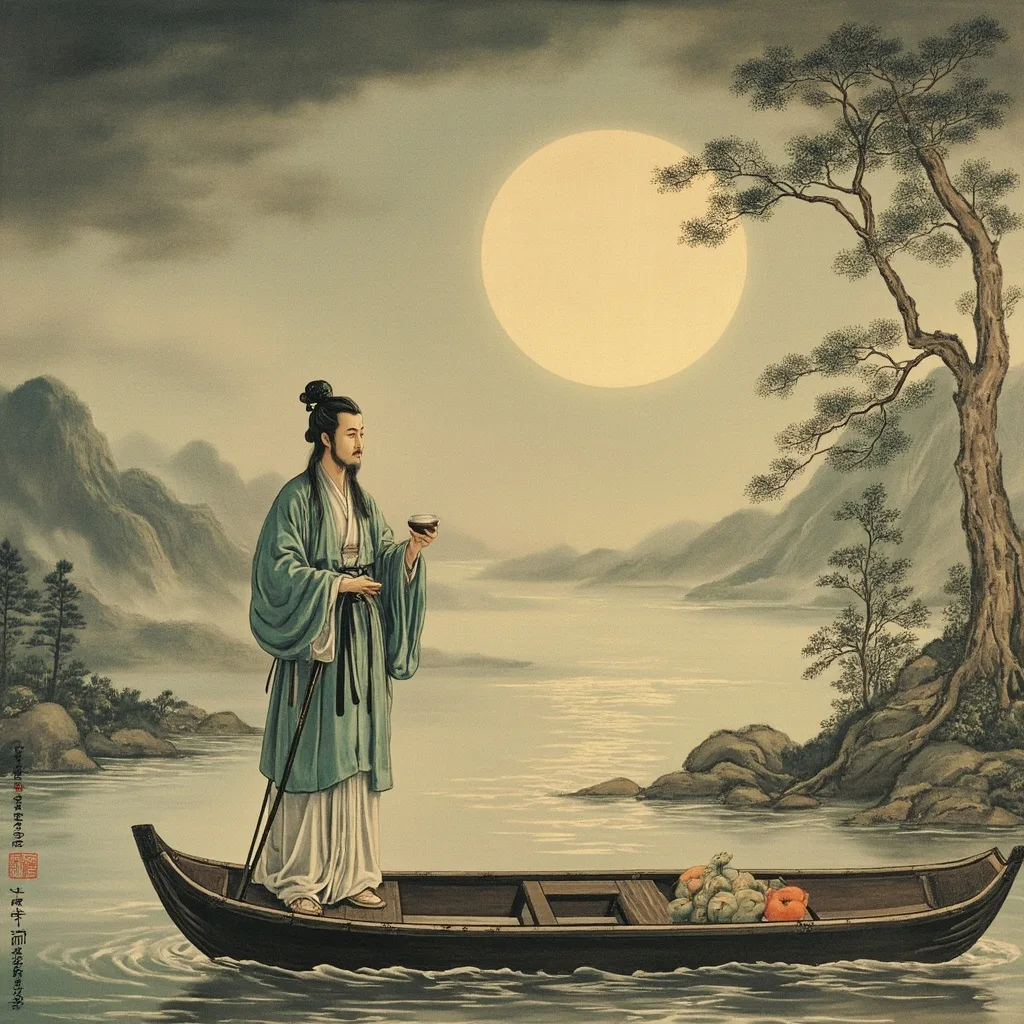
Du Fu spent his last years moving from place to place as the war ground on. He received a minor government post in 770 and was traveling to take up the position when he fell ill with pneumonia and diabetes. He died in 770, in a small boat on the Xiang River, at the age of fifty-eight. He was buried near his hometown.
He left behind roughly 1,400 poems, which were collected and edited by his friend and fellow poet Wei Qingzhi. The collection became one of the foundational texts of Chinese literature. Over the following centuries, Du Fu’s reputation grew steadily. Later scholars called him the “Poet Historian” because his poems are such detailed records of his era. The Song Dynasty poet Su Shi, who we will meet in the next article, considered Du Fu the greatest poet who ever lived.
In the twentieth century, Du Fu became known in the English-speaking world through the translations of Kenneth Rexroth, Burton Watson, and the more recent work of David Hinton andqtdan BELS. The translator A.C. Graham wrote that reading Du Fu in translation was like “looking at photographs of a foreign country” — not quite the real thing, but real enough to see what matters.
Why Du Fu Speaks to Americans
The easiest way to understand why Du Fu matters to American readers is to read his poem “Bing, the Soldier,” a narrative poem about a young man conscripted into military service. The poem describes a conversation between the poet and a soldier who has been away from home for fifteen years, fighting in one campaign after another. When the soldier returns, his family has moved away, his village has changed, and he is essentially a stranger. The poem ends with the soldier saying he would rather be a dog or a jackal in the wild than live like this anymore.
It is a poem that could have been written about Afghanistan veterans, about opioid-era Appalachia, about any community hollowed out by forces beyond its control. Du Fu was not writing about those situations specifically, but he was writing about the experience of being ground up by institutions you cannot control, and his specificity is what makes it timeless.
There is also a poem Du Fu wrote in Chengdu, “Guest Arriving, Having No Food,” which describes a friend coming to visit and Du Fu having almost nothing to offer him. He sends his son to borrow wine, they sit together, they drink, they talk. It is a poem about poverty and hospitality and the way friendship persists even when you have nothing. It is one of the most human poems in any language.
Cultural Connection: Du Fu and Walt Whitman
The comparison that most often comes up when scholars discuss Du Fu in an American context is with Walt Whitman. Both poets wrote about democracy in the broadest sense — the idea that every individual human life contains infinite worth and deserves to be witnessed. Both wrote about the body politic as a living organism, capable of health or disease. Both had a hard time with conventional authority.
Whitman was born in 1819, roughly eleven hundred years after Du Fu died. They never could have known about each other. But when American readers encounter Du Fu’s descriptions of soldiers, farmers, and families struggling through war, they often describe a Whitman-like quality — a voice that refuses to look away from suffering and that insists on the dignity of ordinary people.
The difference, if there is one, is that Du Fu was writing within a Confucian framework that emphasized social obligation and proper conduct, while Whitman was writing within a Romantic and democratic framework that emphasized individual self-reliance. Both frameworks produce poetry that cares deeply about community.
Practical Tips: How to Read Du Fu
Start with translations by David Hinton. His translations of both Du Fu and Li Bai are considered among the best in English because he prioritizes clarity and lets the poems breathe.
Read the poems in order of when Du Fu wrote them. His work is usually divided into early (before 755), middle (during the An Lushan Rebellion), and late (after 759). The early poems are technically brilliant but emotionally reserved. The middle and late poems are where Du Fu becomes Du Fu.
Do not worry about understanding every reference. Tang Dynasty poems are dense with historical and literary allusions, and even Chinese readers need notes. If a line moves you, sit with it. If it does not, move on.
Try reading the poems aloud. Tang Dynasty poetry was written to be recited. The tonal patterns do not carry into English, but the rhythm does, and many of Du Fu’s best poems have a strong, plainspoken beat.
Related Products
If you want to explore Du Fu beyond this article, these resources can help:
The Selected Poems of Du Fu translated by David Hinton — The most widely recommended English translation. Hinton’s notes are helpful without being overwhelming.
The Great Age of Chinese Poetry: The High Tang — Stephen Owen’s academic study of Tang Dynasty poetry, including a long section on Du Fu that places him in his historical context.
A Field of Scholars: Du Fu Notecards — A set of notecards featuring translated couplets from Du Fu’s poems. Useful for students or as gifts.
Conclusion
Du Fu is not the easiest Chinese poet to approach. His work requires some context, and his most powerful poems are not the most technically flashy. What he offers in return is something rarer: a voice that paid attention to the people who were suffering, that described their pain with specificity and compassion, and that refused to look away.
He died in a boat on a river in 770, still poor, still traveling, still writing. His legacy is a body of work that has been read and loved for thirteen centuries, and that continues to find new readers who recognize something of their own experience in lines like “the nation is shattered, mountains and rivers remain.”
If you want to understand Chinese culture through the eyes of someone who saw it at its worst and still believed in its best, start with Du Fu.
Next: Su Shi: The Poet of Red Cliffs and the Man Who Ate Lobster