Du Fu: The Sage of Poetry
Du Fu (712–770) is often introduced in English as China’s “Poet Sage,” or 诗圣, a title that sounds grand until you read what he actually wrote. His poems are full of hunger, cold journeys, failed plans, noisy children, loyal friends, and the terrible cost of war. He could write about the emperor and a poor conscript in the same moral universe. That is one reason his work still feels immediate. You do not have to know every Tang dynasty office to understand a father worrying about his family while soldiers move through the countryside.
Du Fu was born into a scholarly family in Henan during the high Tang, a period later remembered for confidence, cosmopolitan cities, and astonishing poetry. His own life was far less smooth than the dynasty’s reputation suggests. He studied for the civil service, traveled, sought patrons, and waited for an official appointment. Even when he finally entered government, his career remained unstable. He belonged to a world that praised talent but made talented people compete for a narrow doorway.
His poems are not simply historical reports. Du Fu shaped scenes with sound, contrast, and carefully chosen images. Yet his moral attention is hard to miss. He noticed who paid for political mistakes. He noticed what happened to villages when armies passed. He also noticed that private grief does not become less real because a national crisis is larger. That combination, public conscience and intimate detail, is the center of his reputation.
A young scholar in a difficult age
Du Fu’s early life and ambitions deserve more attention than the usual thumbnail biography. He grew up in a family connected to the examination culture that supplied officials to the Tang state. A family background like his gave him education, models, and expectations, but it did not guarantee success. He traveled through eastern China, met other writers, and tried to establish the relationships that mattered in a patronage-based society.
The young Du Fu admired Li Bai, the older poet whose roaming life and vivid imagination became almost legendary. Their friendship, or at least their intense literary relationship, left a mark on Du Fu’s work. In “Spring View,” sometimes translated as “A Spring View” or associated in discussions with his friendship poetry, Du Fu writes from a world in which spring remains beautiful while the capital lies shattered by rebellion. The flowers do not comfort him neatly. Their beauty makes his grief sharper.
Du Fu’s ambitions were practical as well as literary. He wanted a position from which he could help govern. He believed the state had responsibilities toward its people, and he believed a capable official should be willing to criticize bad policy. That combination could be dangerous. A poet who only entertained patrons might survive more easily than a poet who treated public suffering as a moral accusation.
His early poems show a writer learning how to move between grand subjects and small details. He could describe a court ceremony, then focus on a hungry horse or a family waiting for news. He could use the conventions of regulated verse and still make the reader feel that an ordinary person had entered the poem. That skill became essential when the Tang political order began to break apart.
The An Lushan rebellion and poems of witness
The An Lushan rebellion began in 755 and lasted for years, tearing through the Tang empire. An Lushan, a powerful military commander, rebelled against the central government and captured the capitals Chang’an and Luoyang. The conflict caused enormous displacement, deaths, famine, and political upheaval. It is easy to summarize those events in a sentence and forget that Du Fu experienced them as a sequence of separations and dangers.
Du Fu was caught in the collapse of normal life. He was separated from family, moved through unstable territory, and eventually reached the rebel-held capital before escaping. He later served the restored court, but his official career remained fragile. The rebellion changed the scale of his poetry. War was no longer something discussed in memorials or historical examples. It was in the road, the empty villages, the missing relatives, and the frightened conversations of people with nowhere safe to go.
One of his best-known poems, often translated as “Spring View,” opens with a famous contrast: the country is broken, yet mountains and rivers remain. The city is overgrown, and the season’s flowers trigger tears. The poem’s power comes from its refusal to make nature a simple escape. Spring continues, but human order has failed. The flowers and birds do not erase the war; they remind the poet that the world can look alive while people suffer.
Another group of poems, sometimes called “Three Officials” and “Three Farewells,” shows Du Fu listening to the voices of conscripts, families, and officials. The poems do not turn soldiers into abstract numbers. A young man is taken away. An old man has little left to offer. A woman faces separation and uncertainty. Du Fu’s technique is controlled, but the situations feel raw. He lets social pressure appear through speech, silence, and the awkward pauses of people who know that protest may make things worse.
The poem often translated as “A Lament” or “A Lament for the South” belongs to a different register, filled with grief for a country and a culture under pressure. English titles vary, and translations can make the boundaries between individual poems confusing. That is worth remembering when you read Du Fu in English. The exact title may shift, but the central concern stays recognizable: history is lived by bodies, households, and people whose names rarely make it into official records.
Du Fu did not write as an outside observer. He was educated, politically connected, and aware of his own position. That self-awareness gives his work an unusual tension. He could criticize the state while still imagining responsible government. He could mourn the poor while knowing that he belonged to the class that administered taxes and laws. The poems do not solve that contradiction. They keep it visible.
Friends, family, and the work of grief
War poems are only one part of Du Fu’s achievement. His writing about friendship and family gives the larger historical picture a human scale. The friendship poems addressed to Li Bai are especially memorable because they combine admiration, distance, worry, and literary rivalry. “Thinking of Li Bai in Spring,” commonly rendered as “Spring Reminiscence of Li Bai,” presents friendship as something carried across separation. The absent friend becomes part of the speaker’s daily thought.
Du Fu’s family poems can be painfully domestic. He worries about his wife and children, remembers their separation, and notices the small indignities created by poverty. His concern is not sentimental in the modern greeting-card sense. He understands that love includes logistics: finding food, repairing a roof, hearing from relatives, and deciding whether a journey is safe. These details make the poems feel close to contemporary life even when the political vocabulary belongs to the Tang dynasty.
He also writes about aging. Du Fu’s body becomes less reliable, travel becomes harder, and official hopes lose their shine. The poems do not present old age as a wise retreat from the world. He remains irritated, lonely, physically uncomfortable, and alert to injustice. That is part of his honesty. A poetic sage does not have to float above ordinary misery.
The famous poem “Climbing the Heights” is often taught as a masterpiece of regulated verse. The scene includes wind, sky, river, falling leaves, and a solitary speaker. But the poem’s emotional force comes from accumulation. Natural grandeur and personal decline occupy the same space. The speaker is not merely admiring autumn. He is sick, aging, and burdened by years of wandering. The form is disciplined enough to hold feelings that might otherwise spill into complaint.
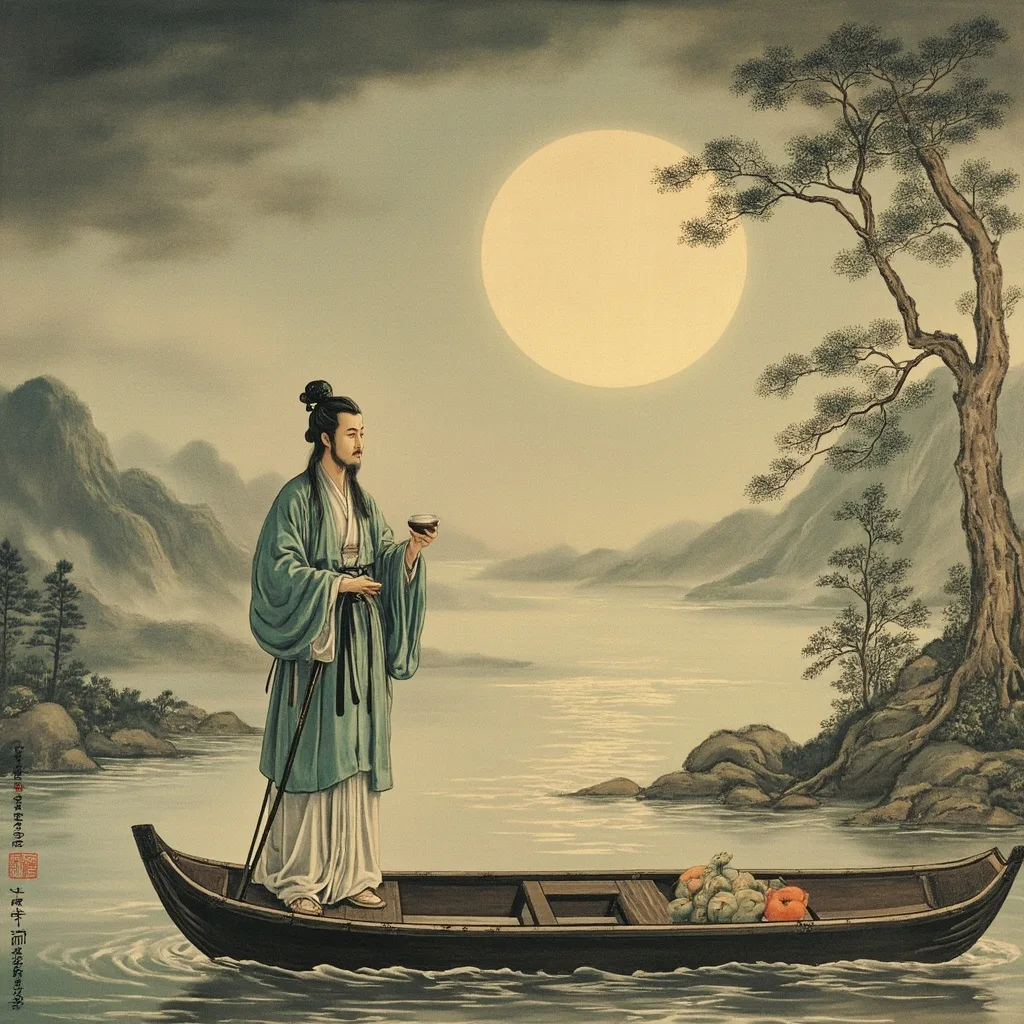
When you read these poems, notice how often Du Fu makes an object carry emotional weight. A lamp, a boat, a letter, a broken wall, or a patch of moonlight can become the meeting point of private and public life. He does not need to announce that the empire is unstable every time. The unstable empire is already present in the way people wait, travel, and remember.
Chengdu and the thatched cottage
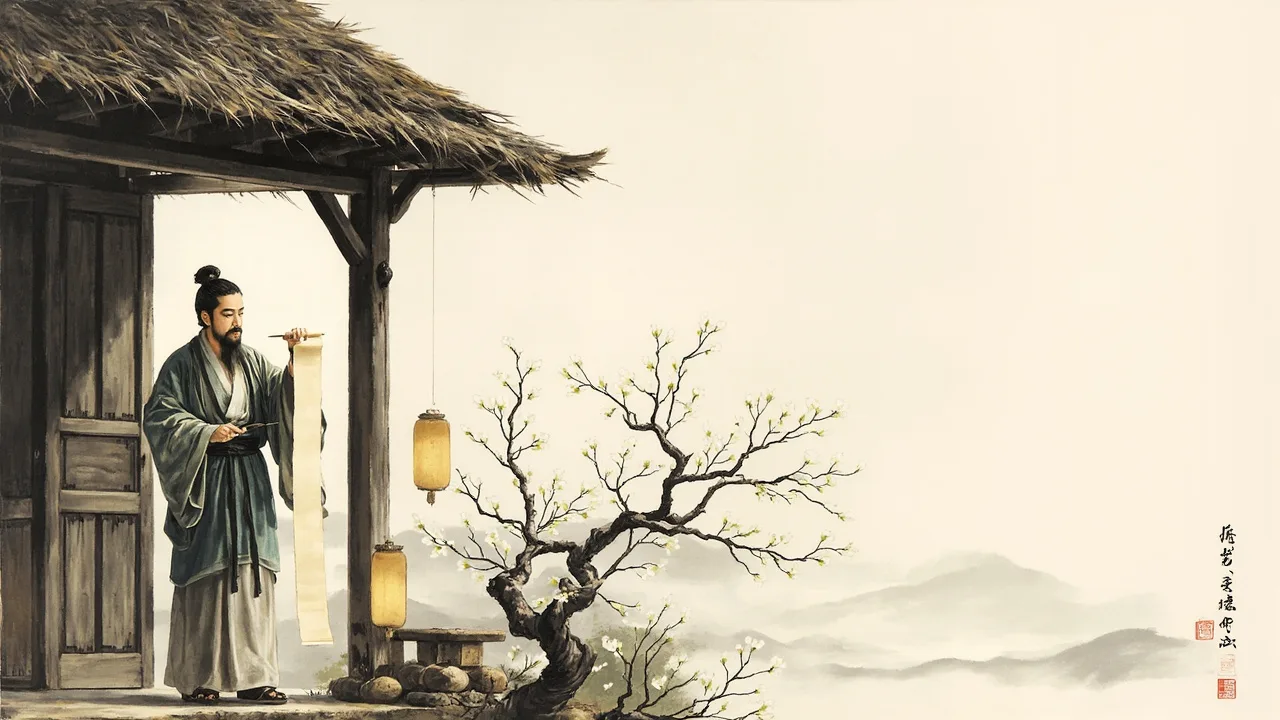
In 759, after years of upheaval, Du Fu reached Chengdu in Sichuan. Friends helped him settle near the Huanhua Stream, where he built a thatched cottage. The site is now commemorated by the Du Fu Thatched Cottage museum and gardens, but the historical importance is not that the poet suddenly became comfortable. His years in Chengdu gave him a period of relative stability, and stability allowed different parts of his personality to appear.
The cottage period produced poems about rain, bamboo, neighbors, farming, children, and the fragile pleasure of having a roof. His poem “My Thatched Hut Was Ruined by the Autumn Wind” begins with a personal disaster. The wind tears away the thatch, and the poet imagines rain entering the house while his family has no dry place to sleep. Then the poem turns outward. Du Fu wishes for a vast, secure dwelling where all poor scholars could find shelter, even if he himself had to remain exposed.
That turn is often quoted because it sounds noble, but the poem works because the physical misery comes first. The reader feels the cold, wet room before hearing the larger wish. Du Fu does not leap over his own suffering to perform virtue. He lets the personal and social levels touch. A damaged roof becomes a question about what a decent society should provide.
The Chengdu museum today includes reconstructed buildings, gardens, pathways, and exhibits about Du Fu’s life and writing. If you visit, it helps to imagine the difference between the polished memorial site and the vulnerable original cottage. Museums preserve memory, but they can also smooth away the uncertainty that shaped the poems. Du Fu did not know that later readers would treat his shelter as sacred ground. He knew whether the roof leaked.
Chengdu also shows how place shaped his imagination. Sichuan’s landscape, streams, plants, and climate enter the poetry without turning into travel-brochure scenery. Du Fu observes the local world as someone who has been displaced into it. He is grateful for refuge, but he remains aware that home is elsewhere and that political danger has not disappeared.
The cottage poems are sometimes read as a period of peace, and relative peace is fair. Still, Du Fu’s peace is precarious. He continues to worry about officials, distant family, disease, and the future. That mixture makes the poems more believable. Happiness does not require forgetting what happened before. A good meal, a repaired wall, or a quiet rain can matter precisely because the poet knows how quickly ordinary life can vanish.
A few useful ways to keep learning
A bilingual Chinese poetry anthology is the best first purchase if you want to read Du Fu rather than only read about him. Look for facing-page Chinese and English, notes on variant translations, and a short introduction to regulated verse. A Chinese history atlas can help you follow the movement between Chang’an, Luoyang, Sichuan, and the other places that appear in his biography. A museum-style book on Tang painting and poetry gives you visual context, while a grid-paper language notebook makes it easy to copy a line and keep vocabulary beside your own translation. These are affiliate recommendations; a retailer may pay a small commission without changing your price.
If you hope to visit Chengdu, a pocket guide to Sichuan museums and historic sites is more useful than a generic coffee-table book. Choose one with maps, transportation notes, and practical information. A beginner Chinese calligraphy set can also deepen your reading, since Du Fu’s poems were copied, memorized, and circulated through handwritten culture. You do not need beautiful handwriting. The point is to slow down long enough to notice how a line is built.
Du Fu can feel difficult at first because translations disagree and historical references pile up. Start with one poem. Read two English versions, then return to the images that remain. You may not resolve every ambiguity, but you will begin to hear why generations of readers call him the Poet Sage.
Closing thoughts
Du Fu’s greatness is not that he escaped history. He stayed inside it. He wrote about rebellion, poverty, friendship, hunger, family, and the stubborn beauty of an ordinary day. His poems ask you to look at public events from the level of the human room. That is why the eighth-century Tang world can still feel close when you open the page.