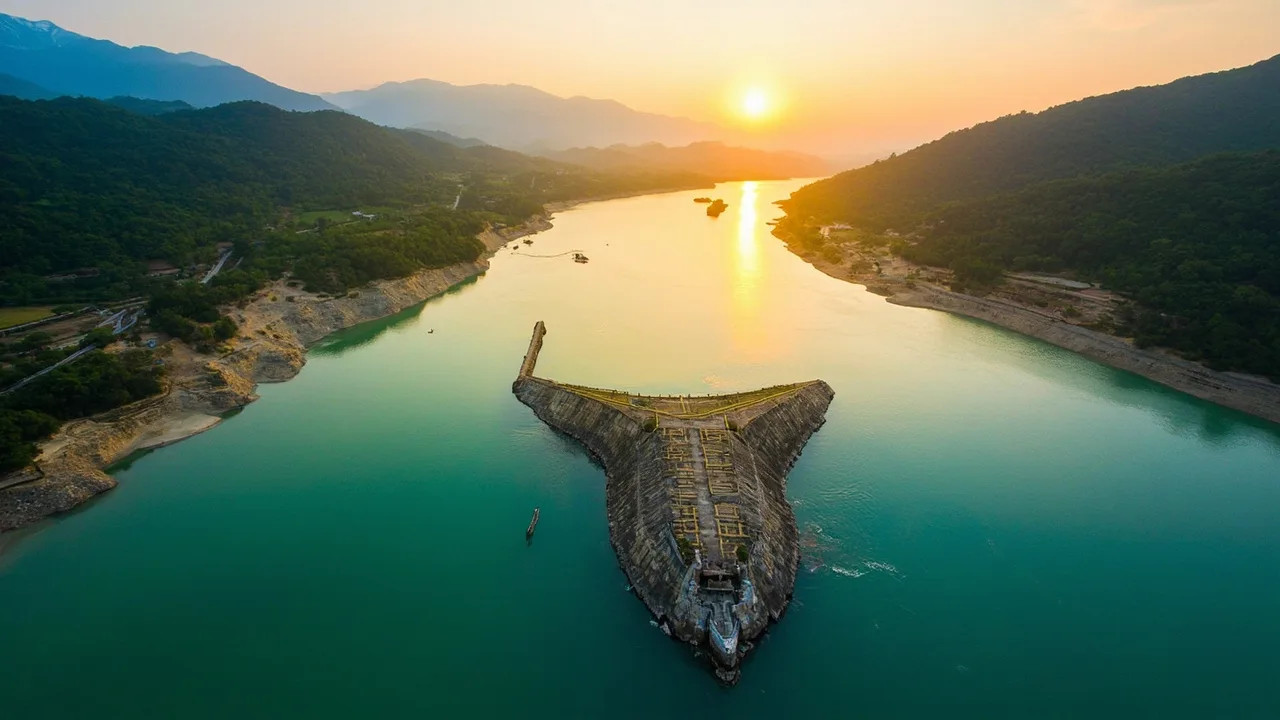
There is a particular kind of wonder reserved for things that simply keep working. A wall built two thousand years ago might still stand as a ruin, but a wall that still does what it was built to do — that is something else entirely. Stand on the stone walkway at Dujiangyan on any morning in autumn, and you will see the Min River (岷江) split around an earthen tongue, send roughly half its volume into a carved channel that fans out across a thousand square kilometers of farmland, and continue south to join the Yangtze. It has been doing this since 256 BC. The men who designed it left no screws, no cement, no metal fasteners. They left stones, sand, and a set of rules.
This is the Dujiangyan Irrigation System (都江堰), and it is the reason Sichuan is not a swamp.
The Flood Problem That Nearly Swallowed Sichuan
Before 256 BC, the Chengdu Plain was not the lush, rice-rich heartland it is today. It was a swamp. A wide, slow-draining marsh, regularly drowned by the Min River, which crashed down from the Min Mountains to the north in spring snowmelt surges and carved new channels through the plain whenever it pleased. Settlements sat on higher ground, hugging the foothills, because the flat land between the river and the surrounding mountains was unusable for most of the year. People farmed what they could on the edges. Malaria flourished in the standing water. The Sichuan basin was, in modern terms, an under-utilized piece of land that the rest of the Qin state badly needed.
The Qin state, which would soon become the first unified empire of China under Qin Shi Huang, had been pushing south and west for decades. By the late fourth century BC, Qin had absorbed the Shu kingdom based around present-day Chengdu and incorporated Sichuan into its sphere. The strategic value was enormous: Sichuan produced grain, timber, iron, and salt, and a Qin state that held Sichuan could outproduce any of its rivals. But there was a problem. The Min River kept flooding the very farmland Qin needed.
There is a saying that gets quoted in almost every Chinese textbook about Dujiangyan: 蜀郡多水患 — “the Shu commandery has many water disasters.” It sounds polite in classical Chinese, but the meaning is blunt. The river washed away villages. It killed people. It made agriculture unreliable. Each spring, as the snowmelt came down from the mountains, the plain would flood, then drain, then flood again. The local governors sent to govern Shu from the Qin court had a near-impossible job: hold the territory, increase output, and stop losing people to flood and disease.
Li Bing (李冰) was appointed governor of Shu in 256 BC. The historical record on him is thin — a few paragraphs in Sima Qian’s Records of the Grand Historian, a handful of later commentaries — but the practical record is enormous. What he built is still here.
Li Bing did not begin by building. He began, by all accounts, by walking the river. He and his son Li Erlang (李二郎) — the second is mostly legendary, but the local tradition insists on him — spent years observing the Min River’s behavior. Where did it flood? When? How much silt did it carry? How did the spring surge differ from the autumn low flow? They talked to local fishermen, to elderly farmers, to anyone who had watched the river for a lifetime. Then they made a decision that no other water engineer of the era would have considered. They decided not to dam the river.
That sounds like a small detail. It is not. Every other major water-control project of the ancient world — the Egyptian irrigation networks, the Mesopotamian canals, the Persian qanats — involved some form of barrier. Walls, berms, raised banks. The assumption was that to control water, you had to push against it. Li Bing’s insight was that the Min River carried too much silt and too much seasonal variation for a dam to last. Any dam would silt up within a decade and then burst catastrophically, taking villages with it. The only way to keep the river useful for thousands of years was to keep it moving.
The result was three structures that, taken together, do everything a dam does — minus the dam.
Li Bing’s Three-Part System: Yuzui, Feishayan, and Baopingkou
The first structure is called Yuzui (鱼嘴), the “fish mouth.” The name is literal. It is an earthen levee shaped like a fish’s mouth that juts into the Min River at a carefully chosen bend, splitting the flow into two channels. The inner channel, called the Neijiang (内江, “inner river”), is the one that carries water into the Chengdu plain. The outer channel, the Waijiang (外江, “outer river”), carries the bulk of the flood waters straight on down to the Yangtze. Because of a basic principle of fluid dynamics that the Qin engineers may have understood only empirically — when a river curves, faster water rides the outside of the bend and slower water hugs the inside — Yuzui automatically sends more water into the Neijiang during the dry winter months, when the plain needs irrigation, and automatically sends more down the Waijiang during the spring flood, when the plain needs protection. The fish mouth does this without moving. It has no gates. It has no operators. The geometry does the work.
The second structure is Feishayan (飞沙堰), the “flying sand weir.” This is a low spillway wall built across the Neijiang downstream of Yuzui. Its job is to get rid of silt. The weir is built to a precise height — high enough to keep irrigation water flowing into the plain during normal conditions, but low enough that during a flood, the rising Neijiang simply spills over it back into the Waijiang, taking the silt with it. The name “flying sand” comes from the fact that during floods, the overflow is so vigorous that stones and gravel literally fly across the weir. The river cleans itself. There are no dredging barges, no maintenance crews scraping mud. The silt leaves the way it came in.
The third structure is Baopingkou (宝瓶口), the “bottle neck.” This is the entrance to the irrigation canal that actually delivers water to the Chengdu plain. It is not a structure Li Bing built — it is a gap he carved. To make it, Li Bing’s workers had to cut through a small mountain called Lidui (离堆) using fire and water. They heated the rock with burning brush, then doused it with cold river water; the thermal shock cracked the stone. They hauled the chunks away. What was left was a narrow, steep-walled channel, narrow enough to throttle the flow of the Neijiang to a rate the downstream canal could handle, even during flood season. The “bottle neck” name refers to how the channel acts like the neck of a bottle, controlling how much water flows out of the river system into the irrigation network.
None of this is concrete-and-steel construction. The fish-mouth levee is built of stones packed into bamboo cages (竹笼). The cages are made on site from split bamboo — a material abundant in Sichuan — and filled with fist-sized river stones. They are heavy enough to stay put in the current and flexible enough to absorb the river’s force rather than shatter against it. When a cage wears out — and they do, every decade or so — workers simply weave another and stack it on top. The whole system can be repaired with materials that grow in the river valley. There is nothing to import.
The scale of the work in 256 BC is worth pausing on. Li Bing mobilized tens of thousands of workers — Chinese sources often cite the figure of 100,000, though this is probably exaggerated. He redirected the river. He cut through a mountain with fire and water. He built a levee that has been continuously maintained for 2,200 years. And he did it on a budget that allowed the rest of the Qin state to keep conquering its neighbors.
Why It Still Works After 2,200 Years
Most ancient irrigation systems died for one reason: silt. The Romans had brilliant aqueducts, but their irrigation channels silted up within decades and had to be rebuilt. Mesopotamian canals lasted centuries before they filled with sediment and were abandoned. Silt is the slow killer of water projects. What makes Dujiangyan extraordinary is that it has solved the silt problem more or less permanently — and the solution does not involve any moving parts.
The Feishayan weir does most of the silt work automatically, as described above. But every winter, since Li Bing’s time, maintenance crews have done something called suixiu (岁修), the annual dredging. In the late autumn, when the Min River drops to its lowest flow, workers cut channels to drain the inner river and the irrigation canal, then shovel out the silt and gravel that has accumulated over the year. The silt is not wasted. Some of it goes to repair the Yuzui levee. Some of it gets spread on fields as fertilizer. The dredged channels are then re-closed, and the river is allowed back in for another year of irrigation. The ritual is so old that the Shu Ji (蜀记, “Records of Shu”) from the Eastern Han period already describes it as an established practice.
What is remarkable about suixiu is that it is not just maintenance. It is also the mechanism that allows the system to adapt. Every year, the workers see how the river has shifted, where the silt is piling up, which channels are filling in. They adjust accordingly. The system gets a small yearly tune-up, the way a pianist tunes a piano before a concert. Most ancient structures were built and then left to the elements; Dujiangyan is rebuilt every winter, in subtle ways, by people who know it intimately.
Modern engineers have studied the site and have a number of theories about why it has lasted. The bamboo-cage construction absorbs shock rather than fighting it. The fish-mouth levee is positioned at a point where the river’s natural current actually pushes more material onto the structure, so it tends to self-reinforce. The system has been tweaked — there have been major reconstructions in 126 BC, in 800 CE, in 1375, in 1933, and after the 2008 Sichuan earthquake — but the underlying design is unchanged from Li Bing’s original. Even the 2008 Wenchuan earthquake, which devastated much of the region, did not destroy the system. Damage was repaired within months, and the system was running again by the end of that year.
There is one more detail that always strikes visitors. The fish mouth is so well-positioned that fish swimming upstream through the Min River pass through the gap and into the Neijiang. Every spring, the local fishermen count the fish that swim up through the irrigation channels — a tradition called yu hui (鱼会), the “fish gathering” — as a way of measuring the system’s health. When the fish come in good numbers, the year will be good. The irrigation system has, in this sense, a built-in ecological indicator. Modern ecologists studying river-system health have since adopted similar principles, but Li Bing’s engineers were doing it 2,200 years before anyone wrote the word “ecology.”
The Cultural Weight of Two Hundred Generations
Engineering alone does not explain why Dujiangyan still matters. The site has been a sacred place for as long as it has been a working system, and the two functions have reinforced each other across the centuries.
Walk up the hillside behind the fish-mouth levee and you reach Erwang Temple (二王庙), the “Temple of the Two Kings.” The “two kings” are Li Bing and his son Li Erlang. The temple was originally built in the Western Han period, shortly after Li Bing’s death, and has been rebuilt, expanded, and renamed many times since. The current structure dates mostly to the Qing Dynasty (17th–19th centuries), but the cult is older than the building. For more than two thousand years, local people have come here to pray to Li Bing not as a god but as the engineer who saved them. There are stelae carved with water-management regulations from the Tang and Song dynasties. There are poems by famous poets. There is a tablet that records the Yuzui regulations from 180 CE — Li Bing’s original operational rules for the fish mouth, almost word-for-word what modern hydrologists still recommend.
The temple complex also embodies an important piece of Chinese political theology. In Confucian thought, good rulers deserve veneration after death. In Daoist thought, particularly the Daoist traditions associated with nearby Mount Qingcheng (青城山) — one of the birthplaces of religious Daoism — engineering that works in harmony with nature is itself a form of spiritual practice. Li Bing was neither a Confucian bureaucrat who ignored the land nor a Daoist hermit who withdrew from it. He was both. He studied the river’s nature. He worked with its grain. And his successors, generation after generation, kept his work alive.
This made Dujiangyan politically useful as well as practically useful. When a new dynasty took over Sichuan, it had a strong incentive to demonstrate that it, too, would maintain Li Bing’s system. When a dynasty failed to maintain the dredging, droughts followed, and the dynasty’s legitimacy weakened. The suixiu ritual became a kind of annual test of whether the current regime was worth keeping. A government that did not maintain the irrigation was a government that did not deserve to govern Sichuan.
The cultural weight of Dujiangyan has only grown in modern times. In 2000, UNESCO inscribed both Dujiangyan and Mount Qingcheng as a joint World Heritage Site. The inscription describes Dujiangyan as “an outstanding example of ancient Chinese civil engineering… still in use.” The “still in use” phrase is what UNESCO rarely gets to write. Most World Heritage sites are preserved because they are too fragile to function. Dujiangyan is a heritage site because it has been doing its job for longer than most heritage sites have existed.
Modern comparisons tend to be unflattering to the modern side. The Three Gorges Dam, completed in 2006, is one of the largest engineering projects in human history. It generates electricity, controls floods on the Yangtze, and allows ocean-going ships to reach Chongqing. It is also a project of immense ecological cost, requiring the relocation of more than a million people and submerging dozens of towns and archaeological sites. Dujiangyan produces no electricity. It does not displace anyone. It asks no one to leave. Every winter the workers come out, do the dredging, and the water flows again. In an era of climate change, when aging concrete dams around the world are being decommissioned because their reservoirs silt up, a 2,200-year-old no-dam system looks less like an antique and more like a prophecy.
That is what stays with you at Dujiangyan. Not the engineering, exactly — though the engineering is impressive. It is the recognition that the people who built this were not trying to dominate a river. They were trying to listen to it. The fish-mouth levee is shaped to take advantage of a fluid dynamic principle. The flying sand weir is calibrated to a flood cycle. The bottle neck is carved to a specific flow rate. Every part of the system is in conversation with the river’s own behavior. Li Bing did not win against the Min River. He made an agreement with it. Two thousand years later, the river is still honoring the agreement.