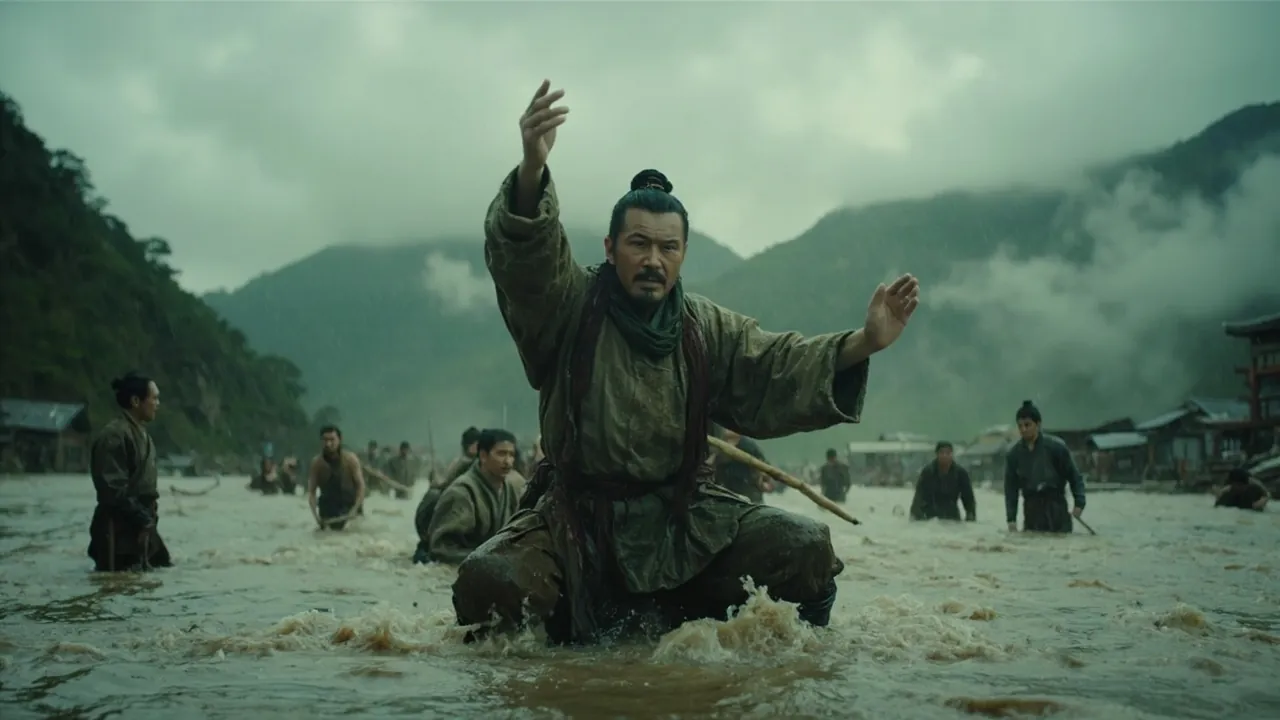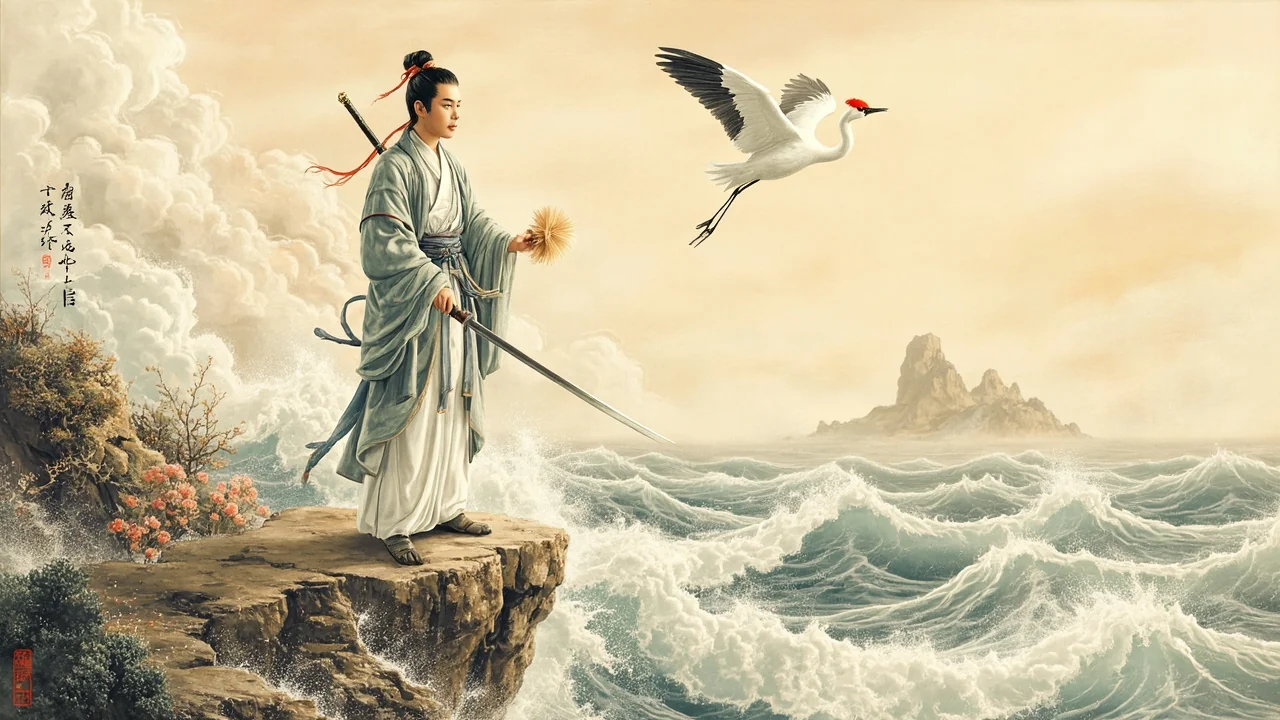
If you have ever seen a piece of Chinese porcelain with eight strange figures on it — a woman with a lotus flower, a scholar with a sword, an old man leaning on a crutch, a tipsy poet holding a ladle — you have already met the Eight Immortals (八仙, Baxian). They are among the most popular and enduring characters in all of Chinese mythology, appearing everywhere from temple carvings to movie posters to the decorations on a teacup your grandmother might have owned.
But here is what makes them unusual, even radical, in the context of Chinese mythology: they were all, without exception, ordinary mortals who became gods through their own effort. There are no divine bloodlines here, no emperors born with heavenly mandate. There is just a collection of outlaws, recluses, beggars, and misfits who broke every rule of society and somehow ended up immortalized in the celestial bureaucracy.
They are, in short, the most relatable team in Chinese mythology. And they have been delighting Chinese culture for over a thousand years.
Who Were the Eight Immortals?
The Eight Immortals are a group of eight figures from Chinese legend, each with their own distinct personality, backstory, and symbolic meaning. They do not form a family or a court — they are more like a supergroup, coming together occasionally to party and then going their separate ways. Their combined symbol is the “Baxian” or “Eight Immortals,” and they represent not just longevity but the diversity of paths to transcendence.
Zhong Kui (钟馗) is the demon queller, a fierce figure who was so ugly he was rejected by the imperial examination system, became enraged, and killed himself. He is depicted with a sword and a ferocious expression, and Chinese families hang his image on doors to ward off evil spirits. If you have ever seen a mask with a big bearded man scowling at you, that is probably Zhong Kui.
He Xiangu (何仙姑) is the only woman in the group. She was a young woman from Guangdong who refused marriage, lived on a diet of mother-of-pearl and cloud fluff, and gained the power to ride clouds. She carries a lotus flower and is associated with beauty, purity, and women’s health. In some versions she is He Xiangu’s twin sister; in others, she is an entirely separate goddess. The mythology has some flexibility here, which is part of its charm.
Iron Crutch Li (铁拐李) is the old beggar with the kind face, limping on a crutch and carrying a gourd that contains elixir of life. He is the patron saint of the disabled and the poor, and his symbol is the crutch itself — a reminder that even those who struggle to walk can achieve enlightenment.
Han Zhongli (汉钟离) is the rotund ex-general who failed at everything and found peace in failure. After losing a battle, he burned his military credentials and walked into the mountains, where he learned the secrets of immortality. He is always depicted with a fan that can revive the dead, which is a useful thing to have at parties.
Zhang Guolao (张果老) is the ancient old man who arrived in the world already old and has been getting older ever since. He rides a white donkey — sometimes backwards — and carries a bamboo tube that contains the scroll of longevity. He represents the Taoist principle that age itself is a kind of wisdom.
Cao Guojiu (曹国舅) is the former nobleman who gave up his wealth and position after his brother killed someone and Cao Guojiu felt responsible. He carries a pair of castanets and is the patron of actors and musicians. His story is the Taoist equivalent of a redemption arc.
Lan Caihe (蓝采和) is the androgynous wanderer who dressed in blue, wore one shoe, and sang drinking songs in the market. Their gender is ambiguous — some say Lan Caihe was a girl, some say a boy, some say something else entirely. They represent spontaneity and freedom from social convention. In modern parlance, Lan Caihe might identify as nonbinary, and Chinese audiences have been cool with that for centuries.
Lu Dongbin (吕洞宾) is the poet-swordsman who is the most famous of the Eight Immortals and probably the most written-about figure in Chinese fiction after the Monkey King. He failed the imperial exams, got drunk, met a strange teacher who turned out to be a Taoist immortal, and spent the rest of his existence wandering, drinking, composing poetry, and occasionally testing whether ordinary people were worthy of help. He is the heart and soul of the group — romantic, irascible, and deeply human.
The Symbolism: Why Eight?
The number eight (八, ba) is a homophone for “prosperity” or “wealth” (发, fa) in Chinese, which is why the Eight Immortals are such popular figures in business and home decorations. But the deeper symbolism goes further than luck.
In Taoist cosmology, the Eight Immortals each represent one of the eight trigrams of the I Ching (易经), the ancient divination text. Each Immortal corresponds to a different element, direction, and virtue. Together, they form a complete map of the cosmos — a kind of divine committee covering every possible human need, from health to wealth to protection from demons to artistic inspiration.
When all eight appear together, it is called the “complete manifestation” and is considered especially auspicious. You will see them depicted in wedding photos, on the walls of restaurants, in company logos, and on the gates of temples. They are everywhere because they represent something for everyone.
The Story of Crossing the Sea
One of the most beloved episodes in the mythology is “The Eight Immortals Cross the Sea” (八仙过海), a story that has become a Chinese idiom meaning a competition of talents or a display of individual prowess.
The story goes that the Eight Immortals were invited to a banquet at the Queen Mother of the West’s palace. Rather than walking or flying, each Immortal used their own unique method to cross the Eastern Sea. Zhong Kui rode his sword. He Xiangu floated on a lotus. Iron Crutch Li balancing on his crutch. Lu Dongbin carried his sword across the water. Han Zhongli drifted on his fan. Zhang Guolao let his donkey walk on the waves. Lan Caihe stepped on a flower basket. Cao Guojiu balanced on his castanets.
The Dragon King of the Eastern Sea was furious — how dare they cross his territory without permission. Chaos ensued, a battle broke out, and eventually the Immortals won, but the story is really about the joy of diverse abilities expressed freely. Each Immortal crossed the sea in their own way, and each way was valid. That is the Taoist message: there are many paths to the same destination.
How the Eight Immortals Entered Chinese Culture
The Eight Immortals were not always a group. In early Taoist texts from the Tang and Song dynasties, they appear individually or in smaller combinations. The standardized list of eight was probably fixed by the Yuan dynasty (13th-14th century), when Taoist priests and popular storytellers began assembling them into a team.
The Yuan period was when Chinese vernacular literature really took off — the form of fiction and drama that ordinary people could read and perform, as opposed to the classical literary traditions of the educated elite. The Eight Immortals were perfect material for this: colorful characters with dramatic backstories, visually distinctive, and morally ambiguous enough to be interesting. Plays about the Immortals became staples of the Chinese stage, and the group took on its familiar shape.
By the Ming dynasty (14th-17th century), the Eight Immortals had become one of the most reproduced subjects in Chinese visual art. They appeared in murals, woodblock prints, lacquerware, jade carvings, and porcelain — particularly the blue-and-white porcelain that China exported to the world. When European collectors first encountered Chinese porcelain in the 16th and 17th centuries, the Eight Immortals were often among the figures depicted on it. They were, in a sense, China’s first global brand.
The Eight Immortals and Taoism
It is important to understand what the Eight Immortals represent in the broader context of Chinese religion and philosophy, because they are not simply fairy tale characters. They are Taoist saints.
Taoism, one of the two great indigenous philosophical-religious traditions of China (alongside Confucianism), teaches that the path to enlightenment — or immortality — is found through living in harmony with the Tao (道), the fundamental principle of the universe. Taoist practitioners sought immortality through internal alchemy, breathing exercises, sexual cultivation, and the consumption of elixirs. Many of the Eight Immortals are said to have achieved their powers through these practices.
But the Immortals also represent a subversive, popular strand of Taoism — not the institutional, priestly Taoism of temples and rituals, but the Taoism of hermits, wandering healers, and people who dropped out of mainstream society. Lu Dongbin is the most famous example: he studied for the imperial exams, failed, got angry and depressed, and then found a teacher who showed him a different path. His story speaks directly to anyone who has ever felt like a failure by society’s standards and wondered if there might be another way.
This is why the Eight Immortals have always been associated with outsiders. In folk tradition, they are the patrons of tea houses, actors, musicians, doctors, and anyone whose trade falls outside the respectable mainstream. They do not judge. They do not demand conformity. They simply show up, with their strange powers and stranger habits, and offer the possibility of transformation.
Where to See the Eight Immortals Today
If you want to encounter the Eight Immortals in the real world, the good news is that you do not have to go far. They are everywhere in Chinese material culture.
In Beijing, the Summer Palace has a famous “Eight Immortals Pavilion” (八仙亭) in the Kunming Lake area. In Chengde, the Mountain Resort contains a temple dedicated to the Eight Immortals. Many Taoist temples across China have murals or carvings depicting the Immortals’ various adventures.
For the most dramatic visual experience, visit the Yongle Palace (永乐宫) in Shanxi province, which contains one of the finest surviving sets of Yuan dynasty murals depicting the Eight Immortals in vivid colors. The paintings are over 600 years old and still remarkable — each Immortal rendered with personality and wit, not the stiff formality you might expect from religious art.
In Taiwan and Hong Kong, the cult of the Eight Immortals remains active. There are temples dedicated to individual Immortals, particularly Zhong Kui and Lu Dongbin, where worshippers pray for protection, academic success, or artistic inspiration. The tradition is very much alive.
Cultural Comparisons for American Readers
If you are an American trying to understand the Eight Immortals, a useful comparison might be the Greek gods — those powerful, capricious, deeply human figures who nonetheless had divine powers and governed different aspects of the world. But there is an important difference: the Greek gods were born divine, while the Eight Immortals earned their divinity through their own efforts.
Another useful comparison might be the American folk heroes — Paul Bunyan, Pecos Bill, John Henry. These are figures who represent idealized qualities of the common person, told and retold until they become part of the cultural furniture. The Eight Immortals serve a similar function in Chinese culture: they are the common person’s pantheon, accessible and relatable in a way that the formal gods of the imperial court never were.
The Eight Immortals also have something in common with the X-Men, if you want to think about it in contemporary pop culture terms: a diverse group of individuals with extraordinary powers, each with their own personality and origin story, occasionally coming together for a common cause. The parallel is not perfect, but it gives you a sense of why the mythology has such enduring appeal — it is a story about misfits becoming heroes.
Conclusion
The Eight Immortals are more than a set of eight characters on a piece of decorative porcelain. They represent a philosophy, a tradition of popular religion, and a vision of human potential that has resonated in China for over a thousand years. Their appeal is simple and profound: anyone can become immortal. It does not matter who you are, where you come from, or how society judges you. There is a path forward, and it does not require you to be born special. It only requires that you keep walking.
So the next time you see a teacup with eight strange figures on it, take a moment to look closer. You might be looking at Zhong Kui scowling at demons, or Lu Dongbin composing poetry, or Lan Caihe singing a drinking song. Each one of them was once an ordinary person who found something extraordinary within themselves. And that, in the end, is a message that still travels well across a thousand years and five thousand miles.
Related Articles
If you enjoyed the Eight Immortals, you might also like our articles on Taoist Philosophy and Chinese Folk Religion, which explore the spiritual traditions that gave rise to the Immortals. For visual art lovers, our piece on Chinese Mythology in Art covers how figures like the Immortals became enduring subjects of Chinese painting and sculpture.