Erlang Shen: The Three-Eyed God Who Rebelled Against Heaven
The Boy Who Was Twice Born
In the mountains of Sichuan, long before the Han Dynasty rose to power, there lived a boy named Liu Yuer. His mother was a mortal woman, but his father — this is where the story gets complicated — was the dragon king of the Qingjiang River. Not exactly the kind of lineage that makes for an easy childhood.
When Liu Yuer was just seven years old, his mother took him to visit his grandfather at the river. The old dragon, seeing the boy for the first time, was furious. A half-dragon child? An abomination! He unleashed a flood to drown them both. Liu Yuer’s mother perished, but the boy survived — saved by a Buddhist monk named Guangchengzi, who raised him in the mountains and taught him the martial arts.
Years later, when Liu Yuer had grown into a powerful warrior, he confronted his grandfather and defeated him in combat. The dragon king, humiliated, complained to the Jade Emperor in heaven. And so began the most consequential battle of Liu Yuer’s life — not against a river dragon, but against the forces of heaven itself.
The story of Erlang Shen is one of the most beloved in Chinese mythology. He’s the god of determination, of fighting against unfair odds, and of loyalty to one’s chosen path — even when that path leads to war with the divine order itself.
The Warrior Who Challenged the Jade Emperor
In Chinese mythology, the universe is organized in layers. At the top sits the Jade Emperor, ruler of the heavens, with a vast bureaucracy of gods managing everything from the weather to the harvest to human destiny. Below heaven is the mortal realm, and below that, the underworld. The system is orderly, hierarchical, and largely inflexible.
Erlang Shen — whose name literally means “Second Lord” — was born into this system with every disadvantage. His mixed blood made him an outsider. His extraordinary strength made him a threat. And his stubborn sense of justice made him impossible to control.
After defeating his grandfather, Liu Yuer caught the attention of the celestial court. The Jade Emperor, wary of this powerful half-dragon youth, offered him a position among the gods. It was both an honor and a trap — accept, and you’d be bound by heavenly law; refuse, and you’d be marked as a rebel.
Liu Yuer refused. And so the heavens sent their armies against him.
What followed was one of the most dramatic battles in Chinese mythology. Erlang Shen was a master of seventy-two transformations — he could become any creature, any object, any element. He could shrink to the size of an insect or grow to touch the clouds. Against the heavenly hosts, he fought with a spear called the “Pointed Star Pole” and a sword that gleamed like the sun.
The celestial armies fell before him, one after another. Not because they were weak, but because Erlang Shen was something the heavens had never quite faced before: a warrior who combined mortal determination with supernatural power, and who refused to accept a verdict he considered unjust.
In the end, it took the combined forces of the Three Pure Ones — the highest deities in the Taoist pantheon — to finally subdue him. Even then, they couldn’t kill him. His power was simply too great. Instead, they made him an offer: serve the heavens, and serve with honor. He accepted, but on his own terms.
The Deflector of Floods and Protector of the Innocent
Today, if you visit the famous ER-lang Temple in Chengdu, you’ll see worshippers from all walks of life. Farmers pray for protection against floods. Merchants ask for success in difficult negotiations. And ordinary people come to ask for courage when facing seemingly impossible challenges.
The worship of Erlang Shen spread throughout China over centuries, but it’s especially strong in Sichuan — his home province, the place where he was born, where he fought the dragon, and where he made his stand against heaven. The Sichuanese, known throughout China for their stubbornness and their spicy courage, see in Erlang Shen a reflection of their own spirit.
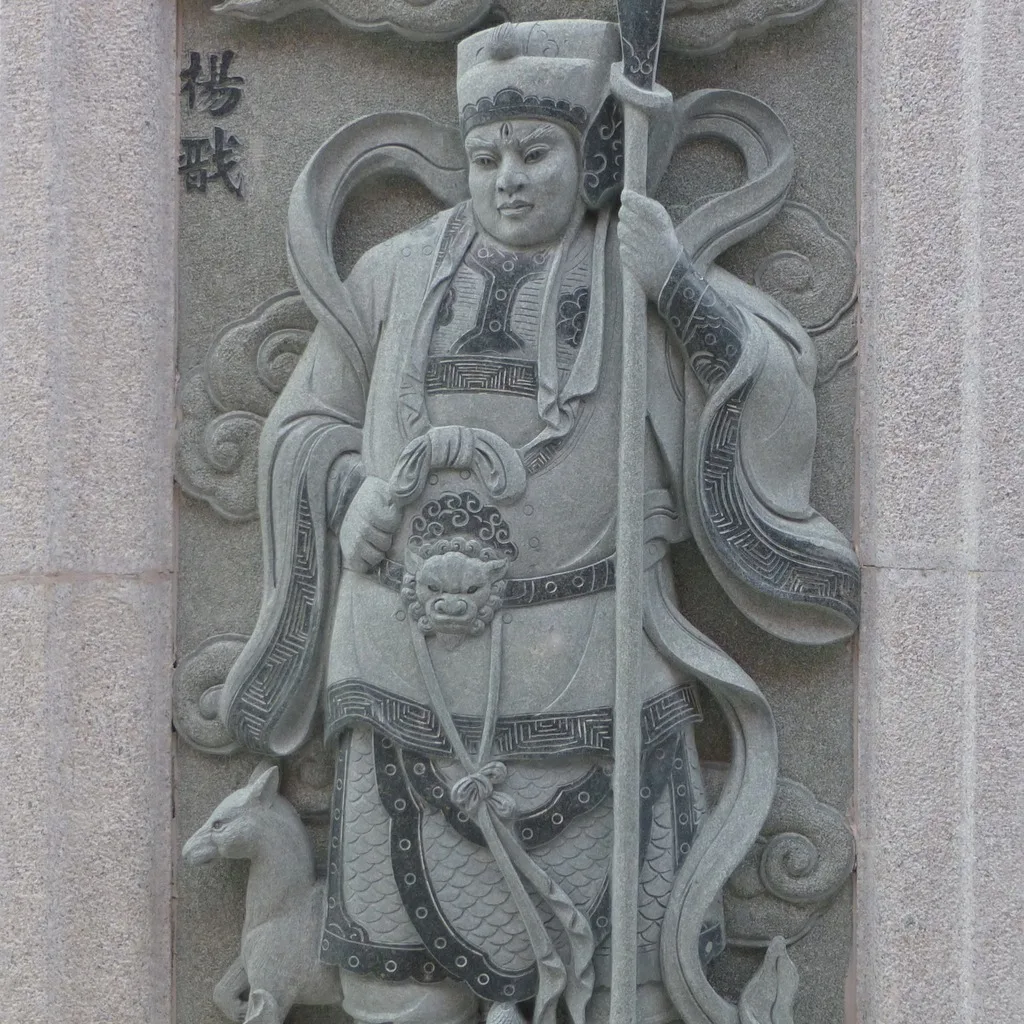
The god’s iconography tells his story. He typically appears as a warrior in golden armor, often riding a black horse or a divine mule. His most distinctive feature is a third eye in the center of his forehead — the “heavenly eye” that can see through any deception, any illusion, any lie. This eye is both a weapon and a symbol: Erlang Shen sees things as they truly are, even when powerful forces want him to see something else.
He also carries a weapon called the “three-edged sword” and wears a cap shaped like a crow’s wings. His loyal companion is a dog — often depicted at his feet in temple statues. Together, they represent the unbreakable bond between a warrior and his sworn companion.
How Americans Can Understand This Myth
Think of Erlang Shen as the Chinese answer to the American myth of the individual who takes on the entire system — and wins. He’s like the characters in the old cowboy movies who ride into town knowing they’re outgunned, but they ride in anyway because it’s the right thing to do.
Or consider the story of Prometheus, the Greek Titan who stole fire from the gods and gave it to humanity. Like Prometheus, Erlang Shen challenges divine authority when he believes that authority is unjust. Both figures represent the same human instinct: the refusal to accept a ruling that violates one’s conscience, even when that ruling comes from the most powerful forces in the universe.
The difference is in the outcome. Prometheus was punished — eternally bound to a rock where an eagle ate his liver every day. Erlang Shen won a kind of victory: he earned respect, earned a place in the celestial order, but kept his independence and his sense of justice intact. In that way, his story is more hopeful than the Greek myth. It suggests that standing up to power can work, that the system can be challenged and changed.
The Third Eye and the Power of Seeing Truth
In Chinese Buddhist and Taoist tradition, the “third eye” is a symbol found across many deities and enlightened beings. It represents insight beyond ordinary sight — the ability to perceive the true nature of reality, unclouded by emotion, bias, or illusion.
Erlang Shen’s third eye is particularly associated with his role as a judge and protector. He sees through false accusations. He sees through magical illusions. He sees through the comfortable lies that powerful institutions tell themselves to justify their actions. This is what makes him the patron deity of those who seek justice against powerful opponents.
For Americans, there’s a modern parallel in the idea of “speaking truth to power” — the civil disobedience tradition from the abolitionists to the civil rights movement. Erlang Shen embodies that spirit, but with a distinctly Chinese flavor: he’s not interested in tearing down the system entirely, but in making it live up to its own stated ideals.
In his mythology, the heavens are not evil. The Jade Emperor is not a tyrant. The system has rules, and those rules can be good — but only if powerful beings are willing to enforce them fairly. Erlang Shen’s rebellion is ultimately a rebellion in service of the system’s own principles, not against them.
Visiting Erlang Shen Today
If you’re ever in Chengdu, the ER-lang Temple (二王庙) is well worth a visit. It’s located on the slopes of Xiling Mountain, overlooking the Min River — the same river where young Liu Yuer nearly drowned as a child. The temple has been rebuilt many times over the centuries, but it’s been a place of worship for Erlang Shen since at least the third century CE.
What strikes visitors most is the atmosphere. Unlike the grand imperial temples of Beijing, Erlang Shen’s shrine feels personal. The god’s image is approachable, almost familiar. And the worshippers who come here — farmers, workers, businesspeople — don’t look like they’re praying to a distant cosmic authority. They look like they’re asking a friend for help.
There’s also a rich tradition of opera and folk art devoted to Erlang Shen’s story. The “Investiture of the Gods” — a classic Chinese novel that dramatizes the battle between the Zhou Dynasty rebels and the Shang Dynasty (with heavy involvement from gods and monsters) — features Erlang Shen as one of its central heroes. If you want to experience the mythology in dramatic form, seek out performances of this story during Chinese opera season.
Why This Story Matters
The myth of Erlang Shen endures because it speaks to something universal: the feeling that the system is rigged, that powerful forces don’t play fair, and that an individual with enough courage can make a difference. Every culture has its version of this story — the hero who fights uphill battles, who refuses to be intimidated, who wins through a combination of skill, determination, and stubborn refusal to quit.
But Erlang Shen is particularly Chinese in his complexity. He’s not a simple rebel. He’s a warrior who chooses to serve, but on terms he can live with. He’s powerful enough to destroy his enemies, but he uses that power selectively. He’s half-divine, half-mortal, which means he understands both the perspective of heaven and the perspective of earth.
In a sense, he’s the mythological embodiment of what the Chinese call “ren” — the quality of being fully human, with all the messiness and moral complexity that entails. The gods of Olympus were beautiful and terrible, but they were also petty and self-interested. The gods of the Hindu pantheon are vast and cosmic, but often distant from human concerns.
Erlang Shen is different. He gets angry. He makes mistakes. He fights battles he might have avoided. But at the end of the day, he uses his power to protect the innocent and challenge injustice. In that, he offers a model that regular people can aspire to — not perfection, but commitment.
The Legacy of the Three-Eyed God
Today, Erlang Shen is one of the most widely worshipped deities in the Chinese folk religion tradition. His temples can be found not just in Sichuan but throughout China, and his influence extends into Buddhism, Taoism, and popular folk culture alike.
He’s invoked by athletes before competitions, by students before exams, and by anyone facing a struggle against a more powerful opponent. His third eye has become a symbol of insight and clarity in Chinese art and iconography. And his story continues to inspire new adaptations — in novels, in video games, in films, and in the living tradition of Chinese opera.
The next time you encounter a character in a Chinese story who has an eye in the middle of their forehead, or who fights against impossible odds with courage and cleverness, you’re seeing the legacy of Erlang Shen. He’s the god who looked at the heavens, saw injustice, and decided to do something about it — even if it meant going to war.
That, in any culture, is a story worth telling.