Type “phoenix” into an image search and you will get flames. A huge eaglelike bird rises from a burning nest, wings made of sparks, reborn after death. Then search for fenghuang, and the same fire may follow, pasted onto a creature from a very different tradition.
The shortcut is understandable. English speakers need a familiar word for a magnificent mythical bird, and “phoenix” is close enough to be useful. It is also far enough away to create confusion. The Chinese fenghuang does not normally die in fire, turn to ash, and regenerate. Its central story is not resurrection. It appears when the world is peaceful and properly ordered, and it embodies virtue, harmony, beauty, and auspicious rule.
That distinction changes the creature’s emotional center. The Western phoenix offers hope after catastrophe: destruction is not the end. The fenghuang offers a sign of conditions brought into balance: virtue makes beauty possible. One emerges from death. The other arrives for peace.
Of course, neither tradition is frozen. The Greek, Roman, Egyptian, Jewish, Christian, Islamic, Persian, and modern fantasy “phoenix” is itself a family of related birds, not one unchanging myth. Chinese accounts of the fenghuang also developed across centuries. Comparing them works best when we resist turning either side into a cartoon.
Meeting the Fenghuang in Ancient China
The name joins two words, feng and huang. Some early sources and later explanations identify feng as male and huang as female. Over time, fenghuang came to name a single sovereign bird and was increasingly treated as feminine, especially when paired with the masculine imperial dragon. This is one reason simple definitions can contradict one another: they may describe different periods.
Bird imagery reaches deep into ancient Chinese material culture. Neolithic objects, Shang and Zhou bronzes, jades, and lacquerware display powerful birds whose exact identities are debated. The character and concept translated as fenghuang developed within this wider world of bird spirits, clan emblems, ritual animals, and celestial omens.
The Classic of Mountains and Seas, a remarkable collection of geography, myth, strange creatures, and ritual knowledge compiled over centuries, describes a multicolored bird associated with virtue. Characters or patterns on parts of its body correspond to moral qualities such as benevolence, righteousness, ritual propriety, wisdom, and trustworthiness. The bird eats and drinks in a measured way, sings and dances, and brings peace when it appears.
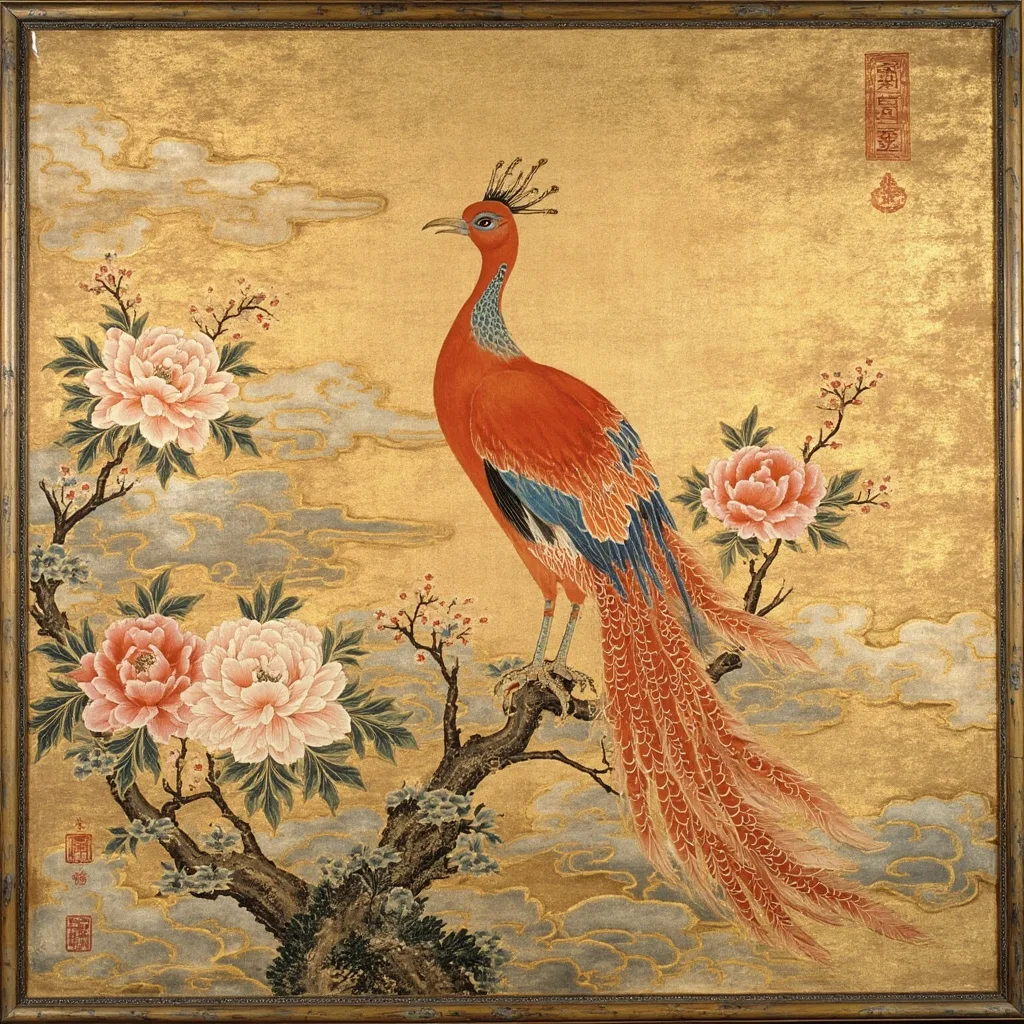
Other texts describe a body assembled from admired creatures: a goose-like front, a deer-like rear, a snake’s neck, a fish’s tail, a fowl’s beak, a swallow’s jaw, and a rooster’s crest. Lists vary. Like the Chinese dragon, the fenghuang is composite. Artists rarely treat such inventories as mandatory construction manuals. They create a recognizably splendid bird using pheasant, peacock, mandarin duck, crane, and rooster features.
Its feathers may display the five colors—traditionally blue-green, red, yellow, white, and black—corresponding to a cosmological system of directions and phases. Modern art often turns the bird into a rainbow. Historical works may be more restrained, using elegant line, gilding, carved silhouettes, or limited ceramic pigments.
The fenghuang is said to roost in the wutong, often identified as the Chinese parasol or paulownia tree, and to eat bamboo seeds. It does not settle casually among ordinary birds. This selectiveness reinforces its status. A ruler cannot simply order a fenghuang to appear. The realm must deserve the omen.
Confucius was later associated with the bird through sayings about its absence in a disordered age. When good government fails, the auspicious creature stays away. That gives the fenghuang a quiet political power. Its nonappearance can condemn the present as effectively as its arrival praises it.
The bird also belongs to music. Its calls were said to correspond with the tones, and male and female phoenixes could sing in harmony. Stories of the music master Ling Lun connect his pitch pipes with phoenix calls. In a tradition where proper music reflects social and cosmic order, the fenghuang is not only beautiful to see. It sounds like the world tuned correctly.
Fenghuang and Western Phoenix: A Careful Comparison
The word phoenix comes through Greek tradition. Classical authors described a rare, long-lived bird associated with Arabia or Egypt and with the sun. Accounts differ on its death and renewal. In influential later versions, it builds a fragrant nest, dies or burns, and a new phoenix emerges. Christian writers adopted it as an image of resurrection, while medieval bestiaries and modern fantasy amplified its fiery character.
The fenghuang’s mythology does not center on this cycle. It may be extremely long-lived or supernatural, but it is not famous for self-cremation. Its primary associations are auspicious government, moral virtue, cosmic harmony, marital balance, imperial femininity, and exceptional talent.
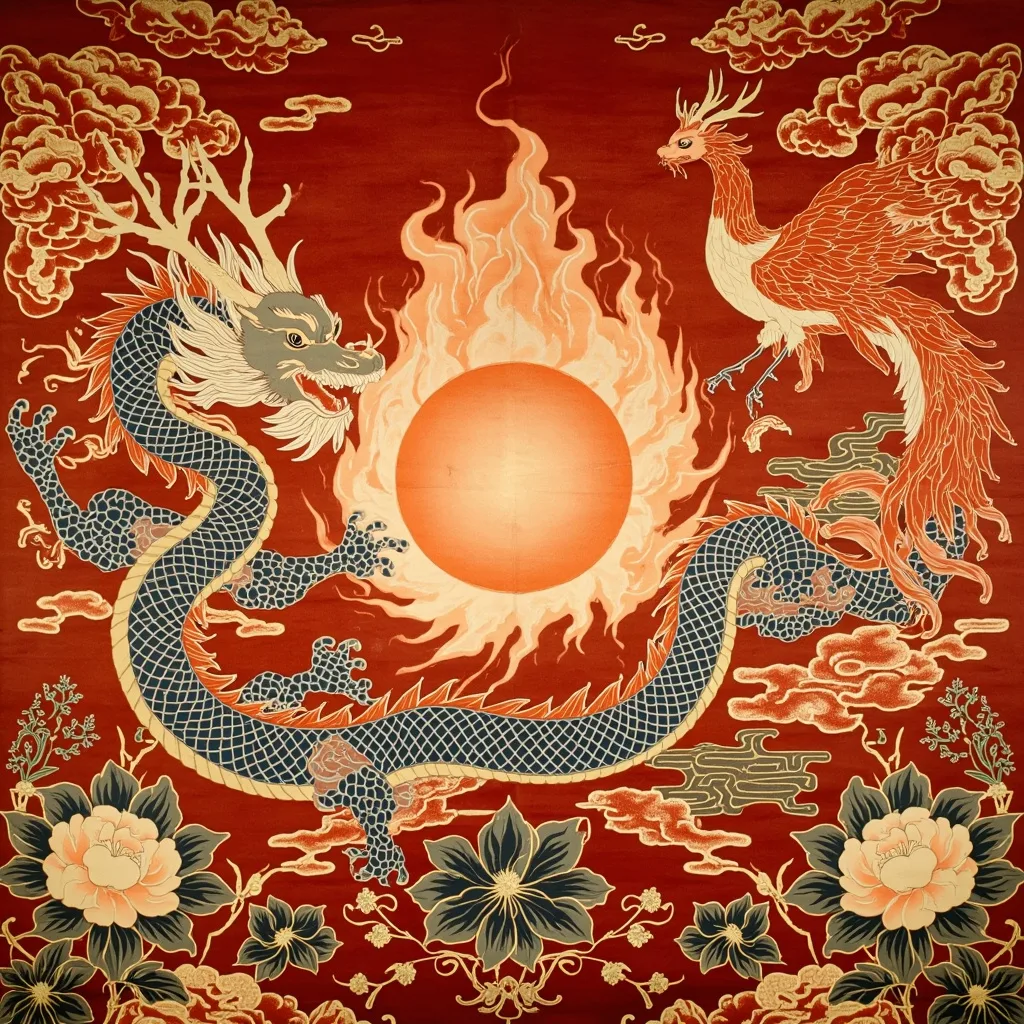
The two birds also look different. The modern Western phoenix is often raptor-shaped, with an eagle’s head and broad wings blazing orange or red. The fenghuang usually has a small pheasant-like or rooster-like head, a long neck, graceful body, and streaming tail feathers. It may carry many colors rather than a fire palette. Clouds, peonies, paulownia, bamboo, sun disks, and dragons surround it more often than burning nests.
Yet translation creates feedback. Once Chinese artists and global audiences routinely call the fenghuang a phoenix, fiery imagery can migrate into new Chinese-inspired designs. Video games, tattoos, animation, and fantasy novels blend traditions freely. A modern “Chinese phoenix” may rise from flames because creators know both visual languages. Cultural accuracy depends on whether the work claims to portray a classical motif or intentionally invents a hybrid.
There are genuine points of contact. Both are rare, majestic birds. Both can be linked to the sun, royalty, long life, transformation, and ideal order. Both become symbols of hope. Similarities explain why the translation took hold; differences explain why a note is needed.
A second source of confusion is the vermilion bird, Zhuque, one of the Four Symbols of Chinese astronomy. It guards the south, corresponds with fire and summer, and appears as a red bird. Zhuque is often labeled a phoenix in English, but it is not simply another name for fenghuang. The fenghuang is the sovereign auspicious bird; Zhuque is a directional celestial guardian within a specific cosmological set with the Azure Dragon, White Tiger, and Black Tortoise.
When evaluating an artwork, ask what clues dominate. Is there a southern directional set? It may be Zhuque. Is the bird paired with a dragon on wedding decor? It is almost certainly fenghuang. Is it burning and regenerating? The work probably draws from Western phoenix tradition or modern fusion.
No culture owns the right to imagine a marvelous bird. The goal is not to police every fantasy illustration. It is to see what each tradition contributes. Calling every splendid bird “basically a phoenix” erases history; refusing any comparison misses the creative work translation has always done.
Empresses, Weddings, and the Feminine Turn
The fenghuang was not originally a female-only emblem. Early yin-yang pairing could divide feng and huang into male and female birds, and the combined creature represented a totality. As imperial symbolism developed, however, the dragon increasingly represented the emperor and the fenghuang the empress.
Court dress made that pairing visible. Phoenix motifs decorated empresses’ robes, crowns, furnishings, and ceremonial objects. The famous fengguan, or phoenix crown, could be an extraordinarily elaborate headdress with metal phoenixes, kingfisher-feather ornament, pearls, gems, and dangling bead strings. Rank and occasion governed details. Surviving Ming examples give a sense of both technical virtuosity and physical weight.
The association with the empress encouraged a broader feminine reading. Fenghuang images came to praise a bride’s beauty, virtue, and dignity. In wedding decoration, the bird meets the dragon as one half of an auspicious marriage. The phrase “dragon and phoenix bring harmony” appears on textiles, ceramics, paper cuts, jewelry, banquet backdrops, and bedding.
Peonies frequently accompany the bird. Because the peony signifies wealth, honor, and luxuriant beauty, “phoenix among peonies” becomes an image of splendor. On an embroidered panel, every feather and petal can display the maker’s skill. The object performs prosperity materially: expensive silk and patient labor embody the abundance they depict.
Gender should not become a trap, though. A fenghuang can symbolize an outstanding man or woman. It can signify imperial authority without reference to marriage. In names and compliments, it may suggest rare talent. Older paired-bird concepts and modern reinterpretations coexist with the empress-bride convention.
For contemporary weddings, this flexibility is useful. Couples may value the traditional design while reshaping its gender assumptions. Two brides, two grooms, or partners who dislike fixed roles can read dragon and fenghuang as complementary energies rather than anatomical labels. Others use two phoenixes. Cultural traditions are not museum cases; living communities negotiate them.
The motif also traveled beyond China. Japanese hō-ō, Korean bonghwang, and Vietnamese phượng hoàng developed from shared East Asian traditions while acquiring local forms and meanings. The phoenix atop Kyoto’s Byōdō-in, the Korean presidential emblem’s historical associations, and Vietnamese imperial decoration should not be treated as merely Chinese objects abroad. Influence does not erase adaptation.
One of the most rewarding things about phoenix imagery is watching it cross materials. Cast in bronze, the bird feels solemn. Painted on lacquer, it moves across a glossy supernatural space. Woven in silk, its tail dissolves into clouds. Painted on export porcelain, it travels into European dining rooms, where buyers may have called it a “flying bird” without knowing its moral biography.
The Fenghuang in Stories, Religion, and Art
Unlike a modern superhero, the fenghuang has no single definitive life story. It appears across myths, omen records, poetry, religious imagery, decorative programs, and local legends. Its role changes according to the company it keeps.
In some traditions, phoenixes attend the Queen Mother of the West, Xiwangmu, a powerful goddess associated with immortality, sacred mountains, and a celestial court. In Daoist visual culture, elegant birds help mark her realm as otherworldly. They may pull chariots or gather near immortal beings.
The fenghuang also appears in Buddhist art after Buddhism entered China. Artists adapted familiar auspicious creatures to decorate sacred spaces and objects. This does not make the bird a specifically Buddhist invention. Chinese religions share visual vocabularies; dragons, lotuses, clouds, lions, and heavenly musicians move among contexts.
Literature uses the bird as a metaphor for the gifted person. A phoenix among common birds is someone whose ability or character exceeds the ordinary. The expression can flatter a scholar, official, child, or couple. Because the bird appears only in a worthy age, it may also represent talent waiting for recognition.
Art historians read fenghuang images through period and medium. On a Han dynasty relief, a bird may belong to an immortal paradise. On a Tang mirror, paired birds may participate in cosmopolitan ornament. On a Ming imperial robe, rank and court ritual matter. On a nineteenth-century export textile, workshops may adjust composition for foreign buyers. Iconography is a grammar, and objects are sentences written in historical situations.
Museums sometimes label a creature simply “phoenix,” which is concise but not always clear. Look for the term fenghuang in the extended description. Pay attention to date and provenance. If you see flames, do not assume the curator made an error; the object may represent a different bird, a syncretic tradition, or a modern reinterpretation.
For tattoo designs, cultural literacy is especially valuable because the image becomes personal and permanent. Decide which mythology you mean. If you want rebirth after trauma, a flame-born phoenix communicates that powerfully. If you want virtue, harmony, and a flourishing realm, consider a classical fenghuang with five-colored plumage, clouds, paulownia, or peonies. If you want both, acknowledge the fusion instead of calling it timeless tradition.
Avoid random Chinese characters added for atmosphere. Characters copied from online images may be backward, nonsensical, or unrelated. A strong fenghuang image needs no text at all. If text is included, consult a skilled reader and calligrapher rather than trusting a decorative font.
Why This Bird Still Matters
The fenghuang proposes that beauty and ethics belong together. Its gorgeous feathers are not mere vanity. They externalize moral qualities. Its song is beautiful because it is harmonious; its appearance is marvelous because society has become peaceful enough to welcome it.
That ideal can feel remote in an age of endless alerts and public distrust. Perhaps that is why the bird remains useful. It asks us to imagine splendor as evidence of care rather than domination. A ruler worthy of the fenghuang does not capture it. Good order invites it.
The creature also demonstrates how translation shapes perception. “Chinese phoenix” gave English speakers an accessible bridge, but bridges influence what crosses them. Flames attached themselves to a bird once known mainly for virtue and harmony. Learning the name fenghuang restores detail without requiring us to abandon the familiar word completely.
Next time you see a long-tailed bird on a Chinese wedding invitation or porcelain dish, pause before looking for ashes. Notice the peony, cloud, dragon, sun, or tree. Ask what kind of world the bird inhabits. The fenghuang’s great miracle is not survival after burning. It is the arrival of grace when the world is ready.
Continue Exploring Chinese Culture
See how the bird joins its most famous partner in Dragon and Phoenix Symbolism. For a human founder whose appearance also signals ordered civilization, read Huangdi, the Yellow Emperor. Ming Blue-and-White Porcelain traces how Chinese motifs crossed oceans and entered foreign homes. And Li Bai, China’s Poetry Immortal offers moonlight, wine, and celestial imagination from the Tang era in which phoenix imagery flourished.