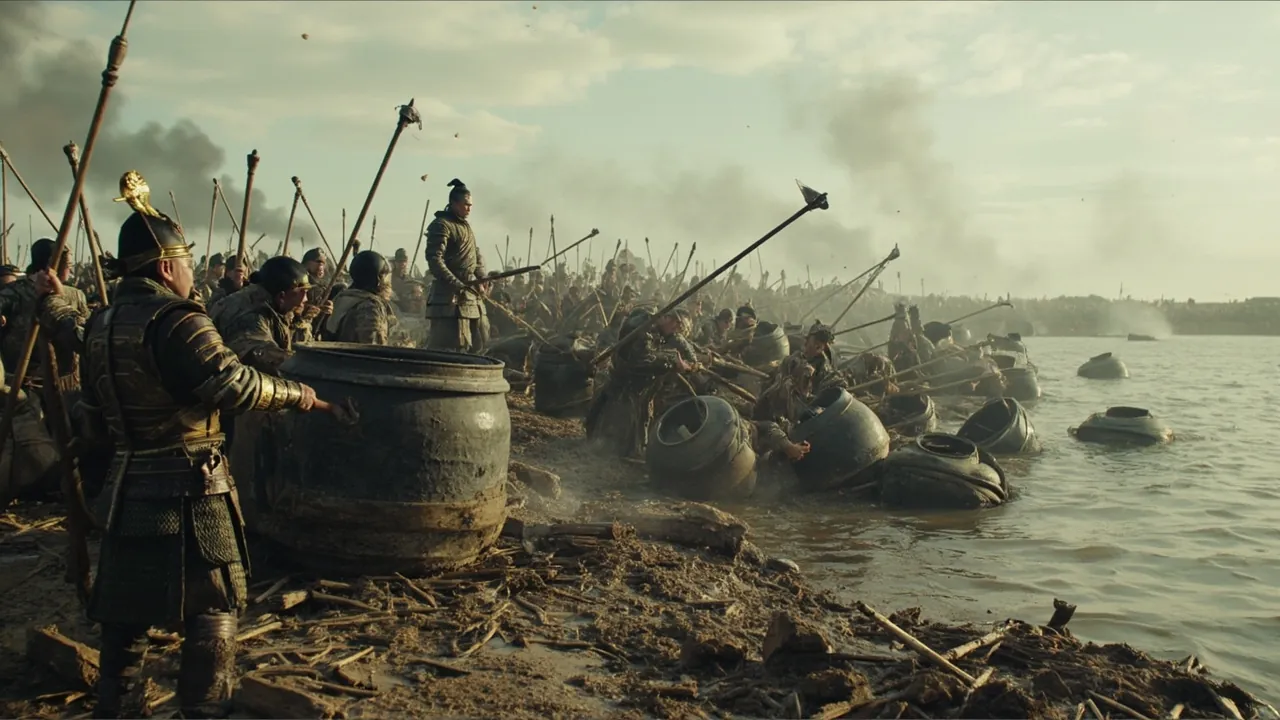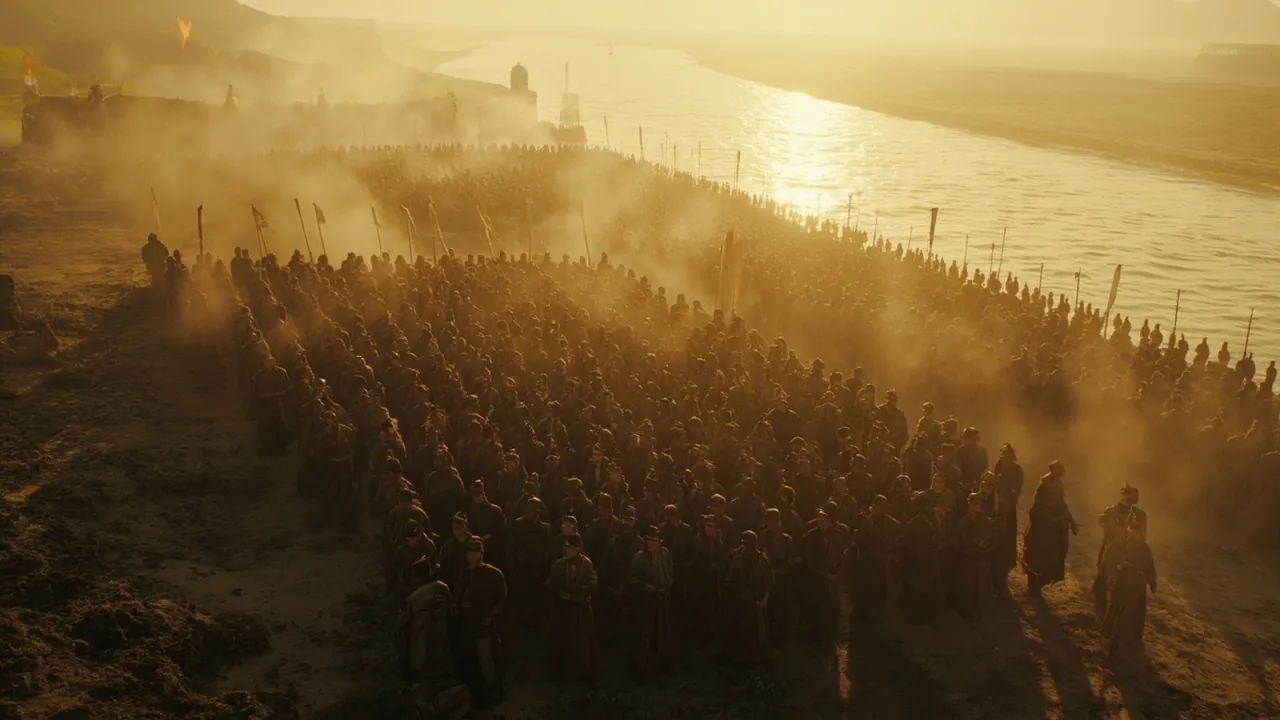
In 204 BC, a general named Han Xin lined his troops up on the banks of the Wei River and prepared to fight an army at least three times larger than his own. His officers watched nervously as he positioned his men with their backs to the water. There was no river crossing behind them. There was no retreat path. There was only the river, the enemy in front, and the absolute certainty that they would fight here or die here.
Then Han Xin ordered his front line to advance into the enemy.
His officers panicked. You don’t advance into a larger force when you’re already in an indefensible position. You hold the high ground, you use the river as a natural barrier, you do anything except advance toward an army that’s already positioned to crush you. Han Xin smiled at their confusion and told them to watch.
This is the story behind 背水一战 — bèi shuǐ yī zhàn — “fighting with your back to the river.” It’s one of Chinese history’s most celebrated military idioms, describing a tactic and a psychological state that has fascinated strategists for over two thousand years: the art of using desperate positioning to transform ordinary soldiers into people who cannot lose.
The Background: Han Xin and the Chu-Han Conflict
To understand this battle, you need to understand Han Xin. He is one of the most remarkable military figures in Chinese history—and also one of the most improbable. Early in his career, he was so poor and so unremarkable that he was once forced to endure the humiliation of having a man walk across his back (a common侮辱 in ancient China for people of low status). He had served as a minor official and then as a fugitive, constantly struggling to find a commander who recognized his genius.
It was the warlord Liu Bang who eventually gave him a chance. Han Xin rose through Liu Bang’s ranks, but his greatest moment came when Liu Bang’s forces were in deep trouble.
In 204 BC, Liu Bang (who would eventually become the founding Emperor of the Han Dynasty) was in a desperate situation. The rival Chu forces under Xiang Yu had defeated his army and driven him out of his territory. Liu Bang sent Han Xin to lead a reinforcement army to attack the Chu forces from behind while Liu Bang distracte
d them from the front. But the force Xiang Yu’s general deployed against Han Xin was enormous—far larger than Han Xin had anticipated. The situation looked hopeless.
Han Xin looked at his options and saw what no one else saw.
The Brilliant Madness of the Deployment
The conventional deployment when facing a larger enemy force is to use terrain to your advantage—hold high ground, use rivers or forests as barriers, give yourself every possible edge. Han Xin did the opposite. He positioned his troops on a flat area directly adjacent to the Wei River, with water only behind them.
Then he did something even more counterintuitive. He sent most of his main force forward to engage the enemy, leaving only a small contingent in the rear camp. He took the banners from his rear camp and had them planted along the riverbank behind his main force.
His officers were baffled. “General,” they said, “we’re going to die. Our backs are literally to the water. If we’re pushed back even slightly, we’ll drown.”
Han Xin replied: “When soldiers know they have no way out except victory, they will fight with extraordinary courage. But if they think they can retreat, they will retreat. I am putting you in a position where retreat means death. The only path to survival is to win.”
The Battle Unfolds
As Han Xin’s forces advanced, the Chu army—confident in their numerical superiority and puzzled by the seemingly suicidal deployment—prepared to crush them. They pushed forward, expecting the Han forces to break and flee into the river.
But the Han soldiers didn’t break. They fought with a ferocity that came from knowing there was literally nowhere to run. Every soldier understood: the water was at their backs, the enemy in front, and death was the only alternative to victory.
The battle was brutal. But something unexpected happened to the Chu forces. As they advanced, Han Xin’s small rear contingent—the one he had positioned with banners along the riverbank—突然 appeared behind them. In the chaos of battle, they had moved through a concealed path, circled around, and appeared in the Chu rear as if reinforcements had arrived. The sight of Han forces appearing behind their lines shattered the Chu army’s morale. They turned to face this new threat.
In that moment of confusion, Han Xin’s front line pressed its advantage. The Chu forces, caught between two forces they hadn’t expected to face simultaneously, collapsed. The defeat was total.
The Psychology of the Desperate Stand
What Han Xin understood—and what the idiom bèi shuǐ yī zhàn captures so elegantly—is something deep about human psychology. In normal circumstances, most people fight at perhaps 60 or 70 percent of their capacity. They work hard, they try, but there’s always a part of them holding back, preserving energy for the retreat that might be necessary later. There’s a mental calculation running in the background: how much do I invest in this, given that I might need to save something for later?
When you remove the retreat option entirely, that calculation stops. There’s no “later” anymore. There’s only now, and the only way out is through.
Military historians have documented this phenomenon repeatedly. The “last stand” appears across cultures and centuries: the 300 Spartans at Thermopylae, the defenders of the Alamo, the British troops at Rorke’s Drift. In each case, the desperate positioning that seemed like suicide became a source of extraordinary fighting power—not because the soldiers were braver than anyone else, but because they had been freed from the burden of strategic retreat.
Han Xin didn’t just understand this psychologically. He engineered it strategically. He calculated exactly how his enemy would respond to his seemingly absurd deployment, and he planned his flanking maneuver to coincide with the precise moment when the Chu forces would be most psychologically vulnerable—pushing forward expecting easy victory and suddenly finding themselves flanked.
The Idiom in Modern Life
Today, bèi shuǐ yī zhàn is used in Chinese business, sports, and personal development contexts with essentially the same meaning it carried on the banks of the Wei River over two thousand years ago. It describes situations where someone deliberately creates a no-retreat scenario to unlock maximum effort.
Entrepreneurs use it when they “put everything on the line” for a startup—selling their house, quitting their job, removing the financial safety net so that success is the only option. Athletes use it when they compete in events where they know they’ve done everything possible to prepare and now face the outcome with no second chances. Students use it when they sit down to an exam knowing that this performance determines everything.
The phrase captures something important that modern psychology has validated: commitment devices work. Removing options is a form of pre-commitment that can dramatically increase the probability of success in situations where maintaining motivation is the primary challenge.
There’s also an important tactical dimension to the idiom that Han Xin’s story illustrates. He didn’t just put his back to the river and hope for courage. He also planned the deception—the hidden flanking force, the strategic placement of banners to create the illusion of a larger army behind. The bèi shuǐ yī zhàn moment—the desperate stand—was just the final act of a plan that had been carefully constructed in advance.
The Difference Between Desperation and Strategy
Not every “back to the river” moment leads to victory. Han Xin’s success depended on several factors that aren’t always present in desperate situations. He had a well-trained army. He had identified a specific psychological vulnerability in the enemy. He had planned the deception carefully. And he had calculated that the enemy would underestimate him precisely because his deployment looked stupid.
The idiom doesn’t celebrate desperation for its own sake. It’s about understanding that sometimes the best way to win is to make losing impossible—and then using that psychological shift as the foundation for a carefully planned strategy.
The lesson isn’t “put yourself in desperate situations and hope courage saves you.” The lesson is: understand that most failures come from people preserving exit options when they should be committing fully, and recognize that sometimes the most powerful strategic move is the one that removes your own flexibility in order to gain psychological momentum.
Han Xin’s back was to the water. He knew he could win. And he did.
Explore more Chinese historical idioms that reveal the strategic wisdom of ancient Chinese military commanders and how those lessons apply to modern challenges.