The Forbidden City: Inside China’s Imperial Palace
In the heart of modern Beijing, surrounded by traffic and the hum of millions of lives, there’s a place that seems to exist outside of time. The Forbidden City—Zijin Cheng, or “Purple Forbidden Enclosure”—served as home to Chinese emperors and the center of imperial power for nearly 500 years. Today, it draws millions of visitors. Despite the crowds, the place keeps an atmosphere of mystery and quiet power. Walking through its gates feels like stepping into another era, where every stone has a story and every hall was once the setting for decisions that shaped Chinese history.
This isn’t just a museum or tourist attraction. The Forbidden City was the physical embodiment of imperial authority—a cosmic design made real in wood and stone, gold and lacquer. It was a city within a city, a closed world where imperial families lived, worked, and governed, cut off from the masses they ruled. The name says it all: common people were forbidden from entering these walls on pain of death. For five centuries, this was the most exclusive address in China.
If you’re planning a trip to Beijing or want to understand one of humanity’s most remarkable architectural achievements, read on. We’ll walk through the history, the significance, and the practical details of visiting this place.
Building an Empire’s Heart
The story starts with one man: Zhu Di, the Yongle Emperor, the third ruler of the Ming Dynasty. When Zhu Di seized the throne from his nephew in 1402, he had a problem. His capital was in Nanjing, far to the south, but China’s political heart had traditionally pulsed from the north. More importantly, Zhu Di had based his claim to power on military strength, and he needed a capital that showed his authority and dominated his rivals. He chose Beijing.
Construction began in 1406, and for the next fourteen years, hundreds of thousands of workers—artisans, laborers, craftsmen, and prisoners—built a palace complex unlike anything the world had seen. The scale was staggering. An estimated one million cubic meters of earth were moved to raise the foundations. Timber came from forests hundreds of miles away. Precious stones arrived from distant provinces. The Yongle Emperor spared no expense.
The design followed classical Chinese principles of cosmic order. The complex sat along a north-south axis, symbolizing the emperor’s role as the bridge between heaven and earth. The southern entrance represented the gate to the celestial realm. Buildings arranged themselves in careful hierarchy, with the most important halls at the center and highest point. Even the number of rooms, the colors of the roofs, and the arrangement of doors followed elaborate rules that reflected Confucian notions of order and propriety.
When the Forbidden City was finally completed in 1420, it covered roughly 180 acres—about 72 hectares, or roughly the size of 140 American football fields. It held 980 buildings with as many as 8,707 rooms, making it the largest palace complex in the world. To put that in perspective, the Palace of Versailles, one of the grandest royal residences in Europe, could fit inside the Forbidden City with room to spare.
The Yongle Emperor wanted not just a palace but a statement—an eternal declaration of the Ming Dynasty’s power and legitimacy. In that, he succeeded. The Forbidden City served as the seat of Chinese imperial power from 1421 until 1912, surviving earthquakes, fires, wars, and revolutions. Today, it remains one of the world’s most complete and well-preserved examples of traditional Chinese architecture.
A City Within a City
The Forbidden City wasn’t just a residence—it was a self-contained world. At its peak, the complex housed the emperor and his family plus thousands of eunuchs, concubines, palace maids, and government officials. Estimates suggest 3,000 to 10,000 people lived within these walls at any given time. They were born there, many died there, and some spent their entire lives without ever setting foot outside the palace gates.
The complex divides into two main sections: the Outer Court and the Inner Court. This division reflected the fundamental separation between public and private life—even the emperor couldn’t fully escape the distinction between his role as ruler and his existence as a human being.
The Outer Court was where the business of empire happened. Here stood the great throne halls—the Hall of Supreme Harmony (Taihe Dian), the Hall of Central Harmony (Zhonghe Dian), and the Hall of Preserving Harmony (Baohetian)—where the emperor held court, received foreign dignitaries, and dealt with weighty matters of state. The largest, the Hall of Supreme Harmony, rises nearly 100 feet above the marble terrace on which it stands. Inside, the emperor sat on his dragon throne, surrounded by symbols of his divine right to rule. The ceiling above the throne features a carved dragon amid clouds, so intricate it seems almost alive. On important ceremonial days, thousands of officials lined up in the courtyard below, arranged in perfect rows according to their rank, kowtowing in unison as the emperor dispensed judgment and favor.
Beyond the throne halls, the Outer Court held numerous smaller halls and pavilions used for various official functions—the storage of imperial treasures, the conduct of Confucian rituals, the administration of the empire’s civil service examinations. Everything here was designed to reinforce the emperor’s authority and the cosmic order his rule represented.
The Inner Court was the emperor’s private domain. Here, in the Palace of Heavenly Purity (Qianqing Gong), the emperor slept, ate, and attended to the less formal business of governance. Here, too, lived the empress and the imperial concubines—the women who bore the heirs necessary to continue the dynasty. The Inner Court also housed the imperial library, the imperial kitchen, and various workshops where artisans crafted the exquisite objects that filled the palace collections.
One of the most striking features of the Inner Court is the Garden of Imperial Peace (Yuhe Yuan), a surprisingly intimate space with winding paths, delicate pavilions, and ancient cypress trees. This was where the emperor could escape the formality of court life, at least temporarily, and find a moment of solitude.
The strict social hierarchies that governed Chinese society were built into the very fabric of the Forbidden City. Every building, every color, every direction a door faced—everything followed elaborate rules that distinguished the emperor from his subjects, the empress from the concubines, the princes from the servants. Even the number of tiles on a roof or the size of a brass doorknocker indicated the rank of the building’s occupant. Anyone who entered the Forbidden City—and very few did—would have understood instantly, in their bones, the vast distance between themselves and the man on the dragon throne.
The Emperor’s Daily Life
Hollywood gives us the image of the Chinese emperor as an absolute monarch, answering to no one, free to do as he pleased within his palace walls. The reality was more complicated. The emperors of the Ming and Qing dynasties may have held absolute theoretical power, but their daily lives were governed by ritual, tradition, and an elaborate bureaucracy that could constrain even the most willful ruler.
A typical emperor’s day began before dawn. The morning was consumed by audiences and meetings—petitioners, officials, and provincial governors seeking the emperor’s attention and approval. The throne halls might seem cold and formal to modern eyes, but they were the crucible in which imperial decisions were forged. The emperor received reports, issued decrees, and reviewed the endless paperwork that governed a vast empire.
Ritual played an enormous role in imperial life. Each day, the emperor performed specific ceremonies—offerings to ancestors, prayers for good harvests, rites marking the seasons. These weren’t optional extras but essential duties that connected the emperor to the cosmic order. A ruler who neglected the rituals was considered unfit to rule, and the legitimacy of the entire dynasty could be called into question. The emperor, despite his immense power, was also the empire’s chief priest, responsible for maintaining harmony between the human world and the divine realm.
The personal life of the emperor was equally circumscribed. The empress occupied a position of honor, but she was far from the only woman in the palace. Imperial concubines—sometimes numbering in the hundreds—were selected for their beauty, their families’ political connections, or their ability to bear heirs. The competition for the emperor’s attention could be fierce, and the politics of the Inner Court were notoriously brutal. Concubines who failed to produce male heirs could find themselves marginalized; those who bore sons might rise in influence. The empress herself often came from a powerful family, and her position was secured by political considerations as much as by the emperor’s affection.
Children in the palace were raised by nurses and servants, not by their parents. The imperial family wasn’t a typical family in any sense; the bonds of affection were subordinate to the demands of tradition and state. The heir to the throne might see his father only occasionally, and the education of young princes was a serious matter entrusted to the most learned scholars in the empire.
Not all emperors were diligent rulers. History records a range of personalities—from the industrious and competent to the negligent and debauched. Some emperors, like the Yongle Emperor who built the Forbidden City or the Kangxi Emperor who consolidated Qing power, were genuinely consequential rulers who shaped the destiny of their nation. Others were figureheads manipulated by powerful ministers or eunuchs. A few were plainly mad. But regardless of their individual character, every emperor operated within a system that constrained and defined their authority.
Treasures and Temptations
The Forbidden City wasn’t merely a political center—it was also one of the greatest treasure houses the world has ever known. Over the centuries, the palace accumulated collections of art, jade, porcelain, lacquerware, textiles, and rare objects that reflected both the wealth of the empire and the refined tastes of its rulers.
The imperial collections included some of the finest examples of Chinese craftsmanship. Jade, considered the most precious of materials, was carved into vessels, figurines, and decorative objects of extraordinary delicacy. The palace’s ceramics collection ranged from simple Song dynasty utilitarian wares to the exquisitely painted porcelain produced for the imperial kilns—objects so prized they were reserved exclusively for imperial use. Bronze ritual vessels from the Shang and Zhou dynasties, centuries old even when they entered the palace, reminded rulers of the ancient traditions they inherited.
The painting and calligraphy collections were equally impressive. Emperors considered themselves cultural patrons, and the palace employed scholars and artists to produce works for the imperial collection. Some emperors, like the Qianlong Emperor of the Qing dynasty, were enthusiastic collectors who devoted enormous energy to assembling and cataloging the palace’s treasures. His private study, the Study of Ten Thousand Volumes (Wanyuange), housed thousands of rare books and manuscripts.
But the Forbidden City’s treasures also attracted predators. The most infamous episode came in 1860, during the Second Opium War, when Anglo-French forces invaded Beijing and looted the Summer Palace. Though the Forbidden City itself wasn’t destroyed, the writing was on the wall for the old order. In 1900, during the Boxer Rebellion, foreign troops occupied parts of the palace and helped themselves to its contents.
The most dramatic transformation came after the fall of the Qing dynasty in 1912. The last emperor, Puyi, was allowed to live in the Inner Court for a time, but in 1925, the palace was converted into a museum. The collections were systematically cataloged, and today the Palace Museum, as it is now known, houses roughly 1.8 million artifacts, of which only a small fraction are on display at any given time.
What you can see today is still breathtaking. The Hall of Clocks displays dozens of timepieces collected from around the world—English grandfather clocks, Swiss pocket watches, mechanical marvels that once fascinated the imperial court. The treasure halls showcase gold, silver, jade, and coral carved into forms of extraordinary intricacy. One particularly striking object is a jade carving of a cabbage—depicting a cabbage leaf with a cricket hidden beneath, carved from a single piece of jade so that the colors flow naturally from leaf to insect. Such objects speak to the incredible skill and patience of Chinese artisans.
Visiting the Forbidden City Today
If you find yourself in Beijing, a visit to the Forbidden City isn’t optional—it’s essential. This isn’t simply a tourist attraction but a place of profound historical and cultural significance. That said, the sheer size of the complex can be overwhelming, and a bit of planning will help you get the most from your visit.
First, some practical information. The Forbidden City is open Tuesday through Sunday, closed on Mondays (except for Chinese public holidays). Summer hours (April through October) run from 8:30 AM to 5:00 PM, while winter hours are slightly shorter. The ticket price is quite reasonable—around 60 yuan (about $8-9 USD) for the main palace area, with additional fees for special exhibitions. Plan to spend at least three to four hours here; you could easily spend a full day and not see everything.
The main entrance is through the Meridian Gate (Wu Men), the grand southern gate that once served as the main entrance for officials entering to attend court. Even today, passing through this gate feels significant—you’re entering a space that was off-limits to nearly everyone for centuries.
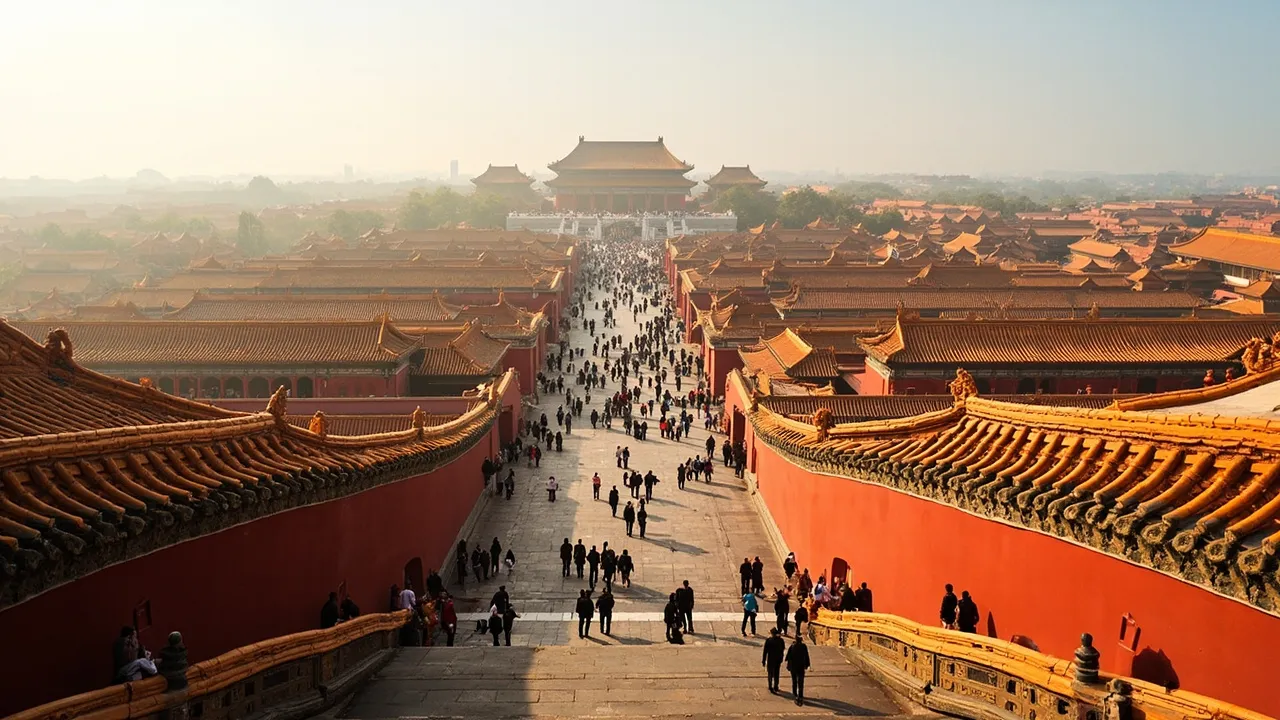
From the Meridian Gate, you’ll pass through a series of courtyards and halls as you work your way north along the central axis. This is the Outer Court, and these are the most impressive and iconic buildings—the throne halls where the empire was governed. Take time to appreciate the architectural details: the intricate carvings on the stone railings, the massive bronze cauldrons (there are originally 18, representing the 18 provinces of China), the golden roofs that gleam in the sunlight.
The transition from the Outer Court to the Inner Court is marked by a smaller gate, the Gate of Supreme Harmony (Taihe Men). Beyond this lies the private world of the emperors—their living quarters, the empress’s palace, the concubines’ quarters. The buildings here are more intimate, less grand, but they offer a glimpse into the daily life of the imperial family.
The northernmost section of the palace, often overlooked by visitors hurrying to see the main sights, includes the Garden of Imperial Peace. This is a wonderful place to rest and reflect, with its pavilions, rockeries, and ancient trees. It’s easy to forget, while standing in a crowded courtyard, that emperors once walked these paths seeking the same kind of peace you might seek.
A few tips for your visit. Wear comfortable shoes—you’ll be walking on uneven stone surfaces for hours. Bring water, especially in summer, as there are limited places to buy refreshments inside. Consider hiring a guide or renting an audio guide; the history of this place is rich, and having a knowledgeable narrator can transform your experience. Finally, try to arrive early in the day or late in the afternoon to avoid the worst crowds.
One often-overlooked aspect of the modern Forbidden City is the subtle way it has been adapted for contemporary use. The palace now houses the Palace Museum, one of the world’s largest and most important museums. Special exhibitions are mounted throughout the year, showcasing artifacts from the collection that are not on permanent display. If you have the chance to see one of these temporary exhibitions, take it—they offer a deeper dive into specific aspects of Chinese art and culture.
As you walk through the Forbidden City today, you may notice something curious: there are no trees in the main courtyards of the Outer Court. The common explanation is that trees could provide cover for assassins, but the real reason is more interesting. The courtyard spaces were designed according to feng shui principles and symbolic geometry; they represent the empty space between heaven and earth, and the absence of trees is part of the deliberate cosmic design. Trees exist in the Inner Court and the Garden, but the open courtyards remain deliberately clear.
Legacy
The Forbidden City is far more than a monument to a vanished past. It stands as a testament to the ambitions, anxieties, and achievements of Chinese civilization—the product of centuries of tradition, countless hours of human labor, and the accumulated wisdom of craftsmen and artists whose names are mostly forgotten but whose work endures.
For Americans curious about Chinese history, the Forbidden City offers a window into a world that operated on fundamentally different principles from our own. The concept of an emperor who ruled by divine mandate, who was simultaneously a ruler and a priest, who embodied the cosmic order in his very person—this is alien to our democratic sensibilities. And yet, for more than two millennia, the Chinese people organized their society around this idea. The Forbidden City is the physical embodiment of that vision.
In 1987, the Forbidden City became a UNESCO World Heritage Site, recognized as “the masterpiece of Chinese architectural ensemble.” It is the largest and most complete wooden palace complex in the world, and the meticulous attention to detail in its construction has ensured its survival for six centuries. It has survived fires, earthquakes, wars, and revolutions. It has been occupied by foreign soldiers and toured by revolutionary leaders. And yet, through all of this, it remains essentially as the Yongle Emperor designed it—a monument to the enduring power of human creativity and ambition.
Today, the Forbidden City faces new challenges. The sheer number of visitors—more than 19 million in a typical year—puts stress on the ancient structures. Conservation teams work constantly to maintain and restore the buildings, using traditional materials and techniques wherever possible. The balance between accessibility and preservation is an ongoing concern.
But the Forbidden City isn’t merely a relic. It has become a symbol of Chinese identity, a source of national pride, and a bridge between past and present. Every year, millions of Chinese visitors come here to connect with their heritage, to walk in the footsteps of emperors, and to see with their own eyes the grandeur that their ancestors could only imagine. For international visitors, the palace offers a glimpse into a civilization that has shaped human history in profound ways.
As you leave the Forbidden City through the northern Gate of Divine Might (Shenwu Men), turn back for one last look. The massive walls and golden roofs, the bronze lions guarding the gates, the marble terraces gleaming in the afternoon sun—this is one of humanity’s great architectural achievements, a place where the past remains vividly present. Whether you come as a tourist, a student of history, or simply a curious traveler, the Forbidden City offers an experience that will stay with you long after you’ve left its gates and returned to the modern world beyond.
The emperors are gone, the forbidden is now open, but the palace still speaks. All you have to do is listen.