The Four Treasures of the Study: China’s Timeless Writing Kit
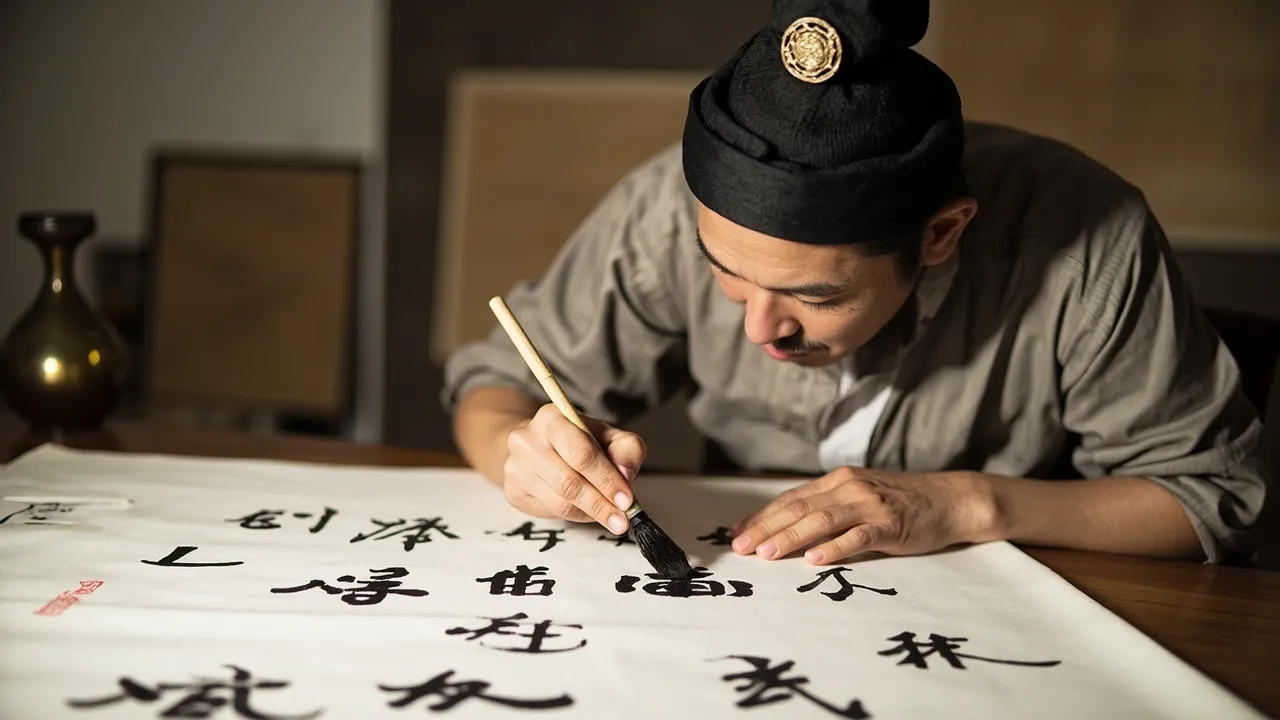
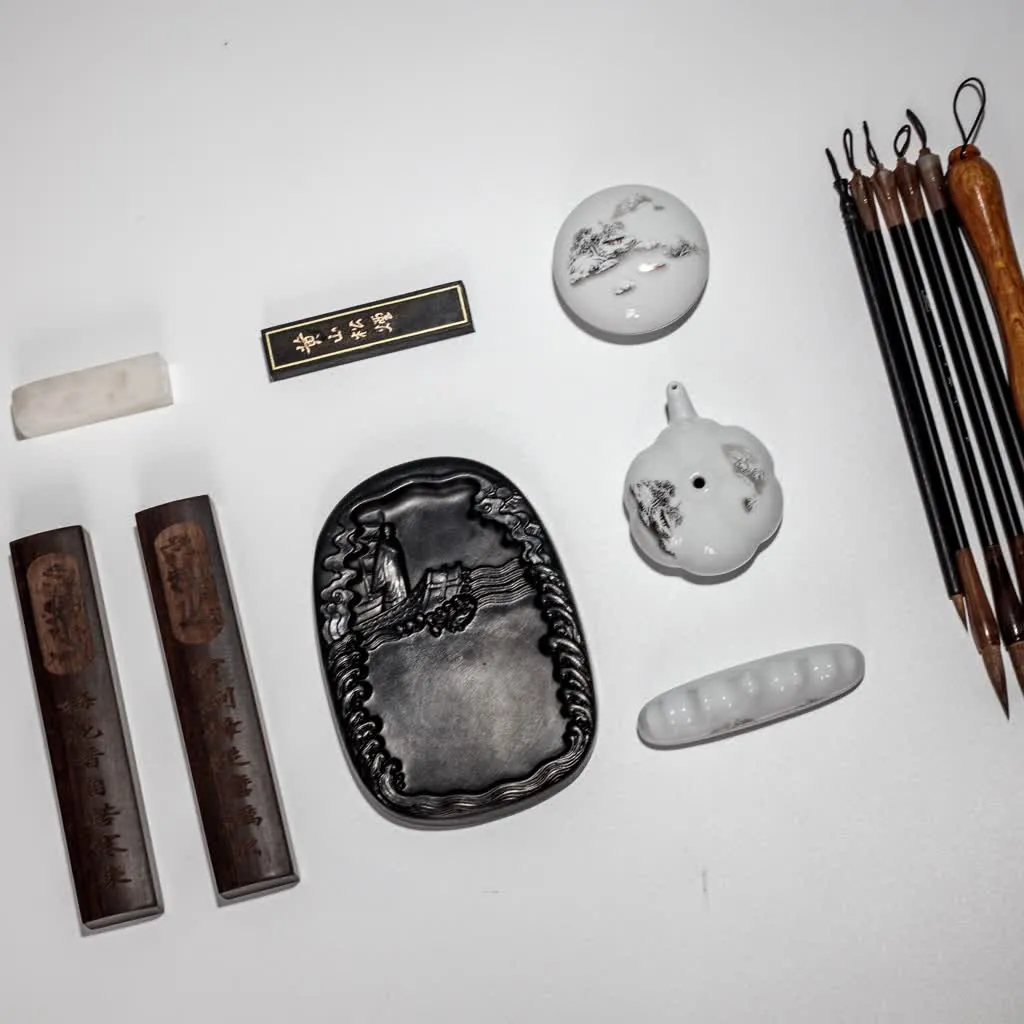
Walk into any traditional Chinese scholar’s study — a space called the wenfang (文房, “literary room”) — and you’d find four objects arranged with quiet reverence on the desk: a writing brush, an inkstick, a slab of special stone, and handmade paper. Together, these are the “Four Treasures of the Study” (文房四宝, wenfang sibao). They are more than just tools. They are the physical instruments through which Chinese civilization recorded itself, expressed beauty, and passed wisdom from one generation to the next.
For over a thousand years, every Chinese scholar, poet, painter, and calligrapher sat before this kit. It was as essential to a learned person’s life as a laptop is to a modern office worker — except that the laptop is generic, while each of these four treasures was chosen for its quality, cared for with ritual, and often passed down as a family heirloom.
If you’ve ever marveled at the sweeping elegance of Chinese calligraphy — those dramatic thick-and-thin strokes that seem to flow like water — what you’re really admiring is the interaction between these four tools. The brush’s flexibility, the ink’s density, the paper’s absorbency, and the stone’s smooth resistance all work together. Change any one element and the whole art form shifts.
The Four Treasures Defined
The Brush (笔, bi)
Chinese brushes are made from a handle — traditionally bamboo, but also wood, ivory, or jade — fitted with a tip of animal hair or fur. Goat hair makes soft, absorbent brushes ideal for broad strokes. Weasel hair produces firmer, more responsive tips perfect for fine detail. Wolf hair sits somewhere in between, favored by professional calligraphers for its spring-back.
The best brushes were (and still are) made in the town of Huzhou in Zhejiang province — so prized that a fine Huzhou brush might cost as much as a small painting. When a scholar put a brush to paper, it was the culmination of craftsmanship that stretched from the animal whose fur supplied the tip to the artisan who bound it.
What makes a good brush isn’t just the material but the construction. The hairs are sorted by length and thickness, then layered so that the outermost hairs form the pointed tip while inner layers provide support. A well-made brush will “return to its point” after each stroke — a quality called fuhui in Chinese, often translated as “spring-back.” This is what allows a calligrapher to produce the delicate hairlines that give Chinese characters their elegance.
The Inkstick (墨, mo)
Before fountain pens, before ballpoints, there was solid ink that you had to grind. An inkstick is a compressed bar of pine soot, animal glue, and aromatic ingredients — frankincense, musk, and other precious materials in the finest sticks. To use it, you’d grind it against your inkstone with a little water until you had a pool of fresh, liquid ink.
This matters because fresh ink is different from the liquid ink sold in bottles. It has a particular viscosity, a subtle scent, and a darkness that bottle ink rarely matches. Scholars in ancient China considered the act of grinding ink almost meditative — a moment of preparation before the act of writing itself. Some called it “grinding the heart-mind.”
The finest inksticks came from Huizhou in Anhui province, and collectors still hunt for antique Huizhou sticks on the art market. A single old inkstick can be worth thousands of dollars. The best ones were made in the Song Dynasty (960–1279 AD), and surviving examples are prized by museums and private collectors alike.
The ingredients matter enormously. Pine soot — the carbon residue from burning pine wood — produces a particularly soft, velvety black. Animal glue (traditionally from ox hide or fish) binds the soot into a solid bar. The aromatic additions don’t just make the ink smell pleasant; they also affect how the ink flows and how it ages on paper. A fine inkstick made with genuine ingredients will remain legible for centuries; cheap modern alternatives fade within decades.
The Inkstone (砚, yan)
The inkstone is where you grind your ink. It’s a flat slab, usually around the size of a paperback book, carved from a special type of sedimentary rock found primarily in Guangdong and Anhui provinces. The best inkstones are called 端砚 (Duanxi) from Duanzhou in Guangdong, and they have a surface so fine and dense that it holds ink without absorbing it too quickly.
The inkstone is meant to last a lifetime — indeed, many families passed them down across generations. The grinding surface gets “broken in” over years of use, developing a personality. A well-aged inkstone that has been ground thousands of times is considered more valuable than a brand-new one, much as a musician values a vintage instrument over a new one.
The quality of an inkstone depends on its mineral composition. The finest stones contain silica particles that are small and uniform, creating a surface smooth enough to grind ink efficiently without being so smooth that the ink slides away. Cheaper stones have larger, irregular particles that wear unevenly, creating a rough surface that tears at the inkstick and produces inconsistent ink.
The Paper (纸, zhi)
Chinese paper is not like the stuff you buy at an office supply store. Traditional Chinese paper — especially the variety called 宣纸 (Xuan paper), produced in the region around Xuancheng in Anhui — is made from the bark of the winged elm tree, beaten into a fibrous slurry and lifted from water as a sheet. It’s extraordinarily absorbent, strong despite its delicate feel, and has a texture that holds ink in just the right way.
Xuan paper was so highly regarded that during the Tang Dynasty (618–907 AD), it was considered a tribute item — local officials would send their best paper to the imperial court as a form of tax payment. Today, artists who work in traditional Chinese painting and calligraphy still insist on Xuan paper or one of its close relatives, because nothing else behaves quite the same way.
The process of making Xuan paper hasn’t changed substantially in centuries. The bark is harvested, soaked, boiled, and beaten into a fiber suspension. This suspension is diluted with water and lifted onto a fine bamboo screen, where the fibers interlock and dry into a sheet. The result is paper with remarkable properties: strong when wet, soft when dry, and capable of holding ink at the surface while allowing it to spread subtly into the fibers for a soft, organic edge.
A quick note for American readers: think of these four items as the equivalent of a master carpenter’s hand tools. Any carpenter can buy a hammer and saw from a hardware store. But a master craftsman has a kit of tools chosen over years — each one balanced just right, each one carrying the marks of its use. The Four Treasures are like that: a scholar’s personal kit was an extension of their hand and eye.
The Philosophy Behind the Tools
You might wonder why these four items made the cut and not other writing implements — why not the candle, the desk, the chair? The answer lies in the philosophy of the Chinese scholar class.
Calligraphy was not just communication — it was self-cultivation. The act of holding a brush and forming characters was considered a form of meditation, a discipline for training the mind and spirit. The quality of your tools directly affected the quality of your expression. A bad brush created hesitation in your strokes. Poor paper made ink bleed. Bad ink looked lifeless on the page.
By choosing the finest brush, the finest ink, the finest stone, and the finest paper, a scholar was not being decadent. He was creating the conditions for excellence in his art. It was the same principle that drives a serious musician to insist on a quality instrument.
This philosophy extended to how the tools were used and cared for. A proper scholar would grind his ink fresh each time he wrote — never using ink that had been sitting overnight, which was considered stale and disrespectful to the act of writing. The brush would be cleaned carefully after each use and stored tip-up to preserve its shape. The inkstone would be covered when not in use to prevent dust from accumulating on its surface.
These weren’t just practical habits — they were rituals that prepared the mind for writing. The few minutes spent grinding ink were a transition from the business of daily life to the stillness required for scholarly work. The careful maintenance of tools was itself a form of practice, a way of keeping the craft present in daily life even when not actively writing.
The Art They Made Possible
It’s impossible to separate the Four Treasures from what Chinese artists achieved with them. Chinese calligraphy is among the most sophisticated writing systems in the world — not just functional, but genuinely artistic. Different calligraphic styles have names that evoke nature: running script (行书), grass script (草书) with its wild, almost illegible strokes, and the classical regular script (楷书) that most students still learn today.
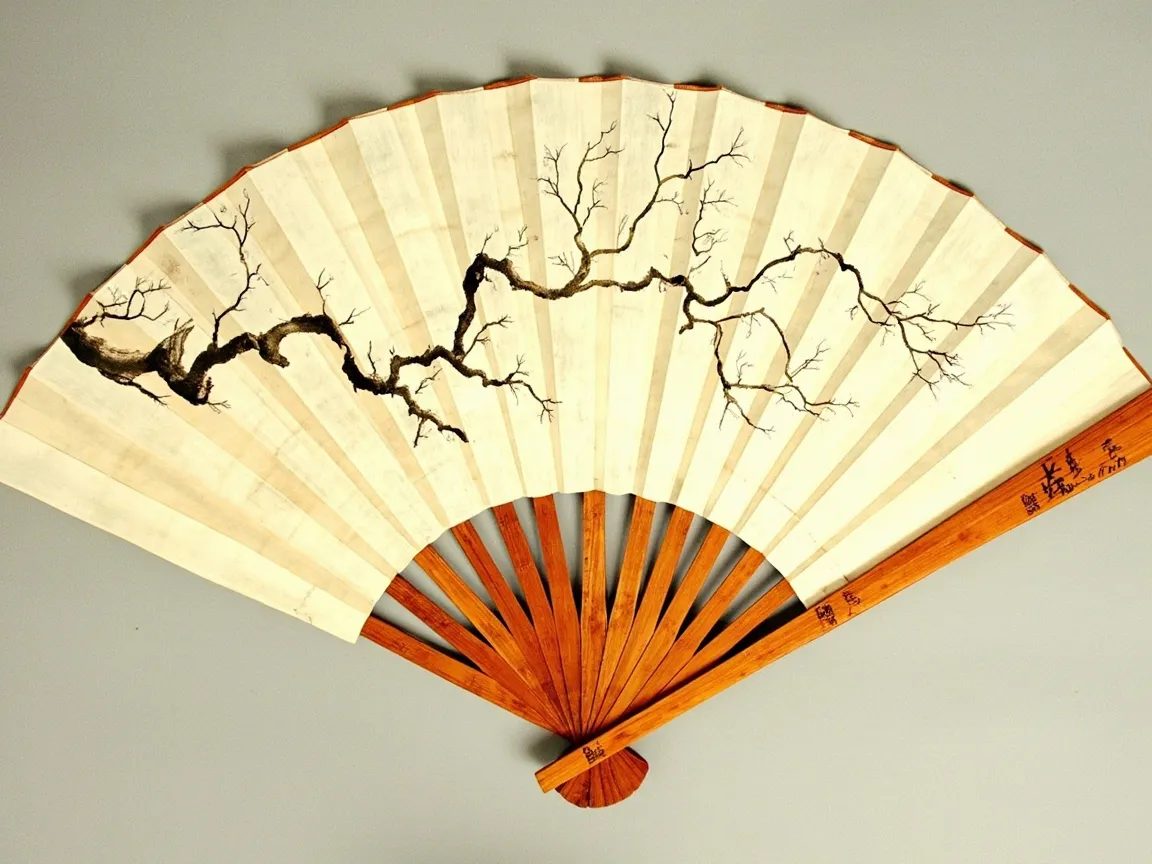
Each style demands different qualities from the Four Treasures. A grass script calligrapher needs a brush with extraordinary flexibility, responding to the lightest touch. An artist painting shanshui (mountain-and-water landscapes) needs paper that allows washes of ink to spread in controlled, organic ways. The same four tools, in different hands, produce wildly different results.
The scholars who used these tools were also the painters, poets, historians, and philosophers who shaped Chinese civilization. When Zhu Xi — one of the most influential Confucian philosophers of all time — sat down to write his commentaries on ancient texts, he reached for his brush and ink, ground on his stone, and wrote on paper. The survival of Chinese philosophy, literature, and history is inseparable from the survival of these four objects.
What makes Chinese calligraphy unique among world writing systems is the degree to which the process of writing is considered part of the art. A poem can be excellent in content but considered mediocre in execution if the brushwork doesn’t match its quality. Conversely, a seemingly simple character written with exceptional skill and verve can be valued as a masterpiece of artistic expression.
This integration of function and beauty extended to other arts. Traditional Chinese painting (guohua) uses the same Four Treasures, treating brush and ink as the primary means of expression. A landscape painting by Shen Zhou or Wen Zhengming isn’t just a picture of mountains — it’s an expression of the artist’s understanding of how ink and paper interact, how the brush responds to pressure, how the stone’s smooth surface yields ink in just the right way.
The Global Journey of Chinese Calligraphy Tools
Perhaps most remarkably, the Four Treasures traveled far beyond China’s borders. Japanese, Korean, and Vietnamese scholars encountered Chinese culture and adapted its tools to their own needs.
Japan developed its own calligraphy tradition using brushes, ink, and paper — though Japanese paper (washi) has different properties than Xuan paper and produces a distinct aesthetic. The Japanese also developed their own ink-making traditions, including sumi, which shares origins with Chinese inksticks but has evolved distinctive characteristics.
Korea used the Four Treasures for its own script, Hangul, which was invented in the 15th century. Korean calligraphers developed distinctive styles that blend Chinese aesthetic sensibilities with uniquely Korean approaches to composition and stroke.
Vietnam, which used Chinese characters for centuries before developing its own alphabet, also adopted the Four Treasures for both Chinese-style calligraphy and for writing in Vietnamese.
Today, you can find calligraphy studios in New York, London, and Sydney that teach students to use traditional brushes and ink. The tools crossed an ocean long before the internet made cross-cultural exchange instant. In some ways, they’re easier to find now than they were a century ago, when political upheaval in China disrupted traditional crafts.
Starting Your Own Four Treasures
You don’t have to be a trained calligrapher to appreciate the Four Treasures — or even to start your own set. Today, basic kits are available online and in art supply stores for under $30. A student-grade brush, a small inkstone, a stick of ink, and some practice paper are all you need to try your hand at your first Chinese character.
Here’s what to look for if you want to go beyond a kit:
- Brush: Start with a medium-sized goat-hair brush. It’s forgiving and absorbs ink well, making it ideal for beginners. As you improve, you can upgrade to weasel-hair or wolf-hair brushes. Look for brushes with a clear point when you wet them — this indicates good construction.
- Inkstick: A small “student-grade” inkstick is fine to start. If you want to experience the real thing, look for a stick made with pine soot rather than petroleum-based ingredients. The smell is a giveaway: real inksticks have a faint, pleasant odor; synthetic ones smell chemical.
- Inkstone: A small, inexpensive Guangdong-style stone is enough for practice. Don’t spend much on a stone until you know you’ll stick with it. Look for a flat, smooth surface without obvious cracks or chips.
- Paper: Xuan paper is ideal, but it can be expensive. Look for “practice Xuan paper” or “semi-Xuan” — it’s less expensive and works well for beginners. You can also start with a smooth, non-porous practice paper that lets you reuse your work.
The key thing to know: traditional calligraphy takes patience. Your first hundred characters will probably look nothing like what you envisioned. That’s not a sign of failure — it’s exactly what happened to every Chinese child learning to write. The brush has a mind of its own, and learning to work with it is half the art.
Don’t rush the process. Before you write a single character, spend a few minutes just grinding your ink. Feel the resistance of the stick against the stone. Watch the water darken as carbon particles release. This isn’t just preparation — it’s part of the practice.
Preserving a Living Tradition
In an age of keyboards and smartphones, the Four Treasures might seem like relics. But calligraphy is far from dead in China. Millions of children still learn to use the brush in school. Adult hobbyist groups practice in parks across Chinese cities on Saturday mornings — literally practicing calligraphy with water on stone slabs, a practice called ti mu (提木), so they don’t waste paper.
The tools themselves have also entered the art market as collectibles. Antique brushes, especially those made in the Qing Dynasty with jade handles, can sell for tens of thousands of dollars. Antique inkstones change hands for similar sums. The finest Xuan paper — especially paper made before the 20th century, when production methods were entirely hand-crafted — is nearly impossible to find at any price.
This market for antiques shouldn’t obscure the fact that traditional crafts are still alive. In Huzhou, artisans still make brushes using techniques passed down for generations. In Huizhou, small workshops still press inksticks by hand. These aren’t museum pieces — they’re working tools that you can buy and use today.
What drives people to practice calligraphy in an age of instant digital communication? Part of it is the desire for tangible, irreversible expression. When you type, you can delete and revise endlessly. When you brush a character, every stroke is permanent. This accountability — that weight of each mark — is part of what makes calligraphy so hypnotic to watch and so satisfying to practice.
There’s also the question of attention. Using the Four Treasures requires a kind of presence that’s increasingly rare. You can’t rush. You can’t multitask. You have to sit still, focus on the ink, and make each stroke with intention. In a world designed to fragment our attention, that stillness is itself a form of resistance.
The Enduring Appeal
There’s something deeply human about the Four Treasures. They represent a time when writing was physical, tactile, and irreversible. Every stroke of the brush left a permanent mark. You couldn’t hit “undo.” That accountability — that weight of each mark — is part of what makes calligraphy so hypnotic to watch and so satisfying to practice.
In that sense, the Four Treasures aren’t just tools for making marks on paper. They’re a philosophy of attention. When you sit down with your brush, ink, stone, and paper, you’re joining a tradition that spans over a thousand years of Chinese civilization — scholars in Tang Dynasty palaces, monks copying Buddhist sutras by candlelight, painters recording mountain landscapes, children tracing their first characters.
That tradition is alive and available to anyone willing to pick up a brush.
More than that, the Four Treasures offer a different relationship with writing itself. Modern technology makes writing easy and disposable. The brush makes it difficult and permanent. In that difficulty lies a strange kind of freedom — the freedom of total attention, of complete presence, of a mind and hand working together without digital mediation.
Recommended Tools & Resources
Ready to start your own Four Treasures collection? These picks will help you find quality tools at every level:
- Professional Calligraphy Brush Kit — Quality brush sets with multiple sizes and hair types let you experiment and find what works for your style.
- Authentic Sumi Inksticks — Traditional inksticks made with pine soot produce the rich, velvety black that liquid ink can’t match.
- Xuan Paper Bundle — The same paper Chinese masters have used for centuries, now available for international shipping.
- Natural Finish Inkstone — A proper grinding stone that will improve with age and use, unlike cheap substitutes.
- Chinese Art & Calligraphy Guide — Background reading that helps you understand the tradition you’re joining when you sit down with your brush.
Want to learn more about the art these tools made possible? Read our article on Chinese Calligraphy to discover the history and styles of this ancient art form.