Some animals in Chinese folklore are dangerous. The tiger is dangerous. The dragon is dangerous in the wrong mood. The white-headed vulture is dangerous if you are a corpse.
The fox is dangerous in a completely different way. The fox is dangerous the way a beautiful stranger at a temple festival is dangerous. The fox is patient, charming, intelligent, often helpful, and not, in any reliable sense, what it appears to be.
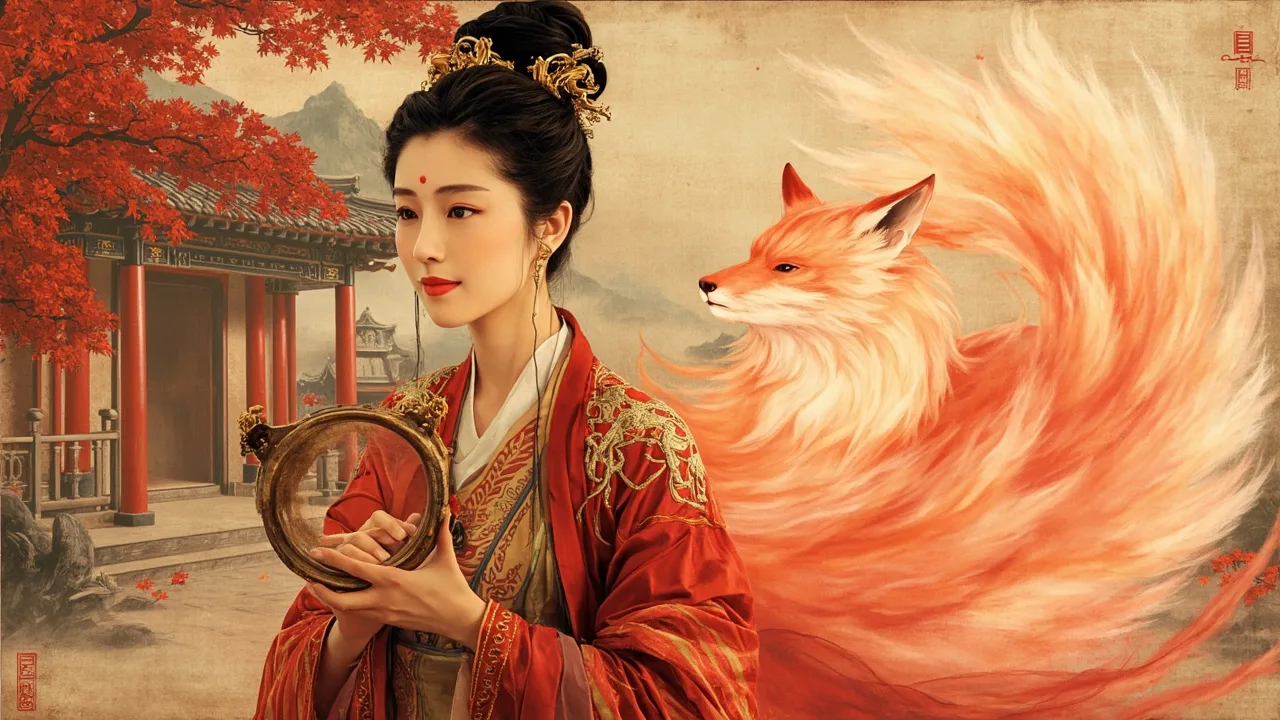
This is the huli jing (狐狸精), the fox spirit, and it is one of the most enduring figures in Chinese mythology. It is also one of the more interesting cases of a folk belief that kept developing new literary, religious, and pop-culture lives for two thousand years without ever quite settling into a single shape.
The Shape-Shifters of the Mountains
The earliest Chinese fox stories are not really fox-spirit stories at all. The Shanhaijing (山海经, Classic of Mountains and Seas), that late-Warring-States encyclopedia of mythical geography, mentions foxes in passing as ordinary wild canids, notable mainly for their cries in the hills. Foxes appear in early ritual texts as creatures whose behavior in certain seasons could be interpreted as omens, but the Shanhaijing fox is a fox, not a spirit.
The shift from fox to fox-spirit happens gradually across the Han dynasty (202 BCE - 220 CE) and accelerates in the Six Dynasties period (220 - 589 CE). Two ideas converge. The first is the older Daoist belief that animals of a certain age and quietude can begin to absorb qi (气), the vital energy that pervades the body and the landscape, and to transform. The second is the older shamanic-folk belief that certain wild places - mountain temples, ruined cemeteries, old bridges - are populated by beings that look human and are not.
By the time the Baopuzi (抱朴子, The Master Who Embraces Simplicity), a 4th-century Daoist text by Ge Hong, was compiled, the fox was explicitly described as one of the creatures capable of cultivating itself toward human form. Ge Hong notes that foxes begin to be able to shapeshift around the age of fifty and reach fuller human-like powers at one hundred, with the canonical nine-tailed form emerging only after a thousand years of practice. The fox becomes, in this framework, a kind of unofficial Daoist practitioner.
This is one of the most distinctive features of the Chinese fox tradition: the fox is not a demonic outsider. The fox is, in the older Daoist and folk-religious view, a colleague - another cultivator on the same path as the human hermit, but starting from a different body. The fox is a flawed colleague, often morally dubious, sometimes predatory, but operating within the same cosmology as the human monks and immortals.
The fox’s reputation changes dramatically across Chinese literary history. In early Tang dynasty (618 - 907 CE) tales, the fox is often a hu xian (狐仙, fox immortal) - a being that has achieved genuine spiritual refinement and behaves, on the whole, beneficently toward humans. The most famous early Tang fox story is probably the tale of the fox who marries a man and serves as a loyal wife, only to flee when her secret is discovered. The tone of these early stories is closer to romance than to horror.
By the Song (960 - 1279 CE) and Ming (1368 - 1644 CE) dynasties, the fox spirit has darkened. The fengshen yanyi (封神演义, Investiture of the Gods), the 16th-century novel that reworked the fall of the Shang dynasty, cast one of the most famous fox spirits in all of Chinese literature: Daji, the fox-spirit consort of King Zhou of Shang.
Daji is the cautionary tale of what happens when a fox spirit turns predatory. She is depicted as a beautiful woman sent by the gods to corrupt the last Shang king, leading him to acts of cruelty that bring about the dynasty’s fall. The fox-spirit framing turns Daji into a supernatural saboteur, but the deeper story is about the political chaos of late Shang court politics and the moral panic of later dynasties trying to explain why dynasties fall.
The fox’s image darkened further in the Qing dynasty (1644 - 1912 CE) through the Liaozhai zhiyi (聊斋志异, Strange Tales from a Chinese Studio), Pu Songling’s enormous collection of short stories. Pu Songling is the single most important author in the fox-spirit tradition. Many of his fox spirits are gentle, learned, witty, and romantically available; many more are dangerous, deceptive, or tragic. The fox spirit in Pu Songling is rarely a simple monster. The fox spirit is, almost always, an exploration of what happens when someone who is not quite human tries to live among humans anyway.
The Cultivation Stages
The fox-spirit tradition developed an unusually elaborate internal chronology. Foxes were believed to cultivate themselves through identifiable stages, each one documented in Daoist-influenced texts.
The standard stages, as they appear in texts like the Baopuzi and later commentaries, run something like this:
- Around fifty years of age, the fox can begin to shapeshift - usually into a woman, sometimes into a man, occasionally into an elderly human of either gender.
- At one hundred, the fox gains fuller human-like abilities, including speech, literacy, and the capacity to perform healing or divination.
- At five hundred, the fox can project its qi into the human world at a distance. The fox may be seen by one person and not by another in the same room.
- At one thousand, the fox grows its ninth tail and becomes, in the strict sense, a jiuwei hu (九尾狐, nine-tailed fox). The nine-tailed fox is the apex of the cultivation, and in some traditions is closer to a celestial being than to a mortal spirit.
The thousand-year fox is the most distinguished member of the fox-spirit pantheon. The most famous nine-tailed fox in Chinese mythology is, again, Daji. According to the Fengshen yanyi, Daji was already a thousand-year-old nine-tailed fox when she entered the Shang court. Her younger sister spirits - the “nine-tailed fox tribe” of the novel - are lesser cultivators who serve as her assistants.
The cultivation framing matters because it embeds the fox spirit in a recognizably Daoist cosmology. The fox is not just a supernatural creature. The fox is a practitioner on a path - one that may end in celestial refinement or, more often, in catastrophic moral failure. The foxes who fail are usually foxes who used their powers for seduction, manipulation, or revenge. The foxes who succeed are foxes who used their powers for healing, scholarship, or quiet companionship.
This is one of the reasons the fox spirit is more interesting than, say, the Western vampire or werewolf: the fox spirit has a moral life. The fox can succeed or fail. The fox has a Dao to cultivate. The fox is, in a strange way, responsible for what it becomes.
The Famous Fox-Women
Two historical-or-legendary fox-women have shaped the Chinese popular imagination more than any others: Daji of the Shang dynasty and Yang Guifei of the Tang dynasty.
Daji (妲己) is associated with the fall of the Shang dynasty (c. 1600 - 1046 BCE), the dynasty that preceded the Zhou. The traditional story holds that King Zhou, the last Shang ruler, was corrupted by Daji into acts of cruelty - the construction of the lutai (鹿台, “deer terrace”), a vast pleasure park; the invention of the pao luo (炮烙), a punishment involving a heated bronze pillar; and the persecution of loyal ministers. The dynasty fell, King Zhou died in flames, and Daji was killed by the founding Zhou general Jiang Ziya.
The Fengshen yanyi version adds the fox-spirit layer. Daji is not really a woman - she is a fox spirit in human form, sent by the gods to corrupt the Shang king as punishment for his earlier sins. This is a useful piece of literary machinery. It lets later writers blame the fall of the dynasty on a foreign, supernatural agent rather than on the structural problems of late Shang politics.
Yang Guifei (杨贵妃, 719 - 756 CE) was a real historical figure: a Tang dynasty imperial consort of Emperor Xuanzong, originally named Yang Yuhuan. She was famous for her beauty, her musical and literary talents, and her role in the An Lushan Rebellion of 755 CE, which devastated the Tang dynasty. After the emperor’s soldiers mutinied and demanded her death, she was forced to be executed at the Mawei Slope.
Yang Guifei was not, in any historical source, a fox spirit. She was a noblewoman and imperial consort. But by the Song and later dynasties, popular retellings began to associate her with fox-spirit lore, and the image of Yang Guifei as a beauty whose love brought down an empire began to blur with the image of the fox-spirit seductress. The conflation was not just literary. It was a comment on imperial politics: the warning that a beautiful woman in the emperor’s bed could unmake a dynasty.
The two cases are easy to confuse, and it is worth keeping them straight. Daji is a fox spirit who helped destroy a dynasty. Yang Guifei was a human consort whose presence was later mythologized into the same story shape. The dynasties are separated by roughly two thousand years.
The East Asian Nine-Tailed Fox
The Chinese fox-spirit tradition does not stop at the Chinese border. Versions of the fox spirit appear across East Asia, with significant local variations.
Korean kumiho (구미호) is the most famous regional variant. The kumiho is a nine-tailed fox that, in the Korean tradition, is almost always malevolent. The kumiho is depicted as a being that consumes human livers or hearts, shapeshifts into a beautiful woman to lure men, and is more often a monster than a tragic cultivator. The Korean kumiho has become a fixture of Korean horror fiction and cinema in the last few decades.
The contrast with the Chinese huli jing is sharp. The Chinese huli jing is morally ambiguous and often sympathetic. The Korean kumiho is morally clear and almost always predatory. The Chinese huli jing’s nine-tailed form is the apex of cultivation. The Korean kumiho’s nine-tailed form is the apex of predatory power.
Japanese kitsune (狐) has its own tradition that is closer to the Chinese huli jing than the Korean kumiho is, but with its own distinct features. The kitsune is a long-lived shapeshifter, often depicted as a messenger of the Shinto deity Inari, and it can be either beneficent or malevolent depending on the story. The most famous kitsune in Japanese culture is probably the kitsune of the Inari shrines, who are usually depicted as white foxes and serve as guardians rather than predators.
The Chinese huli jing is, historically, the parent tradition from which the Korean kumiho and the Japanese kitsune are partly derived, but each has developed in its own direction. Confusing the three is easy. They share the same basic figure - a long-lived fox that can shapeshift into human form - but their moral and cultural registers are different.
The Modern Afterlife
The fox spirit has not faded into obscurity. It has, if anything, become more visible in the last few decades, in three distinct cultural registers.
Classical literature revival. Pu Songling’s Liaozhai zhiyi is read more widely now in English translation than at any point in its history. The 2016 translation by Sidney L. Moss and the earlier translations by Herbert Giles and others have made the fox-spirit stories available to readers who would never have tackled the original classical Chinese. The fox spirit of Liaozhai is a literary character - witty, melancholy, sometimes terrifying, often charming - and the modern English-language revival has been built largely on Pu Songling’s versions.
Chinese mobile games and wuxia fantasy. The fox spirit is a fixture of contemporary Chinese fantasy fiction and games. Onmyoji (阴阳师), the Japanese-developed mobile game with heavy Chinese mythology borrowings, features fox spirits as playable characters. Yanyun (燕云), Gujian (古剑), and other Chinese-developed fantasy games similarly draw on the huli jing tradition. The fox-spirit companion, the nine-tailed fox love interest, and the fox-spirit antagonist are all stock figures of the genre.
Global pop-culture borrowing. The fox spirit tradition has also crossed into global pop culture in ways that are not always acknowledged. The Pokémon character Vulpix and its evolution Ninetales are explicitly based on the Japanese kitsune, and through the kitsune on the broader East Asian fox-spirit tradition. The “nine-tailed fox” of Korean manhwa and Korean dramas - by way of the kumiho - has become a global image of the seductive shapeshifter. The borrowing is not always respectful or accurate; the Chinese huli jing is often flattened into a generic “East Asian mystical fox” by adaptations that mix Chinese, Japanese, and Korean sources freely.
It is worth saying plainly that the global borrowing is real, and it has costs. The Chinese fox-spirit tradition is not just a source of cool monster-girl art. It is a literary tradition with a Daoist cosmological framework, a moral structure, and a body of texts that have been developed for two thousand years. Reducing the huli jing to a “mythical nine-tailed fox girlfriend” archetype loses most of what makes the tradition interesting.
The fox spirit is, in the end, one of the more philosophically serious figures in Chinese mythology. The fox is not just a shapeshifter. The fox is a question: what happens when a being with a long life, sharp intelligence, real power, and no fixed moral compass lives among humans for a thousand years? Pu Songling asked this question again and again in his stories, and he rarely gave a simple answer. Some foxes become saints. Some foxes become monsters. Most become something in between.
The fox spirit is still doing cultural work. The next time you see a nine-tailed fox in a video game, an anime, or a Korean drama, remember that the figure has a longer and more complicated history than the costume suggests.
Recommended Products for Fox Spirit Mythology
If this article has made you curious about the huli jing tradition, here are a few items that hold up well.
- Japanese Fox Mask (Kitsune Mask, White) - The white kitsune mask is a fixture of East Asian fox folklore. It is one of the most recognizable fox-spirit visual objects and a useful display piece.
- Nine-Tailed Fox Statue (Resin or Ceramic) - A decorative nine-tailed fox statue in the Chinese or Japanese style. Look for one with nine distinct tails clearly visible and a flowing, cultivated posture.
- Chinese Mythology: A Source Book - The standard English-language sourcebook on Chinese mythological creatures, including the huli jing, the fox-spirit traditions, Daji, and the Liaozhai stories.
- Gongfu Tea Set (Yixing Clay Teapot + Cups) - A traditional gongfu tea set - a small Yixing clay teapot, a few cups, and a bamboo tea tray. Tea and fox-spirit stories have a long shared history in Chinese literature.
- Fox Spirit Scroll Painting (Reproduction) - A reproduction of a traditional Chinese or East Asian fox-spirit scroll painting, useful for display. Look for one based on the Liaozhai illustrations or Song-Ming dynasty fox-spirit iconography.
The fox spirit has been cultivating itself in Chinese mountains and temple courtyards for a very long time. The next thousand-year fox may already be at work.